Home Blog Page 310

MK Stalin Waxes Eloquent On Press Freedom, Here’s How His Police Hounds Critics Even For Social Media Posts
mk stalin press freedom arrest police foreign trip the wire

On 3 May 2025, Tamil Nadu Chief Minister MK Stalin took to his X handle to decry India’s ‘fall to 151st place’ in the Global Press Freedom Index. He blamed the BJP-led central government for stifling journalism, stating, India has plunged to 151 in the Global Press Freedom Index. Why? Because the BJP regime fears questions. It raids newsrooms, jails reporters, and silences those who expose corruption, rights violations, and its majoritarian agenda. On this #WorldPressFreedomDay, let us remind ourselves: without fearless journalism, democracy dies in darkness. That is why we must safeguard press freedom—not just for the media, but for every citizen’s right to know, question, and speak truth to power.”

While the statement earned applause from some quarters, it rang hollow to many familiar with Stalin’s own record over the past three years. A closer look at his government’s treatment of dissent reveals a disturbing pattern of intolerance toward critics and independent voices, ironically mirroring the very authoritarianism he accuses others of.

Arrests Under MK Stalin’s Watch: A Pattern Of Silencing Critics

Since assuming office in May 2021, Stalin has repeatedly used the state machinery to target YouTubers, opposition figures, social media activists, and even farmers – basically anyone. Below is a timeline of key incidents that paint a starkly different picture of the so-called “freedom fighter” for free speech:

  • In June 2021, YouTuber Kishore Swamy was arrested under the draconian Goondas Act for allegedly defaming Stalin.
  • In October 2021, a YouTuber, Duraimurugan, was arrested on similar charges as above.
  • In January 2022, Duraimurugan was again arrested, this time also under the Goondas Act.
  • In August 2022, stunt master Kanal Kannan was arrested for speaking against EVR.
  • In November 2022, Kishore K Swamy was detained again for posts critical of MK Stalin related to monsoon preparations.
  • In December 2022, the DMK government arrested an AMMK cadre for a meme targetting Udhayanidhi Stalin’s Sports Ministry.
  • In July 2023, The Commune and its directors faced legal action for reporting on the confrontation between Podu Deekshitars of the Chidambaram Nataraja Temple and HR&CE officials.
  • TN BJP Functionary Pravin Raj was arrested in the wee hours of 1 October 2023 for his posts targeting the ruling party and the Congress.
  • In September 2023, the Tamil Nadu police even went up to Noida to try to arrest journalist Abhijit Majumder for his article on Udhayanidhi Stalin’seradicate Sanathana Dharma’ remarks. 
  • In September 2023, Arani Mahesh was jailed for allegedly defaming Udhayanidhi Stalin.
  • In July 2023, a critic of the DMK, Badri Seshadri, was arrested for his comments in an interview on a YouTube channel regarding the Manipur issue, during which he made remarks about the Chief Justice of India.
  • In June 2023, Tamil Nadu BJP State Secretary SG Suryah was taken into custody under non-bailable sections for his comments regarding Madurai CPI-M MP Su Venkatesan concerning a sanitation worker’s tragic death during drain cleaning in Pennadam town, Cuddalore district.
  • In June 2023, an AIADMK IT wing member was apprehended under non-bailable sections for sharing a video meme that humorously referenced MK Stalin’s video statement on Senthilbalaji’s arrest. The meme did not contain derogatory content.
  • In June 2023, a pro-BJP Twitter user was arrested for sharing an old article and allegedly misattributing DMK to an illegal liquor-producing gang in Tiruppur, following the recent hooch tragedy in Marakkanam.
  • In April 2023. Vice President of Tamil Nadu BJP’s Industrial Cell, Selva Kumar, was arrested for criticizing DMK Minister Senthilbalaji.
  • In March 2023, the admin of Voice of Savukku Shankar X handle was arrested for a video meme targeting CM MK Stalin and DMK Minister PTR Palanivel Thiagarajan regarding the “eligible household” clause in the monthly assistance scheme for women.
  • In February 2023, the DMK government traveled to Gujarat to arrest BJP cadre John Ravi, who had made satirical social media posts about CM MK Stalin and his late father, Karunanidhi.
  • In June 2023, Uma Garghi, a BJP supporter was arrested twice on allegations of sharing defamatory posts targeting Tamil Nadu Chief Minister MK Stalin, former CM M Karunanidhi, and Dravidian movement leader EV Ramasamy.
  • In September 2023, former VHP leader RBVS Manian, an octagenarian, was arrested for derogatory remarks on BR Ambedkar.
  • In October 2023, N Muthuramalingam, the State Propaganda Secretary of South India Forward Bloc, was arrested for expressing his views on Facebook regarding the release of terrorists convicted in the 1998 Coimbatore serial blasts case. Muthuramalingam had criticized Dravidian parties for considering the release of 36 prisoners, including those convicted for life in the Coimbatore terror attack, leading to his arrest.
  • In October 2023, an NTK cadre was arrested by TN police for a social media post on Karunanidhi.
  • In October 2023, TN police arrested BJP member Amar Prasad Reddy for allegedly attacking and damaging a JCB machine brought to remove the party’s flagpole outside state president K. Annamalai’s Chennai residence.
  • In October 2023, a BJP cadre was hounded by TN Police for inadvertently sharing a fake news card – his passport was impounded, he lost his job, and he was jailed too.
  • In October 2023, a Hindu Munnani member was arrested for allegedly making ‘defamatory remarks’ against DMK MP A Raja.
  • In November 2023, six farmers protesting land acquisition were jailed under the Goondas Act.
  • In January 2024, BJP IT Wing and Social Media State Secretary Trichy Pugal Machendran was arrested for an alleged provocative Facebook post celebrating the death of the terrorist Palani Baba on his death anniversary. The post referred to Palani Baba as a “poisonous influence.”
  • In March 2024, Minjur Saleem, a pro-BJP activist found himself detained and later arrested for his dissenting views regarding the DMK Party’s governance, which he expressed on the social media platform X (formerly Twitter).
  • In March 2024, TN Police went all the way to Bihar to arrest an online troll for posting a meme on DMK Minister Udhayanidhi Stalin.
  • In May 2024, TN police arrested YouTuber Savukku Shankar for his ‘obscene’ comment about women police officers in a recent interview.
  • In May 2024, TN police arrested YouTuber Felix Gerald for allegedly ‘instigating’ Savukku Shankar to make defamatory remarks against police.
  • In July 2024, DMK government arrested NTK propaganda secretary Sattai Duraimurugan for an alleged defamatory song about Karunanidhi.
  • In August 2024, Savukku Shankar was again detained under Goondas Act for allegedly possessing ganja. Seven cases were filed against him.
  • In October 2024, film director Mohan G Kshatriyan was arrested without following due procedure for a comment he made in an interview.
  • In November 2024, BJP supporter Johny Raja was arrested in Chennai by Vellore police following social media posts allegedly targeting the ruling DMK party.
  • In November 2024, TN police went all the way to Hyderabad to arrest actress Kasthuri Shankar for her remarks on Telugu community, despite having apologised for the same.
  • In November 2024, IMK chief Arjun Sampath’s son Omkar Balaji was arrested for remarks against Dravidianist journo ‘Nakkheeran’ Gopal, he was released later.
  • In December 2024, TN Police arrested a youth for posting a video of an elderly woman throwing slippers and dirt at MK Stalin’s poster. Additionally, a complaint was filed against the old lady by a DMK MLA.
  • In December 2024, temple activist Rangarajan Narasimhan was arrested by Chennai cyber crime police for allegedly “defaming” Udhayanidhi Stalin.
  • In January 2025, a Dindigul BJP leader who exposed the illegal sale of liquor in broad daylight was arrested by TN police.
  • In February 2025, a BJP TN functionary Kannan was arrested for his remarks against Chief Minister Stalin at the budget explanation meeting.
  • In March 2025, an activist and ex-BJP worker who exposed the poor quality of newly built toilets at Tiruchendur Temple complex was arrested by TN Police at 4 AM that day.
  • In March 2025, a Hindu Munnani leader was arrested for posting on social media alleging demolition of a temple.
  • In March 2025, TN BJP leader SG Suryah was arrested for a 3-language policy signature campaign in Chennai, he was released later.
  • In March 2025, YouTuber Savukku Shankar house was attacked – thugs dressed as sanitary workers ransacked his home, terrorized his mother, and smeared filth across the rooms and dining table, allegedly because he exposed TN Congress chief Selvaperunthagai’s hygiene workers vehicle purchase scam.

A Democracy Of Convenience?

Out of those arrested, at least six individuals were booked explicitly for allegedly defaming Stalin or his son and DMK leader Udhayanidhi Stalin. Others were silenced for expressing dissenting views—be it on caste issues, women’s rights, religious practices, or land policies.

When juxtaposed with Stalin’s soaring rhetoric about “fearless journalism” and “democracy dying in darkness,” this track record suggests not a defender of free speech, but a leader who suppresses it when it becomes inconvenient.

If Stalin truly believes that democracy depends on fearless journalism, why does his government repeatedly jail dissenters, slap critics with Goondas Act charges, and stifle independent voices?

World Press Freedom Day should not be reduced to hashtags and hollow statements. It is a moment to reflect on whether those in power practice what they preach. For all his condemnation of the BJP’s media crackdowns, Stalin’s own house appears far from clean.

Subscribe to our channels on Telegram, WhatsApp, and Instagram and get the best stories of the day delivered to you personally.
Why Suriya Is The Flop Star Of Tamil Cinema

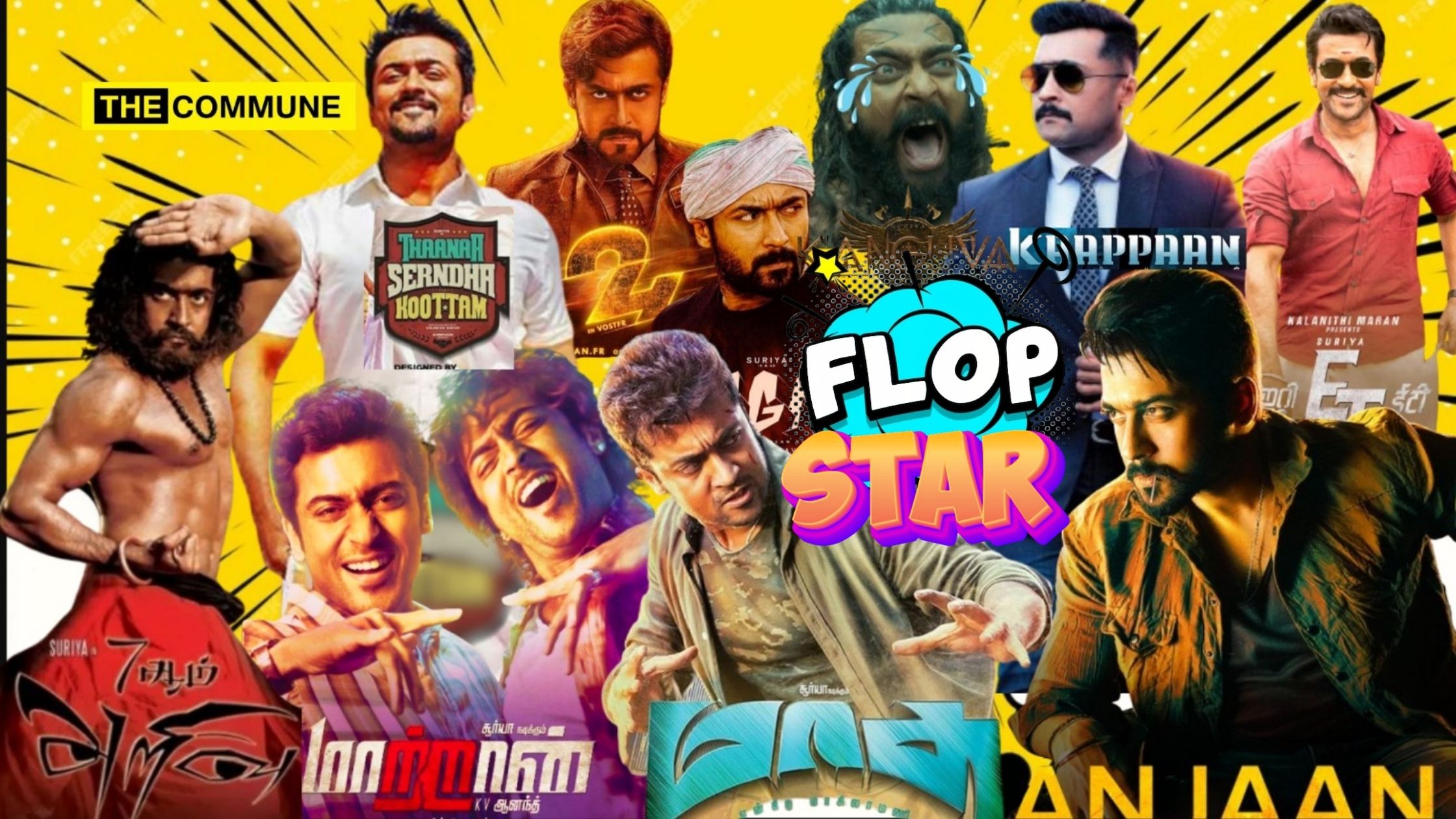
Dravidianist actor Suriya’s career continues to nosedive—and this time, it’s Retro digging him a deeper hole. Once a bankable star, the Dravidianist poster boy seems more interested in riding on the coattails of established directors than actually acting. The result? One flop after another. Instead of picking solid stories, he’s busy chasing names, and it’s clearly not working.

According to industry tracker Sacnilk, Retro barely pulled in ₹3.38 crore (India nett) on day five. Despite an okay opening of ₹19.25 crore on 1 May, the film crashed the next day—same old story. Suriya’s previous film Kanguva followed the exact same script an initial ₹24 crore opening, followed by a free fall to ₹9.5 crore on day two—a humiliating 60% drop. Retro did even worse, plummeting 61%.

Theaters showed the damage. Day two of Retro saw average occupancy at just 40.23%, with morning shows scraping together 23% and even night shows barely touching 53%. No buzz, no pull—just another forgettable release. Coming to Day six the movie had only an overall 14.47% morning show Occupancy.

Suriya’s 16-Year Theatrical Dry Spell

Let’s be blunt, Suriya hasn’t delivered a theatrical hit for all audiences since Singam—way back in 2009. That’s 16 years of consistent underperformance. Why? Because he’s stuck in a loop of poor story choices, playing it safe, and refusing to back new talent. He seems to think success is guaranteed if he latches onto already-famous directors—but they’ve only dragged him down.

Take Jigarthanda Double X, for instance—a box office dud that somehow had a “success meet.” Suriya bought the hype and gave director Karthik Subbaraj another shot. The reward? Retro, a cinematic disaster that’s burning money.

And what’s next? A movie based on RJ Balaji’s Masani Amman script. If you think that’s the comeback vehicle, good luck. Or maybe his direct Telugu venture with Venkatesh Atluri will change things? At this point, it’s less about hope and more about blind faith.

Same Old Face, Same Old Flaws

Even on screen, there’s a big problem, Suriya doesn’t become his characters anymore. He just shows up as “Suriya.” That disconnect is killing any chance of audience immersion. The artificiality is obvious—and Tamil audiences have become far too sharp to fall for name alone.

If he wants to survive in this industry, Suriya needs to wake up. Stop recycling directors. Stop betting on tired formulas. Go back to choosing strong, grounded scripts. Play real, relatable characters again—like in Kaakha Kaakha or Vaaranam Aayiram. Until then, all the “2.0” talk is just noise. You can’t reboot a failing career with lazy decisions.

Subscribe to our channels on TelegramWhatsApp, and Instagram and get the best stories of the day delivered to you personally.

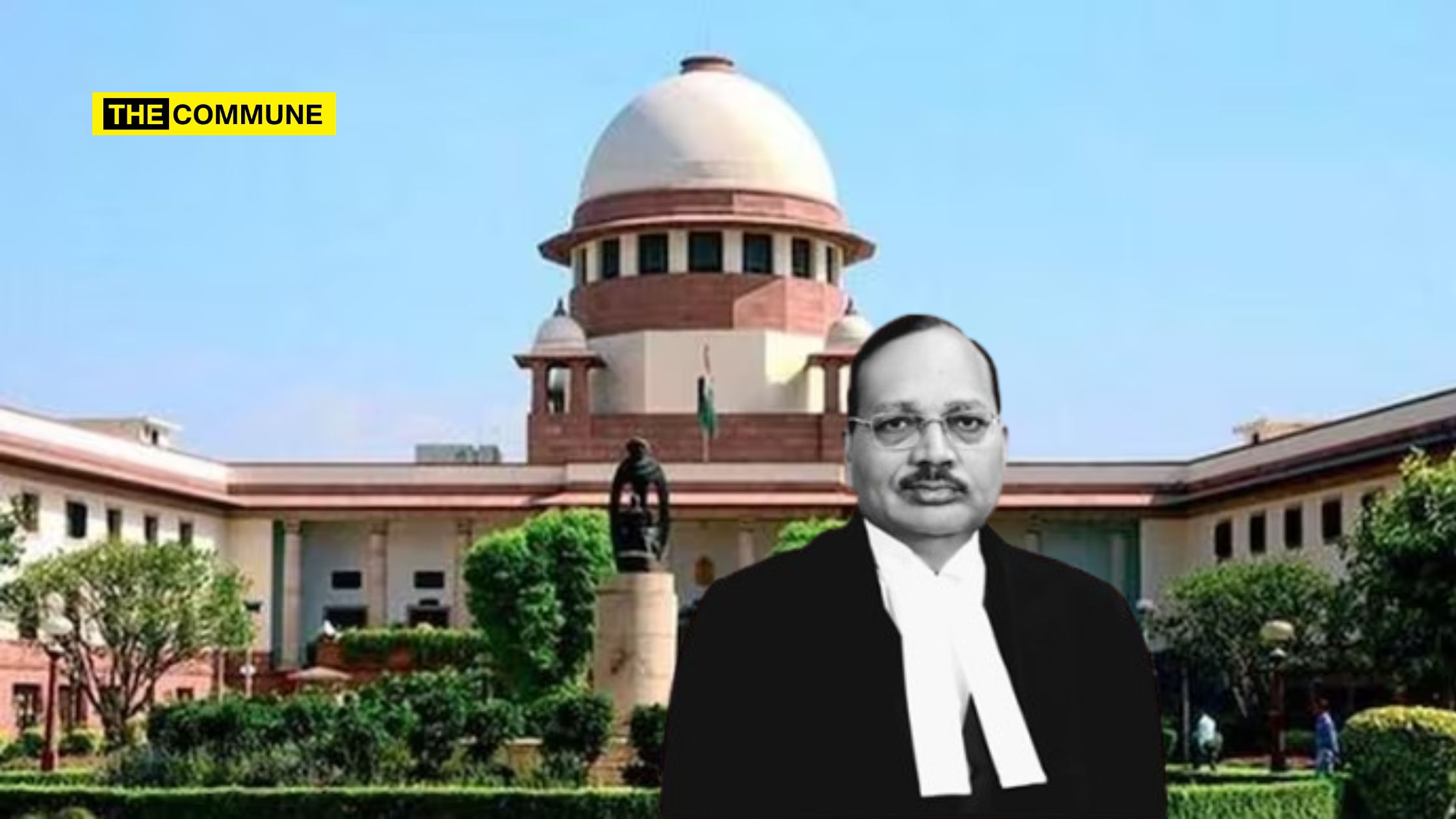
“Reservation Has Become Like Train Compartments, Once In, They Don’t Want To Let Others In”, Says Supreme Court Judge Surya Kant In Maharashtra OBC Quota Case

surya kant supreme court reservation train compartment

Caste-based reservation in India has come under sharp scrutiny from the Supreme Court, with Justice Surya Kant—who is set to become the next Chief Justice of India—drawing a striking analogy during a hearing on local body polls in Maharashtra.

“Reservation in the country has become like train compartments. People who have got in don’t want to let others come in,” Justice Kant observed while hearing a batch of petitions on the implementation of Other Backward Class (OBC) quotas in local elections in Maharashtra. “This is the principle of inclusivity. Governments are duty-bound to identify more classes. There are politically, economically and socially deprived people. Why should they not get the benefit? Only a few families and groups are getting the benefit,” he added.

The hearing focused on the long-pending civic elections in Maharashtra, which were last held between 2016 and 2017. The delay, spanning nearly eight years, is largely attributed to legal and procedural hurdles surrounding OBC reservations. In 2021, the Supreme Court had struck down a state government ordinance that sought to provide 27% OBC quota, ruling it unconstitutional due to non-compliance with a required three-step framework.

The court had earlier mandated that any OBC quota must meet three conditions:

  1. A dedicated commission must conduct a contemporary empirical inquiry into backwardness.
  2. The state must determine the proportion of reservation needed based on the commission’s recommendations.
  3. The total reservation for SCs, STs, and OBCs must not exceed 50%.

Despite the identification of OBCs during delimitation, senior advocate Indira Jaising, appearing for the petitioner, argued that Maharashtra had failed to apply the data meaningfully. She also alleged that the state government was effectively running the local bodies through handpicked officials, avoiding elections under the guise of legal hurdles.

Advocate Gopal Sankaranarayanan, representing another petitioner, emphasized the need to distinguish between politically and socially backward groups within the broader OBC category for the purpose of more equitable reservation.

Interestingly, the “train compartment” metaphor used by Justice Kant was previously employed by another senior judge, Justice BR Gavai, in a ruling on the sub-classification of Scheduled Castes (SCs) and Scheduled Tribes (STs). Justice Gavai, who will become Chief Justice later this month, stated, “I find that the attitude of the categories in the Presidential List opposing such a sub-classification is that of a person in the general compartment of the train. Firstly, the persons outside the compartment struggled to get into the general compartment. However, once they get inside it, they make every attempt possible to prevent the persons outside such a compartment from entering it.”

These observations come at a politically sensitive time, as the Union government has announced the inclusion of caste-based data in the next national Census. The move is seen as a step toward identifying underrepresented communities more effectively for affirmative action, a demand long made by several opposition parties.

The Supreme Court is expected to continue hearing the matter later on 6 May 2025.

(With inputs from NDTV)

Subscribe to our channels on Telegram, WhatsApp, and Instagram and get the best stories of the day delivered to you personally.
Delhi High Court Stays Copyright Injunction Against AR Rahman In Ponniyin Selvan 2 ‘Veera Raja Veera’ Song Case

ar rahman veera raja veera ponniyin selvan 2 delhi high court

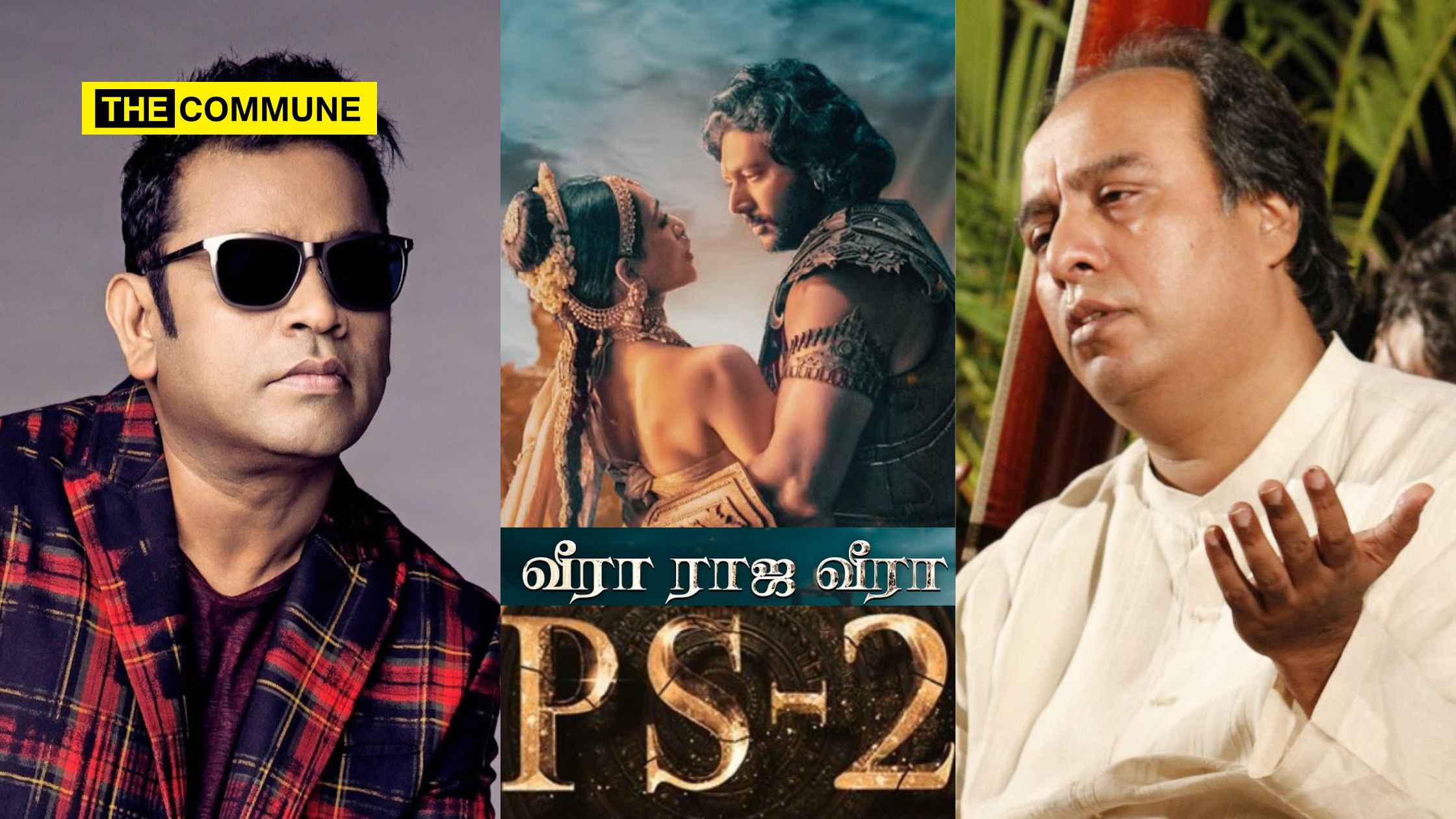
In a significant development, the Delhi High Court on 6 May 2025 stayed an interim injunction issued against renowned music composer AR Rahman in a copyright infringement case linked to the popular song Veera Raja Veera from the 2023 Tamil film Ponniyin Selvan 2 (PS2).

The legal battle was initiated by Indian classical vocalist and Padma Shri awardee Faiyaz Wasifuddin Dagar, who alleged that the composition of Veera Raja Veera was lifted from Shiva Stuti, a musical piece composed by his father Nasir Faiyazuddin Dagar and uncle Zahiruddin Dagar.

On 25 April 2025, a single-judge Bench of Justice Prathiba M Singh had ruled in Dagar’s favour, directing Rahman and the film’s producers to give credit to the Dagar brothers across all digital platforms. The order also imposed ₹2 lakh in costs and directed the appellants to deposit ₹2 crore as security. Rahman appealed against the decision.

The Division Bench comprising Justices C Hari Shankar and Ajay Digpaul on Tuesday granted interim relief to Rahman, staying the injunction until the next date of hearing, 23 May 2025.

“As the subject matter of the copyright in which the injunction has been granted has been in public domain since 2023, without prejudice to the rights and contentions of both sides and without intending the order to be any expression on cases of the parties before us, we stay the operation of the injunction granted by Ld. Single Judge till the next date of hearing,” the Court stated.

The Bench also stayed the ₹2 lakh cost imposed on Rahman and the producers but maintained the direction to deposit ₹2 crore, clarifying that this did not reflect any opinion on the merits of the case.

Dagar had argued that while the lyrics of Veera Raja Veera differ from Shiva Stuti, the “taal, beat and musical structure are identical” to the original composition, which has been performed globally by the Junior Dagar brothers and featured in PAN Records albums.

Rahman, however, strongly refuted the allegations. He maintained that Shiva Stuti is a traditional Dhrupad composition and thus part of the public domain. His legal team further contended that Veera Raja Veera is an original composition rooted in Western musical principles, comprising “227 distinct layers” and diverging significantly from the conventions of Hindustani classical music.

In the initial ruling, Justice Singh had remarked, “In this case, the core of the impugned song Veera Raja Veera is not just inspired but is in fact identical in Swaras (notes), Bhava (emotion) and Aural impact (impact on the ear) of the suit composition Shiva Stuti, from the point of view of a lay listener. Hence the Defendant’s composition infringes the Plaintiff’s rights in Shiva Stuti.”

The outcome of Rahman’s appeal is now awaited, with the matter scheduled for detailed hearing on 23 May 2025.

(With inputs from Bar and Bench)

Subscribe to our channels on Telegram, WhatsApp, and Instagram and get the best stories of the day delivered to you personally.
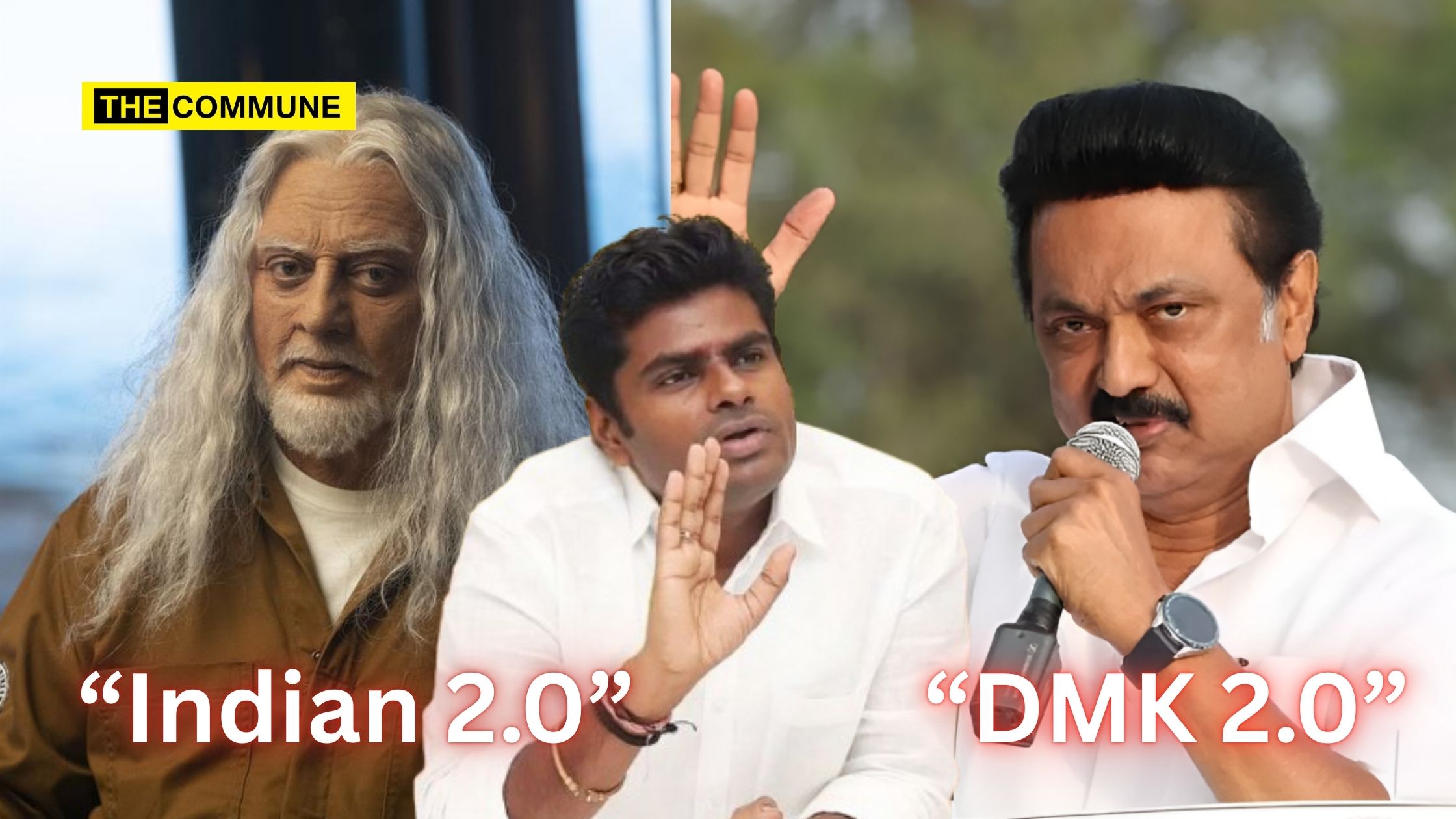
DMK 2.0 Will Become Like Kamal’s Indian 2.0, Annamalai Says

dmk annamalai kamal indian 2.0

Former Tamil Nadu BJP President K. Annamalai has launched a launched a scathing attack on the DMK government, accusing it of failing to maintain law and order in the state. He particularly highlighted a disturbing trend of violent crimes, including a recent spate of robberies and murders targeting elderly individuals in farmhouses across the Kongu region. Despite these incidents, Chief Minister M.K. Stalin has continued to claim that the DMK has delivered good governance and that the party’s return to power in 2026 will mark “DMK 2.0.”

Mocking the Chief Minister’s optimism, Annamalai compared the “DMK 2.0” pitch to Indian 2.0, a sequel to the Kamal Haasan film that was widely panned. Speaking at a protest held in Sivagiri on 5 May 2025, Annamalai ridiculed the comparison, saying, “The Chief Minister says, ‘If they come back to power, we’ll see DMK 2.0.’ But it will end up like the film Indian 2.0. That grandpa is different, and this ‘grandpa’ is different. No matter which 2.0 comes, you all know how it ends. He’s grading himself and claiming a comeback in 2026 like Indian 2.0. Beloveds, we must stand united—beyond party lines. Even if there are DMK cadres among us, I request you to acknowledge that law and order has broken down under this government. You must accept this, because your own families have women and elderly grandparents living in farm lands. This is not a political attack on DMK for the sake of it. It’s a call for everyone to come together.”

The protest was organized to condemn the brutal murder of Ramasamy and Bhakiyammal, an elderly couple living in Megaraiyan estate near Sivagiri in Erode district, who were killed during a robbery on 29 April. Annamalai warned that if the culprits are not apprehended within two weeks, the BJP would launch a continuous hunger strike in Sivagiri starting 20 May.

Citing a pattern of violent crimes in the region, Annamalai listed incidents in Namakkal, Chennimalai, Palladam, and other areas where farmers and elderly individuals were targeted. He expressed concern that the lack of swift arrests in these cases has eroded public confidence in the police force.

Annamalai also revealed alarming statistics that in the past three years, Tamil Nadu has recorded 1,319 sexual assault cases, 4,949 cases of sexual harassment, and 16,518 POCSO cases. “This government lacks the capability to ensure safety. People are waiting for a strong leader who can take decisive action,” he stated.

He demanded that Chief Minister Stalin hand over the investigation into the recent murders in Kongu Mandal to the CBI, criticizing the state government for protecting its image over delivering justice. “Two ministers were forced to resign in a single day. Thirteen are facing corruption cases. This is not governance—it’s chaos,” he added.

Annamalai also criticized the Tamil Nadu government’s silence on national security concerns, such as the central government’s directive to expel Pakistani nationals residing illegally in India, especially in the wake of attacks on Indian tourists in Kashmir.

Earlier in the day, Annamalai visited the bereaved family of the murdered couple and offered his condolences. He was accompanied by BJP leaders, including Modakkurichi MLA Dr. C. Saraswathi.

Subscribe to our channels on TelegramWhatsApp, and Instagram and get the best stories of the day delivered to you personally.

Supreme Court Uploads Judges’ Assets, Appointment Data To Boost Judicial Transparency

supreme court assets constitution

In a landmark move to promote transparency and bolster public confidence in the judiciary, the Supreme Court of India has, for the first time, made the declarations of assets and liabilities of its judges publicly accessible on its official website.

The declarations include those of Chief Justice of India (CJI) Sanjiv Khanna and 20 other sitting judges of the apex court. Among them are the next three judges in line to assume the position of Chief Justice in the near future. This unprecedented decision follows a Full Court meeting held on 1 April 2025, presided over by CJI Khanna, in which all judges unanimously agreed to make their personal asset disclosures public.

Until now, Supreme Court judges were mandated to submit asset statements to the Chief Justice, but these records remained confidential. The recent decision mandates that these statements be uploaded to the Court’s website as a matter of policy and practice going forward.

The initiative comes against the backdrop of controversy following alleged cash recovery from the official premises of Justice Yashwant Varma, a sitting judge of the Delhi High Court, which sparked public debate about accountability within the judiciary.

A press release from the Supreme Court confirmed the move, “The Full Court of the Supreme Court of India has on April 1, 2025, decided that the statements of assets of the judges of this Court shall be placed in the public domain by uploading the same on the website of this Court. Statements of assets of judges already received are being uploaded. Statements of assets of other judges will be uploaded as and when received.”

At present, asset declarations from 22 judges, including CJI Khanna, Justices BR Gavai, Surya Kant, Abhay S. Oka, Vikram Nath, Bela M. Trivedi, and others have been made available online. Declarations from remaining judges are expected to be uploaded as they are submitted.

In addition to the asset disclosures, the Supreme Court has also released detailed information regarding the judicial appointments process. This includes recommendations made by the Supreme Court Collegium for High Court judgeships from 9 November 2022 to 5 May 2025. The publicly available data includes the candidate’s name, High Court, source (Bar or judicial service), date of recommendation and appointment, category (SC/ST/OBC/Minority/Woman), and whether the nominee is related to any sitting or retired judge of a High Court or the Supreme Court.

This new policy marks a turning point in judicial accountability in India. By making such information accessible, the Supreme Court has set a precedent that legal experts and transparency advocates have long demanded.

(With inputs from Live Law)

Subscribe to our channels on Telegram, WhatsApp, and Instagram and get the best stories of the day delivered to you personally.
Dravidianist Media News18 TN & Thanthi TV Run Clickbait Headline, Misquote BJP Leader Annamalai, Message On Vision & Governance Reduced To Misleading Line On Alliance

news18 thanthi tv annamalai

Dravidianist media outlets in Tamil Nadu, eager for clickbait, have come together to push a misleading narrative, misquoting former BJP Tamil Nadu president K. Annamalai after his recent press meet. Annamalai had clearly stated that he does not believe in forming a strong alliance based solely on numbers, but rather in offering the people a vision for a better government. However, these media outlets, which often align with the DMK, selectively twisted his words, misleadingly headlining his statement as, “We have not united to defeat the DMK.”

Media outlets like News18 Tamil Nadu and Thanthi TV played a key role in spreading this distorted narrative.

On 5 May 2025, News18 Tamil Nadu posted a video with a misleading headline, alleging that Annamalai had said, “I don’t believe we have united to defeat DMK”. They cherry-picked the first few words of his statement and used it as clickbait, completely ignoring the rest of his remarks.

Similarly, Thanthi TV ran a headline claiming, “Our alliance did not form to defeat DMK”, presenting an out-of-context response that misrepresented Annamalai’s actual message.

Instead, at the press conference, K. Annamalai stated, “Personally, I don’t have much faith in the idea of a strong alliance to defeat the DMK. What makes strength? Is it the numbers? As far as I’m, the question is, what kind of government will we offer after defeating the DMK? People are asking, ‘You want to send the DMK home, but what are you going to do then? How will you address the law and order? The people ask what is the vision?’ They want a vision. If Tamil Nadu is givern for the next five years, what will we do? Today, our brother Edappadi Palaniswami, the opposition leader and political leaders in Tamil Nadu are already talking about what they will do, but for me, the 2026 elections won’t be decided by just numbers. It won’t be about how many parties are on the DMK’s side versus how many are on the opposition side. What matters is, if the people want to remove the DMK, who will offer them a better government? That’s the conversation happening today.”

He continued, “I don’t believe in, ‘Let’s unite to defeat the DMK.’ What I believe in is ‘Let’s unite to defeat the DMK and give a good government.’ That is what the Bharatiya Janata Party believes and I think all parties, including the All India Anna Dravida Munnetra Kazhagam, believes in.”

Subscribe to our channels on TelegramWhatsApp, and Instagram and get the best stories of the day delivered to you personally.
When The Dutch Bowed To The Maratha Superpower: How Chhatrapati Shivaji Maharaj Abolished Slavery In Dutch-Occupied Tamil Nadu

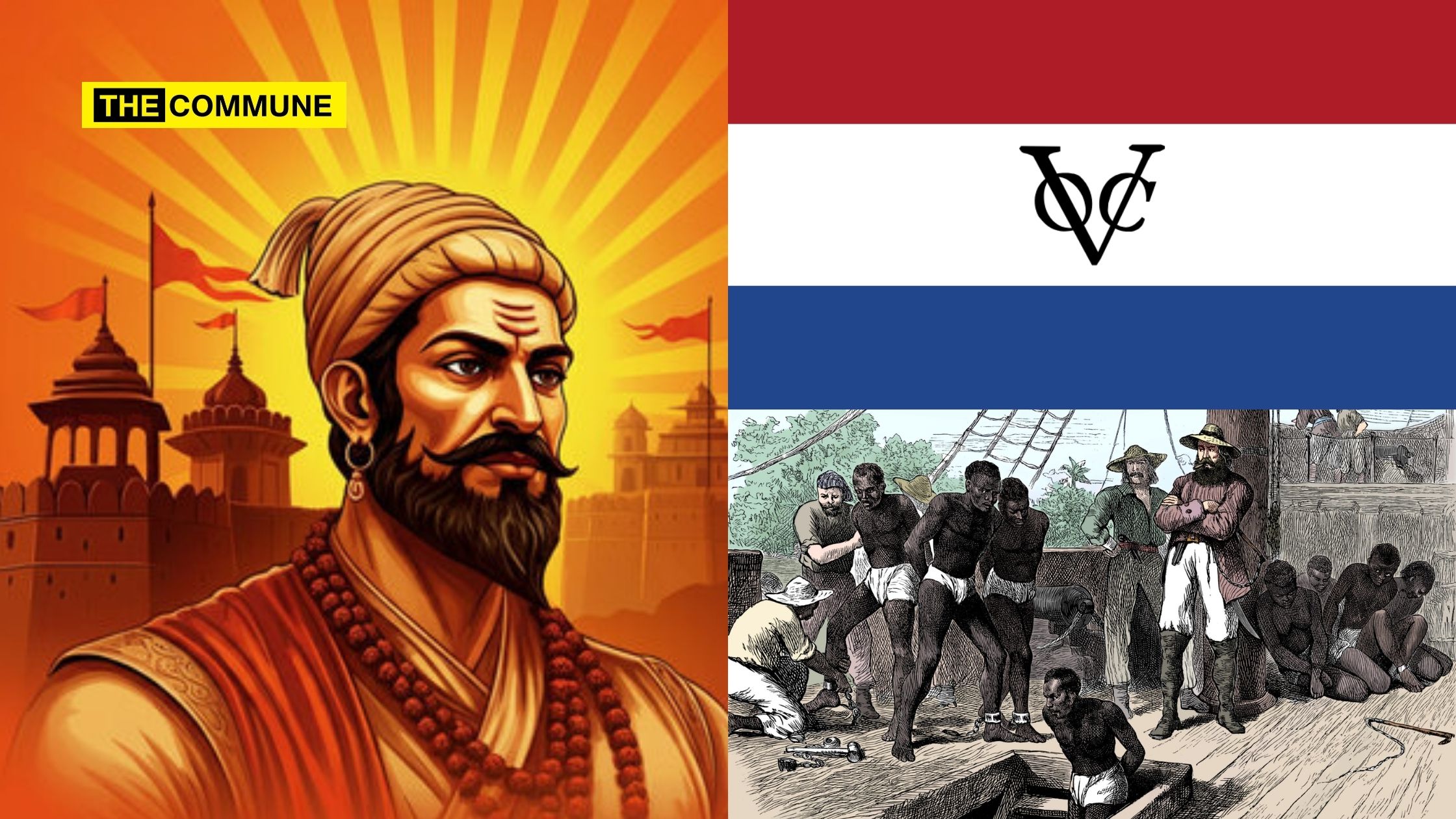
Our nation Bharat was the golden bird of the globe. It was undoubtedly the superpower militarily, economically, culturally, and politically. After the sultanate invasion into Bharat due to the backstabbing of Muhammed Ghori against Samrat Prithviraj Chauhan, the emperor of Delhi, our nation faced considerable upheavals, most importantly religious persecution against Hindus. The onslaught was defended by valiant warriors, who sacrificed their lives and kingdom, refusing to be slaves under these foreign invaders. It was in these circumstances that across Bharat we had multiple uprisings and rebellions against the Islamic Mughal empire. It was Vijayanagara in the east and the south, Ahoms in the northeast, Zamorins and Cheramaperumals in the southwest, and the Sikhs in the northwest. The most important of all of these were the Marathas under Suryatej Chhatrapathi Shivaji Maharaj. After the surrendering of certain forts to Aurangzeb, Kondhana was recaptured by Subedar Tanaji Malusare of Umrat from Udaybhan Rathore (Mughal Vassal).

The Call For Swarajya

The clarion call for Swarajya was given by Maharaja Chhatrapati Shivaji Raje, to break the shackles and smash the chains of religious slavery which was sought to be imposed upon the Hindus by the Islamic Mughal conquerors. Swarajya was not just a word. It was a beacon of hope to the oppressed, a gateway for freedom against Mughal tyranny, and the only force to destroy religious and cultural slavery against the Hindus. This was not an ordinary vision. It was the ultimate goal to be achieved for every self-respecting Bhartiya Hindu and required the full measure of devotion to reclaim the lost glory of this great country called Bharat.

Chhatrapathi Shivaji Maharaj was not an ordinary person; he was the enigma that every Hindu had hoped for against tyrannic Mughal rule. The bhagwa and Talwar was not only a symbol, but a divine ornament gifted to him by Maa Bhavani of Tuljapur. The desire and thirst for swarajya against tyrannic rule was unquenchable, which gave rise to a phoenix in the form of Chhatrapathi Shivaji Maharaj and the Marathas. The victorious Chhatrapathi coronation of Shivaji Raje Maharaj sent shock waves and deep anguish coupled with jealousy not only to the Mughals but across the globe. The British, the Dutch, the French, and the Portuguese were envious as they did not expect this rise in the late seventeenth century post-1645, as the colonial powers were lurking around Bharat trying to have a stronghold in the mainland. For the Hindus of Bharat, this was a pivotal movement in history that demonstrated to the outside world that Hinduism and Bharat cannot be destroyed and will always remain as resurgent as the Sun and the Moon.

During this period, slavery in India was being practiced by the colonial powers in collusion with the Islamic rulers in Bharat—the victims often being the poor, gullible native Hindus. The Hindu rulers at this time wanted to come under the umbrella of either Chhatrapathi Shivaji Maharaj or the Vijayanagara samrajya. In certain areas in the south, the Vijayanagara Samrajya had fallen due to infighting and was not in a position to defend against the continuous Islamic onslaught. This breach in protection had a direct impact on the safety of Hindus in the Deccan (south). Swarajya was founded not for self-enhancement but for a specific purpose: to break the shackles of slavery imposed upon Hindus and the country by Islamic invaders.

The Deccan Digvijayam

When the Mughals started eyeing the Deccan, Chhatrapathi Shivaji Maharaj could not remain a mute spectator as the founder of the Maratha empire. To fulfill the promise he gave to his father of achieving total swaraj of Bharat from Islamic invaders, he set out on a mission rightly named Deccan Digvijayam. This required him to travel deep into south India, including various places in Tamil Nadu along with his brother. He also visited the Kaalikambhal temple in Chennapatnam, present-day Chennai. After various wars that ensued in Tamil Nadu, swarajya was established there to protect Tamilians and Hindus from Islamic onslaught. Thus began the journey of the Bhosle clan rule in Tamil Nadu, a journey that started 350 years ago.

Being the Chhattrapathi, Shivaji Maharaj knew well the deep scar of slavery imposed by the Mughals and Aurangzeb on the Hindus and Bharat. The spectacle of slavery was in full display as the Mughals and the Deccan sultanate were involved in shipping native slaves including prisoners of war abroad at the request of colonists through Firmans. At this point, Chhatrapathi Shivaji Maharaj was encamped in Tamil Nadu with the mission of total swarajya. This was eventually achieved 100 years later when the Swarajya empire extended from Attock in Afghanistan to Tanjore in South India, Pune in the west up to Bengal in the East.

In Tamil Nadu, the colonists wanted to ensure that trade could be facilitated with the establishment of factories on equal terms with Chhatrapathi Shivaji Maharaj. Maratha economic policy was inclusive of better trade relations with colonists provided the European trading partners would treat them as equals. The recognition given by the colonists established the

Marathas as an undeniable military, political, and economic power. Swarajya and the Marathas became the next superpower in Bharat, especially after the decline of the Mughal empire.

The VOC (Dutch East India Company) in Coromandel had fortified settlements and trading centers extensively on the coast. The northernmost was Bimlipatnam (Now Bheemunipatnam in Northern Andhra Pradesh) and the southernmost was Nagapattinam (in Tamil Nadu, captured from the Portuguese in 1658). The capital was Pulicat (30 km North of Chennai). The fort at Pulicat was named Geldria and was built as early as 1613. In 1676, Ekoji, the half-brother of Shivaji, ousted the Nayak of Madurai from Thanjavur. Shivaji started his famous Karnataka campaign in the same year and captured the whole of Adilshahi Karnataka swiftly in 1677.

As soon as he won most of the Adilshahi Karnataka, Shivaji started paying attention to the administration of the province. In this background, treaties known as Kauls were sought with the Marathas. These kauls were both treaties and agreements signed by the Marathas with external powers including Europeans in Tamil Nadu, comparable to the firmans issued by the Mughals. The Dutch had forts at Tarangambadi, Cuddalore, Tanjore, Palaverkadu (Pulicat near Ponneri), and Colachal among other places in Tamil Nadu.

The treachery of Tallikota and the backstabbing by all the sultanates against the Vijayanagara samrajyam was a wake-up call to all Hindu rulers down south. This was another reason for the ascendance of Raghunatha Nayak to the throne of Tanjore. Fresh from his victory against the Golkonda sultanate, he established his kingdom and capital in Tanjore. He allied with the Dutch and wanted to remove all threats against his kingdom. However, the descendants of Raghunatha Nayak were not as formidable, leading to the Dutch extending their influence into the Nayak administration in Tanjore. This weakened the position of the Nayaks and was seen as a threat to the Hindu kingdom. The attempted smuggling of the Murugan idol from Thiruchendhur Murugan temple by the Dutch, though it ultimately failed, gave perfect reason for the establishment of firm Swarajya rule in Tanjore.

In this situation, Chhatrapathi Shivaji Maharaj utilized the opportunity and laid the foundation for swarajya in Tanjore. As a consequence, the Dutch along with the French realized the potential and power of the Marathas and voluntarily came forward to sign a peace treaty with them. This was the first time in the south that European colonial superpowers sought to establish treaty, alliance, and trade relations with Chhatrapathi Shivaji Maharaj and recognized his power in Tamil Nadu, highlighting the success of his Deccan Digvijayam.

Victory At Gingee And The End of Slave Trade

On 26 June 1677, a Maratha vanguard comprising 6000 troops engaged Sher Khan’s army near Thiruvadi. Sher Khan was forced to retreat and was pursued by Maratha cavalry. The next day, he reached the forests of Bhuvanagiri, south of Thiruvadi, and was promptly besieged there. He surrendered on 5 July 1677, and agreed to give up all his territory and pay 20,000 Hons, with his son Ibrahim Khan kept as hostage. Many other smaller fortresses were also captured. In September 1677, after capturing the famous fort of Gingi, Shivaji began reorganizing the administration of the newly won province.

The fort of Gingee, previously administered by the Islamic Adhil Shahji sultanate, suffered a crushing defeat at the hands of Chhatrapathi Shivaji Maharaj, jeopardizing Islamic hegemony in Tamil Nadu and paving the way for Swaraj. The European colonists wanted continuity of trade, while Chhatrapathi Shivaji Maharaj demanded equality, honor, respect, dignity, and freedom from all forms of oppression. The shackles of slavery lingered in the minds of every Maratha soldier, and Shivaji Maharaj was determined to break the chain of Islamic imposition upon native Hindus in Bharat.

To reach a mutual understanding, the French and Dutch submitted to and recognized the dominance of the Marathas in Tamil Nadu. This was the first time European colonists treated a resurgent Hindu empire with equal respect and accepted conditions in a treaty even when against their interests. After reorganizing the administration in Gingee Fort, Chhatrapathi Shivaji Maharaj granted two kauls to the Dutch.

He granted two kauls to the Dutch East India Company (VOC), one to Albert van Weede, head of Tegenapatnam factory, and one to Jacques Caulier, governor of Dutch Coromandel, continuing their trading rights given by the Adilshah except for the purchase of slaves. Herbert de Jager and Nicolas Clement met Shivaji at his camp at Waligondapuram on 6th August. Shivaji, accompanied by Raghunath Pandit and Janardan Pandit, listened to the VOC’s demands and promised to honor previous kauls. He also held a friendly conversation with Nicolas Clement.

The transliteration of these Kauls, especially the one dated 24th of August 1677 signed in Tegenapatnam (Gingee fort), highlights one vital matter: under the insistence of Chhatrapathi Shivaji Maharaj, the issue of slavery was struck down. He made it clear that slavery practiced previously in Islamic rule from Gingee, by transporting various native Hindus as slaves abroad in ships can never be continued as long as Swaraj is in force.”

This Kaul significantly highlights that slavery existed in Tamil Nadu through the Gingee Fort under Muslim Adhil Shahi’s rule. There was an agreement between the Islamic Adhil Shahi rulers and the European colonists to continue slavery, primarily involving native Hindu commoners. Chhatrapati Shivaji Maharaj refused to agree with the Dutch to continue this policy and made it clear that there would be no slavery under Swarajya rule as long as he was Chhatrapathi.

This content in the Kaul symbolizes the Hindu religion and Bhartiya culture, which does not permit or recognize slavery of any kind and represents inherent tolerance and equality. The existence of this kaul has been deliberately kept from public view to suit a Hindu-phobic narrative. The evidence clearly shows that it was the Dutch and Islamic rulers who were responsible for institutionalized slavery in Gingee, while Chhatrapathi Shivaji Maharaj stood firmly against it.

For clarity, the exact words pertaining to the abolition of slavery found in the translated Kaul are: (24.08.1677, Gingee)

“During the Muslim rule, you were allowed to buy slaves (male & female) from here and transport the same (abroad), without being hindered by anybody. But now, as long as I am the master of this country, you can neither buy slaves nor transport them elsewhere. And if you were to do it, and bring slaves on board, my people will oppose it in all ways and not permit that they were reduced to slavery in your house. As such, you must observe and honour the same

  • Credit for Translation & inputs from Nikhil N. Bellarykar
  • Copyright of document & acknowledgement of assistance from National Archives Netherlands, Hague

B Jagannath is an advocate at Madras High Court and has authored the book The First Native Voice of Madras.

Subscribe to our channels on TelegramWhatsApp, and Instagram and get the best stories of the day delivered to you personally.
‘Is The DMK’s Preaching Only For Others, Not For Dravidian Stocks?’ BJP Leader H Raja Slams DMK After Ex-Minister Ponmudi’s Grandson Takes NEET Exam

h raja dmk ponmudy neet

Senior BJP leader and Tamil Nadu BJP Coordination Committee Convenor H Raja has criticized the DMK and its leadership for its blatant hypocrisy regarding the NEET medical entrance exam. While publicly opposing NEET in Tamil Nadu, but its leaders privately ensure their own children prepare for and appear in the same exam.

According to reports, over 1.5 lakh students from Tamil Nadu registered for the National Eligibility cum Entrance Test (NEET) held on 4 May 2025, with approximately 20,000 students appearing from Chennai district alone.

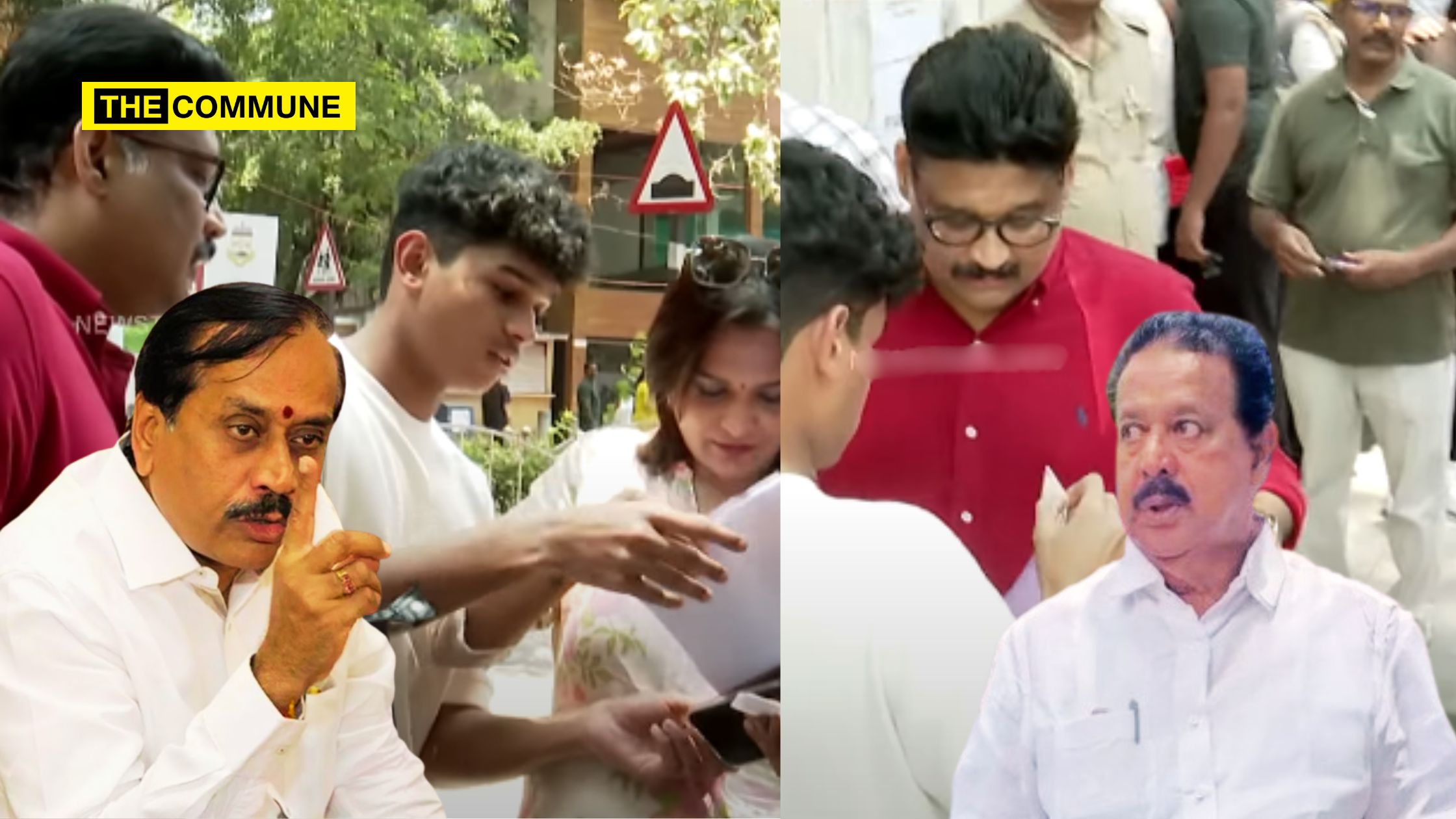
What drew particular public attention was the presence of the grandson of former DMK Forest Minister K. Ponmudi at an exam centre in Chetpet, Chennai accompanied by his father and former DMK MP, Gautham Sigamani.. The incident sparked criticism because, despite the DMK’s ongoing opposition to NEET, their own family members are participating in it. This mirrors similar criticism the party faces over its opposition to Hindi imposition, while simultaneously running CBSE schools that offer Hindi as a language option.

Taking to his official X (formerly Twitter) account, H. Raja mocked the situation, and questioned, “The scene where the grandson of former DMK Minister Mr. Ponmudi goes to write the NEET exam. Is the DMK’s preaching only meant for others? Not for the Dravidian Stocks?” 

This criticism was specifically directed at former DMK Minister K. Ponmudi, who, during his tenure as Tamil Nadu’s Higher Education Minister in 2022, had openly questioned the fairness of NEET. Speaking at the 10th edition of The New Indian Express‘ ThinkEdu Conclave, Ponmudi remarked, “How can you evaluate 12 years of education with just a three-hour exam?”—a statement that underscored the DMK-led government’s firm opposition to the NEET system.

In 2021, the DMK had reaffirmed its unwavering stance against NEET, making it clear that there was no shift in policy. An official statement was issued to counter media speculation, reiterating that the State government supported medical admissions based on students’ performance in their Plus Two board exams, not through centralized entrance tests. During a virtual high-level meeting on educational policy, both Higher Education Minister K. Ponmudi and School Education Minister Anbil Mahesh Poyyamozhi reaffirmed this position, emphasizing the government’s continued resistance to NEET for professional course admissions.

Subscribe to our channels on TelegramWhatsApp, and Instagram and get the best stories of the day delivered to you personally.
How EVR Fetishized About Kerala’s Sambandham System And Sexual Exploitation Of Women

EVR's Gems On Malayalis Especially Brahmins And Nairs

The most disgusting, sadistic and misogynistic ideologues in recent history seem to be the followers of the Dravidianist ideology aka the followers of EV Ramasamy Naicker, whom they hail as ‘Periyar’. Why is that? Because under the pretense of historical critique, they’ve constantly pushed revolting opinions about women—often shaped by their own bizarre fetishes. Their narratives weaken men, strip husbands of dignity, and reduce women to mere flesh to be consumed by men of their ilk. And the worst part? These aren’t accounts backed by real history—they’re made-up tales driven by nothing but their own sick sexual fantasies. And who was the man behind many of these pathetic cucked-up stories? None other than E.V. Ramasamy Naicker himself. He wrote such content under the pseudonym “Chithiraputhiran” in the Kudiyarasu magazine.

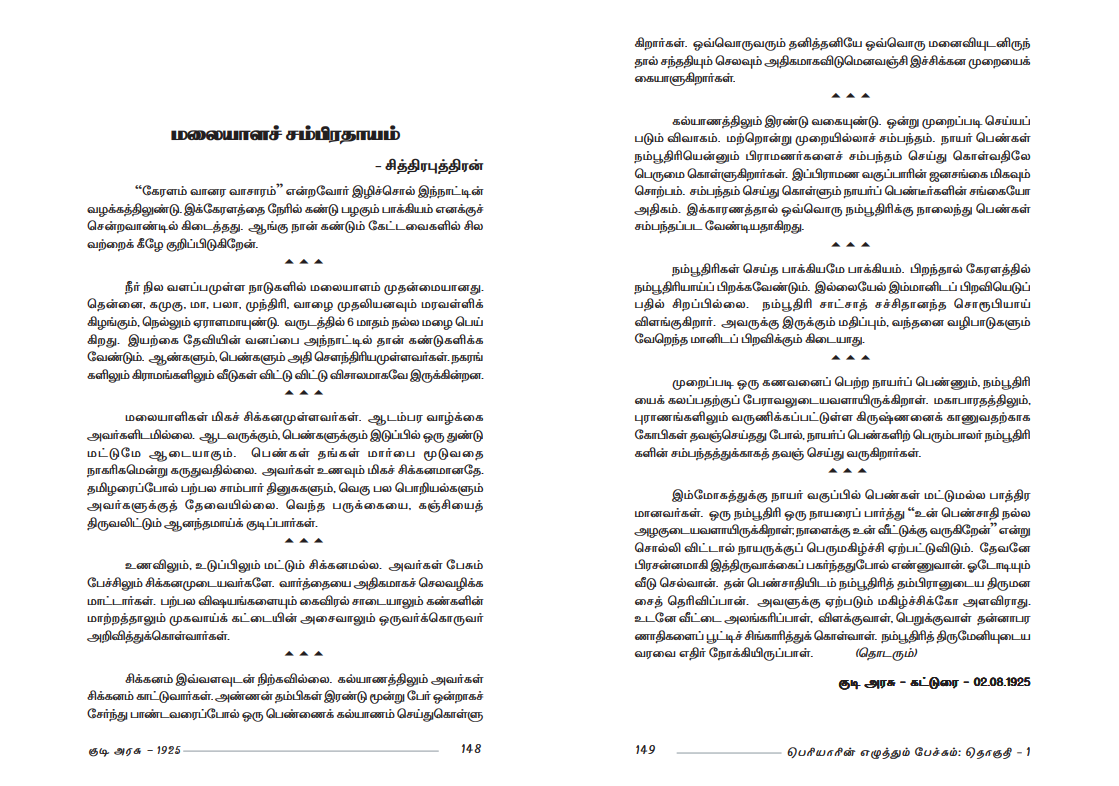
In one such article, titled “Malayala Samudhayam” (“Malayalam Tradition”), dated on 2 August 1925, he goes on to paint a grotesque picture of Kerala society. He casually claims that women don’t cover their chests, that men share wives like it’s some economic strategy, and glorifies Nambudiri Brahmins having access to multiple Nair women—comparing the women’s supposed devotion to them with that of Gopis pining for Krishna. He even says families would be overjoyed if a Nambudiri expressed interest in their daughter, treating it like a divine blessing.

Here’s a disturbing glimpse:

“There is a derogatory term in this country called “Keralam Valara Vasaram.” I had the opportunity to see Kerala firsthand last year. I would like to mention some of the things I observed and heard below. Malayalam (Kerala) is among the first in the world in terms of rich water resources. The region is abundant in coconut, kamuku, mango, jackfruit, cashew, and banana, along with cassava tubers and paddy. It experiences significant rainfall for six months of the year. The goddess of nature can be seen only in that country. Both men and women are very beautiful. In both cities and villages, the houses are spacious and have gaps. The Malayalis are very frugal and do not lead a luxurious life. Men and women wear only a piece of clothing around their waists. Women do not consider it fashionable to cover their breasts. Their food is also very frugal; they do not need many sambar dishes or curries like the Tamils do.

They drink hot porridge with joy. Not only are they frugal in food and clothing, but they are also frugal in speech and do not waste words. They communicate many things to each other through finger gestures, eye movements, and the movement of their muzzles. This frugality does not stop there; they also demonstrate frugality in marriage. Two or three brothers marry one woman, similar to the Pandavas. If each man has his own wife, the offspring and expenses will increase, so they resort to this thrifty method. There are two types of marriage. One is a formal marriage. The other is an informal relationship. Nair women take pride in marrying Brahmins known as Namboothiris. The community of this Brahmin class is very small, while the community of Nair women who marry is large. For this reason, four or five women have to be married to each Namboothiri. The Namboothiris are fortunate. If one is to be born, it is best to be born in Kerala as a Namboodiri. Otherwise, one’s rebirth in this human life is not worthy. A Namboothiri embodies Satsat Sachidananda. No other human birth commands the respect and veneration that a Namboothiri does. Additionally, a Nair woman with a legitimate husband is often eager to be with a Namboodiri.

Just as the Gopis performed penance to see Krishna, as described in the Mahabharata and the Puranas, most of the Nair women are performing penance for the sake of the Namboothiris’ samantham (matrimonial alliance confirming marriage). Not only are Nair women attracted to this passion of the Namboothiri class. If a Namboodiri sees a Nair and says, “Your wife is very beautiful. I will come to your house tomorrow,” the Nair will be overjoyed. He will think that God Himself has appeared and spoken this message. He will run home and inform his wife about the marriage wish of Namboothiri Thambiran. The joy that will come to her will be immeasurable. She will immediately decorate the house, light it, clean it, and adorn herself with her jewels. She will eagerly anticipate the arrival of the Namboothiri.

Let’s be absolutely clear—this wasn’t history. It wasn’t anthropology. And it certainly wasn’t satire. What EVR, under the alias Chithiraputhiran, penned in the Kudiyarasu on 2 August 1925, was a disturbing grotesque blend of fetish-laced fantasy and ideological spin, aimed at degrading women under the guise of cultural commentary.

EVR’s fascination with the Sambandham system—where Nambudiri Brahmins had alliances with multiple Nair women—was less about dismantling caste hierarchy and more about reimagining it to suit a Dravidianist reversal. His writings suggest a subconscious desire to replicate that structure, with Dravidian men taking the place of the Nambudiris, wielding similar power over upper-caste women, particularly Brahmins. This wasn’t a vision of egalitarianism, but rather one of revenge re-cast as sexual dominance. Instead of seeking liberation through equality, EVR’s rhetoric hints at a deep yearning to invert the caste pyramid by asserting masculine control in the most intimate domains—female bodies and sexuality—thus reducing social justice to a fantasy of conquest and humiliation.

Subscribe to our channels on TelegramWhatsApp, and Instagram and get the best stories of the day delivered to you personally.