Home Blog Page 305

“Pakistan Has Hit”: The Hindu Sounds Like ISI Propaganda Outlet Once Again, Publishes Unverified Claims And Deletes It Later

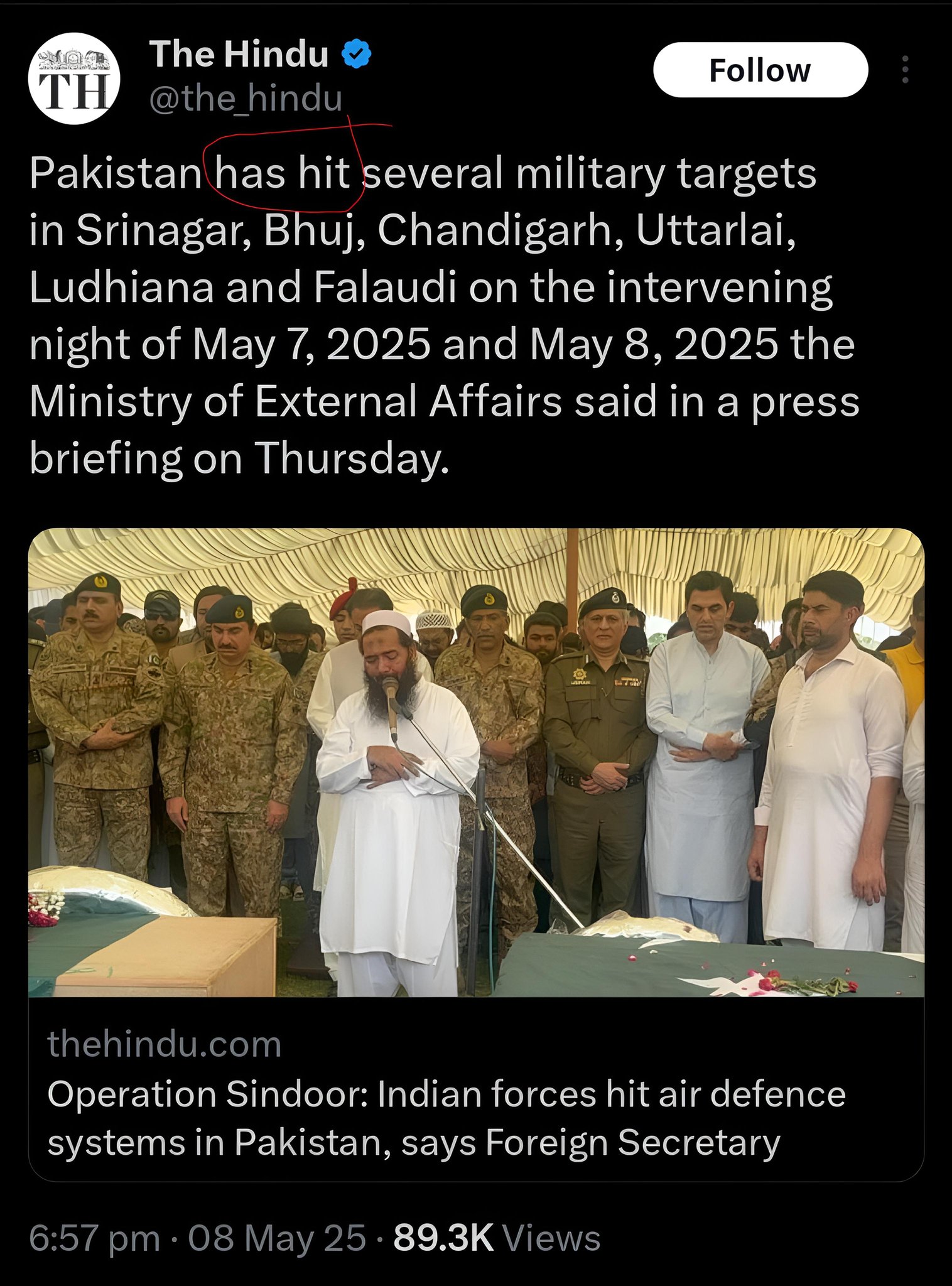
The Hindu once again shared unverified information, falsely reporting that Pakistan successfully struck multiple Indian military targets—when in fact, no targets were hit. This follows a previous incident where the outlet claimed three Indian jets were downed, a narrative quickly amplified by Pakistani and international media before the tweet was deleted.

The social media post published by The Hindu read “Pakistan has hit several military targets in Srinagar, Bhuj, Chandigarh, Uttarlai, Ludhiana, and Falaudi on the intervening night of May 7, 2025 and May 8, 2025, the Ministry of External Affairs said in a press briefing on Thursday.

However, the media outlet silently deleted after official sources confirmed that it was false. Government of India has clearly said in an official statement that all of Pakistan’s attempts to hit specific places were successfully neutralized by the Integrated Counter-UAS Grid and Air Defence systems.

Earlier on 7 May 2025, The Hindu had claimed that atleast three Indian jets crashed in Jammu and Kashmir sharing pictures which looked like AI-generated.

The report was subsequently deleted after widespread backlash, with users accusing the outlet of disseminating misinformation without proper verification. The deleted post reportedly suggested details that aligned with Pakistan’s attempts to distort the success of India’s counterterrorism efforts.

Concerns have been raised whether The Hindu is deliberately acting at the behest of ISI publishing such reports to push Pakistani propaganda.

The Indian Ministry of Information and Broadcasting has highlighted Pakistan’s disinformation campaign, noting that state-affiliated accounts and media outlets have been circulating fabricated content, such as recycled videos and images, to mislead the public and undermine Operation Sindoor. The Press Information Bureau’s Fact Check unit flagged multiple instances of such propaganda, including false claims of Indian military losses and staged victories by Pakistan.

Many have labelled The Hindu’s actions as irresponsible, accusing the newspaper of failing to uphold journalistic standards by not cross-checking sources before publishing.

While The Hindu had put a half-hearted apology for its May 7 false report, it has not not issued a public statement regarding the deletion of the latest post.

Subscribe to our channels on TelegramWhatsApp, and Instagram and get the best stories of the day delivered to you personally.

“Pahalgam First, Tenkasi Next”: TN BJP Leader Ananthan Ayyasamy Receives Explosive Threat Amid Ongoing Anti-Terror Operations

Tenkasi district BJP president Ananthan Ayyasamy received a threatening email on 7 May 2025, from an unidentified sender using the alias “Dasara Udhayanidhi.” The email, sent in the early hours of the morning, made alarming claims including a warning about explosives placed at the Tenkasi Collector Office and demanded evacuation by 1 PM. It also referenced recent political tensions and hinted at connections spanning from Pakistan’s ISI to Tamil Nadu’s political circles.

The message ominously read: “Pahalgam First, Tenkasi Next – Tenkasi is the actual Jugular Vein of India. 4 IEDs placed in Collector Office; evacuate all by 1 PM!” It was sent not only to Ayyasamy but also to the official email addresses of the Tenkasi Collector and a local startup hub.

The sender further warned Ayyasamy to “stay out of Tamil Nadu politics,” and bizarrely referred to a supposed historical incident involving former CIA Director Allen Dulles and an 18-year-old Madras constable, tying it to Dravidian political developments.

Reacting to the threat, Ananthan Ayyasamy took to his official X account to express concern. He wrote,
Received this threat email as #OperationSindooor happens! As much as I would want to see this email as joke, but can’t simply walk past – given the past history, especially the PFI, ISIS related NIA searches (Sept 2022, Feb 2023, Feb 2024) in Tenkasi Dt. Requested @CollrTenkasi @TenkasiPolice for their kind attention and necessary action.

This threat comes days after extensive National Investigation Agency (NIA) raids and arrests in the region linked to proscribed terror organizations. The timing has added urgency to Ayyasamy’s appeal, and local authorities are expected to respond swiftly to ensure public safety.

Subscribe to our channels on TelegramWhatsApp, and Instagram and get the best stories of the day delivered to you personally.

DMK’s Dravidian Model Takes Another Hit As Wells Fargo Shuts Shop In TN

wells fargo dmk dravidian model

In another major setback for Tamil Nadu’s much-promoted “Dravidian model” of governance, American financial giant Wells Fargo has announced the closure of its Global Capability Centre (GCC) in Chennai. The operations will be relocated to Bengaluru and Hyderabad by the fourth quarter of FY27, offering employees the option to move or seek opportunities elsewhere. This marks the third significant shift of business operations out of the state, raising serious questions about Tamil Nadu’s ability to retain investment and talent.

This decision follows similar exits by startups like Wheelocity and Arcana, both of which moved their headquarters to Bengaluru. These moves reflect a deeper concern: Tamil Nadu’s startup ecosystem is struggling to foster innovation, risk-taking, and enterprise at the scale seen in competing states.

Wells Fargo’s Strategic Shift and Chennai’s Image Problem

In an internal communication reviewed by Moneycontrol, Wells Fargo’s regional head Uday Odedra stated that the decision to exit Chennai is part of a global strategy to consolidate operations and provide better career opportunities in Bengaluru and Hyderabad. The company currently employs approximately 10,000 people across its Indian offices, with some employees reportedly beginning to explore new job options rather than relocating.

Despite official explanations tying the move to global planning, social media buzz points to deeper concerns—including Chennai’s perceived insularity, limited social infrastructure, and challenges in attracting talent compared to Bengaluru’s vibrant startup ecosystem.

Why Are Businesses Leaving Tamil Nadu?

Despite government claims of being an attractive destination for investment, Tamil Nadu faces systemic challenges in its entrepreneurial landscape. The state’s ecosystem is often criticized for underfunding, lack of risk appetite, and insufficient support for high-growth, consumer-focused ventures.

Take Wheelocity, for example. Initially headquartered in Coimbatore, it started as a B2B supplier for quick commerce companies such as Swiggy Instamart and Zepto. In 2024, the company pivoted toward a B2C strategy targeting rural markets, backed by a $15 million funding round. To execute its expansion plans—reaching 10 million consumers in 20,000 towns and villages—it moved operations to Bengaluru, citing better access to capital, infrastructure, and growth opportunities.

Arcana, another tech startup, also transitioned its core operations—engineering, support, and product development—to Bengaluru, signaling the deepening trust deficit in Tamil Nadu’s startup environment.

A Sluggish Ecosystem and Funding Gap

According to industry experts and recent data, Tamil Nadu’s startup space suffers from slower growth trajectories compared to hubs like Bengaluru. A report by Venture Intelligence noted that venture capital investments in the state fell by 44% in 2024, hitting their lowest since 2020, even as funding rebounded elsewhere in India.

Arun Natarajan, founder of Venture Intelligence, says the lack of local investors and a risk-averse culture are core challenges. Unlike Bengaluru, Tamil Nadu lacks successful B2C role models like Swiggy or Zepto that attract major capital. Instead, the state has found moderate success in B2B sectors such as enterprise software and fintech.

Despite being India’s second-largest economy by gross national income, Tamil Nadu has produced relatively few unicorns, with just over 250 startups crossing Series A funding and fewer than a dozen becoming billion-dollar companies.

Evolving Mindsets, But Too Slowly

According to Anicut Capital’s Balamurugan, the ecosystem must diversify beyond traditional tech and fintech to include sectors like manufacturing and automotive tech, with room for high-risk ventures. Without a willingness to allow failure, the state cannot build the kind of innovation-driven economy that thrives in uncertainty.

StartupTN CEO Sivarajah Ramanathan argues that while the state has a lower startup failure rate, alternative metrics such as profitability and debt-based funding should also be considered. He noted that in the past six months, ₹90 crore in cumulative funding had been facilitated by the government, though more work is clearly needed.

A Broader Warning Sign

The relocation of major companies and promising startups from Tamil Nadu reflects more than individual business decisions—it signals a warning about the state’s diminishing appeal to innovators, entrepreneurs, and global firms. As China’s tech capital, Bengaluru continues to attract both domestic and international investment, Tamil Nadu risks being left behind unless it makes significant structural and cultural changes to its startup support mechanisms.

(With Inputs From Money Control)

Subscribe to our channels on TelegramWhatsApp, and Instagram and get the best stories of the day delivered to you personally.

Amid India-Pakistan War Tensions, China And Pakistan Resort To Digital Propaganda And Psychological Warfare

india pakistan war china propaganda

During high-stakes situations like the current standoff between India and Pakistan, while the Indian Armed Forces confront the enemy with bravery and precision, a parallel battle unfolds online. Both Pakistani and Chinese social media handles have intensified their disinformation campaigns, not only to deflect attention from their strategic failures but also to pacify domestic unrest and maintain an illusion of control.

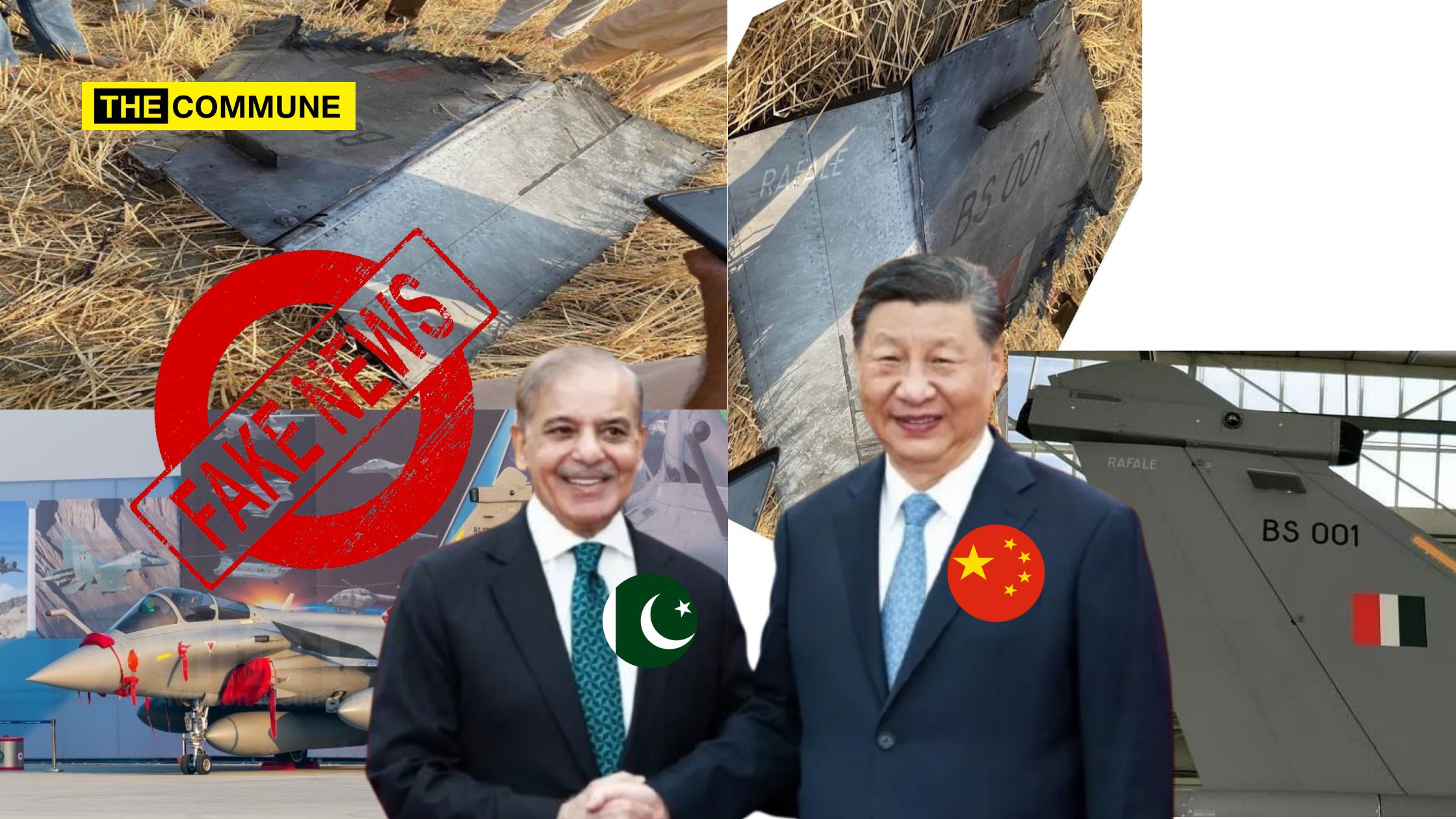
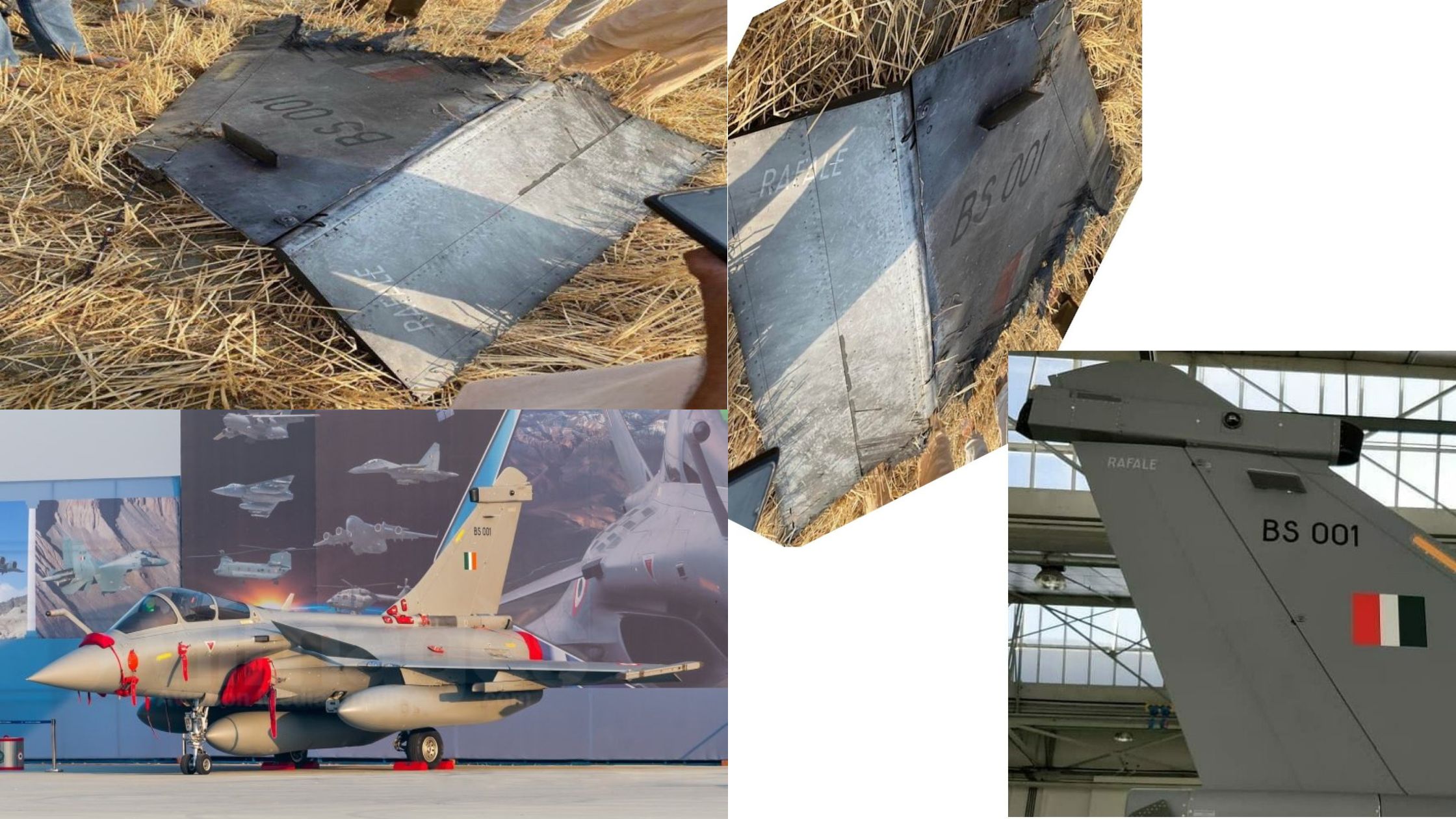
China, rather than showcasing the effectiveness of its defense exports, has entered the realm of psychological warfare. This has included the use of advanced image manipulation tactics to support the false narrative that Pakistani air defense systems supplied by China successfully shot down five Indian aircraft. In reality, these claims have been thoroughly debunked, as the circulated images were either from unrelated past events or digitally doctored to mislead viewers.

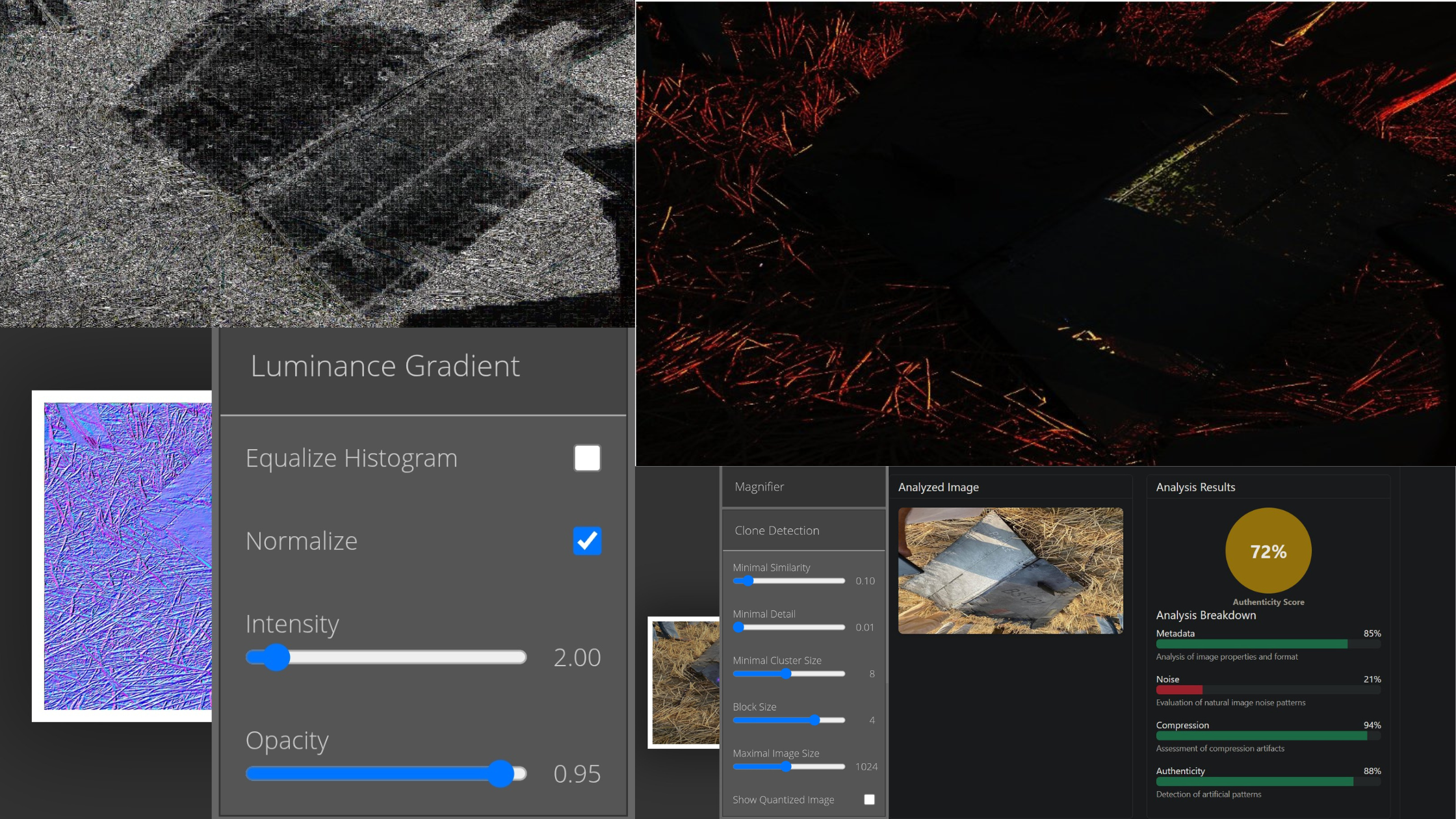
One of the most viral false claims involved the supposed downing of an Indian Rafale jet. At first glance, the image shared online appeared convincing, but detailed forensic analysis told a different story. Upon closer inspection using photo forensics tools, several indicators of manipulation were revealed: cloned areas indicating repeated patterns, inconsistent brightness levels exposed through Error Level Analysis (ELA), and abrupt lighting changes within the luminance gradient. These inconsistencies clearly pointed to digital tampering.

China’s involvement becomes even more apparent when considering the context. The manipulated image was intended to show the destruction of BS001—India’s very first Rafale, which had been widely publicized and symbolized India’s air superiority. This made it an ideal target for Chinese propaganda aimed at undermining India’s morale and credibility.

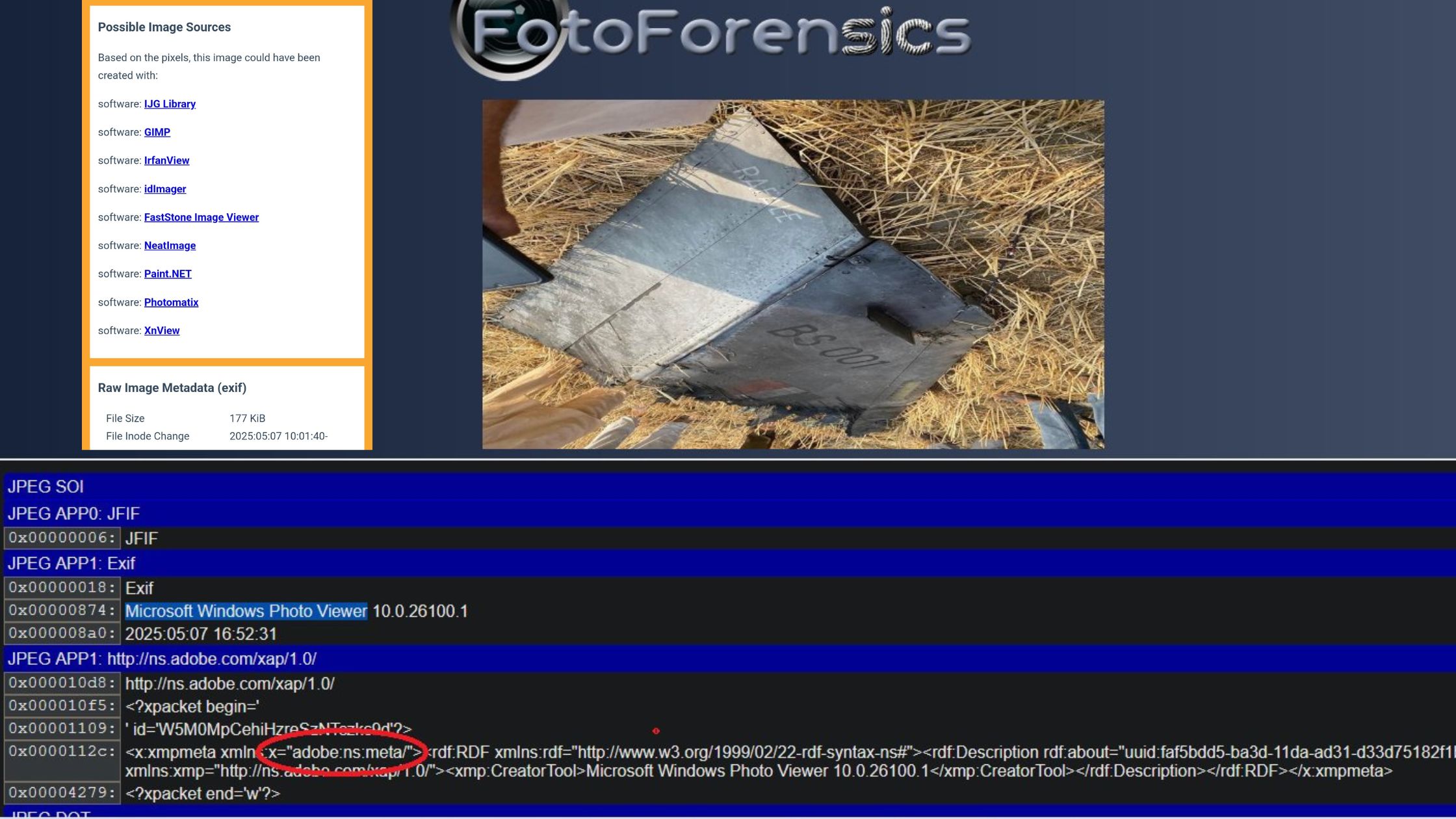
The forensic trail also suggests the image was edited using multiple software tools known for photo manipulation, such as GIMP, Paint.NET, and IrfanView. The repeated saving and editing further compromised its authenticity.

Moreover, China’s motivation isn’t limited to narrative control—it is also attempting to promote its PL-15 missile system and J-10C jets through these fabricated stories, positioning them as superior to India’s defense capabilities. However, these digital deceptions have been exposed by advanced image analysis tools, neutralizing the intended psychological impact.

In short, what we’re witnessing isn’t just fake news—it’s a sophisticated disinformation campaign backed by state actors, aiming to rewrite the outcome of real-world events through digital fiction. But in an age of technology, truth can fight back—and it is.

Subscribe to our channels on TelegramWhatsApp, and Instagram and get the best stories of the day delivered to you personally.

India Neutralizes Pakistan’s Missile And Drone Attacks On May 7-8 Night, MoD Releases Statement

pakistan india drone missile

On the night of May 7-8, India successfully thwarted Pakistan’s missile and drone strikes targeting military sites in Northern and Western India. The Indian Armed Forces also struck key Pakistani air defence radars and systems.

In a statement, the Ministry of Defence confirmed that the air defence system in Lahore was neutralized as Pakistan continued unprovoked firing along the Line of Control (LoC) for the 12th consecutive day following ‘Operation Sindoor.’

The full statement read, “During the Press Briefing on Operation SINDOOR on 07 May 2025, India had called its response as focused, measured and non-escalatory. It was specifically mentioned that Pakistani military establishments had not been targeted. It was also reiterated that any attack on military targets in India will invite a suitable response.

On the night of 07-08 May 2025, Pakistan attempted to engage a number of military targets in Northern and Western India including Awantipura, Srinagar, Jammu, Pathankot, Amritsar, Kapurthala, Jalandhar, Ludhiana, Adampur, Bhatinda, Chandigarh, Nal, Phalodi, Uttarlai, and Bhuj, using drones and missiles. These were neutralised by the Integrated Counter UAS Grid and Air Defence systems. The debris of these attacks is now being recovered from a number of locations that prove the Pakistani attacks.

Today morning Indian Armed Forces targeted Air Defence Radars and systems at a number of locations in Pakistan. Indian response has been in the same domain with same intensity as Pakistan. It has been reliably learnt that an Air Defence system at Lahore has been neutralised.

Pakistan has increased the intensity of its unprovoked firing across the Line of Control using Mortars and heavy calibre Artillery in areas in Kupwara, Baramulla, Uri, Poonch, Mendhar and Rajouri sectors in Jammu and Kashmir.

Sixteen innocent lives have been lost, including three women and five children, due to Pakistani firing. Here too, India was compelled to respond to bring Mortar and Artillery fire from Pakistan to a halt.

Indian Armed Forces reiterate their commitment to non-escalation, provided it is respected by the Pakistani military.”

(With inputs from PIB)

Subscribe to our channels on Telegram, WhatsApp, and Instagram and get the best stories of the day delivered to you personally.

Pakistan’s Defence Minister Khawaja Muhammad Asif Cites Social Media As Evidence For Downing Indian Jets

pakistan defence minister social media

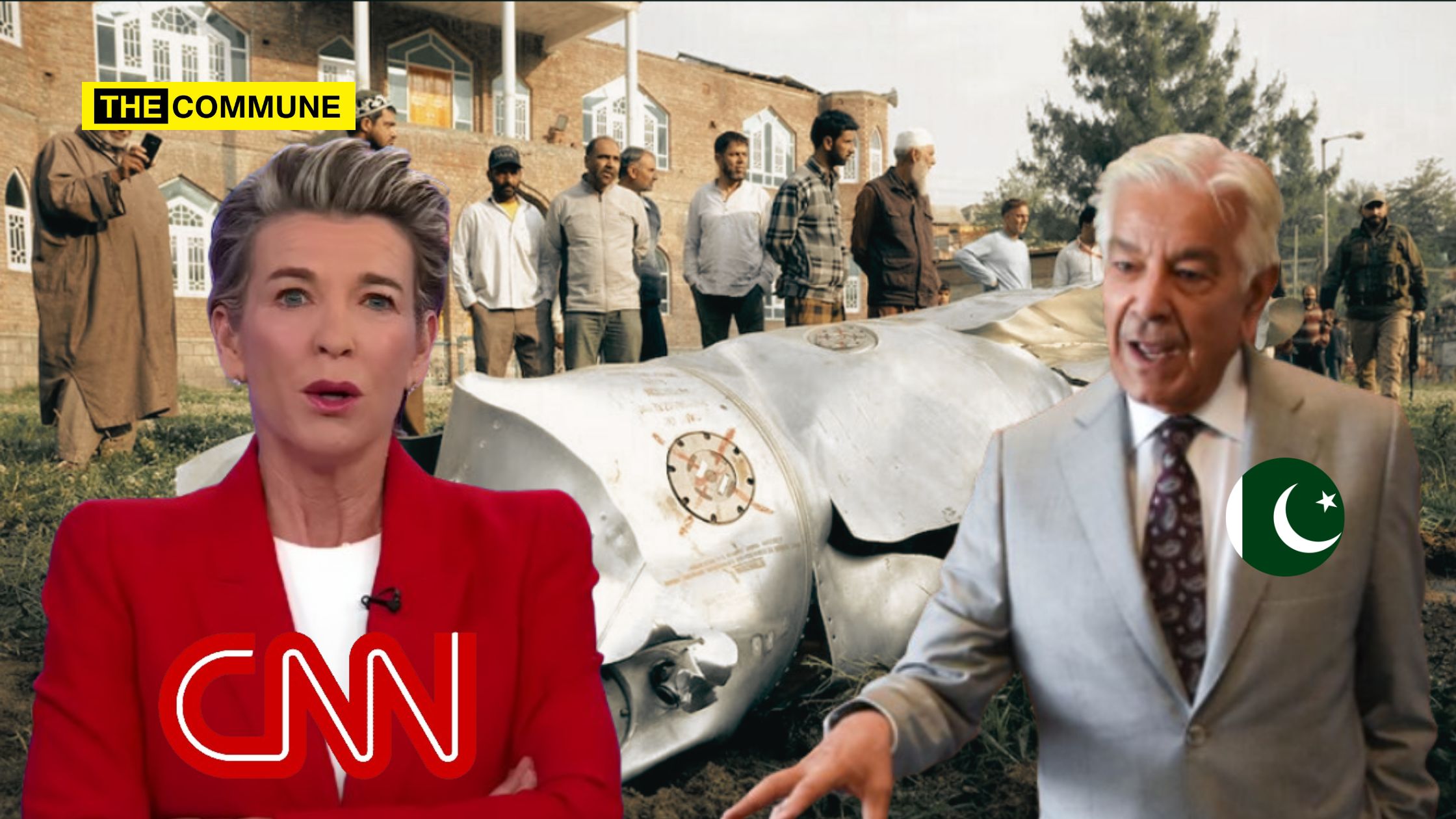
The mystery behind Pakistan’s bold assertion of having shot down five Indian fighter jets—including Rafales—during India’s recent anti-terror operation, has unraveled in an unexpectedly comical way. In a now-viral interview with CNN’s Becky Anderson, Pakistan’s Defence Minister Khawaja Muhammad Asif credited “Indian social media” as the proof behind his country’s extraordinary claims.

When Anderson pressed for tangible evidence to support the supposed shootdowns, asked, “You just put up the fact that India lost some fighter jet. So let’s be quite clear about this. Pakistan claims it shot down five Indian Air Force jets on a drone. As I understand it, India says there’s no evidence of that. No proof. So can you provide any can you provide more detail and SEC response that your Army spokesman threatened, or is there further action to come? Let’s start with these this very specific, allegation of five fighter jets shot down. Where’s the evidence for that, sir?”

Asif casually replied, “It’s all over the social media, on Indian social media, not on our social media. They debris of these jets fell into a occupied Kashmir and it’s all over the Indian media, and they have admitted.”  She promptly reminded him, “You’re the Defence Minister. We didn’t bring you here to talk about social media.”

What followed was a bizarre and disjointed exchange. When asked if Chinese equipment was used, Asif dodged the question by rambling about Pakistan assembling its own aircraft and criticizing India for purchasing jets from France. He claimed India had “already admitted” to losing three jets, yet failed to provide any concrete data photos, videos, radar logs, or even a single verifiable wreckage site.

In another twist, he added that the jets were downed during a “dogfight” and bizarrely claimed that missiles were launched from Pakistani tanks. He attributed the supposed kills to JF-17s or JF-10s, again offering no proof.

Meanwhile, India has released official footage, satellite images, and drone visuals confirming the destruction of nine terrorist facilities inside Pakistan and PoK as part of Operation Sindoor, a precision mission in response to the 22 April Pahalgam terror attack that killed 26 Hindu pilgrims. In stark contrast, Pakistan has relied solely on anonymous posts, recycled media, and unverified claims.

Chinese state media, such as Global Times, also echoed the Pakistani narrative, claiming Indian jets were shot down. But India’s embassy in Beijing quickly debunked the misinformation, urging the outlet to fact-check before spreading propaganda.

Even The Hindu, after initially citing an anonymous source about alleged jet crashes, deleted its post and clarified that no official confirmation existed.

As if things weren’t embarrassing enough, Pakistani military officials doubled down, falsely claiming they had shot down an Israeli-made Heron drone, three Rafales, one MiG-29, and one Su-30MKI—without showing a shred of proof.

While India presented evidence of its successful strike, including the locations and results, Pakistan is trapped in a loop of denial, misinformation, and social media theatrics. Not a single verifiable image of downed aircraft, captured pilots, or on-ground wreckage has emerged.

Internally, Pakistan’s military is grappling with deeper problems. Amid 38% inflation and a ballooning debt-to-GDP ratio, the defense budget has been slashed by 15%. Some units reportedly rely on crowdsourcing for basic supplies. Meanwhile, insurgent groups like the Baloch Liberation Army have launched deadly attacks, killing 14 Pakistani soldiers in Bolan and Kech.

There’s also growing dissent within the Pakistani ranks over the continued use of terror proxies like Lashkar-e-Taiba and Jaish-e-Mohammed. Many officers argue these strategies no longer provide plausible deniability and only provoke stronger Indian retaliation—as demonstrated by the Balakot strike in 2019 and now Operation Sindoor.

Despite mounting internal pressures, Prime Minister Shehbaz Sharif echoed Asif’s bizarre claim to the Pakistani Parliament—that five Indian jets, including Rafales, were shot down by Pakistani forces. He even inflated the figure, alleging that 80 Indian planes participated in the mission. Yet not a single verified image, pilot capture, or debris field supports this grand tale.

As Pakistan’s economy collapses and internal unrest simmers, its government continues to engage in a desperate campaign of bluster and falsehoods. But in the age of instant verification and global media access, the lack of real proof speaks volumes.

(With inputs from OpIndia)

Subscribe to our channels on TelegramWhatsApp, and Instagram and get the best stories of the day delivered to you personally.

Ravish Kumar’s Operation Sindoor Meltdown, Attacks ‘Godi Media’ To Mask His Cope

operation sindoor ravish kumar rant godi media

In a venomous outpouring on his YouTube channel, alleged journalist Ravish Kumar went on a cope fest following India’s Operation Sindoor in retaliation of the Pahalgam terror attack. In what seemed like a 30-minute rant on what he called “Godi media”, Kumar’s commentary in the video discussing the operation, revealed his biased reporting and antagonistic approach toward certain media outlets and narratives.

Kumar persistently used the term “Godi media” throughout his commentary, a pejorative label designed to delegitimize certain news outlets by suggesting they are lapdogs of the government.

Hypocritical Criticism

While criticizing what he calls “Godi media” for sensationalism, Kumar employs the same tactics of exaggeration and emotional manipulation. He accuses others of “making fun of the country” while positioning himself as the sole arbiter of journalistic integrity. His self-righteous tone suggests others are incapable of proper reporting.

Selective Presentation of Facts

Kumar carefully chooses which information to highlight and which to downplay, creating a narrative that aligns with his personal biases. He criticizes media outlets for reporting casualty figures while offering no evidence that these reports are actually false, merely pointing out that they weren’t mentioned in the official press conference.

Divisive Insinuations About Religious Motives

Kumar makes pointed comments about the government’s choice of Colonel Sophia Qureshi and Wing Commander Vamika Singh as speakers, insinuating that other media outlets are viewing the conflict through a religious lens. This injecting of religious considerations into his analysis appears designed to create further division.

False Equivalence

Kumar equates reporting casualty numbers from sources with “talking nonsense,” creating a false equivalence between standard journalistic practice (citing sources) and deliberate misinformation. This reveals his antipathy toward reporting that doesn’t align with his viewpoint.

Operation Sindoor

Speaking on the operation and its name and origin, he said, “There is a lot of emphasis on sindoor and revenge for the destruction of the married woman’s forehead (maang) on Godi channels. In the press conference of the army and the government, it was called Operation Sindoor. But who named it, how it was named, why it was named, was not told. But in the coverage of Godi media, headlines are being made about Suhagin (married woman) and Sindoor. After all, which source is telling Godi media that the name Operation Sindoor was given by Prime Minister Modi? Is there a separate press conference of sources going on? We want to repeat again that we are talking about the difference between the way the government presented its action and the way Godi media presented it to the country, and why there is this difference. Sources have told News 18 that the name Sindoor was given to the army by Modiji in the meeting with the army. In a ticker of News 18 channel, it was written that the Indian army has taken revenge for the Suhag of India’s daughters. It was flashed on the screen as the biggest news, the first coverage. We heard a discussion on a channel that Sindoor was destroyed and ‘Sindoor khela’ took place. A reporter of a channel started the report by remembering the dialogue of the film, Om Shanti Om – “Sindoor ki keemat, tum kya jano”. that you don’t know the value of Sindoor. There is an attempt to create emotion with ups and downs in their reporting. You can find everything from factual mistakes to spelling mistakes.”

Ravish Kumar’s commentary on Operation Sindoor reveals a personality filled with contempt for alternative viewpoints and media outlets. Rather than providing objective analysis, he delivers a venomous critique designed to delegitimize other sources of information while positioning himself as uniquely trustworthy. His approach contributes to polarization rather than understanding, as he consistently demonizes those who do not share his perspective while claiming to be above the fray.

Subscribe to our channels on Telegram, WhatsApp, and Instagram and get the best stories of the day delivered to you personally.

Operation Sindoor Exposes China’s Military Bluff And Pakistan’s False Sense Of Security

operation sindoor india pakistan china

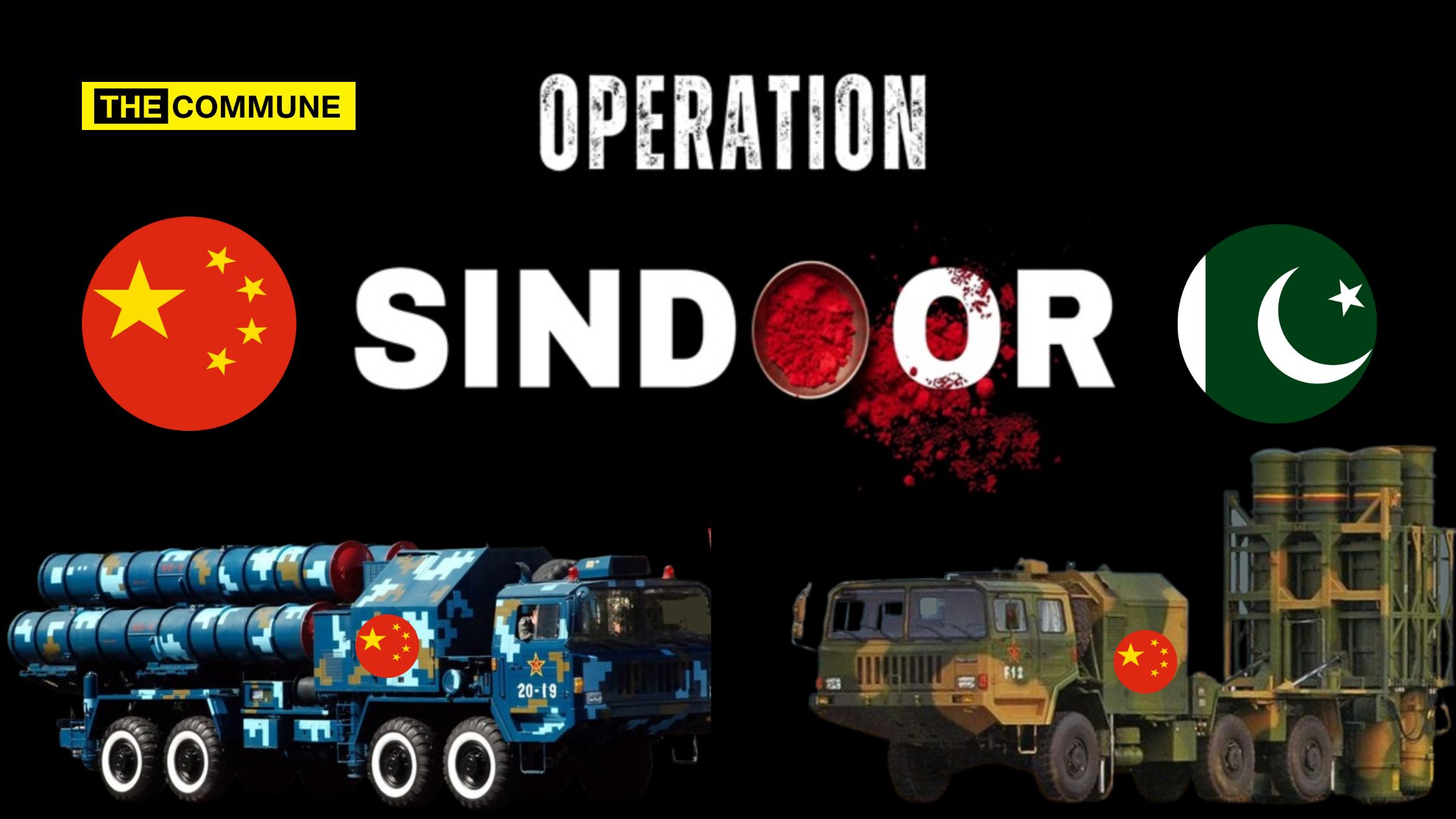
China’s long-standing charade of military dominance, propped up by copycat technology and propaganda, has been thoroughly dismantled—this time not by critics, but by cold, hard battlefield evidence. Pakistan’s boastful reliance on Chinese-supplied air defense systems has been exposed as hollow, as not a single response was recorded during India’s high-precision strikes on terror infrastructure across Pakistan and PoK.

In a game-changing escalation, India executed Operation Sindoor—a targeted strike against nine terror camps—using Rafale jets armed with French-made SCALP cruise missiles. These missiles, known for their ability to fly low and undetected over long distances, punched through Pakistani airspace with zero resistance. Not a single missile was intercepted.

This wasn’t just a tactical victory—it was a brutal exposure of Pakistan’s so-called “cutting-edge” air defense shield, composed of Chinese HQ-9 and LY-80 (HQ-16) systems. These systems, frequently showcased by Islamabad as proof of military modernization, were completely blind to the incoming threat. Modeled after Russia’s S-300, the HQ-9 is advertised as a robust solution against airborne attacks. Yet, when it mattered, it neither detected nor engaged a single missile. The result was operational paralysis—total, humiliating, and deeply revealing.

India didn’t just rely on stealth missiles. Its use of electronic warfare—decoys, jamming, and signal suppression—ensured that Pakistan’s air defense network was effectively silenced before the first impact. Key targets in Bahawalpur, Muridke, Muzaffarabad, and Kotli were wiped out with precision, while China’s billion-dollar tech exports stood powerless and inert.

This failure is not unprecedented. From the 2011 U.S. raid in Abbottabad to India’s 2019 Balakot airstrike, and even a 2022 accidental BrahMos missile incursion, Chinese tech has repeatedly failed to detect or prevent airspace violations. But Operation Sindoor is the most damning chapter yet—a live combat scenario that showcased just how ineffectual Beijing’s military exports really are.

Pakistan’s overreliance on Chinese defense systems now appears not just risky, but dangerously misguided. Despite all the procurement, drills, and upgrades, these systems collapsed under pressure. The HQ-9’s inability to track or respond points to either a detection blackout or an unacceptably slow reaction time—both disastrous in real combat.

Beyond the strategic implications, the aftermath was brutal. While Pakistan officially acknowledged over 50 terrorist fatalities, sources suggest the actual toll could be closer to 90. More damaging, however, was the psychological blow—the realization that Pakistan’s heavily touted defense grid is little more than expensive scrap metal when it counts.

For China, this strike is a blow to its reputation as a global arms exporter. For Pakistan, it’s a sobering reminder that military deals and parade displays offer no real protection. And for India, Operation Sindoor proves its emerging edge in 21st-century warfare—combining precision, stealth, and psychological dominance.

India didn’t just demolish terror camps. It shattered illusions—about Chinese military credibility, Pakistan’s preparedness, and who truly controls the strategic advantage in South Asia.

Because in real warfare, names, labels, and propaganda mean nothing. What matters is whether your systems work when your enemy is already at your doorstep. This time, “Made in China” stood for failure—and the world took note.

(With Inputs From OpIndia)

Subscribe to our channels on TelegramWhatsApp, and Instagram and get the best stories of the day delivered to you personally.

SRM Asst Professor Suspended For Anti-India Remarks On Social Media Amid Operation Sindoor

srmist professor suspended operation sindoor

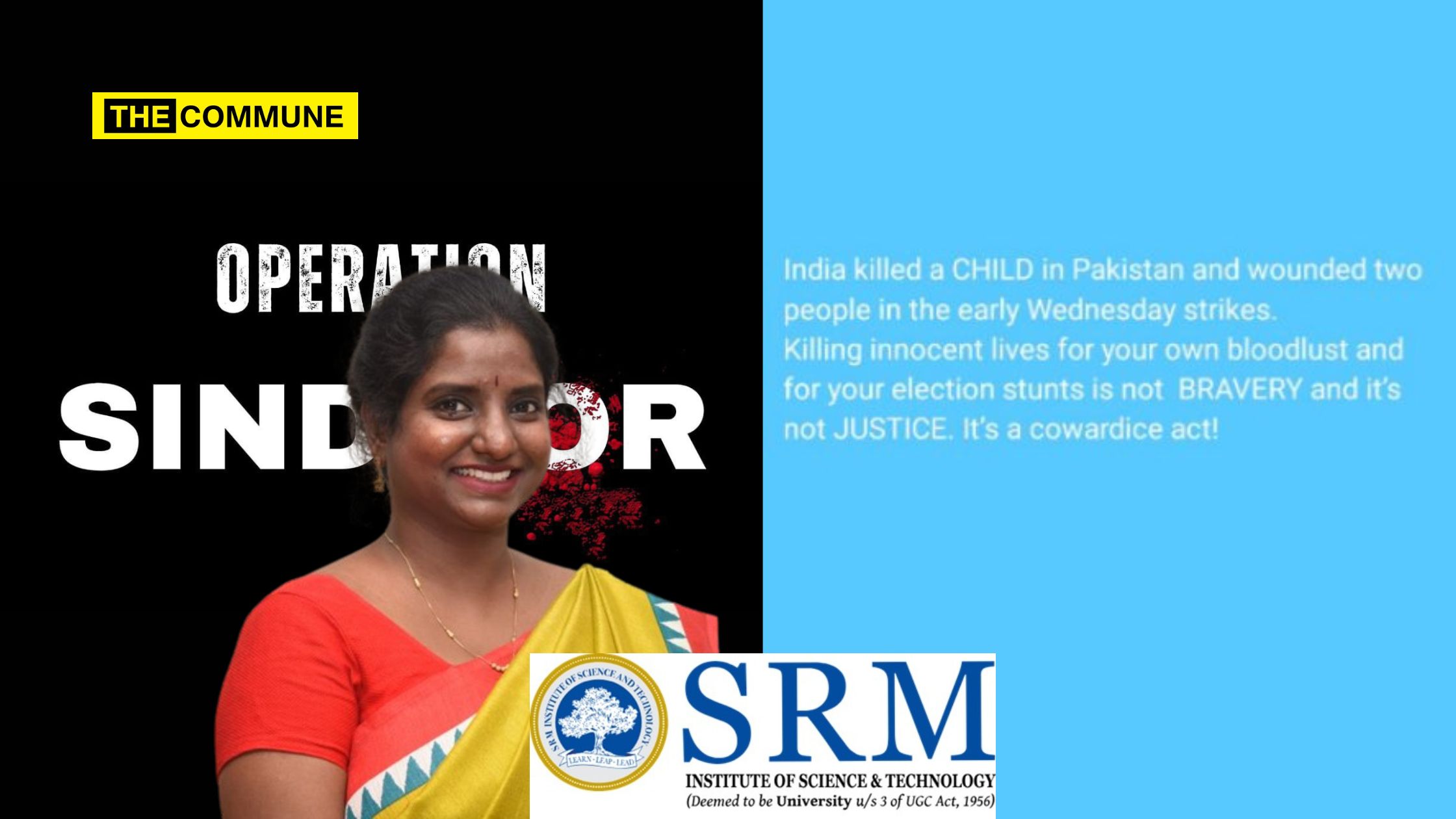
In a swift and decisive move, the SRM Institute of Science and Technology (SRMIST) has suspended Assistant Professor S. Lora following outrage over her alleged anti-India comments posted on social media. The action was taken after students and faculty members reported her controversial WhatsApp status that criticized the Indian Army and questioned the nation’s military operations.

According to screenshots circulated widely online, Lora had written, “India killed a CHILD in Pakistan and wounded two people in the early Wednesday strikes. Killing innocent lives for your own bloodlust and for your election stunts is not BRAVERY and it’s not JUSTICE. It’s a cowardice act!”

The message sparked intense backlash from students, parents, and social media users who accused her of spreading misinformation and insulting the Indian Armed Forces. The incident coincides with the aftermath of India’s military operation “Sindoor”, a high-precision strike targeting terrorist camps in Pakistan and Pakistan-occupied Kashmir, which the government has stated was aimed solely at non-civilian terror infrastructure.

Following internal complaints, SRMIST promptly issued a suspension order dated 8 May 2025. The official memo, signed by Registrar Dr. S. Ponnusamy, stated, “Since Ms. Lora S [ID. 102302], Assistant Professor, Directorate of Career Centre, SRM Institute of Science and Technology, Kattankulathur campus has involved in unethical activities, she is placed under suspension with immediate effect, pending enquiry.”

Lora, who has been associated with SRM for over 11 years, was part of the Career Development Centre, where she taught Communication English, Verbal Aptitude, and Personality Development.

The institute has confirmed that an internal enquiry will now be conducted to assess the matter further. The suspension is currently in effect, and Lora will remain off duty until the investigation concludes.

Subscribe to our channels on Telegram, WhatsApp, and Instagram and get the best stories of the day delivered to you personally.

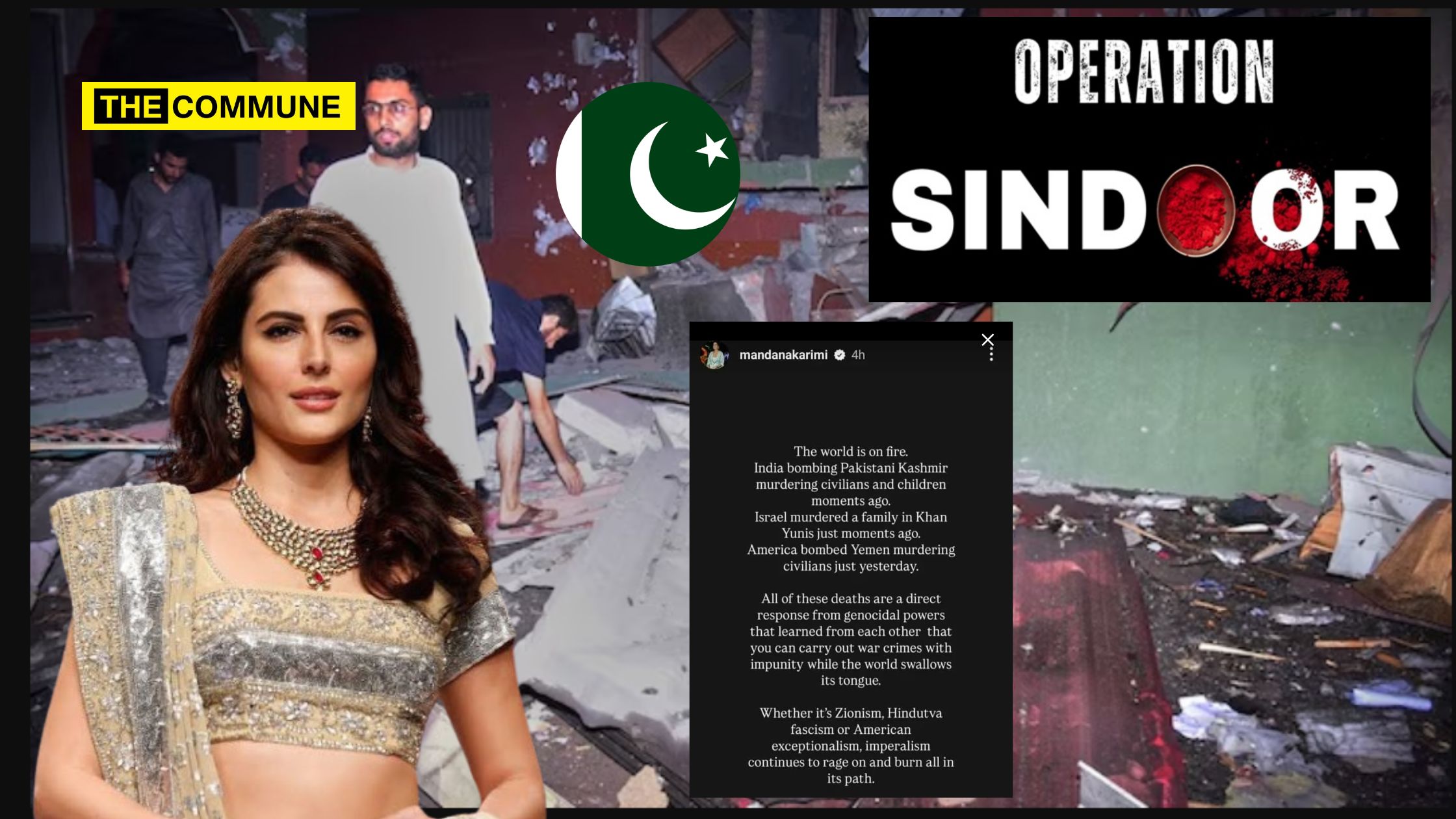
Iranian Actress Mandana Karimi Calls India’s Anti-Terror Strike As Genocidal, Faces Backlash, Posts Clarification & Deletes It

mandana karimi hindutva fascism operation sindoor

In moments of national crisis, India’s unity is often tested—and in that process, those harboring divisive or hostile sentiments are inevitably exposed. One such recent example is actress Mandana Karimi, who hails from Iran but built her career in India’s entertainment industry, featuring in projects like Anil Kapoor’s Thar. Having found in India the professional freedom denied under Iran’s conservative regime, Karimi was once appreciated by Indian audiences. That goodwill, however, appears to have been misplaced.

Following India’s pre-dawn retaliatory strike targeting terror camps in Pakistan, Karimi took to Instagram Stories to express outrage not against terrorism, but against India. In a now-deleted post, captured and circulated by social media users, she accused India of bombing “Pakistani Kashmir” and “murdering civilians and children.” She grouped India with the U.S. and Israel, writing, “The world is on fire… All of these deaths are a direct response from genocidal powers… Whether it’s Zionism, Hindutva fascism, or American exceptionalism, imperialism continues to rage on.”

Her full post read, “The world is on fire. India bombing Pakistani Kashmir murdering civilians and children moments ago. Israel murdered a family in Khan Yunis just moments ago. America bombed Yemen murdering civilians just yesterday. All of these deaths are a direct response from genocidal powers that learned from each other that you can carry out war crimes with impunity while the world swallows its tongue. Whether it’s Zionism, Hindutva fascism or American exceptionalism, imperalism continues to rage on and burn all in its path.”

These comments stood in stark contrast to India’s official position and evidence, which clearly stated that the operation targeted only terrorist infrastructure in Pakistan and Pakistan-occupied Kashmir (PoK). The situation took a more damning turn when Masood Azhar—an internationally recognized terrorist—confirmed that members of his own family were killed in the Indian strike, reinforcing that it was indeed a counter-terror operation, not an attack on civilians.

Amidst this, Karimi’s comments have sparked widespread backlash. Many netizens have called for her deportation, labelling her views anti-India. “Get out of India!” one user wrote. Another demanded, “Her visa should be revoked. We don’t need such people maligning our country from within.”

Posts Clarification Following Backlash, Deletes It

Amid mounting criticism on social media, Karimi returned to Instagram to issue a clarifying note. Responding to the backlash she received for her previous comments—or lack thereof—on a sensitive issue, Karimi defended her stance, insisting that her message had been misinterpreted.

In her post, Karimi stated that her original intent was a “call for peace” rather than any form of political statement or condemnation.

“Let me say this loud and clear: I’ve lived in India for 16 years. I’ve worked hard, adapted, contributed, and made this place my home—with love, effort, and respect. And yes, I’ve had the most incredible friends and people here who made me feel like I belong. But then there’s the other side—the small-minded, toxic corner that will always see me as an outsider, no matter what I do. Here’s the thing: I’ve always been open, vocal, and woke. But if I choose not to speak about something, not to post about something—that’s also my right. It’s a human right. You don’t get to tell me when to speak, what to say, or how to feel. That’s not how it works.”

She further reiterated her respect and admiration for India, emphasizing the bond she has developed with the country over the years.

“And now, let’s talk facts. I’m proud of India. I’m proud of how far this country has come. I have deep respect for the Indian government—for what it’s done to protect its borders, grow its economy, and stand tall on the global stage. This country has given me space, purpose, and pride. And instead of standing together in that spirit, some people just want to tear down, hate, and harass.”
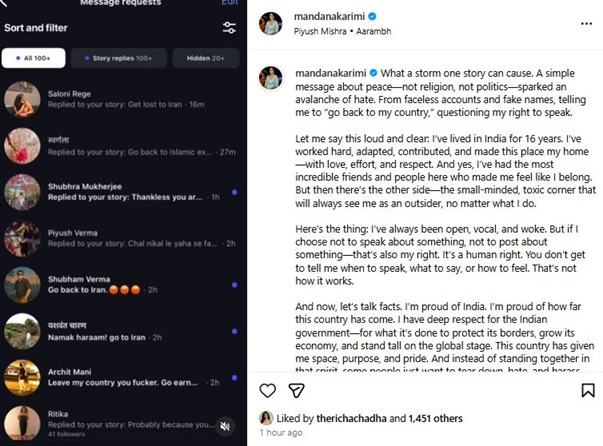

Despite her efforts to clarify her position, the follow-up post has since been removed from her Instagram feed.

Operation Sindoor

India’s ‘Operation Sindoor’, launched after the Pahalgam terror attack that killed 26 people, saw the military targeting nine identified terror bases across PoK. It was a precise, tri-services retaliation involving the Army, Navy, and Air Force. Pakistan, unprepared for such a swift and coordinated response, scrambled jets in a dogfight that became one of the most prolonged air confrontations between the two nations. Despite Islamabad’s claims of downing five Indian jets, New Delhi has not responded, choosing instead to focus on facts and outcomes.

Interestingly, Karimi’s home country, Iran, had earlier expressed willingness to mediate peace between India and Pakistan—yet its own citizen, benefiting from India’s freedoms, chose to defame the very nation that gave her a platform.

While many celebrities have lauded the Indian Armed Forces and shown solidarity with the nation’s stand against terror, Karimi’s outburst stands as a glaring exception—one that many believe reveals where her true loyalties lie.

Subscribe to our channels on TelegramWhatsApp, and Instagram and get the best stories of the day delivered to you personally.