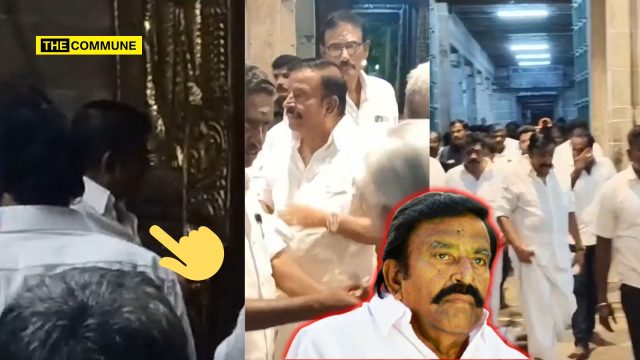
Even as the Enforcement Directorate’s (ED) 232-page dossier alleging a large-scale “cash-for-jobs” scam in the Municipal Administration and Water Supply (MAWS) Department continues to stir political controversy, Tamil Nadu Minister KN Nehru on Tuesday, 4 November 2025, visited the historic Sattainathar Swami Temple in Sirkazhi for darshan.
Nehru, accompanied by Minister for Backward Classes Welfare Siva Meyyanathan, offered prayers at the shrines of Brahmapureeswarar Swami, Thayyal Nayaki Ambal, Sattanathar Swami, and Thoniyappar. Temple authorities welcomed the ministers with garlands, prasad, and portraits of the deities.
During the visit, devotees raised civic grievances, particularly the lack of toilet facilities for pilgrims visiting the Sirkazhi Muthanathar temple from other districts and states. They also complained about garbage accumulation and sanitation issues in several parts of the town.
Responding on the spot, Minister Nehru reportedly instructed municipal administrative officers to set up public toilets and ensure that garbage removal was carried out on a daily basis.
The visit drew attention as it came just days after the ED submitted its detailed dossier to the Tamil Nadu Director General of Police (DGP) under Section 66(2) of the Prevention of Money Laundering Act (PMLA), urging a police investigation into alleged recruitment irregularities within Nehru’s department.
According to the ED, the alleged scam involved bribes of ₹25–35 lakh collected from job aspirants seeking government posts, purportedly facilitated by Nehru’s brothers and close associates.
Meanwhile, Nehru has dismissed the allegations as “politically motivated,” claiming the agency was attempting to malign the Dravidian Model government.
The temple visit also saw the presence of local MLAs Nivedayam Murugan and M. Panneerselvam, former MLA Kuthala Manpazhagan, regional administrators, and civic officials. The ministers were later honored by representatives of the All India Forward Bloc Party.
For a party that prides itself on the rationalist ideals of EVR, Minister KN Nehru’s temple visit — right in the midst of a corruption scandal — exposes the growing contradictions within the DMK’s so-called “Dravidian Model.” As the ED tightens its probe into the alleged ₹35-lakh-per-job racket, Nehru’s sudden turn to temple rituals suggests that even within the ranks of Tamil Nadu’s ruling party, ideology conveniently takes a backseat when political survival is at stake.
Subscribe to our channels on WhatsApp, Telegram,Instagram and YouTube to get the best stories of the day delivered to you personally.
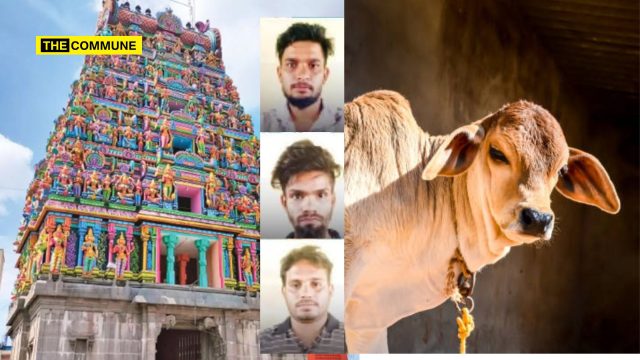
Police have arrested three individuals for allegedly stealing a cow that had been left as an offering at the historic Kottai Mariamman Temple in Salem and selling it to a meat shop.
According to police sources, Suman (52), an auto driver from Johnsonpet, had dedicated the bull he had raised to the goddess at the temple during last year’s Aadi Thiruvizha festival after a vow he made was fulfilled. Since then, he had been visiting the temple every two days to feed the animal.
On 4 October 2025, when Suman arrived to feed the cow, he was shocked to find it missing. Following his complaint, the Salem Town Police registered a case and began an investigation.
A special team led by Town Assistant Commissioner Harishankari reviewed CCTV footage from the temple premises, which showed three men stealing the cow. Acting on this lead, police traced the suspects to Kichipalayam and arrested them. The accused were identified as Dharmesh Moideen (26) of Kalam Nagar, Alauddin (27) of Ashok Nagar, and Salim (28) of Tippu Nagar, Ponnammapet.
குற்றவாளிகளின் பெயர்கள்,
மா பாஷா மகன் அலாவுதீன்,
கிச்சிப்பாளையத்தை சேர்ந்த மொய்தீன் மகன் தர்மேஷ் மைதீன்,
Preliminary inquiries revealed that the stolen cow had been sold to a local meat shop. Police are investigating whether the trio was involved in similar thefts in the area.
Meanwhile, members of the BJP’s Salem District Spirituality and Temple Development Unit lodged a formal complaint demanding strict action, alleging a broader pattern of cows left at temples being sold for slaughter.
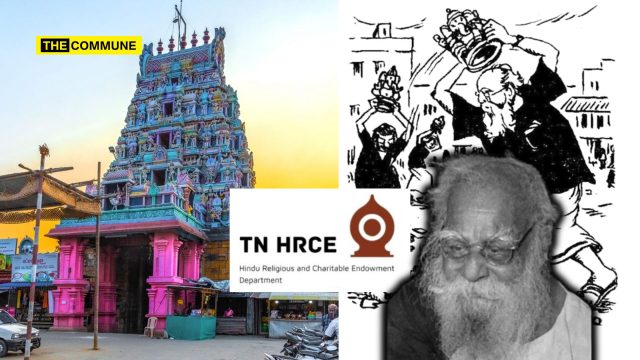
A recruitment interview conducted by the Hindu Religious and Charitable Endowments (HR&CE) Department at the Perur Pateeswarar Temple has triggered widespread outrage among devotees after candidates were asked questions about EV Ramasamy Naicker also known as “Periyar” to his followers known for his Hindu hatred.
The interviews, held yesterday to fill several vacant posts at the ancient Saivite shrine, included questions such as, “What do you know about EVR?” “Which of EVR’s quotes inspired you the most?” and “What has the Dravidian Model government contributed to spirituality in Tamil Nadu?”
The Perur Pateeswarar Temple, also known as Melai Chidambaram, is one of Tamil Nadu’s most revered Saivite temples, praised in the hymns of the four great saints – Gnanasambandar, Appar, Sundarar, and Manickavachakar. The recruitment drive sought to fill six positions: two junior assistants, one record clerk, one ticket vendor, and two sanitation workers.
According to officials, around 375 candidates attended the interview, which was conducted by the temple’s assistant commissioner and officers of equivalent rank from the HR&CE Department.
Several candidates who attended expressed shock at the line of questioning. Many said they had expected to be asked about temple customs, Saivite traditions, or administrative responsibilities, not about Periyar, who had openly rejected religious worship.
“What connection does spirituality have with EVR? How can they ask about someone who said there is no God, when we’ve come for temple jobs?” one interviewee remarked after the session.
The incident has drawn sharp criticism from devotees and Hindu organizations, who condemned the HR&CE Department’s approach as “disrespectful to faith” and “irrelevant to temple service.”
With the 2026 Tamil Nadu Assembly elections approaching, senior Congress leaders have renewed their demand for more seats and a share in power within the DMK-led alliance.
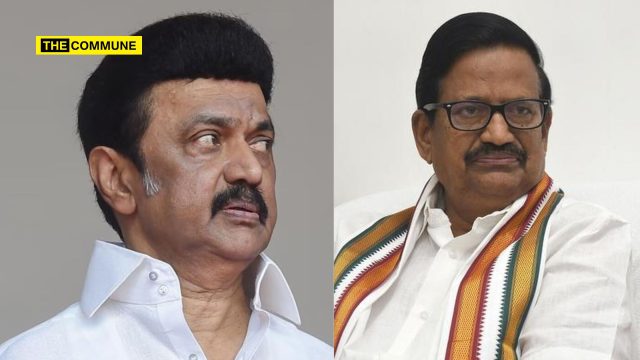
Former Tamil Nadu Congress Committee (TNCC) president K. S. Alagiri has called for a “rightful share in governance” for the Congress party within the DMK-led alliance, asserting that the current coalition arrangement is detrimental to the party’s growth and dignity.
In an interview with The Hindu Tamil, Alagiri said the Congress had made repeated sacrifices for the alliance and that it was time to “change this coalition philosophy.” He noted that the party, which once contested 110 assembly seats, is now limited to 25 under the DMK alliance. “This shows that the existing formula is not working for us,” he said, emphasizing that the demand for a share in power was “essential for the survival and dignity” of the Congress.
Alagiri clarified that his criticism was not directed at Chief Minister MK Stalin or the DMK leadership. “Among the current alliances, we consider the DMK under the leadership of Stalin to be a fair ally. That is precisely why we are putting forth this demand,” he said.
When asked about possible repercussions if the DMK rejected the demand, Alagiri expressed confidence that the party’s national leadership would support his position. Recalling an earlier dispute during his tenure as TNCC president over seat allocations in local body elections, he said the then Congress president Sonia Gandhi had upheld his stand after hearing his reasoning.
Alagiri said he had refused to retract a statement accusing the DMK of “violating alliance ethics” after the Congress was allotted only two union councils, while smaller parties were given more. “When I met Sonia Gandhi, I explained the situation, and she said, ‘What Alagiri says is right. Then why are you troubling him?’” he recalled.
Despite his criticism of the current power-sharing arrangement, Alagiri dismissed talk of regime change in Tamil Nadu. He said the present DMK government was functioning efficiently and that Chief Minister Stalin’s administration was “policy-driven and sincere.” “It is our duty—and everyone’s duty—to strengthen his hands,” he added.
Reflecting on the Congress’s long-term aspirations, Alagiri said a “Kamaraj-style government” could emerge in Tamil Nadu only if Congress leaders and cadres aimed beyond individual electoral success. “If Congress workers believe it is enough to become MLAs or MPs, a Kamaraj-style government can never be achieved. The goal should be for a Congressman to become the Chief Minister of Tamil Nadu,” he said.
He added that the Congress has the capacity to rebuild itself in the state through hard work and unity but acknowledged that “the time for it has not yet arrived.”
In September 2025, Alagiri said it was the Congress’s right to seek more Assembly seats and a share in power within the DMK alliance ahead of the 2026 polls. Rejecting speculation of a rift, he called the DMK a “friend” and said Congress only sought fair representation. His remarks followed AIADMK leader Edappadi K. Palaniswami’s criticism of TNCC chief K. Selvaperunthagai for being “more loyal to the DMK than Congress.” Selvaperunthagai hit back, accusing Palaniswami of hypocrisy for allying with the BJP and recalled earlier DMK jibes about Palaniswami “crawling” to secure power under V. K. Sasikala.
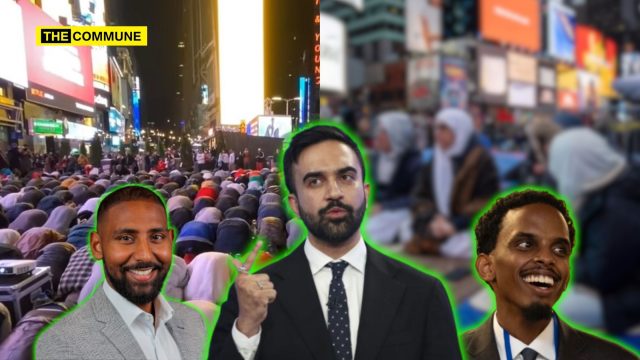
And the day has come when New York City has voted in a radical Islamo-leftist candidate Zohran Mamdani as their Mayor.
Zohran Kwame Mamdani, a self-proclaimed democratic socialist and member of the Democratic Socialists of America (DSA), has been elected mayor of New York City, becoming the first Muslim, first Indian-origin, and first African-born leader of America’s largest city.
The 34-year-old Mamdani defeated Republican Curtis Sliwa by a wide margin, capping a dramatic rise for the former state legislator from Queens. His campaign centred on taxing the rich, mandating halal food in schools, making public transport free to ‘reduce crime’ seemed to resonate strongly with the ‘community’ in NYC. The election saw the city’s highest turnout in more than five decades, with over two million ballots cast, according to the New York City Board of Elections. This huge turnout seems to be the outcome of CAIR leader Nihad Awad’s call to come out in large numbers to vote and support their candidate during elections.
Let us not forget: A radical faction within the DSA group, the DSA Liberation Caucus, recently came under national scrutiny after joining a campaign to free Elias Rodriguez – the man accused of murdering two Israeli embassy staffers in Washington, D.C., in what federal authorities described as a terrorist attack.
Zohran Mamdani’s anti-Hindu and antisemitic history is known to all – He previously led demonstrations against the construction of the Ram Mandir in Ayodhya, India, where protesters shouted anti-Hindu slurs — remarks he never publicly condemned. He has also been photographed alongside Khalistani separatists during rallies that critics described as hostile to Indian interests.
To secure all Hindu votes, Mamdani even did temple runs in Queens, where he spoke about ‘pluralism and inclusivity’. However, opponents accused him of hypocrisy, citing his earlier participation in protests that vilified Hindu symbols and practices.
Mamdani has also been criticized for his refusal to condemn the slogan “globalize the intifada,” which appeared at several rallies he attended. His campaign reportedly received financial backing from groups such as the Council on American-Islamic Relations (CAIR), which has been accused of past links to extremist funding networks.
Zohran Mamdani’s campaign was supported by organizations including the Indian American Muslim Council (IAMC) and Hindus for Human Rights (HfHR), both accused by analysts of ties to Pakistan-backed lobbying efforts and banned extremist movements such as Jamaat-e-Islami. Mamdani has not addressed these allegations directly but has emphasized his commitment to representing all communities in New York.
From glorifying Hamas and denigrating India to pushing anti-Israel resolutions, New York legislator Zohran Mamdani embodies the dangerous nexus of left-wing extremism and Islamist propaganda—heavily bankrolled by global “philanthropic” networks.
The son of acclaimed filmmaker Mira Nair and Ugandan academic Mahmood Mamdani, Zohran has long leveraged his privileged background to push divisive identity politics under the garb of “solidarity.”
Mahmood Mamdani, a professor at Columbia University argued for a controversial reframing of suicide bombers, stating they should be seen as soldiers rather than barbarians in the aftermath of the 9/11 Twin Tower terror attack. Mamdani even appeared to evade a question about Sharia law during a public interaction.
His record in the New York State Assembly and beyond exposes a pattern—relentless attacks on India, Hindus, and Israel, echoing talking points crafted by global left-Islamist lobbies.
Mamdani has received significant backing from advocacy groups linked to Islamist organizations and pro-Hamas outfits.
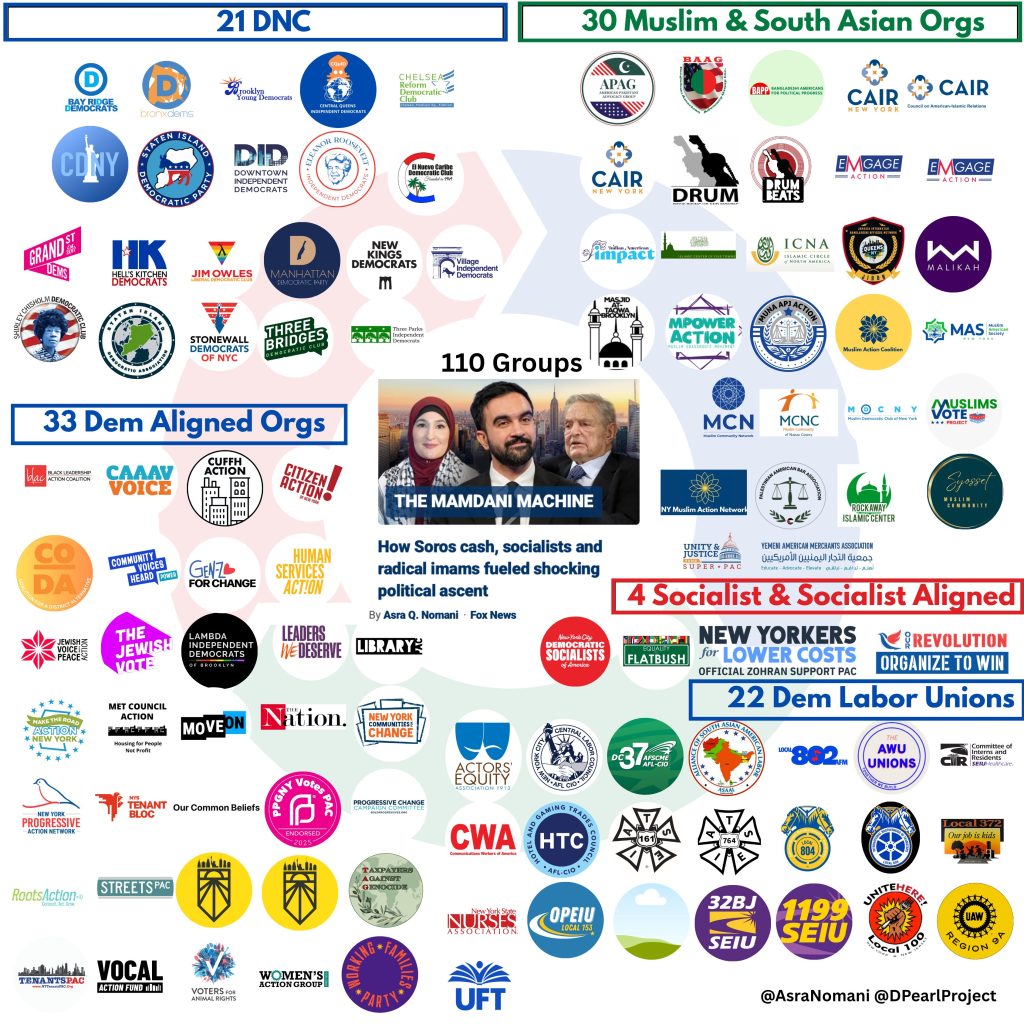
A groundbreaking Fox News investigation by Asra Nomani, in collaboration with the Daniel Pearl Project, has shed light on the sprawling coalition and funding behind Zohran Mamdani’s campaign to become New York City’s next mayor.
Groups such as ICNA, prohibited in India and Russia for their ties to terrorist organizations, and CAIR, previously named in terrorism financing investigations, have been integral parts of the campaign’s network. Donations from the Unity & Justice Fund and coordinated actions by members of Jamaat-e-Islami and other global Muslim entities underscore the campaign’s far-reaching terror connections.
The Council on American‑Islamic Relations (CAIR) and its super-PAC arm Unity & Justice Fund are reported to have funneled substantial funds into a PAC supporting Mamdani’s campaign. One report cites a $25,000 gift on May 30 and a further $75,000 on June 16, 2025. Another source places the figure at about $100,000 in total. In addition, the US Campaign for Palestinian Rights Action (USCPR Action) publicly endorsed his campaign in September 2025 — their first-ever candidate endorsement.
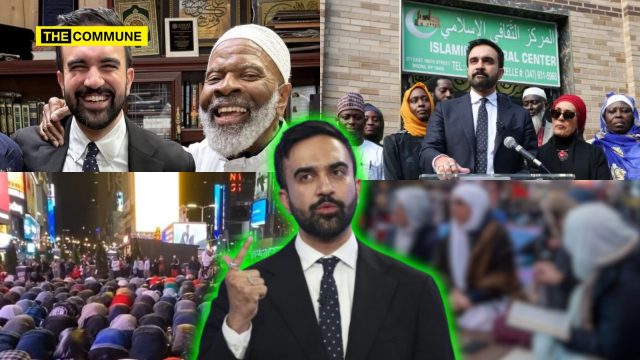
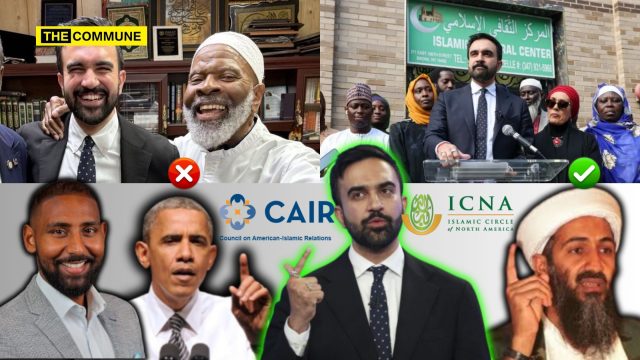
He was seen with an Imam, who has historical ties as an unindicted co-conspirator in the 1993 World Trade Center bombing.
In 2023, the New York State Assembly passed a controversial bill aimed at stopping tax-exempt donations from state-registered charities that funded Israeli settlements in the occupied West Bank – activities widely regarded as violations of international law.
The legislation, titled “Not on Our Dime!: Ending New York Funding of Israeli Settler Violence Act,” was introduced by the then-Assembly member Zohran Mamdani in May 2023. It sought to prohibit not-for-profit corporations registered in New York from using charitable funds to support organisations linked to Israeli settlement expansion or violence against Palestinians in the occupied territories.
Mahmood Mamdani, a professor at Columbia University and father of New York mayoral candidate and Islamist terror supporter Zohran Mamdani, argued for a controversial reframing of suicide bombers, stating they should be seen as soldiers rather than barbarians in the aftermath of the 9/11 Twin Tower terror attack. Mamdani even appeared to evade a question about Sharia law during a public interaction.
The Democratic Socialists of America (DSA), the organization backing mayoral frontrunner Zohran Mamdani, is facing a severe public condemnation just as the NYC mayoral polls come closer and the information that a radical faction within its ranks openly praised and launched a campaign to free Elias Rodriguez, the man accused of murdering two Israeli embassy staffers in a terror attack in Washington, D.C.
And just like that, like London, New York has also fallen.
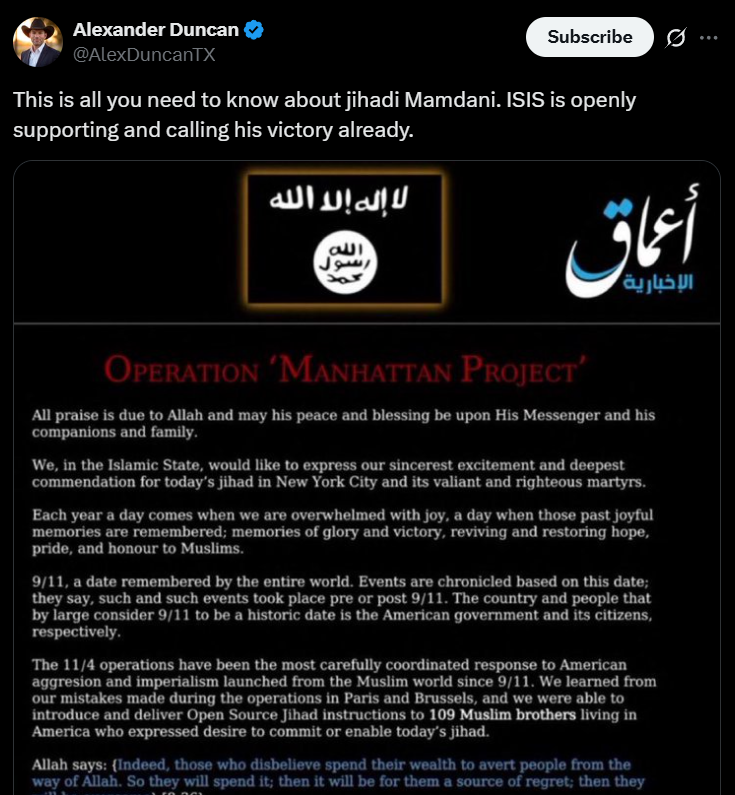
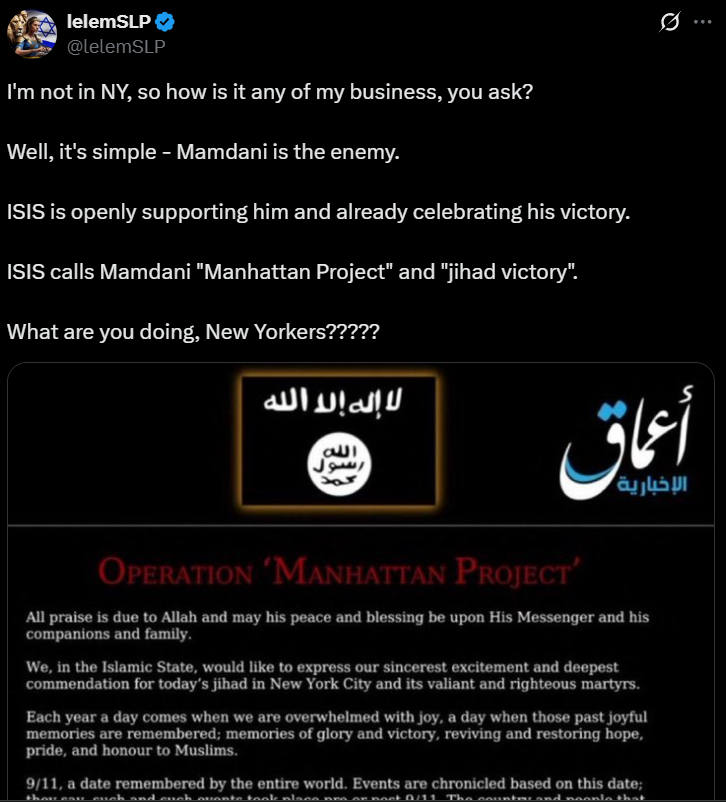
Netizens on social media showed shared pictures of ISIS note welcoming Mamdani’s election as Mayor of New York
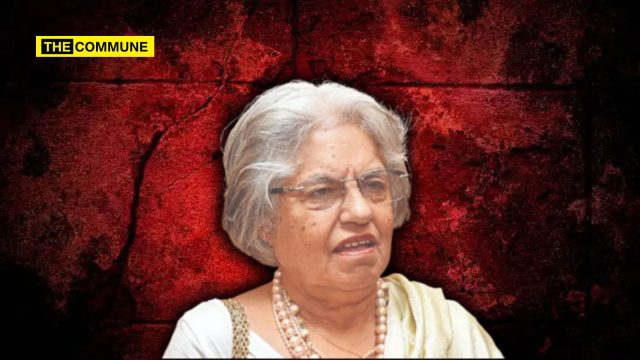
Senior Advocate Indira Jaising, a prominent figure in Indian jurisprudence, has often been at the center of significant legal and political debates. From her stances on constitutional principles to her comments on high-profile cases and her NGO’s legal troubles, her career has been marked by both acclaim and contention.
This report compiles 12 such controversial episodes between 2016 and 2025, highlighting the polarizing nature of her public interventions and the consistent backlash they have triggered from various quarters, including the government, legal bodies, and political commentators.
#1 Call to Lower the Age of Consent Sparks Backlash – July 2025
Senior Advocate Indira Jaising urged the Supreme Court to lower the age of sexual consent from 18 to 16 years, arguing that criminalizing consensual teenage relationships under POCSO drives them underground. She advocated for a “close-in-age” exception, linking sexual autonomy to constitutional rights. This position triggered widespread criticism from child rights activists and others who contended that such a move would dangerously expose minors to exploitation and coercion, undermining the protective intent of the POCSO Act in a society where manipulation of young girls remains a serious concern.
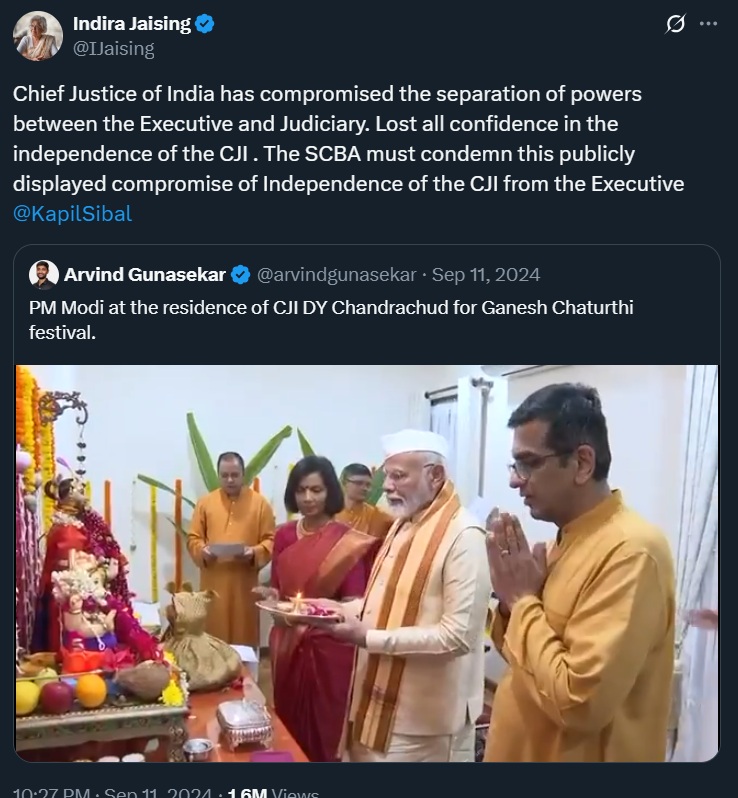
#2 Remarks on CJI After PM’s Ganesh Puja Visit – September 2024
Indira Jaising sparked a controversy after the Prime Minister attended a Ganesh Puja at the residence of Chief Justice of India D.Y. Chandrachud. Taking to social media platform X, she stated that the CJI had “compromised the separation of powers” between the executive and judiciary, adding that she had “lost all confidence” in his independence.
Her remarks were criticized by many in the legal fraternity who saw the visit as a customary cultural event and accused Jaising of unnecessarily politicizing and undermining the judiciary’s integrity.
#3 If Ram is the Idea of Bharat, Then You Don’t Need Judiciary – May 2024
At a legal conference, Indira Jaising reacted to a statement that “Ram is the idea of Bharat” by asserting that for her, the Constitution is the idea of India. She further stated, “If Ram is the idea of Bharat, then you don’t need a judiciary; you can go back to the days of divine justice.” This comment was perceived by critics as a dismissive take on cultural faith and its coexistence with constitutional governance, leading to accusations of her belittling a majoritarian spiritual sentiment.
#4 Argument on CAA and Voting Rights in Supreme Court – March 2024
During a Supreme Court hearing on the Citizenship Amendment Act (CAA), Indira Jaising argued that the law would affect Indian minorities. She contended that granting citizenship to persecuted non-Muslim migrants from neighboring countries was a concern because “they will get voting rights… that is how it will affect them [minorities].” This argument was widely circulated and critiqued, with opponents alleging it framed the grant of citizenship to persecuted communities as a majoritarian threat rather than a humanitarian act.
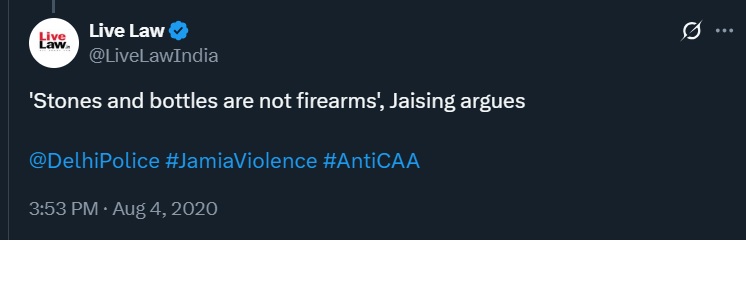
#5 Defence of Jamia Students, Downplays Violence – August 2020
Representing students in the Delhi High Court concerning police action during anti-CAA protests at Jamia Millia Islamia, Indira Jaising sought an inquiry into “police brutality.” She argued that the police used excessive force, stating that “stones and bottles are not firearms” and were not a justification for the deployment of riot control equipment.
Critics accused her of downplaying the violence directed at police and justifying mob aggression under the guise of legal defense.
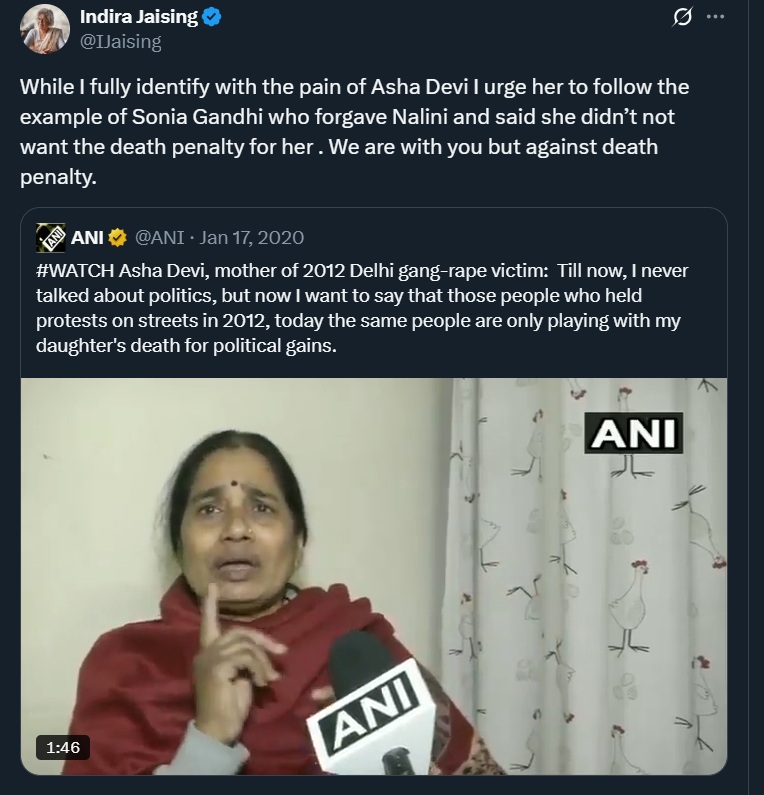
#6 Urges Nirbhaya’s Mother to Forgive Convicts – January 2020
In a tweet that provoked national outrage, Indira Jaising urged Asha Devi, the mother of the 2012 Nirbhaya gang-rape and murder victim, to forgive the convicts and oppose the death penalty. Citing Sonia Gandhi’s forgiveness of her husband Rajiv Gandhi’s assassin, Jaising stated, “We are with you but against the death penalty.”
The comment was widely condemned as insensitive and presumptuous, for imposing an activist’s ideological stance on a grieving mother seeking closure through the judicial process.
#7 CBI Raids on Home and NGO Over FCRA Violations – July 2019
The Central Bureau of Investigation (CBI) conducted raids at the residences and offices of Indira Jaising and her husband Anand Grover, founders of the NGO Lawyers Collective. The action was based on a complaint from the Ministry of Home Affairs alleging violations of the Foreign Contribution Regulation Act (FCRA), citing the misuse of foreign contributions exceeding ₹32 crore between 2006 and 2015. The ministry also alleged that Jaising received remuneration from foreign funds while serving as Additional Solicitor General, without due permission.
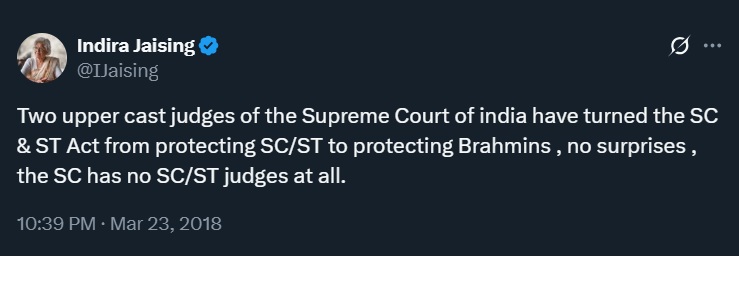
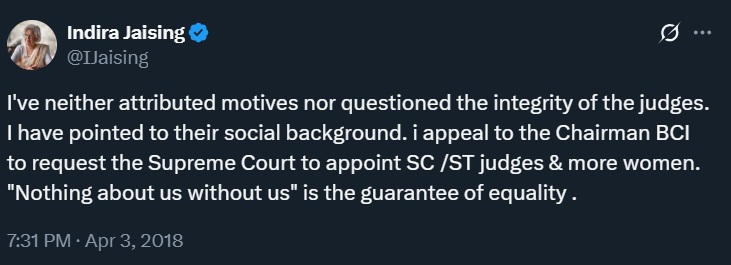
#8 Bar Council Slams ‘Derogatory’ Tweet on SC Judges – April 2018
The Bar Council of India (BCI) condemned Indira Jaising for a tweet posted on 23 March 2018, in which she stated, “Two upper caste judges… have turned the SC & ST Act from protecting SC/ST to protecting Brahmins.”
The BCI demanded she withdraw the “derogatory” remarks, which they said questioned the judiciary’s integrity. Jaising defended her comment as highlighting the lack of SC/ST representation in the Supreme Court, but refused to delete the tweet, sustaining the controversy.
#9 Legal Fees from Banned Outfit PFI in Hadiya Case – March 2018
Investigations revealed that the banned organization Popular Front of India (PFI) spent nearly ₹1 crore on legal expenses for the ‘Hadiya case’ in the Supreme Court. Out of this, approximately ₹93 lakh was paid to four senior lawyers, including Indira Jaising, who represented Shafin Jahan, the husband of the woman at the center of the case. The disclosure linked Jaising to payments from an organization later outlawed for alleged terror activities, drawing significant criticism and raising questions about the funding sources for legal advocacy.
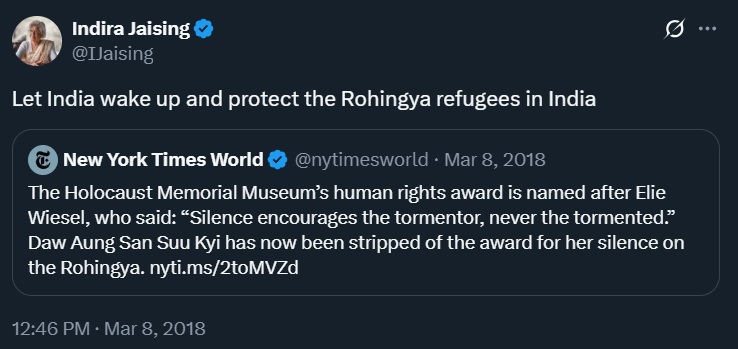
#10 Support for Rohingya Refugees and UN Appointment – March 2018
Indira Jaising voiced strong support for Rohingya refugees in India, tweeting, “Let India wake up and protect the Rohingya refugees.”
This stance aligned with her earlier appointment in May 2017 by the United Nations to chair a fact-finding mission to investigate alleged atrocities by Myanmar security forces against the Rohingya community. While lauded by human rights groups, her position was contentious in India, where the government has expressed security concerns regarding illegal immigration.
#11 NGO’s FCRA Licence Permanently Cancelled – December 2016
The Union government permanently cancelled the FCRA licence of the Lawyers’ Collective, the NGO run by Indira Jaising and her husband Anand Grover. The Home Ministry cited violations, including the use of foreign funds for activities with “political overtones” such as rallies and dharnas. A key allegation was that Jaising received foreign contributions as remuneration while serving as Additional Solicitor General (2009-2014), which was a violation of service rules as the post is a government office.
#12 NGO Linked to George Soros Funding – June 2016
Intelligence reports indicated that Indira Jaising’s NGO, Lawyers Collective, was among the recipients of funds from American donors, including the George Soros-linked Open Society Foundations, which were placed on a government ‘watchlist’. These donors were reportedly funding unregistered Indian NGOs and were described in reports as “controversial” and known for promoting “regime change.” This association placed Jaising’s organization under heightened scrutiny for its sources of foreign funding and the nature of its activities.
Subscribe to our channels on WhatsApp, Telegram,Instagram and YouTube to get the best stories of the day delivered to you personally.
We have been noticing a few names in the news especially from the United States of America, running for the mayoral position. Most prominent among them is Zohran Mamdani. We are also seeing a few more gaining prominence – Omar Fateh and Mussab Ali, and they will make the headlines more often after Mamdani is named NYC Mayor.
Where and how did these people come into the picture from – all three of them have a few things in common – primarily, all three of them are Muslims, they are children of immigrants and all three are ‘Democratic Socialists’.
While Mamdani and Ali are naturalised American citizens, Fateh is an American by birth.
For people from such backgrounds, one would need immense amount of funds to gain public visibility and then acceptance. One wonders why Vivek Ramaswamy could not gain as much attention as the trio – was it the money, was it because he was Hindu, well, let’s analyse this in detail.
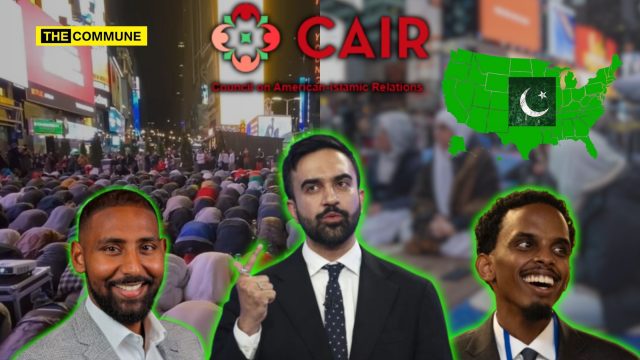
This report is based on the extensive research done by Amy Mek, founder of RAIR Foundation and it details a multi-decade, multi-tiered strategy being executed by the Council on American-Islamic Relations (CAIR) and its leadership to embed Islamic political influence within the United States’ governing, legal, and cultural institutions.
Evidence, drawn from public statements by CAIR leaders, reveals a coordinated plan utilizing tax-exempt religious infrastructure, sophisticated political financing, and a generational “pipeline” to produce a new class of journalists, lawyers, and politicians loyal to a specific ideological project.
A New York Post investigation found that the Council on American-Islamic Relations (CAIR), via its “Unity & Justice Fund,” directed $100,000 to Mamdani’s campaign. CAIR was named an unindicted co-conspirator in the 2007 Holy Land Foundation terrorism financing trial, where five leaders were convicted of funneling over $12 million to Hamas.
The recent mayoral campaign of Zohran Mamdani in New York City is not an isolated event but a proof-of-concept for this larger, long-term operation aimed at fundamentally reshaping American society and governance by the year 2050.
The Political Vanguard: Proof of Concept in American Cities
The first visible manifestation of this strategy is the rise of a new class of political candidates who blend democratic socialist policies with a base of support mobilized through Muslim-American identity politics.
The Trio of Test Cases:
Zohran Mamdani (New York City): The Democratic nominee for Mayor of NYC, Mamdani has been hailed as the “real Obama” by supporters like Jersey City candidate Mussab Ali. His platform includes mandatory Halal food in public schools and fare-free transit. Crucially, his campaign has been financially propelled by CAIR’s political machinery.
Mussab Ali (Jersey City): A former Jersey City School Board President, Ali laid the local groundwork by instituting Eid holidays, halal lunches, and Islamic dress code accommodations within the public school system. His mayoral campaign is endorsed by Congresswoman Ilhan Omar, linking him to a national network.
Omar Fateh (Minneapolis): A state senator running for Mayor of Minneapolis, Fateh has pledged to sever all cooperation between the city’s police and federal immigration authorities (ICE), stating, “Under no circumstance should MPD ever collaborate with ICE, not for escorts, not for crowd control, not for anything.” He, too, is endorsed by Ilhan Omar.
The Common Thread: CAIR and Ilhan Omar
The endorsement of both Mussab Ali and Omar Fateh by Congresswoman Ilhan Omar is significant. Omar, who has made controversial statements about the 9/11 attacks and U.S. foreign policy as well as Hinduphobic statements, represents a national political figure whose allegiances raise eyebrows. This provides a bridge between local campaigns and a broader, ideologically-aligned national movement. More critically, as revealed by ‘activist’ Linda Sarsour, the financial engine behind Mamdani’s campaign is “Muslim money” channeled through CAIR.
She says, “Right now, I am a little more quiet because I am on the quiet side of this race, but I am going to tell you that once November 4th comes around, I will tell the story. The story is not just that it’s random, Zohran ascended to this place – it is out Muslim-American communities. And I’ll also say that it’s Muslim money. The PACs have supported Zohran or a particular PAC that has supported Zohran is probably over 80% of Muslim-American donors in this country, high net donors, grassroots donors, and I want to make the point, the unity and Justice Fund PAC which is a CAIR Super PAC was the largest institutional donor to the pro-Zohran PAC in New York.”
BREAKING: Who bankrolled @ZohranKMamdani‘s campaign and the DSA takeover of the Democrats? @lsarsour tells all.
The Financial Weapon: CAIR’s Multi-Tiered Political Machine
The ability to run and win campaigns requires funding. CAIR has constructed a sophisticated, legally shielded financial ecosystem to influence U.S. elections.
The Architecture of Influence:
The 501(c)(3) Shield (CAIR National): The core entity enjoys tax-exempt status, allowing for tax-deductible donations. While legally restricted from political campaigning, it focuses on “civic engagement” and maintains a powerful legal wing of over 70 attorneys for litigation and to intimidate critics.
The 501(c)(4) Lobbying Arm (CAIR Action): This affiliate can engage in unlimited lobbying and political activism. Donations are anonymous, creating a potential conduit for untraceable including foreign funds to influence U.S. policy.
The Political Action Committees (PACs): These allow for direct, limited contributions to candidates.
The Game-Changer: The Super PAC (Unity and Justice Fund): This is the most powerful tool. CAIR leader Nihad Awad has explicitly celebrated its creation, stating, “The real money is in the Super PAC… These are the organizations that make or break political campaigns.” A Super PAC can accept unlimited donations and spend unlimited sums to elect or defeat candidates.
🟥 WARNING – THIS IS HOW WE LOSE AMERICA
CAIR Now Has a Muslim Super PAC to Capture U.S. Elections Using Mosques as the engine — and they have already begun.
The Mamdani Case Study: A Campaign Bought and Paid For
As mentioned above, Linda Sarsour confirmed the strategy’s success: “The story is not just that it’s random, Zohran ascended to this place – it is our Muslim-American communities. And I’ll also say that it’s Muslim money. The PACs have supported Zohran… the Unity and Justice Fund PAC, which is a CAIR Super PAC, was the largest institutional donor to the pro-Zohran PAC in New York.” This admission proves that Mamdani’s rise was not grassroots-driven but the direct result of a centralized, well-funded political operation.
The Operational Hub: Weaponizing America’s Mosques
The strategic plan was delivered explicitly from the pulpit. At the East Plano Islamic Center in Texas and the Islamic Society of Orange County, CAIR leader Nihad Awad provided a step-by-step guide for using religious infrastructure for political conquest.
The “Mosque as Engine” Model:
Awad instructed mosques to function as the base of the political machine:
Use the MOSQUE (tax-deductible 501(c)(3)): To build a loyal voter bloc, conduct voter registration, and raise funds for the broader political project.
Use the CAIR C4 (501(c)(4)): To lobby, draft legislation, and mobilize people at all levels of government.
Use the SUPER PAC: To funnel unlimited money into races to “make or break” campaigns.
The 2050 Blueprint: A Generational Takeover
In Orange County, Awad laid out a 25-year plan for institutional domination. He called on each of America’s 4,000 mosques to establish a fund to produce:
100,000 Muslim journalists
100,000 Muslim filmmakers
100,000 Muslim lawyers & policy operatives
100,000 Muslim candidates & officeholders
“In the year 2050, imagine the Muslim community will have 100,000 of each,” Awad said. “Then we will tell our own story… defend… and… run for public office at all levels of government.” He reframed this political mobilization as a religious duty, stating, “Political engagement should be the norm… Voter registration… the norm… Running for political office… the norm.”
🟥 WARNING AMERICA…
You think Mamdani is bad? You have no idea what is coming.
While everyone is finally waking up to what one CAIR-backed Marxist Muslim candidate in New York represents…
The Ideological Roots: The Muslim Brotherhood Playbook
CAIR is not an independent entity; it is the execution arm of a well-established ideological movement.
Documented Terror Ties: The U.S. Justice Department named CAIR an unindicted co-conspirator in the 2007 Holy Land Foundation trial, the largest terrorism-financing case in U.S. history, which exposed its financial ties to Hamas.
The Muslim Brotherhood Connection: CAIR’s co-founder, Omar Ahmad, was identified as a member of the Muslim Brotherhood’s “Palestine Committee” in America, established to support Hamas.
The Stated Goal of Domination: The Muslim Brotherhood’s motto leaves little room for interpretation: “Allah is our objective. The Prophet is our leader. The Qur’an is our law. Jihad is our way. Dying in the way of Allah is our highest aspiration.” Its founder, Hassan al-Banna, stated the mission clearly: “It is in the nature of Islam to dominate, not to be dominated, to impose its law on all nations and extend its power to the entire planet.”
A “Civil Rights” Front: CAIR’s activities in the U.S, infiltrating institutions, political lobbying, and cultural influence perfectly mirror the Brotherhood’s strategy of gradualist, non-violent takeover from within.
Nihad Awad himself revealed the ultimate objective when he told a mosque audience, “We have to protect the future of the Ummah here. We have to protect America from itself.” This is not a call for civic participation; it is a declaration of a mission to fundamentally alter the United States.
The Legal and Existential Threat to the United States
The combination of a documented ideological agenda, a sophisticated financial network, and a long-term generational plan presents a clear and present danger to American sovereignty and constitutional order.
Subversion of Tax Law: The use of tax-exempt mosques and non-profits to build a partisan political machine is a potential massive violation of IRS 501(c)(3) regulations, effectively subsidizing the movement with taxpayer dollars.
Foreign Influence Conduit: The anonymous donation structure of CAIR’s 501(c)(4) and Super PAC, combined with its history of foreign funding, creates a high-risk pathway for foreign money to illegally influence American elections.
Institutional Capture: The goal of placing 100,000 loyalists in journalism, law, and government is a blueprint for creating a parallel ruling class, one whose primary loyalty is to an ideological project that seeks to “impose its law on all nations.”
The Erosion of National Cohesion: This is not a movement seeking integration but domination. It actively promotes a form of identity politics that prioritizes religious and ideological loyalty over allegiance to the U.S. Constitution, inevitably leading to societal fragmentation and conflict.
Conclusion: An Unfolding Political Conquest
The evidence is overwhelming and comes from the movement’s own leaders. CAIR is not a civil rights group but a political insurgency using America’s own laws, financial systems, and principles of religious freedom against it.
The campaigns of Zohran Mamdani, Mussab Ali, and Omar Fateh are the first skirmishes in a long-term war for political control. The establishment of the Unity and Justice Fund Super PAC provides the financial artillery. The mobilization of thousands of mosques provides the infantry. The 2050 blueprint provides the battle plan.
This is a coordinated, well-funded, and ideologically-driven project to execute a slow-rolling political seizure of the United States. The warning has been delivered from the pulpit. The machinery is now active. The only remaining variable is whether American institutions and the American public will awaken to the threat and take action before the conquest is complete.
A new political vanguard, mirroring a playbook perfected in the United Kingdom, is seemingly seeking control of major American cities. This movement combines the language of democratic socialism with a base motivated by identity politics and, critics argue, an ideology at odds with Western liberal values. At the forefront are three candidates: Zohran Mamdani of New York, Omar Fateh of Minneapolis, and Mussab Ali of Jersey City.
Mussab Ali: The Jersey City Groundwork Layer
Mussab Ali, a Pakistani-American, is the former President of the Jersey City School Board and a current mayoral candidate. His political career, which began when he was elected to the school board at age 20, has been focused on embedding specific religious and ideological policies within public institutions.
As School Board President, Ali was instrumental in forcing through several Islamic measures:
The institution of Eid as an official school holiday.
These actions are cited by critics as the deliberate layering of religious doctrine onto a secular public system, establishing a foundation for a broader political project. His campaign for mayor has been endorsed by Congresswoman Ilhan Omar, a figure whose own associations have been the subject of intense scrutiny regarding alleged jihadist links.
While operating in different cities, Mamdani, Fateh, and Ali share a common template and concerning associations.
Zohran Mamdani (New York City): The Ideological Import
Mamdani, hailed by Mussab Ali as the “real Obama,” has pushed for mandatory Halal food in all NYC public schools – a policy critics label as the enforcement of religious doctrine using public funds. His campaign has accepted $100,000 from the Council on American-Islamic Relations (CAIR), an organization named an unindicted co-conspirator in the 2007 Holy Land Foundation terrorism financing trial. Furthermore, Mamdani has been photographed with Imam Muhammad Al-Barr, a religious leader recorded praying for violent jihad.
Omar Fateh (Minneapolis): The Policy Enforcer
Fateh has pledged to block all cooperation between the Minneapolis Police Department and federal immigration authorities (ICE) and to establish systems to actively warn communities ahead of ICE operations. “Under no circumstance should MPD ever collaborate with ICE, not for escorts, not for crowd control, not for anything,” he has stated. Like Ali, Fateh has been endorsed by Ilhan Omar.
The Ilhan Omar Endorsement: A Common Thread Between Ali & Fateh
The endorsement of both Mussab Ali and Omar Fateh by Congresswoman Ilhan Omar is a significant commonality. Omar, who famously described the 9/11 terrorist attacks by saying “some people did something,” has been a controversial figure due to statements perceived as anti-Israel and criticisms of US foreign policy. This shared endorsement links the local campaigns of Ali and Fateh to a national political figure whose own allegiances have been repeatedly questioned.
Soros – Another Common Thread Between Ali & Mamdani
Mussab Ali was awarded the Paul & Daisy Soros Fellowship for New Americans in 2022.
Investigations have linked Mamdani’s rise to a multimillion-dollar funding network reportedly tied to George Soros’s Open Society Foundations. Forensic complaints filed with the IRS allege that Soros-linked charities funneled roughly $40 million through tax-exempt nonprofits that illegally supported Mamdani’s campaigns via field operations and voter mobilization. Whistleblower Sam Antar claims this structure “laundered” charitable dollars for partisan activity, while documents suggest coordination between 501(c)(3) and 501(c)(4) entities. Although the Open Society Foundation has denied wrongdoing, critics argue the funds formed part of a sophisticated political machine backing Mamdani’s ascent and similar progressive candidates nationwide, prompting calls for federal scrutiny.
Conclusion: An American Replication
The rise of Mamdani, Fateh, and Ali is not a series of isolated events but a coordinated political movement. They represent the American replication of a strategy that has fundamentally altered the political landscape of the United Kingdom. By leveraging socialist rhetoric to gain broad appeal while being powered by a base that prioritizes religious and ideological loyalty, these candidates seek to redefine civic life in America’s largest cities. Their success would mark a significant step in the transformative project already visible across the Atlantic.
Subscribe to our channels on WhatsApp, Telegram,Instagram and YouTube to get the best stories of the day delivered to you personally.
A social media post by leftist mouthpiece The Hindu has triggered widespread discussion after users accused the publication of hypocrisy regarding political neutrality.
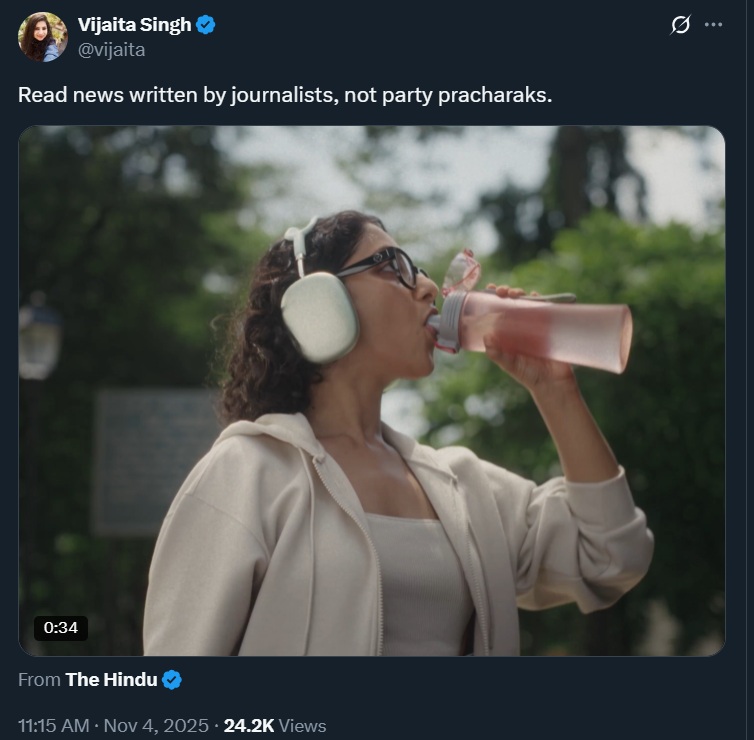
The controversy began when The Hindu’s official X handle released a promotional video stating, “When gossip is dressed up as news, it stops being journalism. Read, hear, and share news written by journalists.”
Soon after, The Hindu’s senior ‘journalist’ Vijaita Singh reshared the post with the caption, “Read news written by journalists, not party pracharaks.”
Her remark drew sharp criticism from netizens, who accused the publication of partisanship.
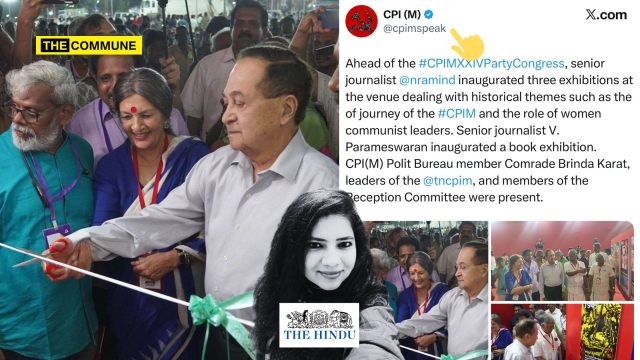
Several users pointed out that the newspaper’s former Editor-in-Chief and current Director of The Hindu Publishing Group has been seen participating in events organized by communist-affiliated groups and political figures.
It is noteworthy that over the years, The Hindu has drawn sustained criticism for functioning as a de facto mouthpiece of the Communist Party and a consistent amplifier of Chinese state narratives. Its editorial choices frequently echo Beijing’s geopolitical messaging while undermining India’s sovereignty, military, and foreign policy.
From publishing distorted maps of India and false defence reports to glorifying the Chinese Communist Party’s centenary and running paid Chinese advertorials, the newspaper has repeatedly aligned with China’s interests. Its coverage of the Galwan clash, BRI projects, and LAC tensions routinely foregrounded Beijing’s perspective while sidelining India’s.
By normalizing Chinese propaganda, publishing sympathetic pieces on the CPC’s “achievements,” and hosting the Chinese Ambassador at its Chennai office, The Hindu has positioned itself less as an independent Indian publication and more as a reliable amplifier of left-wing and Chinese state viewpoints.
Subscribe to our channels on WhatsApp, Telegram,Instagram and YouTube to get the best stories of the day delivered to you personally.
In an interview clipping that has gone viral, Jersey City mayoral candidate Mussab Ali is seen praising New York City mayoral candidate Zohran Mamdani, drawing a direct comparison to former President Barack Obama and suggesting a political parallel with London Mayor Sadiq Khan.
Speaking on Mamdani’s electoral prospects, Ali stated, “Based on what the Mamdani team has done thus far, I think they are in good shape going into November. I think he is going to be the first Muslim mayor of the largest city in America.”
The interviewer expanded the comparison, noting, “I think you can say the two largest cities in the hemisphere, London and New York. London has Sadiq Khan who is of a Pakistani Muslim background and Mamdani is an East African, originally Indian.”
In his response, Ali elaborated on the Obama analogy. “You know Republicans, if you think about what they used to say about Obama right, they are like Obama is not born in America, he was born in Africa, Obama’s a socialist, a Muslim,” Ali said. “Literally Mamdani is a Muslim socialist who was born in Africa and is now actually the mayor of New York city. I think it is incredible like what they thought about Obama, this man he actually is.”
The conversation seems to be indicating that Islamists are rejoicing that they have taken London with a Pakistani Muslim mayor and now it’s New York’s turn.
It is also noteworthy to look at Ali’s previous political actions as Jersey City’s School Board President, he allegedly forced through Eid holidays, halal lunches, and Islamic dress code accommodations in public schools.
🚨 WARNING NYC and NEW JERSEY 🚨
“The Real Obama Has Arrived”—and Jihadis Worldwide Are Celebrating
Radical Jersey City mayoral candidate Mussab Ali praises NYC mayoral hopeful Zohran Mamdani, calling him the “real [Jihadi] Obama”:
From glorifying Hamas and denigrating India to pushing anti-Israel resolutions, New York legislator Zohran Mamdani embodies the dangerous nexus of left-wing extremism and Islamist propaganda—heavily bankrolled by global “philanthropic” networks.
The son of acclaimed filmmaker Mira Nair and Ugandan academic Mahmood Mamdani, Zohran has long leveraged his privileged background to push divisive identity politics under the garb of “solidarity.” His record in the New York State Assembly and beyond exposes a pattern—relentless attacks on India, Hindus, and Israel, echoing talking points crafted by global left-Islamist lobbies.
Mamdani has received significant backing from advocacy groups linked to Islamist organizations and pro-Hamas outfits.
A groundbreaking Fox News investigation by Asra Nomani, in collaboration with the Daniel Pearl Project, has shed light on the sprawling coalition and funding behind Zohran Mamdani’s campaign to become New York City’s next mayor.
Groups such as ICNA, prohibited in India and Russia for their ties to terrorist organizations, and CAIR, previously named in terrorism financing investigations, have been integral parts of the campaign’s network. Donations from the Unity & Justice Fund and coordinated actions by members of Jamaat-e-Islami and other global Muslim entities underscore the campaign’s far-reaching terror connections.
The Council on American‑Islamic Relations (CAIR) and its super-PAC arm Unity & Justice Fund are reported to have funneled substantial funds into a PAC supporting Mamdani’s campaign. One report cites a $25,000 gift on May 30 and a further $75,000 on June 16, 2025. Another source places the figure at about $100,000 in total. In addition, the US Campaign for Palestinian Rights Action (USCPR Action) publicly endorsed his campaign in September 2025 — their first-ever candidate endorsement.
He was seen with an Imam, who has historical ties as an unindicted co-conspirator in the 1993 World Trade Center bombing.
In 2023, the New York State Assembly passed a controversial bill aimed at stopping tax-exempt donations from state-registered charities that funded Israeli settlements in the occupied West Bank – activities widely regarded as violations of international law.
The legislation, titled “Not on Our Dime!: Ending New York Funding of Israeli Settler Violence Act,” was introduced by the then-Assembly member Zohran Mamdani in May 2023. It sought to prohibit not-for-profit corporations registered in New York from using charitable funds to support organisations linked to Israeli settlement expansion or violence against Palestinians in the occupied territories.
Mahmood Mamdani, a professor at Columbia University and father of New York mayoral candidate and Islamist terror supporter Zohran Mamdani, argued for a controversial reframing of suicide bombers, stating they should be seen as soldiers rather than barbarians in the aftermath of the 9/11 Twin Tower terror attack. Mamdani even appeared to evade a question about Sharia law during a public interaction.
The Democratic Socialists of America (DSA), the organization backing mayoral frontrunner Zohran Mamdani, is facing a severe public condemnation just as the NYC mayoral polls come closer and the information that a radical faction within its ranks openly praised and launched a campaign to free Elias Rodriguez, the man accused of murdering two Israeli embassy staffers in a terror attack in Washington, D.C.
New Yorkers must decide if they want their city to be taken over by an Osama.
Subscribe to our channels on WhatsApp, Telegram,Instagram and YouTube to get the best stories of the day delivered to you personally.