Home Blog Page 260

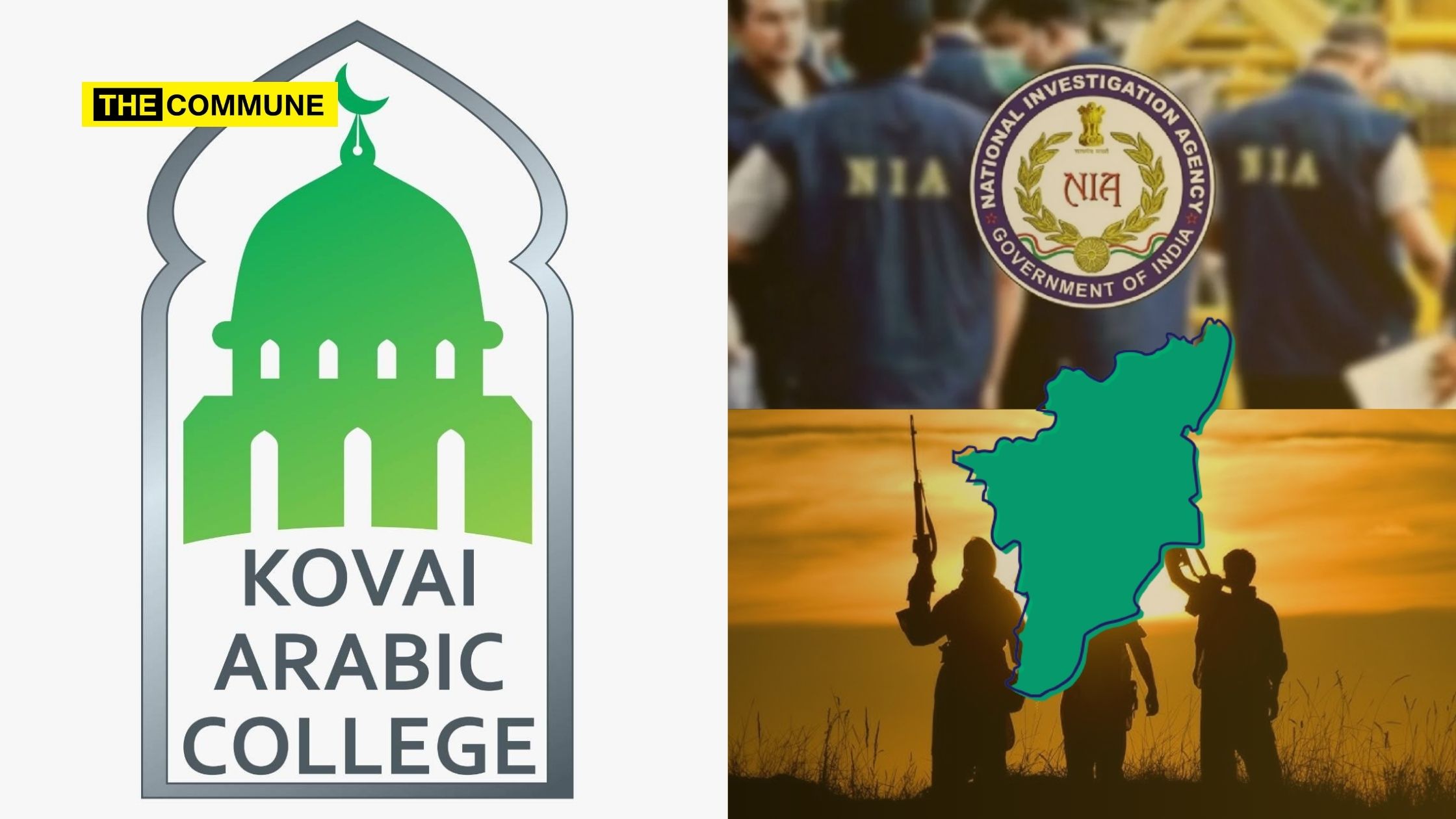
Four More Arrested By NIA In ISIS Radicalisation Case Linked To Kovai Arabic College

nia isis recruitment kovai arabic college

The National Investigation Agency (NIA) has arrested four additional individuals in connection with an ISIS-inspired radicalisation and recruitment case in Tamil Nadu, bringing the total number of arrests to eight. The case is an offshoot of the 2022 Coimbatore car bomb blast investigation.

In a press release issued on Wednesday, 18 June 2025, the NIA identified the newly arrested accused as Ahmed Ali from Chennai, Jawahar Sathik, Raja Abdullah alias MAC Raja, and Sheikh Dawood from Coimbatore and Dindigul. These individuals were allegedly part of a wider extremist network that recruited and radicalised youth under the pretext of Arabic language education.

According to the NIA, the arrested individuals were indoctrinated by Jameel Basha, founder of the Madras Arabic College in Coimbatore. Basha, who was previously arrested along with associates Irshath, Syed Abdur Rahman, and Mohammed Hussain, is accused of using classroom settings and social media platforms to promote Salafi-Jihadi and Khilafat ideologies. The network advocated violent jihad and the establishment of an Islamic state through the overthrow of India’s democratically elected government.

Investigators believe the radicalisation campaign contributed to the deadly car bomb blast on 23 October 2022, near the Kottai Eswaran Temple in Coimbatore, which killed the bomber, Jamesha Mubeen. The NIA took over the case shortly afterward and began unravelling the broader ISIS-linked recruitment network operating in Tamil Nadu.

The agency revealed that the group’s operations extended beyond Coimbatore to Chennai and Dindigul, and involved logistical support for terror-related activities.

Officials confirmed that the NIA is now preparing a supplementary chargesheet to include the four latest accused. Investigations into possible international connections and additional recruits are continuing, as the agency works to dismantle what it describes as a significant threat to national security.

Subscribe to our channels on Telegram, WhatsApp, and Instagram and get the best stories of the day delivered to you personally.

DMK Ally Islamist Party Threatens To Lay Siege To US Consulate In Chennai

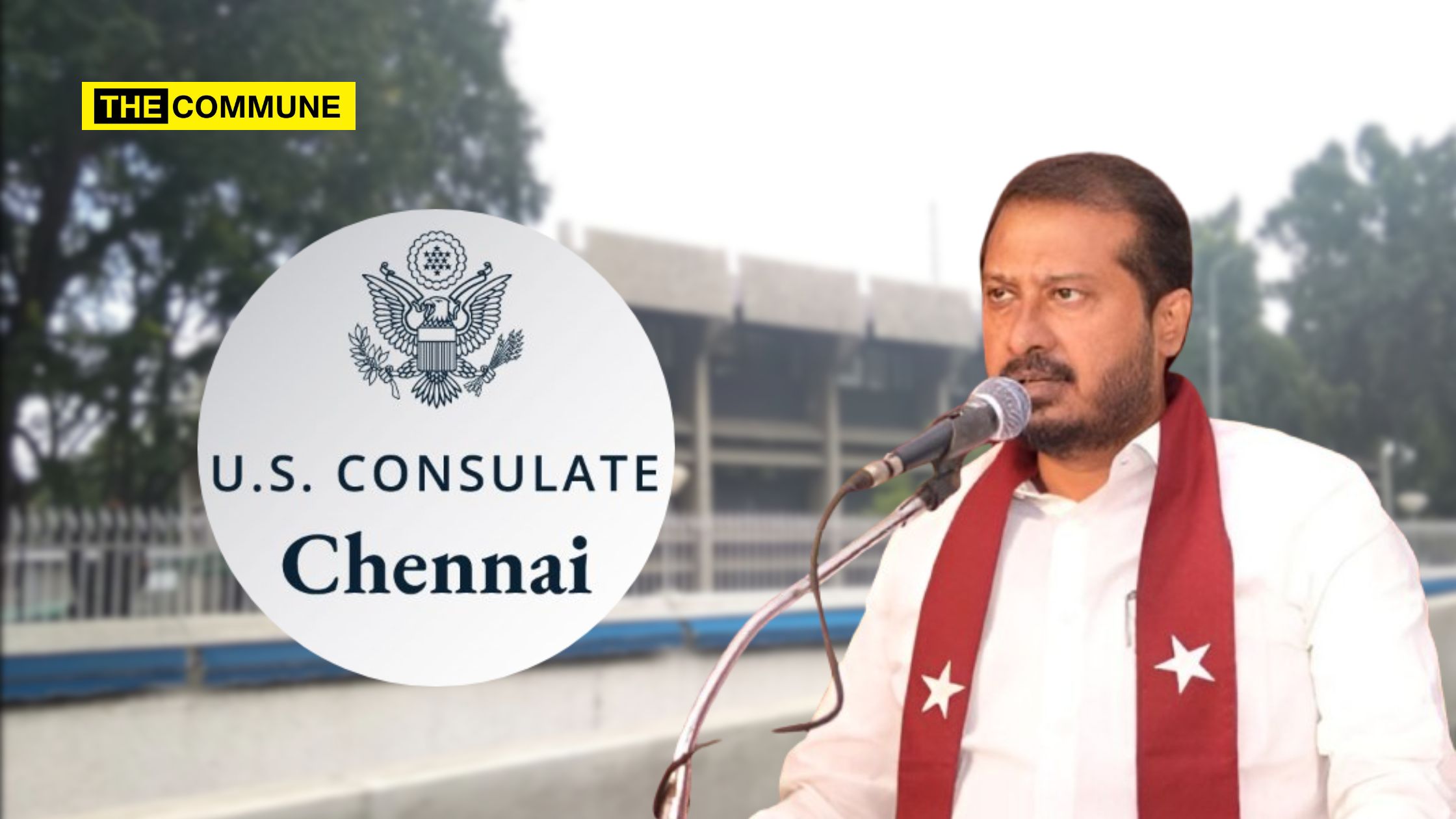
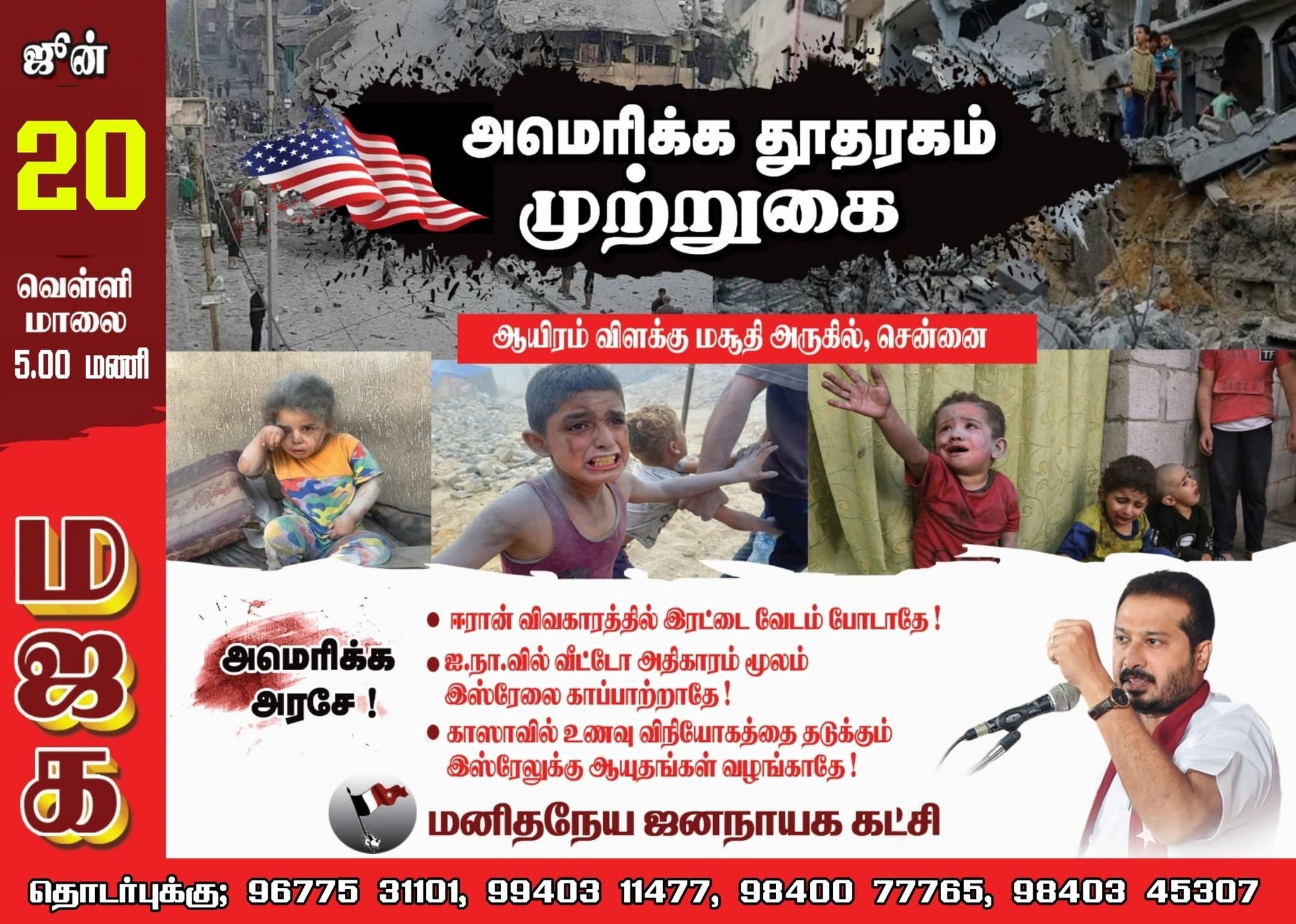
On 18 June 2025, Thamimun Ansari, President of the Manithaneya Jananayaga Katchi (MJK) and an ally of the DMK, shockingly announced that a protest to besiege the American Consulate in Chennai on 20 June 2025. The protest is being organized to condemn the United States for allegedly spreading war hysteria, inciting geopolitical tensions, and backing Israel’s continued ‘aggression’ in the Middle East.

In a post shared on social media, Ansari stated that, “Don’t Incite War!” “Siege the U.S. Consulate!” “MJK Chief M. Thamimun Ansari’s Statement!” Since the Cold War ended between the U.S. and the Soviet Union, the United States has been working steadily to bring the world under its control. It continues to escalate the war in Europe by maintaining a NATO mercenary force. Similarly, it is stoking the flames of war in the Middle East by having Israel as its vassal and using it as a proxy. The encouragement and weapons that supplied by America to Israel is what keeps the Middle East in a state of perpetual war.”

Adding further, the statement said “For the past two years, Israel’s cruel attacks on Gaza in Palestine have been condemned throughout the world. Furthermore, when food distributions are taking place there on the initiative of the UN, Israeli Zionist forces are also killing the people who come running due to hunger. This is a cruelty the world has never seen. Currently, Israel has been launching attacks on Iran since last Friday. Both countries are now clashing. This has caused concern all over the world. This war is turning into one that can also cause economic devastation. America, which has been providing all kinds of assistance to Israel while claiming not to be directly involved in this war, is the primary culprit in this.”

“Therefore, it is announced that a democratic protest will be held by the Manithaneya Jananayaga Katchi to besiege the American Consulate in Chennai this coming Friday at 5 PM, condemning America for continuously spreading war frenzy, inciting tension, and supporting Israel’s atrocities in the Middle East. We request that pacifists, human rights activists, and righteous people participate in large numbers.”, the statement concluded.

The Islamist party’s youth wing also organized an online meeting for anti-Israel propaganda in which DMK-supporting Dravidianist Thirumurugan Gandhi was the chief speaker.

Previous Attack At US Consulate, Chennai

In September 2012, a violent protest erupted outside the U.S. Consulate in Chennai as hundreds of demonstrators, many linked to the Tamil Nadu Muslim Munnetra Kazhagam (TMMK), stormed the premises in response to the controversial anti-Islam film Innocence of Muslims.

Protesters hurled stones, shoes, and damaged security infrastructure, including CCTV cameras and windowpanes. Some scaled the compound wall and reached sensitive areas near the visa cabin. American symbols were desecrated, and effigies were set on fire. Despite the consulate’s fortified structure, only a small police contingent was present when the crowd broke through, prompting serious questions about local security preparedness.

Police eventually regained control after reinforcement arrived, arresting 86 individuals. Fortunately, no U.S. personnel were harmed in the incident.

Subscribe to our channels on TelegramWhatsApp, and Instagram and get the best stories of the day delivered to you personally.

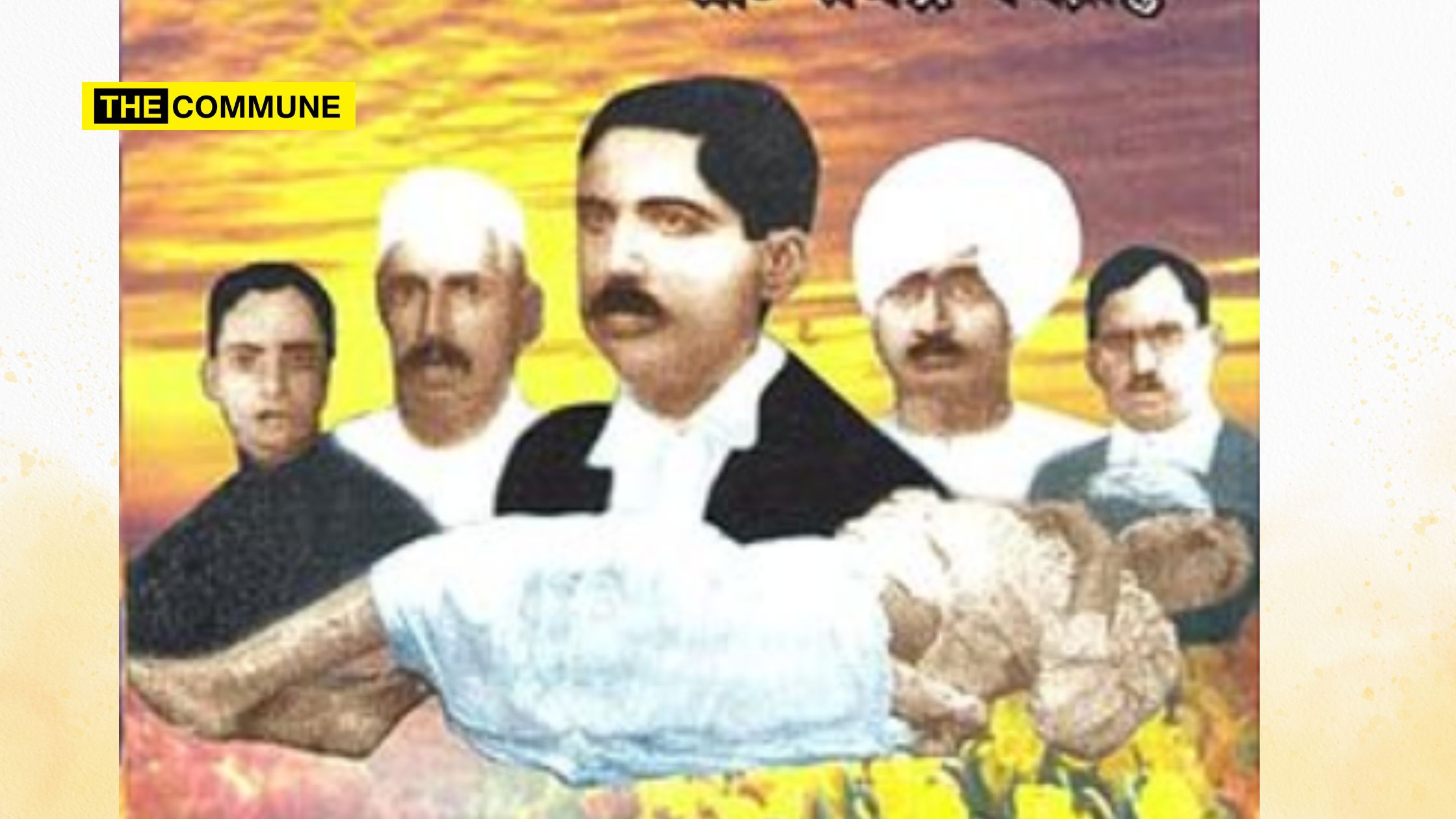
Radha Kishan Modani: The Unsung Martyr Who Defied The Nizam For Dharma

During the oppressive rule of the Nizam in Hyderabad, Hindus faced severe restrictions on their religious freedom. Practicing the Hindu faith often came with harassment or the pressure to convert to Islam. Under the shadow of the Razakars, a brutal fundamentalist militia loyal to the Nizam religious persecution became routine. Yet, amidst this dark period, a few brave individuals stood firm, resisting tyranny with unwavering courage. One such unsung hero was Radha Kishan Modani, also known as Radha Krishna Modani.

Born on 14 December 1886 in Hyderabad, Modani came from a family originally hailing from Sanju village in Nagaur district, Rajasthan. His parents, Shri Jeetmal Modani and Smt. Rambai, had settled in Hyderabad nearly two decades prior. The family lived in Esamia Bazaar, where they also ran a kiryana (grocery) shop. Educated in Hindi and Urdu, Radha Kishan married Mohini, the daughter of Jayanarayanji Gilda of Nizamabad.

While the early rule of Osman Ali Khan was relatively stable, the situation worsened under his successors. The Nizam’s administration began clamping down on Hindu religious activities, banning public rituals like Arya Samaj gatherings during festivals. Celebrating religious events became dangerous, with arrests and beatings becoming common. Outrages like cow slaughter further deepened the unrest among the Hindu population.

Radha Kishan Modani, disturbed by these violations, took an active role in the Satyagraha movement against the Nizam, which ran from 31 January to 20 July 1939. He became a vocal critic of the regime’s authoritarianism. In open defiance of the Nizam’s prohibition on Hindu rituals, Radha Kishan Modani is said to have conducted a yagna publicly in the Nizamabad market—a powerful act of spiritual resistance. This courageous stand against the ban provoked the anger of the Razakars.

On 2 August 1939, as the Satyagraha reached its final phase, Modani was brutally assaulted in front of the Nizamabad town police station while conducting the yagna. He succumbed to his injuries, becoming a martyr for the cause of religious freedom and resistance to tyranny.

His death triggered widespread grief and anger. Nizamabad’s entire market shut down for three consecutive days as a mark of protest. His sacrifice was later honored in several ways, in 1943, a session of the Arya Samaj conference named the location ‘Shaheed Radhakishan Modani Nagar’, and in 1961, the Nizamabad Municipal Council renamed a major street ‘Shaheed Radhakishan Modani Road‘.

Today, he is remembered as a valiant but lesser-known freedom fighter who laid down his life to uphold the right to practice one’s faith freely under oppressive rule.

Atrocities by Razakars In Hyderabad At the Dawn of Indian Independence

In the period surrounding India’s independence in 1947, while widespread communal violence primarily characterized the partition, another brutal conflict unfolded in the princely state of Hyderabad a year later. This involved the Razakar militia, an armed group supporting the Nizam of Hyderabad’s desire for independence, and their actions against the backdrop of the Indian Army’s intervention.

The Nizam’s Stance and the Rise of the Razakars

Hyderabad, one of over 500 princely states, initially enjoyed autonomy under British rule. Unlike most other states that acceded to India after independence in 1947, Hyderabad’s Muslim Nizam sought to remain independent. This refusal to join the Indian Union sparked a tense standoff with the Indian government in Delhi. During this period, the Razakar militia, the armed wing of Hyderabad’s dominant Muslim political party, emerged as a significant force. Comprised largely of Muslims, with some Dalit Hindus also noted among them, the Razakars were vehemently opposed to Hyderabad’s integration into India. They actively terrorized villages, targeting those perceived as Indian partisans, who were predominantly Hindu due to the state’s demographic makeup. While the primary victims were Hindus, some Muslims also suffered from their actions.

Instances of Razakar Violence

Reports indicate numerous acts of brutality by the Razakars. K.M. Munshi, India’s Agent-General in Hyderabad post-1947, documented 260 incidents of violence committed by the Razakars against civilians, mainly in the rural areas. Estimates vary, but some analyses suggest fewer than 1,000 people were killed by the Razakars.

A stark example of their atrocities is the Gorta B village massacre on May 10, 1948. According to accounts from survivors and their descendants, after a Muslim official in Gorta was reportedly killed by members of the Arya Samaj, the Razakars retaliated violently. Approximately 200 Hindus were reportedly lined up and killed in cold blood, women were raped, and widespread looting occurred. A chilling slogan attributed to the Razakars at the time was: “Loot the Brahmin, kill the trader, and share in the pillage.” Despite the presence of around 40 Muslim households in Gorta B, some of whom attempted to protect their Hindu neighbors, they were unable to withstand the external Razakar forces.

Indian “Police Action” and Aftermath

In September 1948, the Indian Army launched a “police action” to integrate Hyderabad. While the Nizam’s forces were swiftly defeated with minimal civilian casualties during the initial invasion, reports soon emerged of widespread violence in its aftermath. The Pandit Sundarlal Committee, commissioned by Prime Minister Jawaharlal Nehru to investigate these reports, concluded that the violence against Muslims was an “inevitable repercussions of the atrocities committed on Hindus only a few days before by the Razakars.”

The committee’s “conservative estimate” indicated that at least 27,000 to 40,000 people lost their lives during and after the police action, with some later scholarship suggesting figures as high as 200,000 deaths. The four worst-affected districts, identified as Razakar strongholds and areas that suffered heavily at their hands, were Osmanabad, Gulbarga, Bidar, and Nanded. The report further detailed: “Almost everywhere in the affected areas communal frenzy did not exhaust itself in murder alone in which at some places even women and children were not spared. Rape, abduction of women… loot, arson, desecration of mosques, forcible conversions, seizure of houses and lands, followed or accompanied the killing.” It also noted that “tens of crores worth of property was looted or destroyed.” The primary victims of these atrocities were Muslims, particularly in rural areas.

While the Razakars committed violence and their leader, Kasim Rizvi, was eventually tried and jailed, later departing for Pakistan, the subsequent large-scale violence against Muslims after the Indian Army’s intervention went largely unpunished. The Pandit Sundarlal Committee report, which also pointed to the involvement of “Hindu communal organisations” from outside Hyderabad in the violence against Muslims, was not published until 1988, contributing to a lack of public awareness about the full extent of the post-invasion massacres.

Subscribe to our channels on TelegramWhatsApp, and Instagram and get the best stories of the day delivered to you personally.

Whistleblower Grad Student Expelled From Internship At ‘Jesuit’ Santa Clara University After Exposing Allegedly Explicit, Ideological Content In Counseling Program

Santa Clara University, a prominent Jesuit institution in California, has come under scrutiny following the expulsion of Naomi Epps Best, a 26-year-old graduate student and intern in its counseling program. Best, who was training to become a licensed Marriage and Family Therapist (MFT), was reportedly dismissed from her internship after publicly criticizing the university’s curriculum, which she alleged included compulsory exposure to sexually explicit material and ideologically driven assignments that she claimed violated the American Psychological Association’s ethics code.

Best was participating in a state-accredited program that required internships for licensure when she raised concerns about certain practices within the curriculum. Her complaints, which gained widespread attention following a June 6 exposé published in The Wall Street Journal, included claims that students were compelled to view pornographic material involving sadomasochistic content and complete a “sexual autobiography” detailing personal and intimate sexual experiences. She argued that these assignments not only breached professional ethical boundaries but also imposed ideological conformity.

The controversy deepened when Best released a video statement on June 13 via social media platform X, shortly after being informed of her termination. She described the decision as having been made reluctantly by her supervisor, citing institutional pressure. In her message, she expressed concern for the future of psychological care, warning that excluding dissenting worldviews from therapist training would risk alienating clients and causing further harm.

Best’s case has since drawn national attention and support from within the mental health field. A number of psychologists and academics, including practitioners who own private therapy clinics and university faculty, expressed solidarity, highlighting broader concerns over ideological enforcement in graduate education and therapy training. Some offered her alternative internship opportunities.

According to her accounts published on Substack, Best described her experience in one class where students were shown a video depicting a social media influencer engaged in bondage, gagging, and other forms of BDSM. She claimed the material was presented without appropriate warnings and that her own request to opt out—on religious, ethical, and trauma-informed grounds—was denied, even though, according to her, Muslim students had been allowed exemptions.

The program, she said, treated non-traditional sexual practices such as kink, polyamory, and swinging as equally healthy alternatives to monogamous relationships focused on child-rearing. She further reported that the curriculum mandated the completion of an 8–10-page sexual autobiography detailing one’s sexual history, preferences, and aspirations, and that students were encouraged to share personal information in co-ed discussion groups.

Best also claimed that required reading materials included books that were sexually graphic and, in some cases, blasphemous. She cited one text that allegedly depicted sexual acts alongside satirical illustrations involving religious imagery, and another that she said contained erotica involving violent sexual scenarios.

Santa Clara University, while maintaining that it does not discuss individual student matters due to privacy policies, responded to The Wall Street Journal article by referencing California law, which it said necessitates comprehensive instruction on human sexuality in counseling education. It neither confirmed nor denied the specific allegations made in the article.

The university, which identifies itself with Catholic and Jesuit values, also promotes a policy of “inclusive excellence,” including expansive definitions of gender identity and sexual expression. Critics argue that this dual commitment—to religious tradition and contemporary progressive ideologies—has led to internal contradictions within the institution’s academic and cultural environment.

(With inputs from The Stream)

P.S: A previous version of this article stated that a Santa Clara University graduate student was terminated from the internship at the university. Associate Director of Communications at the Santa Clara University stated that the internship was neither hosted nor affiliated with Santa Clara University and was arranged independently by the studen. Accordingly, the termination decision was made by the clinic. The student was not expelled from the university’s program, according to the University.

Subscribe to our channels on Telegram, WhatsApp, and Instagram and get the best stories of the day delivered to you personally.
Asst Professors Hospitalized After Consuming Food Contaminated By Dead Lizard During Naan Muthalvan Scheme Training At Madras University

naan muthalvan training university of madras lizard food contamination hospitalised

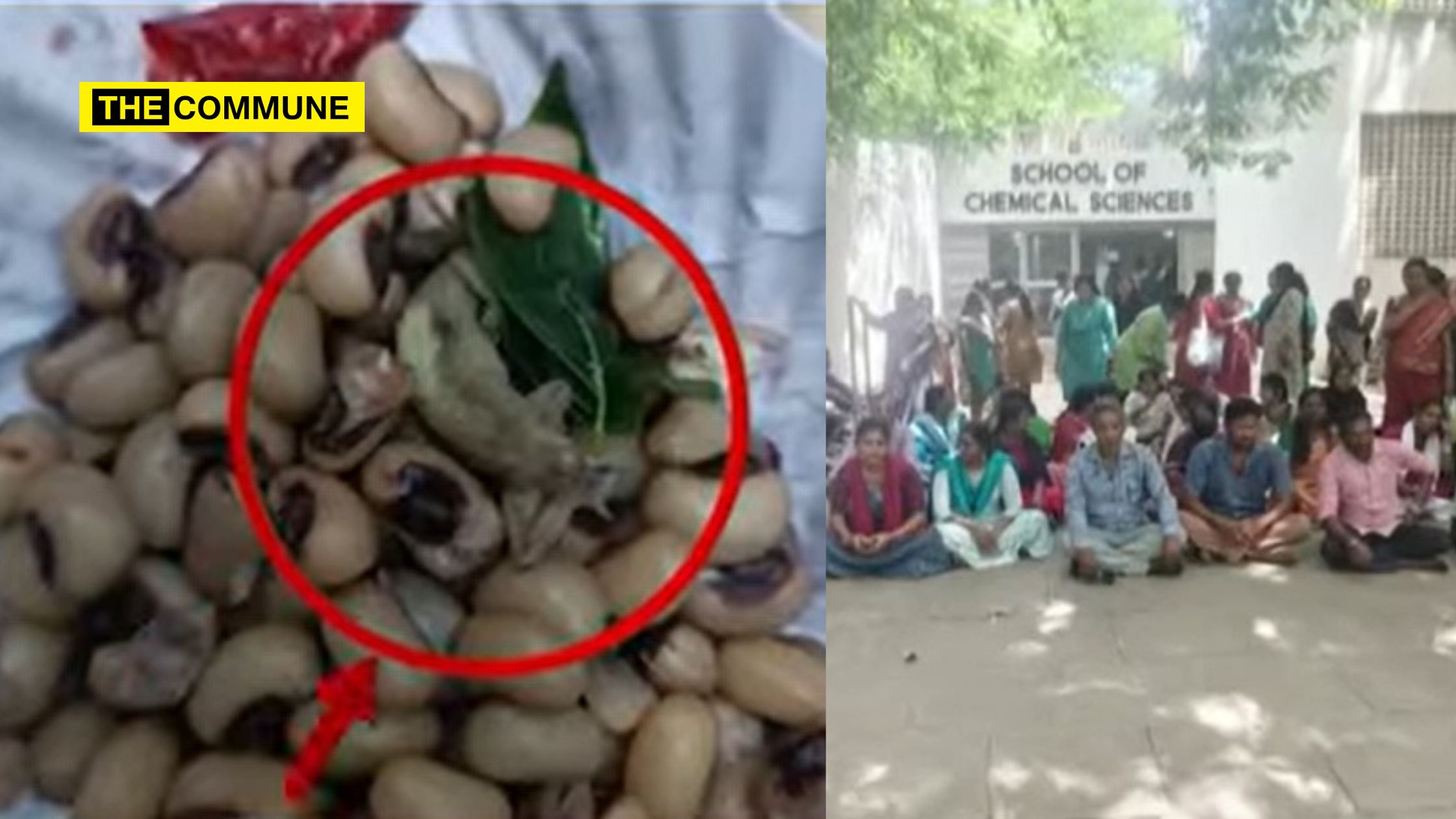
A major health scare unfolded at the University of Madras’s Kotturpuram campus on Wednesday, 18 June 2025, after more than a dozen assistant professors fell ill during a training session under the Naan Muthalvan scheme. The cause? Contaminated food — specifically, chickpeas reportedly containing a dead lizard.

The affected professors were attending the third day of the government-run training program aimed at preparing faculty to coach students for competitive examinations. Over a hundred assistant professors from government and private arts and science colleges had gathered for the event.

According to reports, the contaminated chickpeas were served during a meal. Shortly after consumption, more than ten professors began vomiting and collapsed on the premises. Emergency medical services were called immediately, and the ill were rushed to Saidapet Government General Hospital for treatment.

Eyewitnesses and participants claim the food appeared visibly unhygienic, and some alleged that the contaminants had fallen from a tree before being served. The situation quickly escalated, prompting protests by faculty members against the university’s lack of oversight in ensuring food safety during such official events.

More than a dozen ambulances were deployed to the campus in response to the incident. Hospital sources confirm that several of the professors are being treated for symptoms consistent with food poisoning.

Subscribe to our channels on Telegram, WhatsApp, and Instagram and get the best stories of the day delivered to you personally.
Mysterious Fire Destroys ISKCON’s Kurma Village Temple In Srikakulam, SP Denies Foul Play

srikakulam kurma village iskcon

Andhra Pradesh Deputy Chief Minister Pawan Kalyan voiced deep concern over the recent fire that destroyed Kurma village’s farm community temple near Hiramandalam. Calling the incident deeply unfortunate, he emphasized the need for a thorough investigation and assured that the government would provide all necessary assistance to the affected community.

Kurma village, established by ISKCON, is known for its spiritual values, commitment to traditional living, natural farming, and Vedic education. Pawan Kalyan acknowledged its cultural significance and said it stands as a rare example of sustainable heritage worth preserving in today’s fast-changing world.

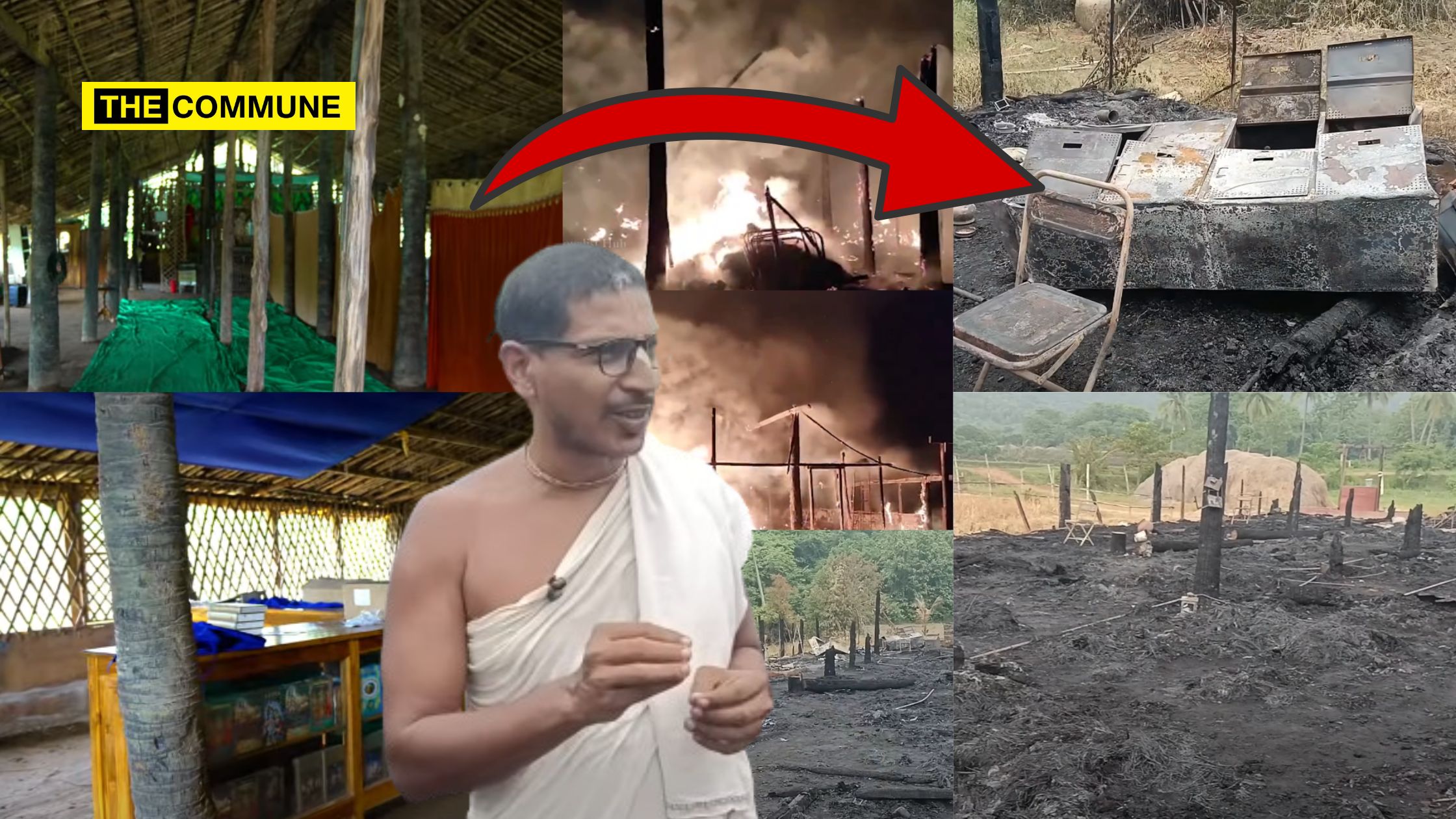
The fire reportedly broke out in a prayer room constructed from mud and straw, sparking suspicion among the locals about possible foul play. However, Srikakulam SP K.V. Maheswara Reddy on 14 June 2025 clarified in a statement that initial investigations found no evidence of malicious intent or external involvement.

Residents explained that lighting oil lamps for prayer is a daily practice and that these are typically extinguished afterward. Officials believe that an unattended lamp might have led to the blaze. Samples and evidence from the site have been sent to the Forensic Science Laboratory for further analysis.

What the Head Priest Says?

Speaking to the local media, the temple priest Charan Das recounted, “Everything happened on the night of the 10th, Tuesday, around 9:45 PM. Usually, all our activities conclude by 8 PM. By 8:30 PM, the temple hall is completely closed. The structure is made entirely of palm leaves, standing at a height of at least 25 feet and measuring about 120 by 60 feet in size.

At exactly 9:45 PM, a fire broke out in one corner of the temple. That spot houses the Radha-Krishna idols. There are no lamps or candles left burning after we finish. Our routine is very strict — everything is shut by 8:30 PM, and the priest exits with a small lantern. Even if by chance a lamp was left lit, the nearby houses would have clearly noticed it and alerted us immediately.

But on that particular day, everything was shut by 8:30 PM. After that, no one was inside. Suddenly by 9:45 PM, flames erupted in the corner, and within just 10 minutes — by 9:55 — the fire had spread rapidly. The entire structure, including the straw roof, caught fire all at once. Though it had rained earlier that evening, which usually reduces fire risk, the structure still burned down in seconds. It was as if petrol had been poured — that’s how intense and fast the fire spread. The heat was so strong that no one could go within 50 feet of it. Even now, four days later, we can still feel the residual heat.

We stood and watched in disbelief as the fire consumed everything. The flames reached all corners, even areas covered with cross beams and diamond-pattern wooden ventilation slats. It’s shocking — both the top and bottom caught fire almost simultaneously.”

The anchor questioned, “I have a serious doubt here. For such a massive fire to break out, either an electrical fault or an open flame should be involved. But there was no electricity in the area, and no lamps were left burning.”

Charan Das replied, “That leaves us with only one possibility — foul play. It seems likely that someone, driven by jealousy or resentment, may have done this intentionally. Kurma village promotes spiritual values and traditional living. Every day, we get around 300–400 visitors. About 20–30 people even stay to learn how our ancestors lived. Some come to study the Bhagavad Gita. There’s a noble spirit here. But just as in ancient times — even during Prahlada’s era — whenever there is devotion, there are always forces working against it. We suspect that someone who doesn’t want this dharmic way of life to thrive may have done this. Today, we see similar incidents happening elsewhere too — idols being vandalized or temples being targeted. We left behind jobs and city life to live peacefully and simply. That’s the kind of community we have here.”

Subscribe to our channels on TelegramWhatsApp, and Instagram and get the best stories of the day delivered to you personally.

“Go Fight Alongside Hamas If You Support Them!” – Retired Army Officer Shuts Down Dravidianist Ponraj After He Compares Terror Group To Netaji Subhas Chandra Bose

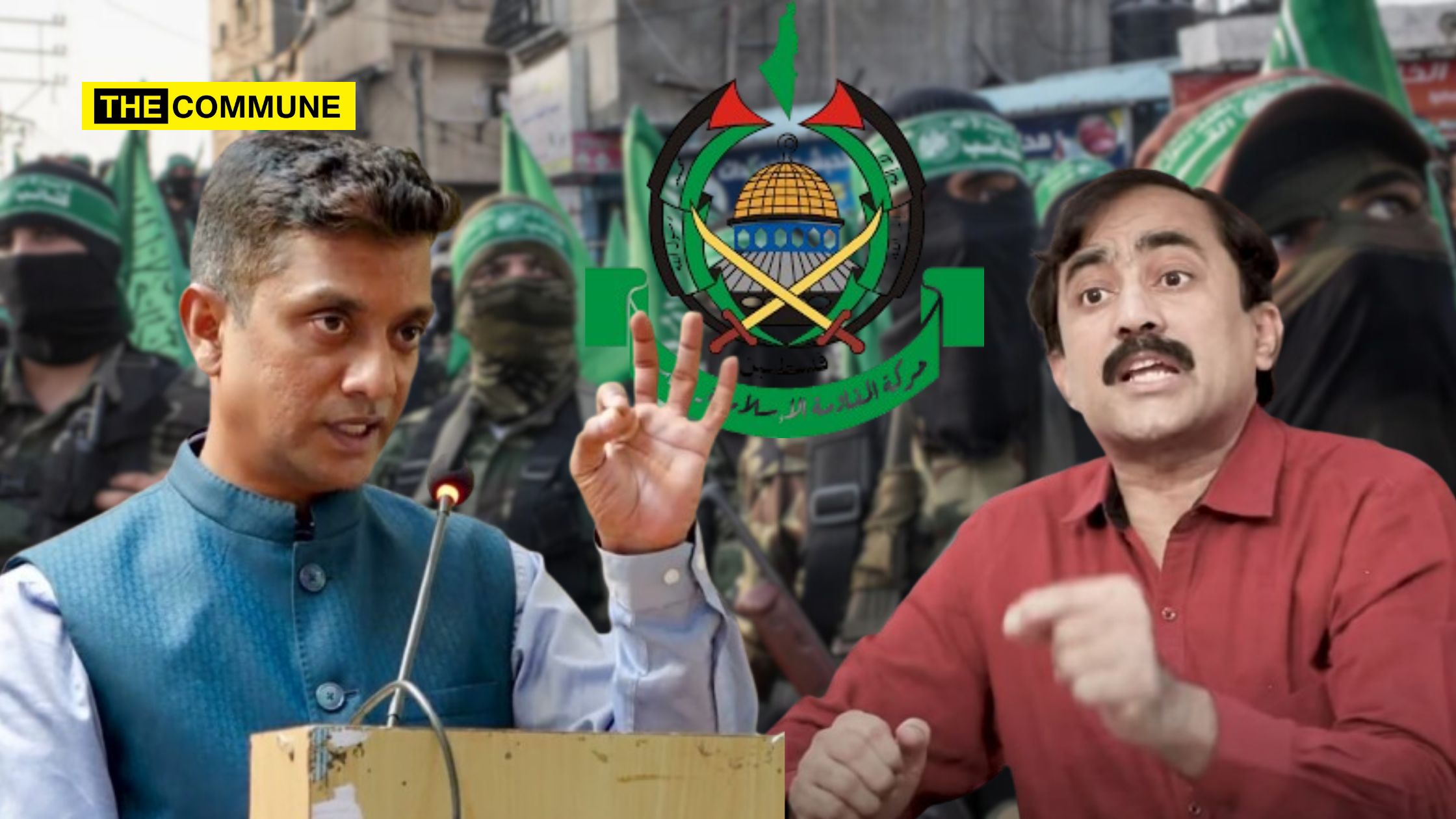
Retired army officer Major Madhan Kumar outright demolished Dravidianist sympathizer and former scientist Ponraj Vellaichamy during a heated Tamil news channel prime-time debate. Ponraj attempted to glorify the internationally recognized terrorist group Hamas by portraying them as freedom fighters under the usual “sons of the soil” rhetoric and even went as far as comparing them to Indian revolutionary leader Netaji Subhas Chandra Bose — a move that Major Madhan slammed without holding back.

The debate, which was supposed to focus on the recent Iran-Israel escalation, quickly veered off course as Dravidianist influencers on the panel began defending Hamas, injecting the Palestine issue into the discussion, and painting Israel as the sole aggressor. Instead of addressing the core geopolitical and historical facts, they pushed one-sided narratives that seemed more about justifying terrorist actions than understanding the broader context, a line Major Madhan refused to let slide.

Former Major Madhan stepped in with a powerful rebuttal, “What everyone is alluding to is, they are attacking, children, causing collateral damage, and everyone condemns the anti-human actions, but no one speaks about what happened on 7th October. That was the trigger point. Everything was going smooth, diplomatic talks were going on, Mossad’s covert operations were happening here and there but on the 7th October, the terrorist organisation Hamas crossed the line – that was reason for such serious consequences.”

The anchor acknowledged Madhan’s point and confronted Ponraj directly, asking whether Hamas’s 7th October attack wasn’t the catalyst for the conflict. Ponraj, visibly cornered, dodged the question and launched into pro-Palestinian rhetoric instead. He said, “What is the root cause of the conflict?” he argued. “The fundamental thing is Israel and Palestine issue. There’s been no resolution for the issue so far. Where will the 7 lakh displaced Palestinians will go?”

The anchor pushed back, “If you see the series of events the attack began after 7th October, because of Iran’s attacks using Hamas, deployed Hezbollah and others followed.”

To which Ponraj shockingly replied, “Yes, of course they will attack. How can you say Hamas cannot retaliate during war? Of course, they will retaliate if you plan to destroy Gaza completely, which is under their control.”

This response irritated even the anchor, who sharply called out his hypocrisy asked, “We are condemning the human rights violations in Gaza. But how can you justify the unprovoked attack on civilians, including rape, on 7 October? I’m surprised you are.”

Major Madhan (retd), visibly incensed, slammed Ponraj’s attempts to legitimize Hamas, “If Hamas does all this, then is it an army? It’s a declared terrorist organization.”

Do not be surprised, the anchor also immediately jumped in to add, “Not by India!”

Ponraj, in a desperate attempt to defend his position, blurted, “All those who are against a country are terrorist organizations for them. As far as they are concerned, they are fighting for the freedom of his country. Terror means what? For whom did he do terror for what? Why is he fighting? You have encroached his territory and if he fights against this, will you call him a terrorist? How can you call him terrorist? Who is branding them terrorist organisation?”

Former Major Madhan countered emphatically, “It is a declared organisation. UN declared. The same UN that you are speaking of, the same organisation declared it.” He emphasized, “Hamas is a UN declared terrorist organisation. The UN, US has said this, ‘Hamas a terrorist organisation.’ It won’t change if you shout about it. It is a declared terrorist organisation. If you speak this outside, you won’t even get a visa.”

Ponraj, now losing ground, lamenting back provocatively, “The same US has said Pakistan as terrorist organisation and the same America is helping them, then what to say? Will India just let them be if America helps and Pakistan captures total Kashmir, will you let them? Will India be silent? Won’t India protest?”

Madhan responded sternly, “We won’t wait and watch till they capture entire Kashmir. The Indian Army or the government will not wait and watch.”

In a final attempt to blur the lines, Ponraj shamefully asked, “Then is Netaji Subhas Chandra Bose a terrorist too?”

Former Major Madhan exploded, “Don’t you dare compare Netaji to Hamas. Netaji never attacked women or kill children. Who are you comparing with whom? Is Hamas and Netaji the same?” He added, “Is the Indian National Army which fought for the freedom struggle—and will you compare Indian national leader to a terrorist organisation?”

Madhan concluded with a scathing rebuke, “If you support them that much, go and fight alongside them. Why are you talking here? Go and fight alongside them. It is a declared terrorist organisation and has committed anti-human activities. It is everyone’s duty to retaliate against such an organisation. India has supported Palestine and its people. India has been aiding them financially. Your and my tax money is going to it, but you are buttressing a terrorist organisation like Hamas.”

Subscribe to our channels on TelegramWhatsApp, and Instagram and get the best stories of the day delivered to you personally.

Idols Vandalized At Black Mariamman Temple In Coimbatore, Police Launch Probe

black mariamman temple idols vandalised coimbatore

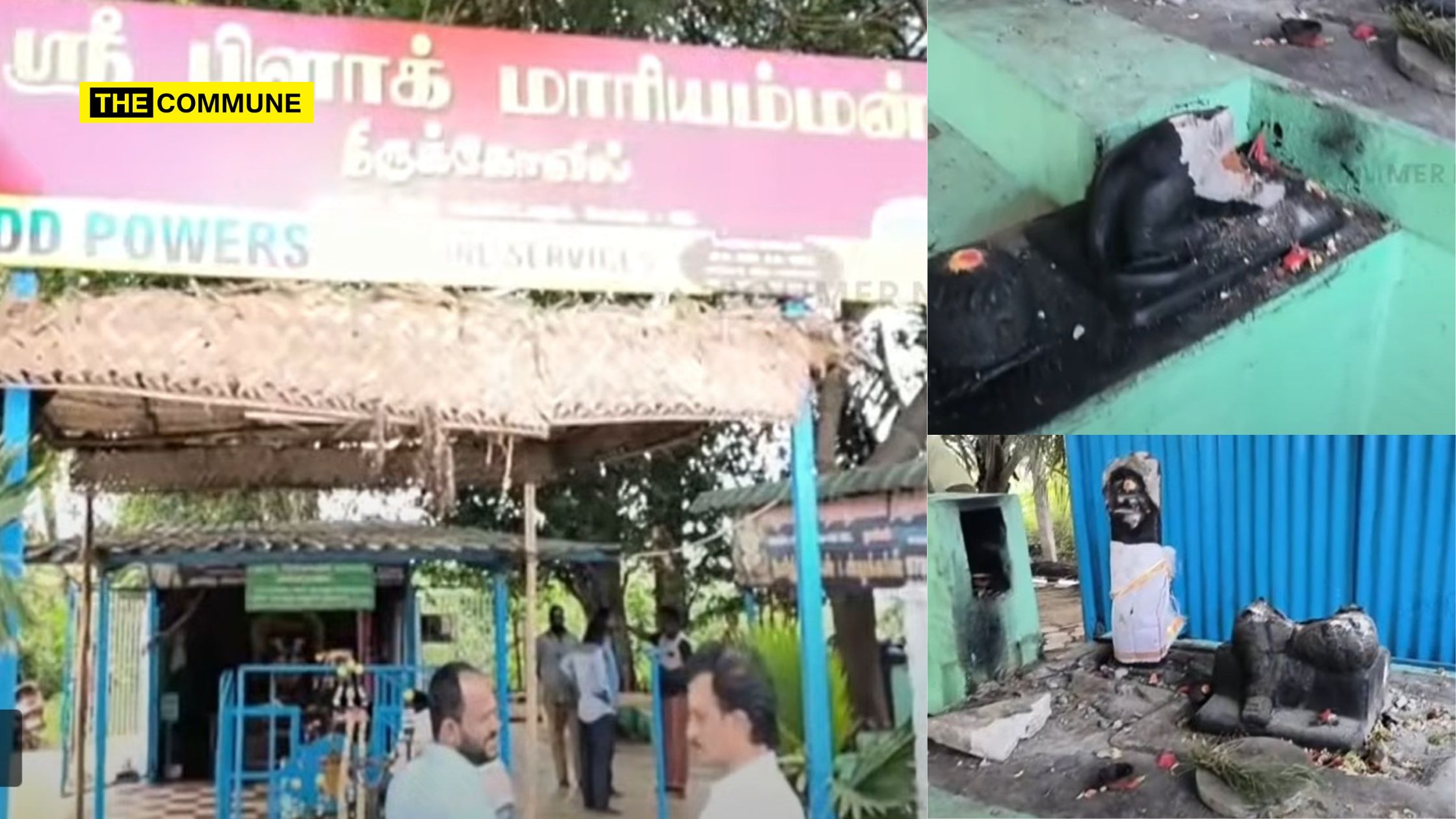
A case of idol vandalism at the Black Mariamman Temple in the Chinnampalayam area of Coimbatore has triggered public outrage and a police investigation. The temple, situated on a hillock near Avinashi Road in Senniyampalayam, came under focus early Wednesday, 18 June 2025, morning after broken idols were discovered.

According to reports, the temple priest arrived to open the premises and was shocked to find that several idols — including those of Lord Ganesha, Rahu, Ketu, and the Mooshik (vehicle of Lord Ganesha) — had been deliberately damaged. The news quickly spread among local residents, leading to a large crowd gathering at the temple, resulting in visible tension in the area.

Upon being informed, Deputy Superintendent of Police Thangaraman and Sulur Police Inspector Lenin reached the temple and launched an inquiry. As part of the investigation, police are reviewing CCTV footage from the area to identify the perpetrators. Additionally, a heavy police presence has been deployed around the temple to maintain law and order and prevent any further unrest.

Authorities have assured the public that those responsible will be identified and brought to justice. The incident has deeply disturbed the local community and raised concerns about the security of religious sites in the region.

Subscribe to our channels on Telegram, WhatsApp, and Instagram and get the best stories of the day delivered to you personally.
Congress MP Jairam Ramesh Lies Again – Uses Jan 2025 US Readout To Attack PM Modi

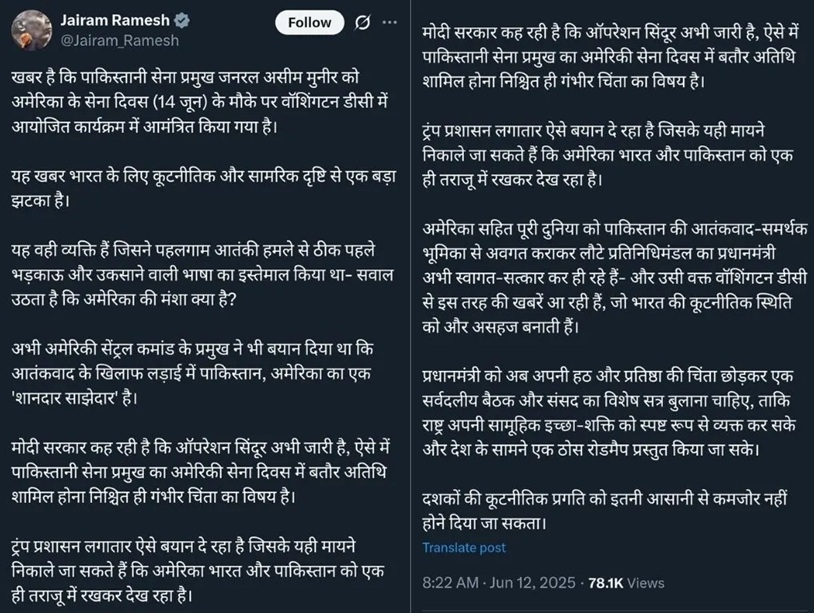
A few days ago, Congress MP Jairam Ramesh amplified a misleading claim on social media platform X alleging that Pakistan Army Chief General Asim Munir was invited to the U.S. Army Day parade in Washington, D.C.

Image Source: OpIndia

Ramesh suggested this was a diplomatic failure for India and a blow to Prime Minister Narendra Modi. However, the narrative quickly unraveled when the White House clarified that no such invitation had been extended, exposing the claim as false.

The April 22 terrorist attack in Pahalgam, Jammu and Kashmir, which claimed 26 lives, came days after General Munir, on 16 April 2025, declared in Islamabad, “Our stance is absolutely clear, it was our jugular vein, it will be our jugular vein, we will not forget it. We will not leave our Kashmiri brothers in their heroic struggle,” referring to Kashmir.

Following President Trump’s rushed departure from the G7 Summit back to the US, Ramesh alleged, “Field Marshall Asim Munir, the man whose inflammatory, incendiary and provocative remarks were linked directly to the April 22 Pahalgam terror attacks, is having lunch today with President Trump in the White House. Is this why President Trump abandoned the G7 Summit a day early denying Mr. Narendra Modi a huge hug? President Trump himself has trumpeted 14 times that he brought about a ceasefire berween India and Pakistan meaning he ended Operation Sindoor. Gen. Michael Kurilla, the US Central Command Chief calls Pakistan a ‘phenomenal’ partner in counter-terrorism operations. This is triple jhatka to Howdy Modi by Namaste Trump! Indian diplomacy is being shattered and the PM is totally silent. And tomorrow is the fifth anniversary of his (in)famous clean chit to China.”

Speaking to ANI, Ramesh said, “… the statement given by Asim Munir about setting fire is directly related to the terrorist attack that took place in Pahalgam on April 22. Today, this very person (Asim Munir) has received a special invitation to dine with President Donald Trump… Our delegation could only meet the Vice President, but Asim Munir has met the President… Today, news came that Prime Minister Modi and US President Donald Trump spoke on the phone for 35 minutes… There is a world of difference between what President Trump said about the conversation and what we were told… Prime Minister Modi, why don’t you call an all-party meeting? Why don’t you (Prime Minister Modi) invite the opposition?… In an all-party meeting, tell us what was discussed with them (US President Donald Trump)…”

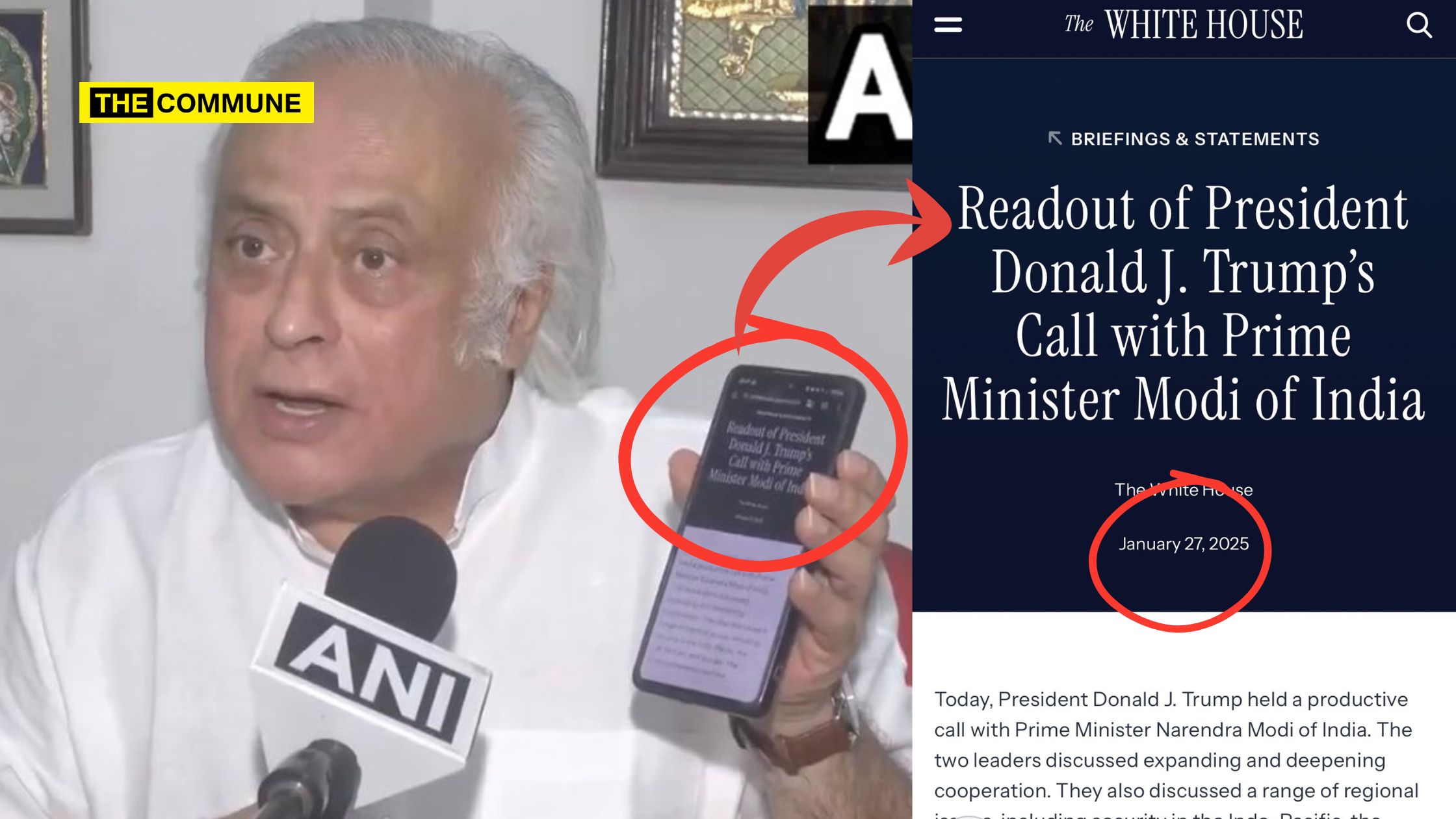
As he was speaking to ANI, Ramesh also waved his phone dramatically, accusing the government of contradicting the US readout of a phone conversation between PM Modi and President Trump.

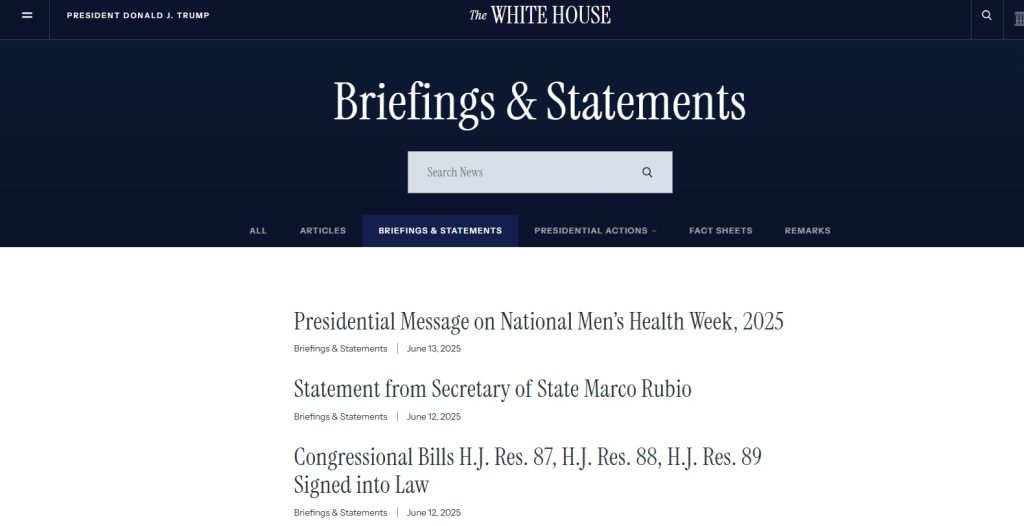
However, it was revealed that the readout he cited was from January 2025, not the latest conversation. No official U.S. release has yet been issued for the recent call. The last updated message is from 13 June 2025.

Foreign Secretary Vikram Misri confirmed that Prime Minister Modi had a 35-minute phone conversation with President Trump, where the PM briefed him on Operation Sindoor. During the call, PM Modi briefed President Trump on Operation Sindoor, firmly stating that no trade-related topics were discussed in connection with the operation.

Reaffirming India’s long-standing position, the Prime Minister made it clear that India has never accepted and will not accept any form of third-party mediation. He further emphasized that India now views acts of terrorism not as proxy warfare, but as direct acts of war.

President Trump extended an invitation for an in-person meeting during his current U.S. visit, but PM Modi was unable to accept due to prior commitments. Both leaders, however, agreed to meet in the near future.

Once again, Jairam Ramesh has egg on his face for peddling lies and misinformation against PM Modi and India.

(With inputs from Live Mint)

Subscribe to our channels on Telegram, WhatsApp, and Instagram and get the best stories of the day delivered to you personally.

Instances When Church Opposed Infrastructure And Development Projects In India (2001–2025)

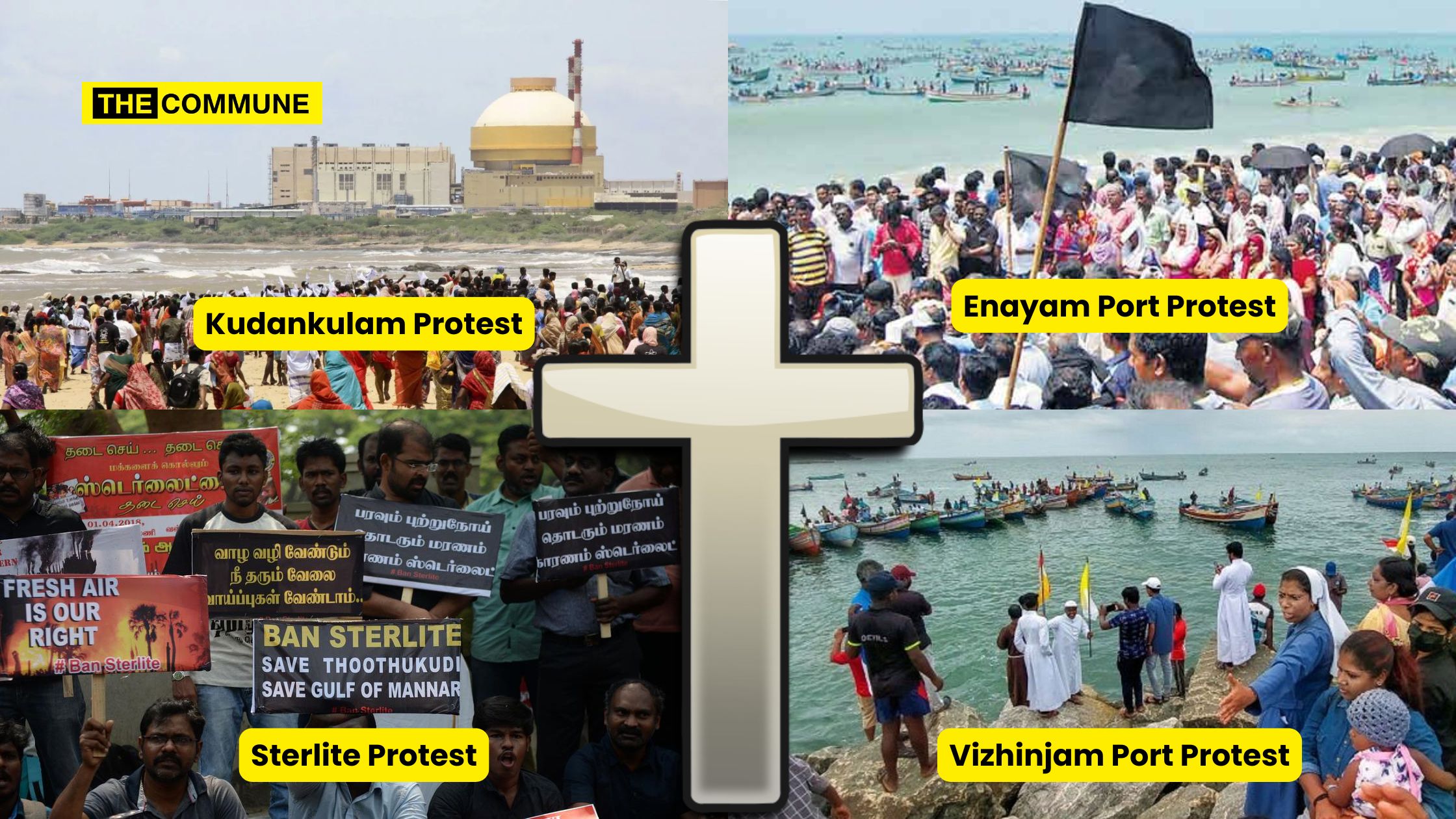
A few days ago, a viral video on social media led The Commune to report about how DMK supporting Christian priest Jegath Gaspar had once instigated the people of a village in Kanyakumari to not allow the construction of the Enayam port there. In this report, we will look at 13 documented incidents between 2001 and 2025 in which church leaders or church-affiliated organizations have opposed major infrastructure and development projects across India.

#1 India’s First Deepwater Seaport Could’ve Been in Tamil Nadu, Opposed by Priest Jegath Gaspar “In the Name of Jesus”

As Kerala celebrated the arrival of MSC Irina at the newly launched Vizhinjam International Seaport, questions arose in Tamil Nadu about what could have been. The Enayam deepwater port project, once backed by the Centre, promised to transform Tamil Nadu’s coastal economy. However, it was stalled due to local opposition, prominently led by Christian priest Fr. Jegath Gaspar Raj, who invoked religious sentiments to rally resistance, calling the project a threat to divine creation and coastal heritage. His emotionally charged speech at a church festival framed the port as a danger to both livelihoods and sacred land. Now, as Vizhinjam positions itself as a global transshipment hub rivaling Colombo, many in Tamil Nadu reflect on how a mix of religious rhetoric and political resistance may have cost the state a game-changing economic opportunity.

https://twitter.com/mattmurock123/status/1932299887603077618

#2 Church-Led Protests Stall Vizhinjam Port, Spark Communal Tensions

On 26 November 2022, church-led protesters, primarily from the Latin Catholic community, blocked construction vehicles and clashed with police at the Vizhinjam International Seaport site in Kerala. Despite prior assurances to the Kerala High Court, demonstrators blocked roads, halted over 20 trucks, and erected barricades, stalling a project halted for over 100 days. The Adani Group, executing the project, expressed frustration over repeated disruptions despite favorable court rulings. While protestors cited environmental and livelihood concerns, critics argue the port’s strategic importance outweighs objections. Hindu organizations, including NSS and SNDP, launched counter-protests demanding swift completion. The standoff took on communal tones as both sides engaged in stone pelting. The Vizhinjam port, once completed, is expected to challenge Colombo, Dubai, and Singapore as a key transshipment hub, with deep natural draft and global trade proximity.

#3 Church-Run Daily Slams Kerala’s SilverLine Project As “Rail of Tears”

On 23 March 2022, Deepika, the Catholic Church-run daily in Kerala, published a sharp critique of the state’s SilverLine (K-Rail) semi-high-speed rail project. The article, penned by Fr. Michel Pulickal of the Kerala Catholic Bishops Council (KCBC), accused the government of prioritizing a flashy, costly venture over real infrastructural needs. Titled “Does development only mean K-Rail?”, the piece warned of mass displacement, environmental harm, and rampant corruption. It highlighted failed promises like the Kochi Metro and unscientific projects such as the Vyttila and Edappally flyovers. Fr. Pulickal described the SilverLine as a “rail of tears,” referencing past evictions like Moolampilly, where victims still await rehabilitation. The article questioned the state’s financial capacity to fund such a mega-project, urging focus instead on road and KSRTC upgrades. The Church’s intervention amplified growing public skepticism over the project’s social and economic costs.

#4 All Saints Church Protests Bangalore Metro Land Acquisition

On December 12, 2021, members of Bengaluru’s All Saints Church congregation staged protests against the Bangalore Metro Rail Corporation Limited (BMRCL) for acquiring 883 square meters of church land for the Vellara Junction Metro Station. The heritage church, over 150 years old, is located at the Richmond Road–Hosur Road junction. Congregants, supported by environmental groups, held daily sit-in protests citing concerns over heritage loss, environmental impact, and damage to a sacred site. Protest leader Ebenezer Prem Kumar stated that BMRCL’s proposed construction poses a threat to the church’s structural safety. He suggested using an alternative government-owned plot—103 meters of defence land already acquired by BMRCL—located directly opposite the church. Despite repeated appeals, BMRCL did not issue a response.

#5 Orthodox Bishop Slams K-Rail As Anti-People, Anti-Nature

On 11 August 2021, Geevarghese Mor Coorilos, metropolitan of the Niranam diocese of the Malankara Jacobite Syriac Orthodox Church, publicly opposed Kerala’s SilverLine (K-Rail) semi-high-speed rail project. In a strongly worded Facebook post, the bishop criticized the plan to evict around one lakh people and warned of irreversible environmental damage. Calling the project “against people and nature,” he highlighted the unpredictability of climate due to unchecked exploitation and questioned how the government, already deep in debt, could justify a project expected to cost over ₹1 lakh crore. The bishop stressed that real development should not come at the cost of human displacement and ecological harm. He urged the government to heed global climate warnings and scrap the project altogether, questioning how a Leftist administration could promote such destructive development.

#6 Church Opposes Coal Mining Auction in Tribal Jharkhand

On 15 July 2020, Church leaders and tribal activists, including Father Vincent Ekka of the Jesuit-run Indian Social Institute, strongly opposed the central government’s plan to auction 41 coal blocks—nine of them in Jharkhand—for commercial mining. They warned that the move would displace indigenous communities, destroy biodiversity, and devastate farmland and forests vital to tribal livelihoods. Father Ekka questioned government claims of job creation, noting that mining has historically failed to prevent mass migration. He emphasized that tribals are the true custodians of the environment and should not be sacrificed for economic gains. Jharkhand’s Chief Minister Hemant Soren also criticized the Centre’s decision, calling it a violation of federal principles and filed a petition in the Supreme Court demanding environmental and social impact assessments.

#7 Church-Backed Protests and Closure of Sterlite Copper Plant in Thoothukudi

In 2018, Vedanta’s Sterlite Copper plant in Thoothukudi, Tamil Nadu, was shut down following mass protests, heavily influenced by local Catholic churches and religious leaders like Brother Mohan C. Lazarus. Declaring Sundays as “Protest Day,” church groups mobilized villagers using unverified claims of pollution and health hazards. Despite NEERI and NGT reports showing Sterlite’s emissions were within legal limits, misinformation spread rapidly. Post-closure, many locals regretted participating, acknowledging they were misled by external agitators. Sterlite had provided jobs, scholarships, and women’s welfare schemes. Later studies disproved many health allegations. Intelligence reports suggest foreign interests and political agendas were involved in fueling unrest. Many now seek Sterlite’s reopening, recognizing its crucial role in India’s copper supply and local economy.

#8 Christians Protest BMC Move to Demolish Heritage Cross and Graves

On 22 May 2016, over 15,000 Christians protested in Mumbai against the BMC’s road-widening plan that threatened to demolish a 450-year-old heritage cross and part of the graveyard at Our Lady of Remedy Church, Kandivali. Christian NGOs Save Our Land (SOUL) and Watchdog Foundation led the protest, alleging collusion between builders and BMC officials to clear religious structures obstructing real estate projects. Protesters highlighted that the church, built in 1550, holds historical and religious significance, with graves containing semi-decomposed bodies. The community warned that demolition could hurt religious sentiments and cause unrest. SOUL criticized BMC’s failure to provide a cemetery for Mumbai’s 3 lakh Christians despite years of promises. They demanded preservation under heritage laws, citing the Church’s inclusion in BMC’s proposed Heritage Category II A list and protections under the Archaeological Sites and Remains Act, 1958.

#9 Church-Backed Protests Stall Kudankulam Nuclear Project

Between 2011 and 2012, the Kudankulam Nuclear Power Plant in Tamil Nadu faced large-scale protests allegedly orchestrated by Church leaders and Church-funded NGOs, including the Tuticorin Diocese Association. The St. Lourdes Church in Idinthakarai was turned into a protest hub, with pastors reportedly selecting protestors under bishops’ guidance. Villagers feared a Fukushima-like disaster, but government agencies and a 2012 IB report later alleged foreign funding and Church involvement aimed at stalling India’s nuclear progress. In 2017, a Republic TV sting revealed a parish priest coordinating funds and protestors in Idinthakarai, allegedly under the direction of Bishop Yvon Ambroise. NGOs linked to the protests had their FCRA licenses revoked, and cases were filed by the CBI and Tamil Nadu police. Reports suggested protest participation was incentivized monetarily, raising questions about the movement’s true motives.

#10 Church Opposes POSCO Project Over Displacement Fears in Odisha

On 19 May 2010, Church leaders in Odisha, including Fr Ajay Kumar Singh and Bishop Lucas Kerketta of Sambalpur, publicly opposed the $12 billion POSCO steel project, arguing it threatened the livelihoods of tribal and Dalit communities. The Church criticized the government’s plan to forcibly acquire land, especially from fertile villages like Dhinkia, Nuagaon, and Gadakujanga. While the state promoted the project as a path to economic growth and employment, the Church emphasized the need to protect marginalized communities from eviction and ecological harm. Fr Singh condemned industrialization “on the backs of locals,” accusing the state of acting as a corporate agent. Bishop Kerketta urged the government to prioritize people’s needs over profits and seek amicable solutions for resettlement and employment. The Church backed peaceful protests as villagers blocked access to their land, defending their rights against what they saw as forced and unjust displacement.

#11 Church-Backed Opposition Halts Vedanta’s Niyamgiri Mining Project

In 2009, Vedanta’s bauxite mining project in Odisha’s Niyamgiri Hills faced strong resistance from tribal communities, supported by Church-backed NGOs and international activists. These groups warned that the project would displace over 8,000 Dongria Kondh tribals and devastate the local ecosystem. The protests drew global attention, with figures like Bianca Jagger and Arundhati Roy voicing opposition. The Church of England also withdrew its £3.8 million stake in Vedanta. Accused of funding and organizing the agitation, the Church and associated NGOs played a significant role in pressuring authorities. In 2012, Vedanta announced the closure of its Lanjigarh refinery, which was constructed to process the 78 million tonnes of bauxite found in the hills. This episode is often cited as an example of how foreign-funded activism, under the pretext of tribal rights and environmental concerns, stalled a major industrial initiative with national economic implications.

#12 Catholics Protest BMC’s Plan to Demolish Orlem Cemetery

On 18 December 2004, Mumbai’s Catholic community protested the Brihanmumbai Municipal Corporation’s (BMC) road-widening project that proposed demolishing part of the historic Orlem Church cemetery in Malad. Parishioners, led by Fr. Alex Carvalho, objected on religious and emotional grounds, highlighting the sanctity of graves and limited burial space. While BMC claimed the move was necessary to ease traffic congestion, residents argued that the cemetery section being targeted wouldn’t solve the issue and accused the BMC of selecting the wrong area for expansion. Some community members supported development, citing an alternative burial ground at Asmita Jyoti Cross. However, many demanded that the BMC provide replacement burial space. Church leaders stated they would consult parishioners before deciding. The BMC agreed to continue discussions with the church, seeking a peaceful resolution while emphasizing the importance of infrastructure development.

#13 Hyderabad Church Members Protest Commercial Use of School Land

On 27 July 2001, over 15,000 members of the Methodist Church in Hyderabad staged a peace rally opposing a clergy-backed plan to convert the Methodist Boys High School premises in Abids into a commercial complex. The rally, organized by the Hyderabad Regional Conference, began at the Centenary Methodist Church and ended at the school site. Protesters accused church authorities of misusing church funds and violating the religious and educational purpose of the property. B.S. Abraham Lincoln, convener of the regional conference, revealed that demolition work began despite state education authorities and the Education Minister publicly opposing the project. A resolution was passed demanding accountability from church officials and the protection of the school premises. The protesters also submitted a memorandum to then Chief Minister N. Chandrababu Naidu, urging government intervention and calling for autonomy from the central Methodist Church of India.

#14 Don Bosco-Affiliated NGOs Involved In Aarey Metro Protest Reveals Expose

The Legal Rights Observatory (LRO) has alleged that the Bombay Salesian Society, affiliated with Don Bosco, is funding and orchestrating protests against government infrastructure projects. The NGO claimed the Society received ₹176 crores over the past decade, including ₹10.19 crores last year, and used shadow groups like ‘Vana Shakti’ and ‘Greenline’ to oppose the Mumbai Aarey metro car shed. Greenline operates from Don Bosco School, Matunga. LRO further accused Saint Stanislaus School in Bandra of coercing parents and students to participate in protests, prompting an NCPCR-directed probe. The LRO also highlighted past Church opposition to Konkan Railways and accused Caritas India, a Salesian-linked NGO, of conversions.


Subscribe to our channels on Telegram, WhatsApp, and Instagram and get the best stories of the day delivered to you personally.