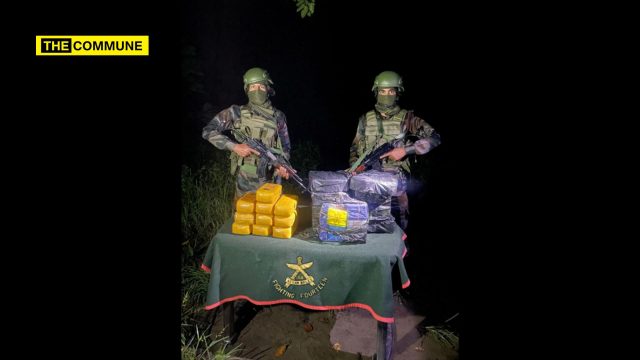
The Assam Rifles have seized highly addictive methamphetamine tablets and heroin valued at around ₹40.05 crore in Mizoram, officials said on Sunday, 27 July 2025.
A Defence spokesman said that after getting intelligence inputs, the Assam Rifles troops have launched an operation at Melbuk areas in border town Zokhawthar in eastern Mizoram’s Champhai district on Saturday night. “On conducting a thorough search, the para-military personnel recovered 1.041 kg heroin and 9.381 kg methamphetamine tablets valued approximately 40.05 crores from an abandoned place,” he said. The seized contrabands have been handed over to the Narcotics Control Bureau (NCB). Officials suspect that the Methamphetamine tablets, also known as Yaba or party tablets, and heroin were smuggled from Myanmar. Methamphetamine, which comes in tablet, powder, or crystalline form — commonly called ice or crystal meth — is a stimulant that suppresses the need for sleep and is often used by partygoers and young adults.
Myanmar’s Chin State has emerged as a major hub for drug trafficking, wildlife smuggling, and other illicit activities. The contraband is often routed through six districts in Mizoram — Champhai, Siaha, Lawngtlai, Hnahthial, Saitual, and Serchhip — which share unfenced borders of 510 km with Myanmar.
Meanwhile, Assam Rifles have been conducting awareness campaigns like seminars and group discussions highlighting the bad effects of the drugs and drugs trafficking are a punishable offence under the Narcotics Drugs and Psychotropic Substances (NDPS) Act 1985.
The Defence spokesman said that the aim of these awareness campaigns is to educate the local population, especially the youth, about the harmful effects of drug abuse and the serious legal consequences associated with drug trafficking and peddling.
The speakers in this campaign highlighted the rising threat of narcotics in society and especially in border areas of Mizoram and urged the participants to stay vigilant and not to get entrapped.
–IANS
Subscribe to our channels on Telegram, WhatsApp, and Instagram and get the best stories of the day delivered to you personally.
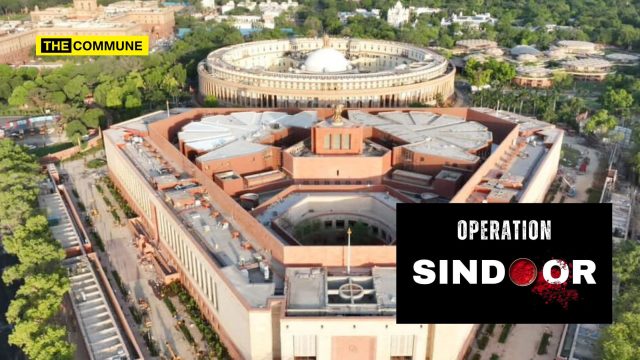
After a turbulent first week of the Monsoon Session marred by repeated disruptions, Parliament is set for a high-stakes debate on ‘Operation Sindoor’ and the Pahalgam terror attack on Monday, 28 July 2025. The proceedings are expected to be a defining moment of the Monsoon Session, focusing on matters of national security and foreign policy.
In the Lok Sabha, Defence Minister Rajnath Singh will open the debate on Operation Sindoor, a critical military and diplomatic initiative launched in response to the Pahalgam terror attack. The discussion is scheduled to continue for 16 hours, reflecting the gravity of the issues at hand.
Joining him will be Home Minister Amit Shah and External Affairs Minister S. Jaishankar, who will present the government’s stand on both the Pahalgam attack and the broader implications of Operation Sindoor. Prominent BJP MPs including Anurag Thakur and Nishikant Dubey will also contribute to the debate. On the Opposition side, Congress leader Rahul Gandhi and Rajya Sabha Leader of Opposition Mallikarjun Kharge are expected to spearhead the response, along with Samajwadi Party chief Akhilesh Yadav and several other leaders.
The Congress party has issued a whip directing all its Lok Sabha MPs to remain present for the next three days, underlining the importance it attaches to the debate. The Monsoon Session began on a stormy note, with the Opposition stalling proceedings over the Special Intensive Revision (SIR) of electoral rolls in Bihar and other contentious issues.
However, earlier on 25 July 2025, Parliamentary Affairs Minister Kiren Rijiju confirmed that the Opposition had agreed to initiate discussions on national security matters starting Monday in the Lok Sabha and continuing in the Rajya Sabha on Tuesday.
–IANS
Subscribe to our channels on Telegram, WhatsApp, and Instagram and get the best stories of the day delivered to you personally.
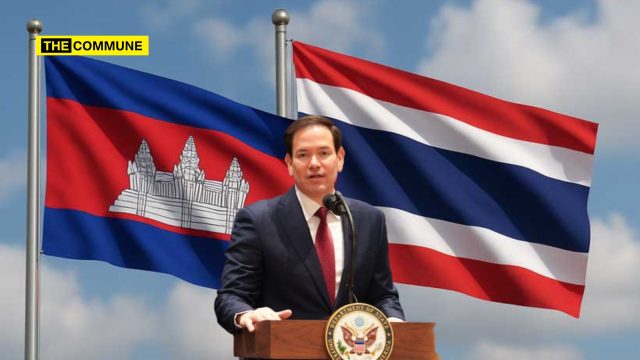
US Secretary of State Marco Rubio announced that Cambodia and Thailand are set to commence high-level talks in Malaysia, aiming to achieve an immediate ceasefire amid the escalating border clashes between the two nations.
“Cambodia and Thailand are scheduled to begin high-level talks in Malaysia shortly in hopes of achieving an immediate ceasefire. State Department officials are on the ground in Malaysia to assist these peace efforts. Both President Donald Trump and I remain engaged with our respective counterparts for each country and are monitoring the situation very closely. We want this conflict to end as soon as possible,” read a press statement issued by Rubio.
Meanwhile, Rubio on Sunday held separate telephonic conversations with Thai Foreign Minister Maris Sangiampongsa and Cambodian Deputy Prime Minister and Foreign Minister Prak Sokhonn, urging both nations to de-escalate tensions immediately and agree to a ceasefire over the ongoing border dispute between the two countries.
“Secretary Rubio reiterated President Trump’s desire for peace and the importance of an immediate ceasefire. The United States is prepared to facilitate future discussions in order to ensure peace and stability between Thailand and Cambodia,” said US State Department spokesperson Tammy Bruce. Thailand on Sunday responded to US President Donald Trump’s call for a ceasefire on the Thai-Cambodian border, saying that the country agrees in principle to have a ceasefire in place but would like to see a sincere intention from the Cambodian side.
In a statement released early Sunday, the Thai Foreign Ministry confirmed that “Acting Prime Minister Phumtham Wechayachai had a conversation with President Trump, who requested that Thailand and Cambodia agree to a ceasefire immediately.”
Phumtham told Trump that “Thailand agrees in principle to have a ceasefire in place. However, Thailand would like to see sincere intentions from the Cambodian side,” said the statement. Phumtham asked Trump to convey to the Cambodian side that “Thailand wants to convene a bilateral dialogue as soon as possible to bring forth measures and procedures for the ceasefire and the eventual peaceful resolution of the conflict,” it added.
On the other hand, Cambodian Prime Minister Hun Manet on Sunday reiterated Cambodia’s willingness for an “immediate and unconditional ceasefire” between the armed forces of Cambodia and Thailand. Clashes in the border areas between Cambodia and Thailand began on Thursday, with both sides accusing each other of violating international law.
–IANS
Subscribe to our channels on Telegram, WhatsApp, and Instagram and get the best stories of the day delivered to you personally.
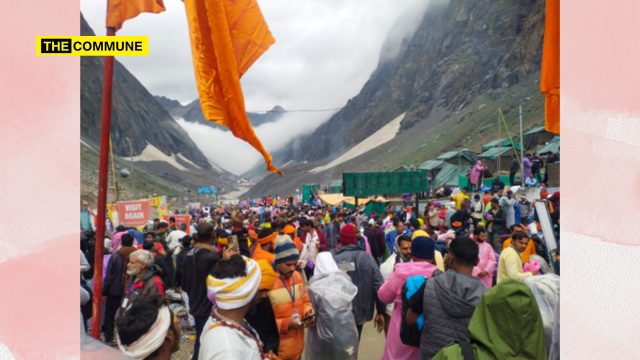
Over 3.77 lakh people performed the ongoing Amarnath Yatra since it started this year on 3 July 2025 as another batch of 1,635 devotees left Jammu for the Valley on Monday, 28 July 2025.
Officials of the Shri Amarnath Shrine Board (SASB) said the ‘Chhari Sthapana’ ceremony was held at the Shri Amareshwar Temple inside the Dashnami Akhara Building in Srinagar yesterday. Officials said the ‘Chhari Pujan’ will be celebrated on 29 August 2025 on ‘Nag Pachami’ at the same temple in Srinagar while the final journey of the Chhari Mubarak will start on 4 August 2025 towards the holy cave shrine.
“A fresh batch of 1,635 pilgrims left Jammu in two escorted convoys today. First convoy of 17 vehicles carrying 374 Yatris left at 3.25 A.M. for the Baltal base camp while the second convoy of 42 vehicles carrying 1,261 Yatris left at 4 A.M. for the Pahalgam base camp”, officials said.
Lord Shiva’s holy mace, the ‘Chhari Mubarak’, is traditionally housed inside the Amareshwar Temple at the Dashnami Akhara Building in the Budshah Chowk area of Srinagar city. It is the journey of the Chhari Mubarak that determines the landmarks of the Amarnath Yatra. It will start its final journey towards the cave shrine from the Amareshwar temple in Srinagar on August 4 and will reach the holy cave shrine on 9 August 2025, marking the official conclusion of the Yatra.
During its journey from its seat to the holy cave shrine, traditional Puja will be held en route at Pampore, Bijbehara, Mattan and Pahalgam before the Chhari Mubarak arrives at its final destination, the holy cave shrine. Authorities have made extensive multi-tier security arrangements for this year’s Amarnath Yatra, as this takes place after the cowardly attack of 22 April 2025 in which Pakistan-backed terrorists killed 26 civilians after segregating them based on faith in the Baisaran meadow of Pahalgam.
An additional 180 companies of CAPFs have been brought in to augment the existing strength of the Army, BSF, CRPF, SSB and the local police. The Army has deployed over 8,000 special commandos to secure the passage of the pilgrims this year. The Yatra started on 3 July 2025 and will end after 38 days on 9 August 2025, coinciding with Shravan Purnima and Raksha Bandhan. Yatris approach the holy cave shrine situated 3888 metres above sea level in the Kashmir Himalayas either from the traditional Pahalgam route or the shorter Baltal route. Those using the Pahalgam route pass through Chandanwari, Sheshnag and Panchtarni to reach the cave shrine, covering a distance of 46 km on foot.
This trek takes a pilgrim four days to get to the cave shrine. And those using the shorter Baltal route have to trek 14 km to reach the cave shrine and return to the base camp the same day after having darshan. No helicopter services are available to Yatris this year due to security reasons.
The cave shrine houses an ice stalagmite structure that wanes and waxes with the phases of the moon. Devotees believe that the ice stalagmite structure symbolises the mythical powers of Lord Shiva.
–IANS
Subscribe to our channels on Telegram, WhatsApp, and Instagram and get the best stories of the day delivered to you personally.
At least 11 people were injured in a stabbing at a Walmart store in Traverse City in the northern part of the US state of Michigan. Around 4:45 p.m. local time (2045 GMT) on Saturday, a 42-year-old man entered the store and used a folding knife style weapon to stab people there, the Grand Traverse County Sheriff Michael Shea told reporters.
The suspect was in custody and the attack appeared to be a random one, said the sheriff. As of Saturday evening, three people were undergoing surgery at Munson Medical Center. Five victims were in serious condition and six in critical condition, Munson Healthcare said in a statement.
People are advised to avoid the area as the investigation continues, Xinhua news agency reported. Earlier in the day, the Michigan State Police said the suspect had been taken into custody. Shea said the suspect is believed to be a Michigan resident but declined to share further details.
Gov. Gretchen Whitmer said: “Our thoughts are with the victims and the community reeling from this brutal act of violence.” Walmart said in a statement that it would continue to work closely with law enforcement in the investigation. “Violence like this is unacceptable. Our thoughts are with those who were injured and we’re thankful for the swift action of first responders,” the statement said. FBI Deputy Director Dan Bongino said in a social media post that bureau officials were responding to “provide any necessary support.”
–IANS
Subscribe to our channels on Telegram, WhatsApp, and Instagram and get the best stories of the day delivered to you personally.
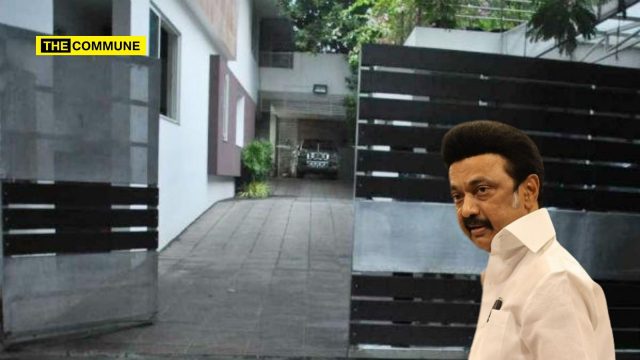
In the early hours of Sunday, an unidentified caller rang the Chennai Police Control Room claiming that a bomb had been planted at the residence of Tamil Nadu Chief Minister M.K. Stalin in Alwarpet. The alarming call triggered a swift and high-level security response. Immediately after receiving the threat, the police dispatched a bomb disposal squad along with a sniffer dog unit to the Chief Minister’s official residence.
A thorough search operation was conducted across the premises, with officers combing every corner of the house and its surroundings. After a detailed inspection lasting over an hour, police confirmed that the bomb threat was false. No explosive materials or suspicious objects were found on the premises.
Officials have now launched an investigation to trace the person behind the hoax call. The call was reportedly made from a mobile phone, and efforts are underway to track the number and identify the caller. Senior police officers confirmed that the incident is being treated seriously and that appropriate legal action will be taken against the individual responsible for creating panic and attempting to disrupt public order. Cyber and technical teams have been roped in to assist in the investigation.
This is not the first time that such fake bomb threats have been reported in Tamil Nadu. Over the past year, several prominent locations — including government offices, shopping malls, schools, and railway stations — have received similar hoax threats, often leading to evacuations and security sweeps.
In April 2023, multiple schools across Chennai and Coimbatore received email threats warning of planted bombs, which also turned out to be false. In another instance in early 2024, a threat call targeted the Madras High Court premises, which led to a temporary lockdown of the area. Security experts have warned that repeated hoax calls can lead to desensitisation of emergency response systems and drain valuable public resources. Police have appealed to the public to refrain from such mischief, stressing that strict legal consequences await those found guilty.
Meanwhile, CM Stalin, who has been governing the state from a hospital bed following a recent medical procedure, was promptly informed of the development.
–IANS
Subscribe to our channels on Telegram, WhatsApp, and Instagram and get the best stories of the day delivered to you personally.
South Korea has the second-highest share of manufacturing in its gross domestic product (GDP) among major economies, data showed on Sunday, underscoring its vulnerability to the aggressive tariff measures by the United States.
The manufacturing sector accounted for 27.6 percent of South Korea’s GDP in 2023, far higher than the average 15.8 percent of the member countries of the Organization for Economic Cooperation and Development (OECD), according to the National Assembly Budget Office (NABO). It ranked second among OECD member countries, following Ireland at 31 percent.
By comparison, Germany recorded 20.1 percent and Japan 20.7 percent, reports Yonhap news agency. “While most advanced economies are seeing an increasing share of the service sector, South Korea continues to maintain a relatively high level of manufacturing output,” the office said. “Given the size of its economy, South Korea is still regarded as a country with a relatively high dependence on manufacturing.”
The manufacturing sector remains the backbone of the Korean economy, with key industries, including semiconductors, rechargeable batteries, shipbuilding and automobiles, maintaining global competitiveness. Driven by its manufacturing-based economy, South Korea remains highly dependent on exports as a key growth engine. As of 2024, exports accounted for 44.4 percent of the nation’s GDP, compared with the OECD average of 30 percent. Among the Group of Seven (G7) nations, Germany posted the highest export-to-GDP ratio at 41.8 percent, followed by France with 33.9 percent, Italy with 32.7 percent and Canada with 32.4 percent. The U.S. recorded 10.9 percent.
South Korea’s export dependence on the U.S. stood at 18.8 percent in 2024. Given the country’s high manufacturing ratio and export reliance on the U.S., the envisioned reciprocal tariffs are feared to deliver a major economic blow. Last-minute negotiations are under way between Seoul and Washington, as the Donald Trump administration has warned that South Korea will face a 25 percent reciprocal tariff unless a deal is reached before Aug. 1. “If the proposed reciprocal tariffs take effect, the Korean economy could suffer a significant impact,” said Yang Joon-seok, an economics professor at the Catholic University of Korea. “We should leverage our strengths in key sectors, such as shipbuilding and semiconductors, during the negotiations,” he added.
—IANS
Subscribe to our channels on Telegram, WhatsApp, and Instagram and get the best stories of the day delivered to you personally.
A flood alert has been issued for residents living along the banks of the Lower Bhavani River, as the water level in the Bhavanisagar Dam (Lower Bhavani Dam) in Tamil Nadu’s Erode district is rapidly rising and is likely to reach 100 feet on Sunday.
According to officials from the Water Resources Department (WRD), the dam recorded a water level of 99.06 feet at 11 a.m. on Saturday, with an inflow of 7,383 cusecs. The dam’s full capacity is 32.80 tmcft, which corresponds to a water level of 105 feet. Once the level reaches 100 feet — likely on Sunday morning — the surplus water will be released into the Bhavani River.
A senior WRD official said the inflow has surged due to persistent rainfall in the dam’s catchment areas, which are expected to continue for the next few days. “As per standard operating procedure, surplus water must be released when the water level reaches 100 ft in July. We will maintain the level at 100 ft till July 31. From August 1, it can be held up to 102 ft,” he said.
This marks the first release of surplus water from the Bhavanisagar Dam since October 2022. In the intervening period, water was discharged only for irrigation and drinking purposes. The department warned that the current water discharge of 3,000 cusecs may be increased up to 10,000 cusecs or more, depending on the inflow. “All people residing along the Bhavani River and in low-lying areas should move to safer locations. Precautionary steps must be taken to safeguard lives and property,” the WRD stated. Erode District Collector S. Kandasamy has advised the public to stay away from the river.
“People should refrain from bathing, fishing, taking photographs, or allowing livestock into the river,” he said. Meanwhile, in neighbouring Tiruppur district, water release from the Amaravathi Dam has been increased to 6,950 cusecs. The dam, which has remained at full capacity for over 45 days, recorded a level of 88.16 feet (3,880 mcft) on Saturday, just short of its maximum of 90 feet (4,047 mcft). The inflow stood at 10,961 cusecs, and the outflow at 12,450 cusecs. “With inflow likely to rise further, we plan to reduce the dam’s maintenance level to 87.5 feet soon,” a WRD official said. Authorities continue to closely monitor the situation and urge the public to follow safety instructions.
–IANS
Subscribe to our channels on Telegram, WhatsApp, and Instagram and get the best stories of the day delivered to you personally.
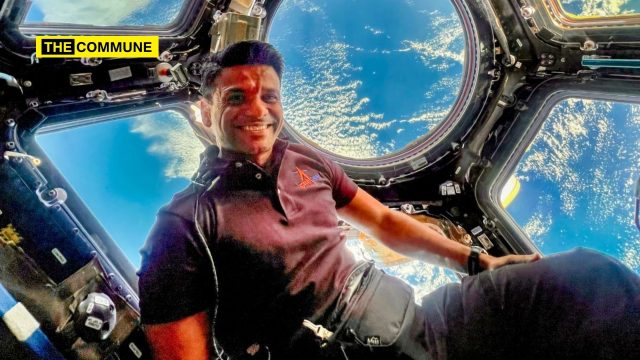
Prime Minister Narendra Modi on Sunday expressed pride over the recent achievements by Indians in space, science, sports, and culture. Addressing the 124th episode of his monthly radio programme ‘Mann Ki Baat’, PM Modi made a special mention of Indian astronaut Shubhanshu Shukla, whose recent space mission created waves of joy and national pride across the country.
“In the past few weeks, a lot has happened that has made every Indian proud — be it sports, science or culture. Recently, Shubhanshu Shukla’s return from space was discussed a lot in the country. The moment Shubhanshu landed safely back on Earth, people jumped with joy. A wave of happiness spread across every heart. The whole country was filled with pride,” said PM Modi. Recalling the excitement and curiosity generated after Chandrayaan-3’s successful moon landing in August 2023, he noted how the mission had sparked a deep interest in science and space among children.
“I still remember when Chandrayaan-3 successfully landed on the moon… Even young kids now say, “We will also go to space, we will also land on the moon and become space scientists.” The Prime Minister highlighted the growing reach of the Inspire-Manak campaign, an initiative to promote innovation among school children. “Five children are selected from every school who bring new ideas. So far, lakhs of children have become part of this initiative, and after Chandrayaan-3, the number has doubled,” he said. PM Modi also spoke about the rapid rise of space-related startups in the country, stating that their numbers have jumped from fewer than 50 five years ago to over 200 today.
In this context, he announced that August 23 will be celebrated as ‘National Space Day’ and invited citizens to share their suggestions on how they plan to mark the occasion. Stressing the new energy with which Indian science is progressing in the 21st century, he proudly spoke of Indian students winning medals at the International Chemistry Olympiad. “Devesh Pankaj, Sandeep Kuchi, Debadatta Priyadarshi and Ujjawal Kesari – these four made India proud,” he said. He also acknowledged India’s achievements in mathematics, noting the students’ performance at the International Mathematical Olympiad, where they brought home three gold, two silver and one bronze medal. Looking ahead, PM Modi said India will host the Astronomy and Astrophysics Olympiad in Mumbai next month, with participants from 60 countries. He noted that this will be the largest such Olympiad held so far and added, “In a way, India is now moving forward in both Olympic and Olympiad.”
–IANS
Subscribe to our channels on Telegram, WhatsApp, and Instagram and get the best stories of the day delivered to you personally.
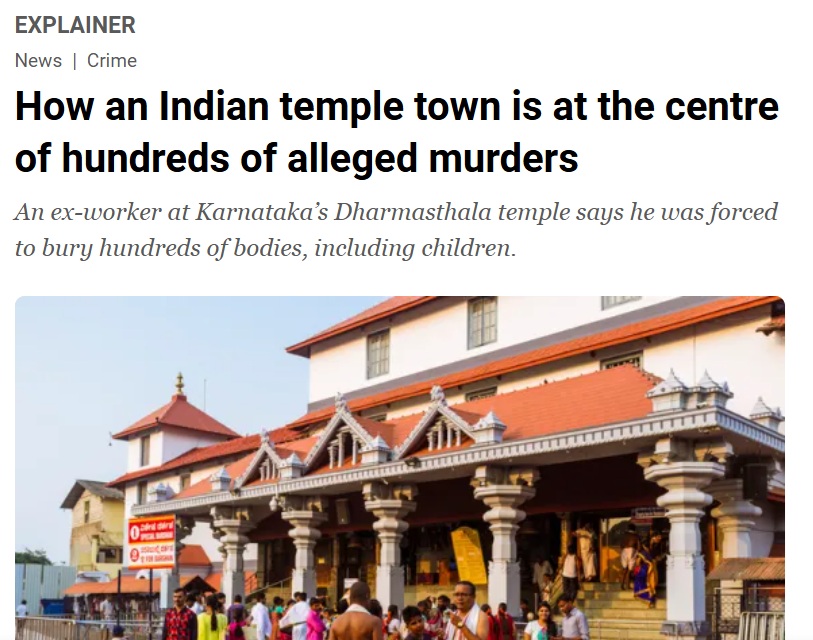
Dharmasthala, formerly known as Kuduma, is a historic temple town located on the banks of the Nethravathi River in Belthangady taluk, Dakshina Kannada district, Karnataka. It is renowned for the Dharmasthala Temple, dedicated to Lord Manjunatha (Shiva), along with shrines to deities like Ammanavaru, Chandranath, and Dharma Daivas such as Kalarahu and Kumaraswamy. Uniquely, the temple is managed by a Jain administration while Vaishnava Hindu priests conduct the rituals. This rare blend of Jain and Hindu traditions draws about 2,000 pilgrims daily, making it a prominent spiritual and cultural destination in southern India.
Over the past few weeks, the temple town and the temple administration have been rocked by allegations following explosive claims by a former sanitation worker. He alleges that, over a span of nearly two decades, he was coerced into burying the bodies of rape and murder victims on behalf of the temple administration. These sensational accusations have been aggressively promoted by left-leaning media outlets such as The News Minute, which have portrayed the claims, despite their anonymous and unverified nature, as evidence of a systemic cover-up.
Their journalists Pooja Prasanna, known for her Keeladi & Auroville propaganda videos, also entered the scene for the Dharmasthala issue.
The Allegations: A Summary
The whistleblower, a former sanitation worker, alleges:
He was forced to bury hundreds of bodies (mostly women and minors) between 1998 and 2014.
The bodies showed signs of sexual assault, strangulation, and acid burns.
He fled Dharmasthala in 2014 after his niece was molested by someone linked to the temple.
He returned in 2025, exhumed one skeleton, and filed an FIR seeking witness protection.
Media outlets, particularly The News Minute, have aggressively pushed this narrative, drawing parallels to the 2012 Sowjanya case (an unresolved rape-murder) and insinuating a systemic cover-up by the Dharmasthala temple administration.
However, no concrete evidence has been presented beyond the whistleblower’s testimony.
Al Jazeera’s Narrative
Jumping on this bandwagon to malign Dharmasthala’s name is Al Jazeera, the Qatar government funded propaganda outlet that is known for peddling anti-Hindu and anti-India narratives.
In their short video report, they make even worse allegations than TNM and other leftist media.
The video starts by framing the issue as “one of the worst serial killings in history.”
Then they shift to the “whistleblower” and identify him as “Dalit”, then they go on to say, “According to Hinduism’s caste system, the Dalits are at the bottom. They’re considered unpure and are often persecuted in India. As per tradition, temple administrators are from a higher caste.”
Critical Flaws In The Allegations
With so many allegations and exaggerated numbers floating around, there seems to be no evidence to prove any of those. However, several questions crop up in the mind owing to the following flaws in the allegations made.
#1 No Physical Evidence Or Independent Verification
The whistleblower claims to have buried hundreds of bodies, yet only one skeleton has been presented. No forensic reports, DNA tests, or autopsy records have corroborated his claims.
The locations of these alleged burials remain undisclosed, despite his offer to guide police.
Here’s what needs to be asked – If hundreds of bodies were buried over 16 years, why has no one else – locals, pilgrims, or workers – ever reported foul smells, suspicious activities, or mass graves?
#2 Contradictions In The Whistleblower’s Account
He claims he was forced to bury bodies secretly, yet Dharmasthala is a highly frequented pilgrimage site with thousands of visitors daily.
He alleges superiors threatened him, but no names have been disclosed, even in his FIR. He fled in 2014 but returned only in 2025 – why the 11-year delay?
Here’s what needs to be asked – If he was truly traumatized, why did he wait so long to speak up? Was he influenced by external forces?
#3 Panchayat Records Dispute The Claims
Dharmasthala Panchayat Vice President Shrinivas Rao stated that all unclaimed bodies are officially documented and disposed of lawfully.
Records of burials (including suicides near the Netravati River) have been maintained since the 1980s, with receipts and official approvals.
The panchayat denies any clandestine burials and challenges the whistleblower to provide proof.
Here’s what needs to be asked – If the panchayat has maintained records, why hasn’t the media scrutinized them instead of relying solely on unverified claims?
#4 The Sowjanya Case: A Separate Tragedy, Not Proof Of A Conspiracy
The 2012 rape and murder of Sowjanya, a 17-year-old student, was a horrific crime that remains unresolved. However, linking it to the current allegations is misleading. Santhosh Rao, the accused, was acquitted in 2023 due to lack of evidence.
The CBI and courts found no proof of involvement by temple officials. Sowjanya’s family’s grief is genuine, but activists are exploiting their pain to push unverified claims.
Here’s what needs to be asked – If the temple was involved in a cover-up, why did the CBI, CID, and Karnataka HC find no evidence in Sowjanya’s case? And if these were connected, why were there no protests at that time? As per the witness, the murder and burials were a decade before Sowjanya’s rape and murder occurred.
#5 Why Did Only One Whistleblower Come Forward After So Long?
The lone witness says he remained silent for over a decade, that is, throughout years of major protests about other tragedies in the same town, only coming forward now, after living “in hiding”. Why didn’t his conscience or fear for his life drive him to speak up during previous waves of scrutiny?
The whistleblower admits to having no identifiable information regarding the deceased – he claims he never knew their names, origins, or details, and cannot explain why no families except one (Ananya Bhatt) have stepped forward even after massive publicity
#6 Why Are There No Missing Persons Records Or Family Testimonies?
The magnitude of “hundreds” and “thousands” of rape, murder, and disappearances would, in any scenario, be expected to provoke multiple missing persons reports, press coverage, or at least numerous families demanding action. Since the claims surfaced, only one family (Ananya Bhatt’s mother) has registered a fresh case supporting the exhumation request. Is it credible that all other families have been silenced, lost, or uninterested?
Panchayat and police protocols mandate notices in newspapers, week-long waits for bodies to be claimed, and official registration of every natural or unnatural death in the area.
Al Jazeera claims “How did anyone not notice so many people were missing? Well, here’s the thing. They did. For years, people in the area have reported the sudden disappearance of girls and women. Families and activist groups say their complaints went nowhere as influential people, even the police, covered up the questions surrounding the town.”
Here’s what must be asked – Are there factual gaps in the audit trails? Where are the records of missing, untracked individuals to support these extraordinary claims?
Is Dharmasthala Being Targeted By Leftist Communal Forces?
Is this a coordinated attack on Dharmasthala’s religious and social influence? If the whistleblower’s claims are true, why has no one else, no grieving families, no co-workers, no local witnesses come forward in 20+ years?
Dharmasthala is located in Dakshin Kannada, a communally sensitive region with Islamist forces trying to gain foothold like they did in Malappuram region of Kerala. Over the past decades, Dakshin Kannada has seen several instances of communal violence and murders linked to religious or community-based issues. There have been cases of ISIS-recruitment in the region as well.
It is possible that Dharmasthala which has deep religious significance for Kannadigas and Hindus in general has been fighting the Islamist jihadi forces and preventing from converting the masses.
While there may be truth to the murders of Sowjanya, Ananya, and other young girls, tying it to the institution, the temple is not right. Investigation is necessary for each of the cases and the perpetrator must be brought to justice. But to malign an entire institution, an entire community just for the sake of the leftist agenda is so not done.
The News Minute’s Credibility Falters, Yet Again
The News Minute, in the past, has been at the forefront of all anti-Hindu/anti-India narratives – be it the Kalakshetra case, the manufactured Keezhadi issue or the more recent hit-job on Auroville peddled by the portal.
All three cases have been shining examples where they unnecessarily created controversy to set a narrative suitable to the leftists and the powers working behind the curtains. The Commune doggedly reported on the truth behind each issue and will continue to do so in the Dharmasthala case as well.
A Coordinated Assault On Dharmasthala?
What we are witnessing in the Dharmasthala controversy appears to be part of a larger, orchestrated information war driven by a nexus of left-leaning media houses, global anti-Hindu platforms, and ideological operatives. Outlets like The News Minute and Al Jazeera have consistently amplified unverified, sensational narratives against Hindu institutions – be it temples, spiritual communities, or cultural symbols, while conveniently ignoring the glaring lack of evidence or contradictory facts. These platforms operate with a clear agenda: to delegitimize Hindu religious spaces, undermine traditional faith systems, and erode public trust in centuries-old cultural institutions. The strategy is always the same—plant a salacious story based on dubious testimonies, repeat it across coordinated media nodes, invoke emotional triggers like caste, gender, and justice, and finally, frame it as a fight against systemic oppression. In doing so, they provide intellectual cover for radical elements that seek to fracture India’s social fabric – from jihadist recruitment hubs in sensitive regions like Dakshina Kannada to global actors interested in destabilizing India’s civilizational confidence. Dharmasthala isn’t just a temple under attack; it is a symbol being targeted in a coordinated ideological assault masquerading as journalism.