In a shocking display of ignorance and (or) deliberate twisting of facts, DMK chief M.K. Stalin during his ‘We Reject ADMK’ Gram Sabha meet organized as part of his campaign trail in Cuddalore, peddled misinformation and outright lies about the recently enacted farmer empowerment laws.
The DMK chief while addressing the public said “The Central Government.. the BJP government has brought in three agriculture laws. It states that farmers can no longer cultivate crops in their lands. No farmer can sell his produce at a price determined by him. All mandis will be closed. It is all going to go to private corporate companies. It is going to go to Adani group. We can’t get profits from the crop we sow, it will all go to corporate companies.”
All the things said by M.K. Stalin are baseless and blatant lies. It seems like a deliberate attempt to peddle misinformation about the laws among the public to mislead them and gain votes in the upcoming Assembly elections. In fact, the three laws seek to do the exact opposite of what Stalin is peddling.
Here is an explainer busting the lies that are frequently peddled by DMK and its henchmen in the media:
Lie 1: MSP will be scrapped
Truth: Time and again, the Government of India has clarified that procurement through Minimum Support Price (MSP) will continue and farmers can sell their produce at MSP rate.
In fact, in the ongoing Kharif Marketing Season (KMS), Government of India continues to procure Kharif crops at MSP rates from farmers as per existing MSP Schemes.
Procurement has been going on smoothly across different states in India that includes Punjab, Haryana, Uttar Pradesh, Madhya Pradesh, Odisha, Kerala and Tamil Nadu to name a few. 462.88 LMT of paddy has been procured up to December 28 registering a 24.90% increase against the corresponding purchase of 370.57 LMT last year.
About 57.47 lakh farmers have already been benefitted from the ongoing procurement operations with MSP value of ₹87391.98 crore.
The Central Government, based on the proposal from the States, approved for the procurement of 51.66 LMT of Pulse and Oilseeds for the 2020 Kharif Marketing Season for the States of Tamil Nadu, Karnataka, Maharashtra, Telangana, Gujarat, Haryana, Uttar Pradesh, Odisha, Rajasthan and Andhra Pradesh under Price Support Scheme(PSS).
Lie 2: Government is conspiring to sell the lands to rich capitalists and industrialists
Truth: The act provides for contract farming between a buyer and farmers. A contract farming agreement between the farmer and the buyer must provide for a conciliation board as well as a conciliation process for settlement of disputes. The board should have a fair representation of the parties to the agreement. The act proposes to create a three-level dispute settlement mechanism: the conciliation board, Sub-Divisional Magistrate and Appellate Authority. At first, all disputes must be referred to the board for resolution. If it remains unresolved for more than 30 days, parties may approach the Sub-divisional Magistrate for resolution. If the parties are not satisfied with the decision of the sub-divisional magistrate, they will have a right to appeal to an Appellate Authority which will be presided by collector or additional collector. Penalty can be levied by the Magistrate or the Appellate Authority on the party contravening the agreement.
However, sale, lease or mortgage of farmers’ land is totally prohibited and farmers’ land is also protected against any recovery.
Lie 3: Farmers will be disadvantaged in terms of fixing the price
Truth: The farmer will have full power in the contract to fix a sale price of his choice for the produce. They will receive payment within maximum 3 days.
Lie 4: Buyers will exploits farmers
Truth: The price of farming produce should be mentioned in the agreement. For items where prices are subjected to fluctuations, a guaranteed price for the produce and a clear reference for any additional amount above the guaranteed price must be specified in the agreement. The process of price determination must also be mentioned in the agreement. Thus, this act will encourage farmers to engage with processors, wholesalers, aggregators, large retailers, exporters etc., on a level playing field.
Lie 5: Farmer will be severely hit if there are market fluctuations
Truth: Price will be assured to farmers even before sowing of crops. In case of higher market price, farmers will be entitled to this price over and above the minimum price. It will transfer the risk of market unpredictability from the farmer to the sponsor. Due to prior price determination, farmers will be shielded from the rise and fall of market prices.
If the acts are said to be of benefit to the farmers, why is there opposition to it?
Agricultural produce selling has 3 major stakeholders at play apart from the farmers: commission agents, state mandis and bureaucracy. The local APMC mandis are heavily politicized with the commission agents and middlemen having political influence gulping a major portion of the profit. The existing system leaves the farmer parched with less money. Once these reforms are implemented, those who have been making money at the cost of farmers will stand to lose. The middlemen commission and patronage structure will disappear. It is these middlemen who stand to lose who are against these laws.
DMK in its 2016 election manifesto had promised the same things it is opposing now
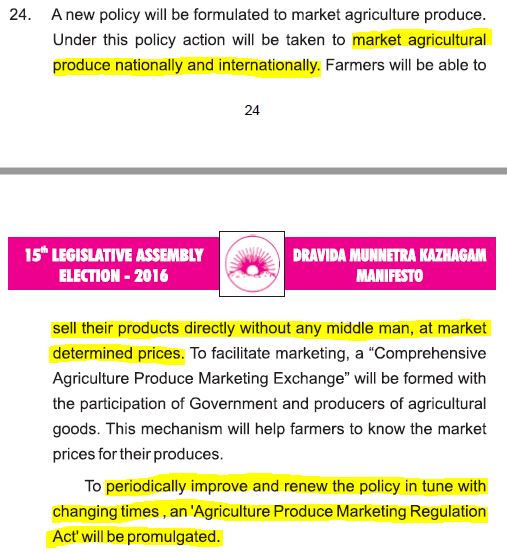
It has been found that the DMK is protesting against the very same things that they promised in their manifesto in 2016.
In its 2016 manifesto for the Assembly Elections, the DMK had promised to formulate a new policy to help farmers market agricultural produce nationally and internationally.
It had stated that it would bring in a policy that will enable farmers to sell their produce directly without the interference of any middlemen at market determined prices.
It had also stated that it would review the Agriculture Produce Marketing Regulation Act with changing times.
This is exactly what the recently enacted farm laws seeks to do. Through the new farm laws, farmers have been empowered by giving them the choice to sell their produce where they get a better price. Those who want to sell in the APMC can continue to do so and those wanting to explore the market have been given the choice to. The middlemen commission and patronage structure will disappear as farmers have the choice to sell directly to anyone at the farm gate.











DMK chief MK Stalin lies through his teeth about farmer empowerment laws
In a shocking display of ignorance and (or) deliberate twisting of facts, DMK chief M.K. Stalin during his ‘We Reject ADMK’ Gram Sabha meet organized as part of his campaign trail in Cuddalore, peddled misinformation and outright lies about the recently enacted farmer empowerment laws.
The DMK chief while addressing the public said “The Central Government.. the BJP government has brought in three agriculture laws. It states that farmers can no longer cultivate crops in their lands. No farmer can sell his produce at a price determined by him. All mandis will be closed. It is all going to go to private corporate companies. It is going to go to Adani group. We can’t get profits from the crop we sow, it will all go to corporate companies.”
All the things said by M.K. Stalin are baseless and blatant lies. It seems like a deliberate attempt to peddle misinformation about the laws among the public to mislead them and gain votes in the upcoming Assembly elections. In fact, the three laws seek to do the exact opposite of what Stalin is peddling.
Here is an explainer busting the lies that are frequently peddled by DMK and its henchmen in the media:
Lie 1: MSP will be scrapped
Truth: Time and again, the Government of India has clarified that procurement through Minimum Support Price (MSP) will continue and farmers can sell their produce at MSP rate.
In fact, in the ongoing Kharif Marketing Season (KMS), Government of India continues to procure Kharif crops at MSP rates from farmers as per existing MSP Schemes.
Procurement has been going on smoothly across different states in India that includes Punjab, Haryana, Uttar Pradesh, Madhya Pradesh, Odisha, Kerala and Tamil Nadu to name a few. 462.88 LMT of paddy has been procured up to December 28 registering a 24.90% increase against the corresponding purchase of 370.57 LMT last year.
About 57.47 lakh farmers have already been benefitted from the ongoing procurement operations with MSP value of ₹87391.98 crore.
The Central Government, based on the proposal from the States, approved for the procurement of 51.66 LMT of Pulse and Oilseeds for the 2020 Kharif Marketing Season for the States of Tamil Nadu, Karnataka, Maharashtra, Telangana, Gujarat, Haryana, Uttar Pradesh, Odisha, Rajasthan and Andhra Pradesh under Price Support Scheme(PSS).
Lie 2: Government is conspiring to sell the lands to rich capitalists and industrialists
Truth: The act provides for contract farming between a buyer and farmers. A contract farming agreement between the farmer and the buyer must provide for a conciliation board as well as a conciliation process for settlement of disputes. The board should have a fair representation of the parties to the agreement. The act proposes to create a three-level dispute settlement mechanism: the conciliation board, Sub-Divisional Magistrate and Appellate Authority. At first, all disputes must be referred to the board for resolution. If it remains unresolved for more than 30 days, parties may approach the Sub-divisional Magistrate for resolution. If the parties are not satisfied with the decision of the sub-divisional magistrate, they will have a right to appeal to an Appellate Authority which will be presided by collector or additional collector. Penalty can be levied by the Magistrate or the Appellate Authority on the party contravening the agreement.
However, sale, lease or mortgage of farmers’ land is totally prohibited and farmers’ land is also protected against any recovery.
Lie 3: Farmers will be disadvantaged in terms of fixing the price
Truth: The farmer will have full power in the contract to fix a sale price of his choice for the produce. They will receive payment within maximum 3 days.
Lie 4: Buyers will exploits farmers
Truth: The price of farming produce should be mentioned in the agreement. For items where prices are subjected to fluctuations, a guaranteed price for the produce and a clear reference for any additional amount above the guaranteed price must be specified in the agreement. The process of price determination must also be mentioned in the agreement. Thus, this act will encourage farmers to engage with processors, wholesalers, aggregators, large retailers, exporters etc., on a level playing field.
Lie 5: Farmer will be severely hit if there are market fluctuations
Truth: Price will be assured to farmers even before sowing of crops. In case of higher market price, farmers will be entitled to this price over and above the minimum price. It will transfer the risk of market unpredictability from the farmer to the sponsor. Due to prior price determination, farmers will be shielded from the rise and fall of market prices.
If the acts are said to be of benefit to the farmers, why is there opposition to it?
Agricultural produce selling has 3 major stakeholders at play apart from the farmers: commission agents, state mandis and bureaucracy. The local APMC mandis are heavily politicized with the commission agents and middlemen having political influence gulping a major portion of the profit. The existing system leaves the farmer parched with less money. Once these reforms are implemented, those who have been making money at the cost of farmers will stand to lose. The middlemen commission and patronage structure will disappear. It is these middlemen who stand to lose who are against these laws.
DMK in its 2016 election manifesto had promised the same things it is opposing now
It has been found that the DMK is protesting against the very same things that they promised in their manifesto in 2016.
In its 2016 manifesto for the Assembly Elections, the DMK had promised to formulate a new policy to help farmers market agricultural produce nationally and internationally.
It had stated that it would bring in a policy that will enable farmers to sell their produce directly without the interference of any middlemen at market determined prices.
It had also stated that it would review the Agriculture Produce Marketing Regulation Act with changing times.
This is exactly what the recently enacted farm laws seeks to do. Through the new farm laws, farmers have been empowered by giving them the choice to sell their produce where they get a better price. Those who want to sell in the APMC can continue to do so and those wanting to explore the market have been given the choice to. The middlemen commission and patronage structure will disappear as farmers have the choice to sell directly to anyone at the farm gate.