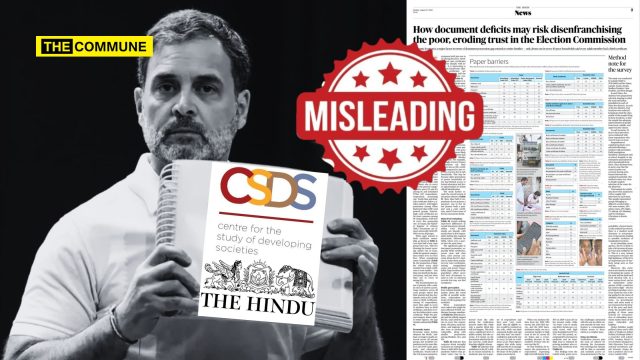
On August 17, The Hindu published a headline screaming that Indians are losing “trust” in the Election Commission. But what the newspaper deliberately concealed behind its sensationalism was a grossly flawed survey design and methodology that make its sweeping claims completely baseless.
The survey behind the headline wasn’t pan-India. It covered only six states—Assam, West Bengal, Kerala, Uttar Pradesh, Madhya Pradesh, and Delhi—with 500 respondents per state. Assam and UP were given equal weightage, despite huge differences in population and demographics. These limitations were hidden in fine print, while the headline loudly claimed a nationwide truth. And the paper expected readers to take it at face value.
Far from a nationwide study, the survey covered only six states—Assam, West Bengal, Kerala, Uttar Pradesh, Madhya Pradesh, and Delhi—with a limited sample size of 500 respondents per state. Assam and Uttar Pradesh were bizarrely given equal weight despite their vastly different populations, fatally compromising the results. The paper failed to disclose these critical limitations in its headlines or reporting, misleading millions of readers about the survey’s true scope.
The Hindu also ignored the religious makeup of these states, four of which have significant Muslim populations, a key factor that was nowhere acknowledged or analyzed. It did not question why these six states were chosen or scrutinize the sample design and weighting that remain undisclosed behind closed doors.
Even more damningly, The Hindu deliberately overlooked glaring contradictions in its own sourced data: while over 97% respondents in Assam and West Bengal reportedly have the necessary documentation for voting, 45% still fear “vote cutting.” This disparity was not investigated but instead presented uncritically as unquestioned truth.
On the very day The Hindu published this misleading story, Rahul Gandhi launched his Bihar Yatra with claims of “vote chori” (vote theft), leveraging the badly reported survey to fan political flames. The Hindu’s reckless amplification of the agenda without demanding transparency or verifying facts makes it complicit in spreading misinformation.
By failing its readers in this manner, The Hindu not only betrayed journalistic standards but encouraged distrust in democratic institutions without any credible basis. This is a shameful exhibition of irresponsible journalism, reducing a respected paper to a conveyor belt for unchecked narratives.
The Hindu owes its readers an explanation for why it amplified unverified claims from a flawed survey and chose to ignore critical context that would have told a very different story.
Dilip Mandal has sharply criticized The Hindu for irresponsibly reporting on the Lokniti-CSDS survey that claimed a loss of trust in the Election Commission. He pointed out the paper’s failure to highlight the survey’s limited scope, flawed methodology, and ignored contradictions in the data. Mandal condemned the newspaper for amplifying unverified claims without scrutiny, misleading readers, and fueling political narratives without demanding transparency from the survey agency. His critique highlights a severe lapse in journalistic standards and calls attention to media accountability in the face of politicized data.
Dear Editors of The Hindu,
Say sorry to your readers.
On the morning of August 17, you @the_hindu published survey findings of @LoknitiCSDS with a screaming headline claiming that Indians are losing “trust” in the Election Commission.
Lord Manjunatha is far more than a deity—he is the living embodiment of faith, reverence, and an eternal spiritual bond, consecrated in the sacred crucible of Dharmasthala. But this sacred temple town was dragged through the mud by the usual suspects of leftist media, with The News Minute leading the charge.
In an unmistakably malicious attempt to defame Hindus and their religious institutions, it spearheaded a campaign of baseless allegations, fabrications, and selectively distorted reporting.
While repeatedly brandishing the victim card under the guise of free speech, they sought to portray themselves as authorities on ‘exposing’ the Dharmasthala Temple management—an obvious attempt to provoke local Hindus into questioning their reverence for the temple by fabricating a scandal.
Before we get into the nitty-gritties of what and how they reported, here’s a primer that exposes their agenda.
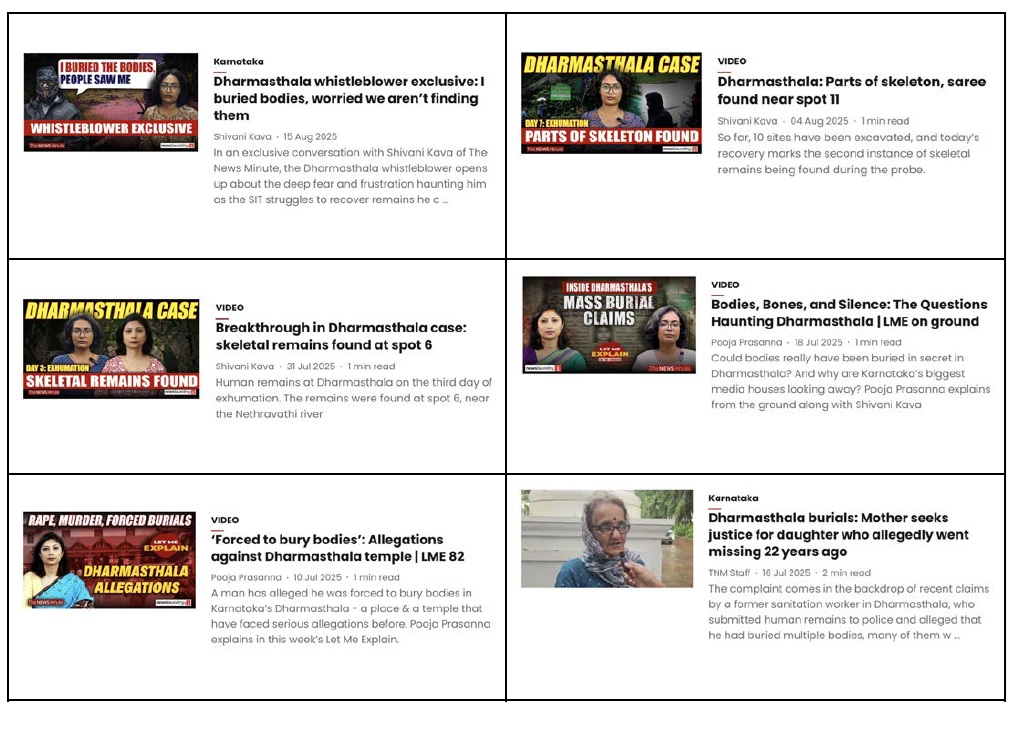
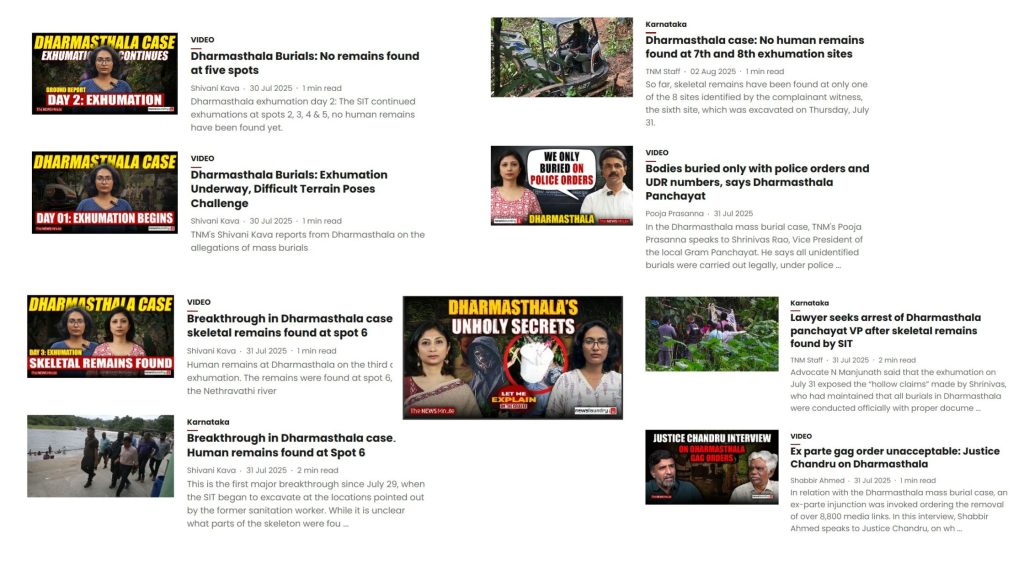
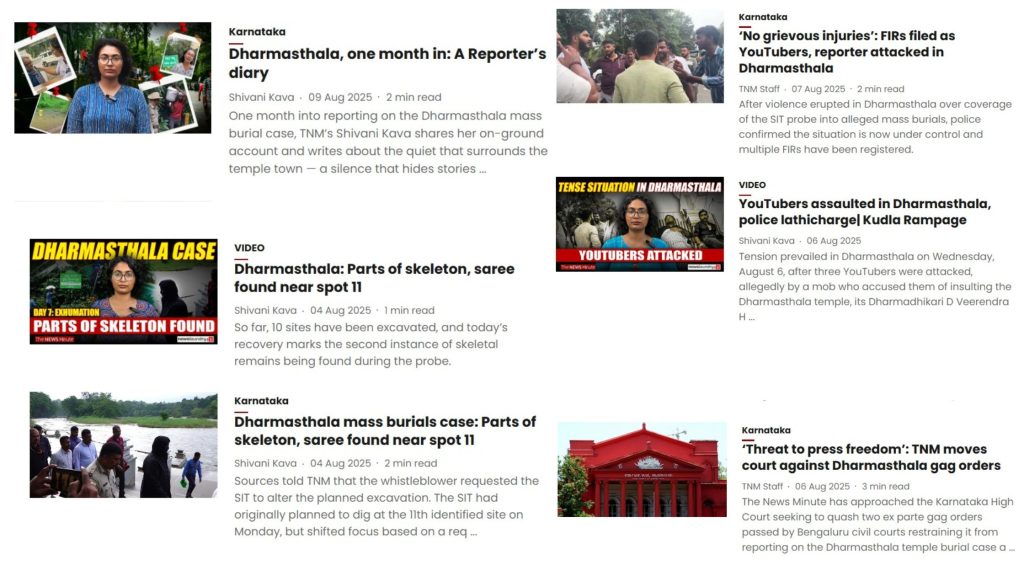
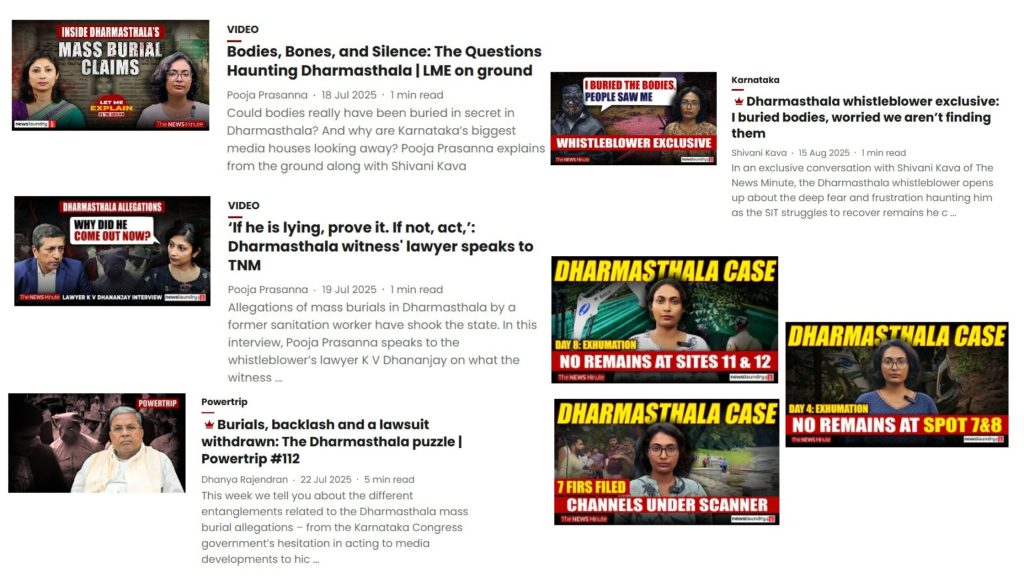
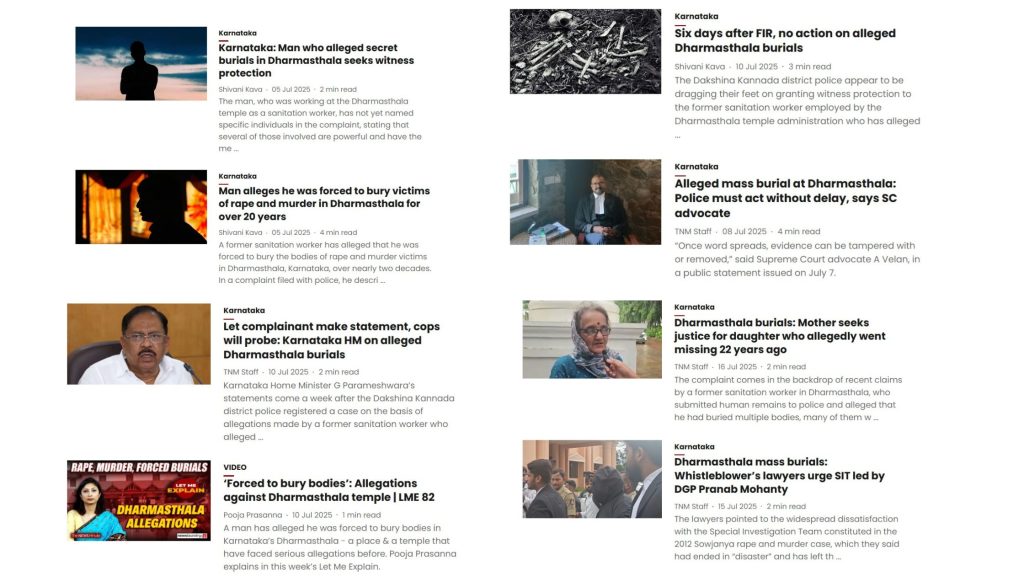
In 2025 alone, The News Minute pushed out more than 24 full-length reports on the Dharmasthala issue without even proven allegations of sexual assault or rape being reported.
Some of the reports include:
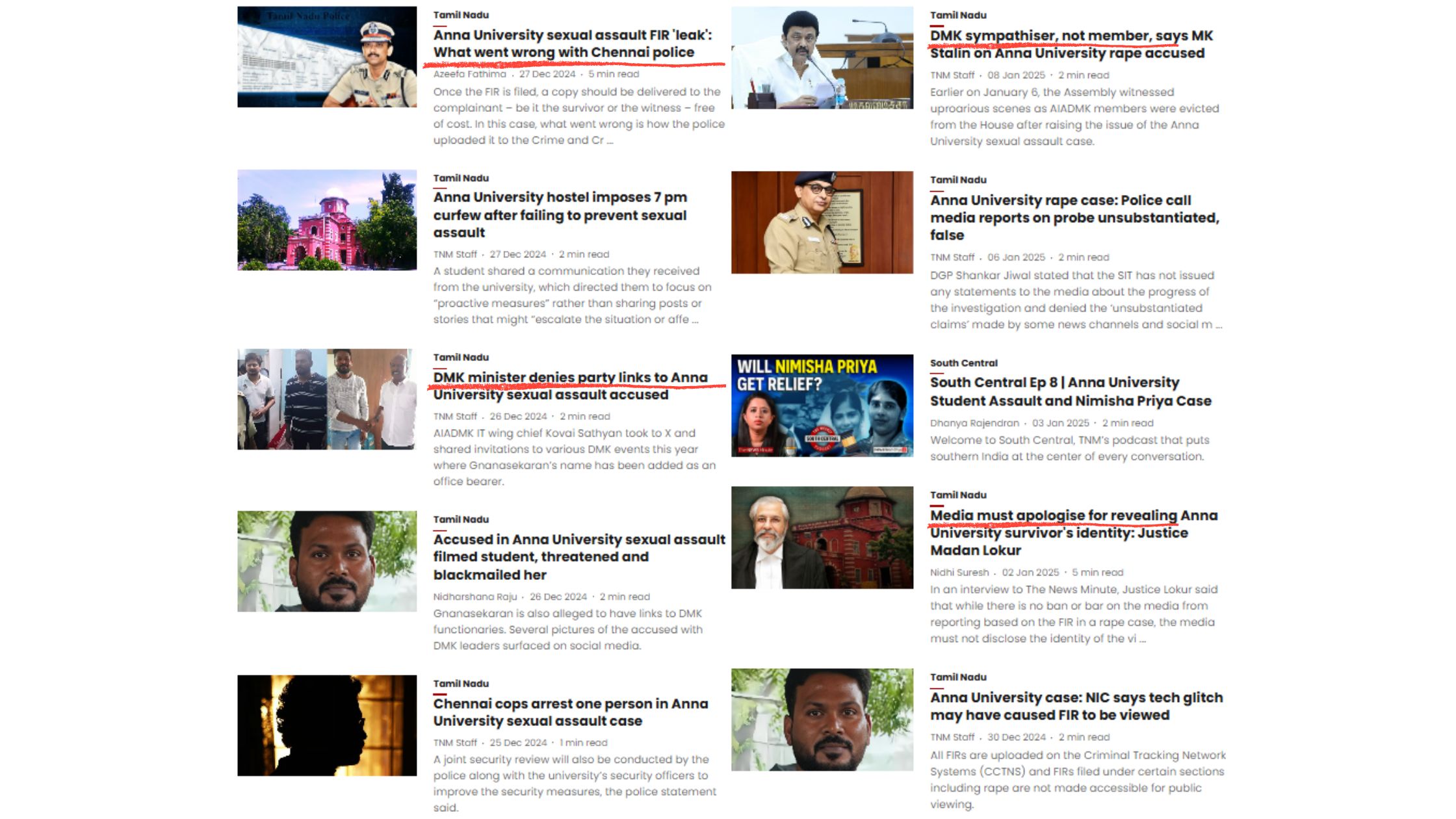
In glaring contrast, their reporting on the Anna University sexual assault case lays bare the truth—they are not The News Minute, but The New Murasoli, the DMK’s unofficial mouthpiece masquerading as a news outlet.
On one hand, TNM took the words of a ‘masked man’ at face value, eagerly amplifying baseless claims and peddling propaganda without a shred of proof. Yet when confronted with incontrovertible evidence implicating a DMK man as the perpetrator in the Anna University sexual assault case, it went into protective mode—downplaying the facts and shielding the party it favors.
Coming back to our topic, let’s now take a closer look at how The News Minute tried to smear the Dharmadhikari Veerendra Heggade–run Dharmasthala temple and shame Hindus about their faith.
Reporting – Facts Or Fiction?
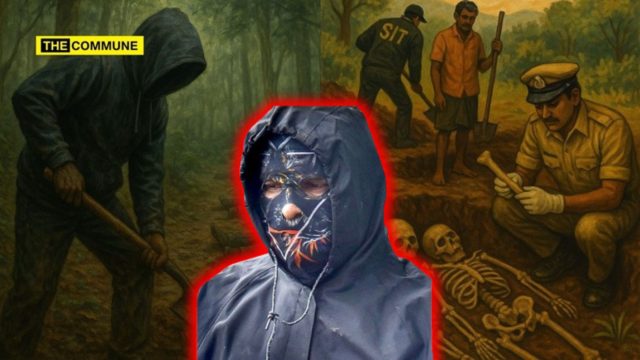
Their “reporting” or rather concerted campaign started on 5 July 2025 when the masked man made his appearance.
The portal continued reporting on the daily developments via news articles while preparing for video interviews and explainers later in July 2025. While all their videos and explainers are presented as a neutral conversation/report, they contain several problematic elements that favour the anti-Dharmasthala narrative.
The daily exhumations were covered by their reporter Shivani Kava and one could also see Pooja Prasanna doing ground reports with Kava a few times.
Dhanya Rajendran, the editor-in-chief of the leftist portal, also chipped in during the South Central podcast episodes.
Let Me Explain ❌ Let Me Peddle Propaganda ✅
In the first offering on 10 July 2025, Pooja Prasanna used speculation and sensationalism to begin the reporting series.
The report presents a simplistic and arguably incorrect view of police procedure to cast the authorities in a negative light. Prasanna says, “The response should be immediate and that’s not an opinion. That’s how the law works.”
This is a mischaracterization. While police must investigate serious claims, a claim of this magnitude requires meticulous planning, warrants, and expert involvement. Deliberation is not “dereliction of duty”; it is a necessary step to ensure the investigation is forensically sound and legally defensible. Portraying caution as incompetence or complicity is misleading.
While discussing legal challenges to reporting is valid, Prasanna presents every gag order as an illegitimate tool to suppress truth, without adequately exploring the legal principle of protecting against defamation until a claim is proven.
The video does not ask basic journalistic questions: How could hundreds of murders and burials occur over 20 years in a major pilgrimage center without a single other person noticing? How does one man alone manage this? Where are the missing persons reports for hundreds of individuals? And how come he had a change of heart all of a sudden after 20 years? What’s the motive of the ‘masked man’?
Shifting The Narrative From ‘If’ To ‘How’ By Linking Old Cases
In the video that was published a week later, on 18 July 2025, the title and the opening statements prime the viewer to accept the premise that there is a mystery with hidden bodies, moving the discussion from “if” it happened to “how” it happened.
The report strategically links the new, unproven allegations to older, genuine tragedies (the Sowjanya case, the 1993 disappearances, alleged Ananya Bhat murder). This creates a powerful emotional and narrative connection, implying a pattern and a cover-up that spans decades. While asking if there is a pattern is valid, presenting them together as evidence for the new claim is a form of guilt by association. The existence of past unsolved crimes does not prove the current mass burial allegation.
Shivani Paints, Pooja Blurs The Picture For Propaganda
Instead of asking the right questions, the “evidence” of the skeletal remains is accepted without any critical questions.
The Panchayat vice president’s explanation (unclaimed bodies, suicides) is presented and undercut by stating it “has already been challenged as an attempt to intimidate.” Pooja Prasanna and Shivani Kava do not investigate the validity of his claims about documented procedures for unclaimed bodies, instead framing his statement purely as a threat. They use the “possibility” as a narrative device to imply truth.
While the discussion of gag orders is important context, it doesn’t prove the underlying allegation is true.
Prasanna and Kava presuppose the truth of the core allegation, frame skeptics as complicit, leverage past tragedies for emotional impact, and openly position themselves as an advocacy organization fighting a legal battle. This prioritizes narrative setting over the meticulous, evidence-based, and neutral verification that such a serious allegation demands.
Pooja Prasanna and Shivani Kava, with this kind of “journalism”, blur the lines between advocacy and reporting.
Gram Panchayat VP Interview
Pooja and Shivani interviewed Shrinivas Rao, the Gram Panchayat Vice President of Dharmasthala who explains that all unclaimed bodies are officially documented and disposed of lawfully. Records of burials (including suicides near the Netravati River) have been maintained since the 1980s, with receipts and official approvals. The panchayat denied any clandestine burials and challenges the whistleblower to provide proof.
But Pooja Prasanna’s questions are loaded and framed to imply guilt or incompetence. For example, persistently asking about rape and murder victims presupposes that such bodies were handled by the Panchayat, a claim he is explicitly denying. This is not neutral questioning; it’s an attempt to force a specific admission.
The duo of Kava and Prasanna repeatedly demand that the Vice President produce detailed police and medical reports (autopsy details, cause of death) that he has clearly stated are held by the police department, not the Panchayat. The Panchayat’s role, as he explains, is to dispose of the body after the police have completed their documentation (UDR number, post-mortem). Badgering him for documents he does not possess is a fundamental misrepresentation of the process.
The Vice President provides context for the high number of bodies (e.g., high pilgrim footfall, suicides, river accidents), but the reporters dismiss this context in favor of a more sinister narrative. He offers a plausible explanation for the statistics, that Dharmasthala attracts a large number of people in distress seeking spiritual solace, some of whom die by suicide or accident. Prasanna tries to act smart by asking, “Why here and why not in Kukke Subramanya?”.
TNM claims they are the go-to portal for anything south – Prasanna exposes her ignorance about the pilgrimage site and the local beliefs and rituals. It is a deeply held local belief that those who pass away in the sacred town of Dharmasthala attain salvation. Similar to how Hindus believe that dying in Kashi, being cremated there, or having one’s ashes immersed in the holy waters of Ganga grants moksha—the liberation from the cycle of birth and death. Does TNM not know this? A visit to the temple or speaking to the people or reading some books on the temple town will tell them but hey who cares about research!
It is even more telling of her that she chose to name another Hindu pilgrimage site and not of any other religion.
The Vice President goes on to explain that practices were less formalized before 2006, and burials might have occurred in various locations based on police direction. Instead of treating this as a historical explanation for why bodies might be found in non-cemetery areas, the reporters treat it as a “gotcha” moment, as if he is admitting to the mass burial conspiracy.
While applying scrutiny to the VPs statements, Pooja Prasanna fails to do the same to the main allegation and the masked man. They treat the masked man’s extraordinary claims as an established premise about which we detail in the upcoming sections.
Masked Man Lawyer Interview
They also carried interviews of the masked man’s lawyer KV Dhananjay. This interview was published on 19 July 2025. It is puzzling how a man who says he was “born into what is considered the lowest caste and worked as a sanitation worker” could reach out to a senior Supreme Court lawyer, why does it sound so easy? Or is there some other ‘hand’ at work here?
All through the interview, TNM allows the negative narrative is well absorbed. Dhananjay shifts the burden of proof on the police and the state by saying “If he is lying, prove it by digging. If you don’t dig, it means he’s telling the truth.” The burden of proof always lies with the accuser. The state is under no obligation to disprove every fantastical claim; it is the claimant who must present credible evidence to justify an intrusive and sensational investigation. Imagine if tomorrow someone wearing a mask alleges that bodies are buried beneath The News Minute’s office in Bengaluru—should the police be expected to raid the premises on their own, or should they first demand proof from the accuser?
The entire justification for the witness’s story is an “appeal to emotion” – he is “wrecked with guilt,” driven by “fear of God.” While this is a possible motive, a journalist should treat it as a claim, not a fact. Dhananjay insists we must take it as “prima facie true” but that is neither a journalistic standard nor a valid basis for rigorous investigation
The entire premise that “powerful people” (implicitly the Jain religious leadership) are behind this and are shielding the investigation is treated as a given, not an allegation. No evidence is presented for this central pillar of the story. Dhananjay speculates that in the 15 days, the “accused” might be moving bodies. This is pure conjecture presented with no evidence, yet it serves to poison the well; if nothing is found, he can claim the evidence was moved, not that it never existed.
Dhananjay is an advocate. His job is to present his client’s case in the most persuasive way possible. The journalist’s job is to interrogate that case. In this interview, the journalist effectively becomes the lawyer’s junior partner, allowing him to control the narrative entirely. The segment begins and ends with a promotional plea for subscriptions, framing this advocacy as “responsible and sensitive reportage,” which it is not.
Shabbir Ahmed & Justice Chandru Interview
Not to be left behind, Shabbir Ahmed brings in DMK supporting casteist retired Justice Chandru to amplify TNM’s victim card about the legal gag order. Justice Chandru called the ex parte gag orders as unconstitutional and contrary to Supreme Court precedent. He argued that reputation should be protected through damages, not censorship, and distinguishes between legitimate postponement orders to protect fair trial rights and blanket bans on publication. Chandru also condemns the routine use of expansive “John Doe” orders, which in this case targeted nearly 9,000 links, as “extraordinary” and “unjustified”. He stresses that such gag orders violate both the public’s right to information and the media’s right to report, particularly in cases like Dharmasthala where allegations are of grave public interest.
The P In Dhanya Rajendran’s Podcast Stands For Propaganda
The News Minute podcast South Central, although seems like a healthy discussion, on closer examination favours the narrative that TNM has been building so hard.
First, the discussion conflates unrelated issues – an unproven mass burial claim, decades-old unsolved murders, and statistical suicide data – into a single ominous storyline. This creates a false impression of causality, implying that past crimes and suicide rates make the new allegation plausible.
It relies heavily on anecdotes and local sentiment as substitutes for evidence. Prasanna says “locals say it is very possible” and this is used to lend weight to extraordinary claims, validating belief over verifiable proof.
The podcast assumes malice from authorities by default. The absence of extensive CCTV or police hesitation to exhume bodies is framed as evidence of guilt or complicity, inverting the burden of proof and ignoring alternative explanations like negligence or procedural caution.
The gag order debate is contextually weaponized. Instead of being examined as a broader media-law issue, it is presented as proof that the temple has “something to hide,” reinforcing a conspiracy-driven frame.
The core claim itself goes unexamined. The logistical impossibility of secretly burying hundreds of victims in a bustling pilgrimage town is never questioned, allowing the allegation to stand unchallenged.
Digging Difficult Because Of Terrain
Apart from taking the masked man’s statements/allegations as “Gospel Truth”, they make many excuses to re-affirm that the burial sites were in difficult terrain and it was tough on the excavators to dig and exhume the bodies and that they needed to dig deeper, because the weather was not conducive and what not. So how did the masked man manage to bury them if the terrain was so tough? What did he do when he was asked to bury during rainy days? Why did it not strike them to ask the masked man the same questions?
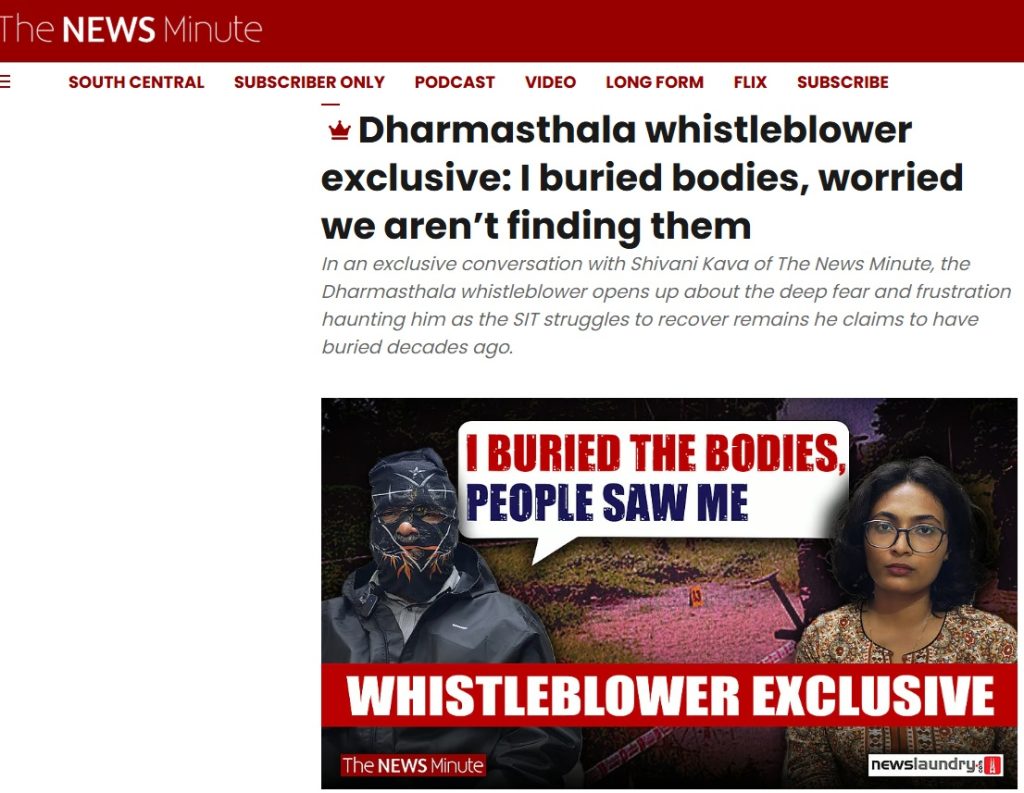
And guess what, they parked an “exclusive” interview of the masked man (wonder what prodded him to speak to them) behind a paywall.
However, there is a YouTube video of the interview which is yet another attempt at legitimising the narrative.
Begging For Public Funding To Support Their Lies
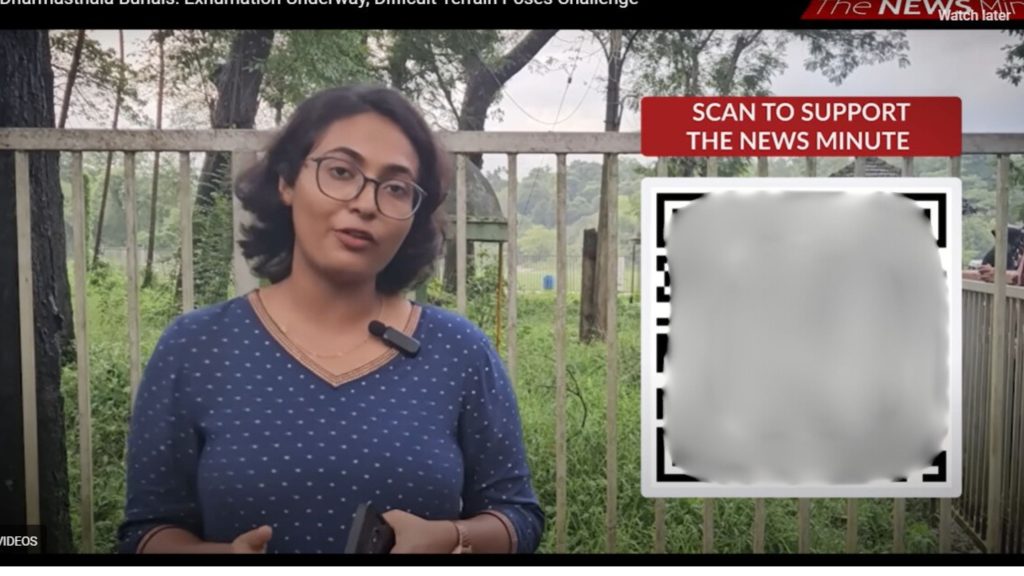
The News Minute has been constantly doing the “jholi bichana” to viewers for funds to “support independent media” and their constant coverage from the ground in Dharmasthala. Every single video of theirs has this QR code flashed and viewers gaslighted to literally extort the viewers “We are bringing you this major breakthrough; now pay us to continue.”
They even flashed the bowl asking viewers for money to help pay “legal bills” to fight gag orders.
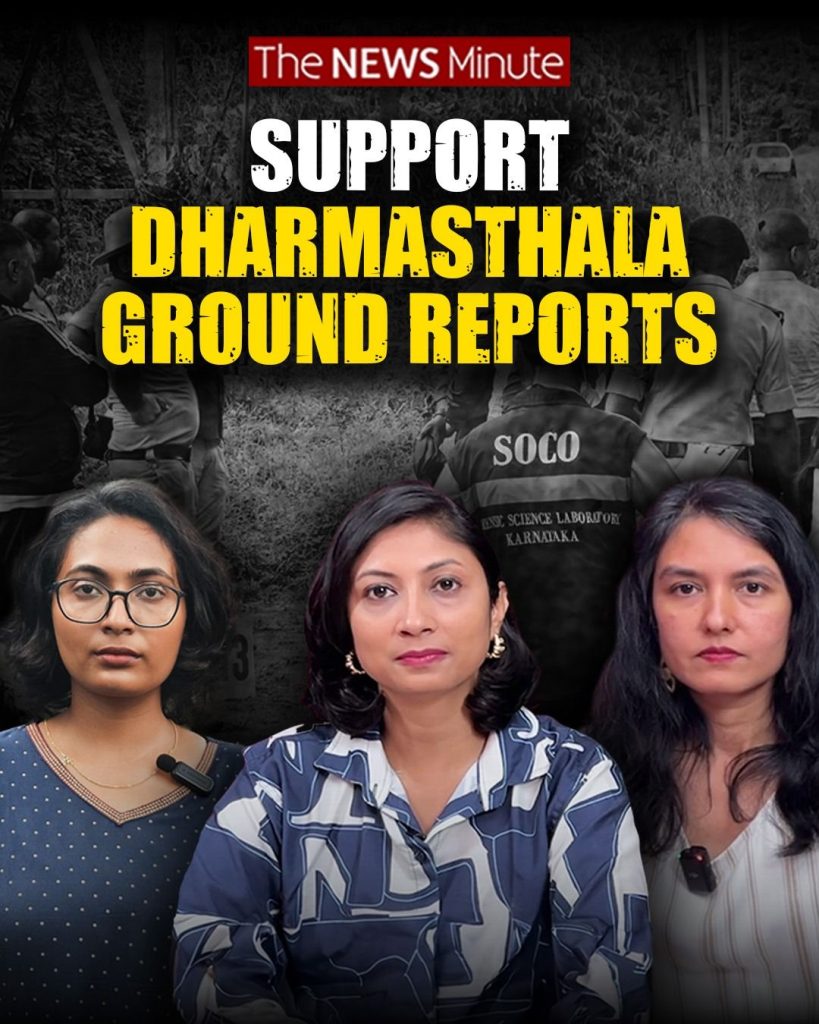
Then there’s these posters too plastered across their social media handles.
Premature Celebration When Skeletal Remains Were Discovered
TNM posted 2 videos, a short one reporting the “presence of skeletal remains” on 31 July 2025 and a longer “explainer” on 2 August 2025. These two videos are perfect examples of what can be seen as premature celebration to the news of skeletal remains found in one of the excavation sites.
In the video published on 31 July 2025, the most significant issue with the reporting is the immediate framing of the discovery of partial skeletal remains as a validation of the whistleblower’s entire story. They called it a “major breakthrough” – a highly sensational and conclusory term. Finding partial remains at one of 13+ sites confirms that a body was buried there. It does not confirm the core allegations of “hundreds of bodies,” “women and girls,” or “sexual assault.” The cause of death, identity, and date of burial are all completely unknown at this stage.
“…there might be the truth to it” – Shivani Kava, explicitly connects the find to the whistleblower’s most shocking claims, stating the discovery lends credibility to his story about burying victims of sexual assault. As with every other video, this report continues the unethical practice of linking this new discovery to unrelated, past tragedies to heighten emotional impact.
They continue to accept the whistleblower’s claims as a given and uses them as the framework for all analysis, without applying basic journalistic scrutiny. There is no mention of the most obvious and likely explanation provided by the Panchayat VP himself in their own previous interview: that these could be old, unclaimed bodies buried officially before the cemetery was built. The possibility that this is a tragic but routine burial is completely excluded from the narrative.
That the whistleblower masked man came out of guilt to help find the “100s of buried girls/women” – the reporter duo create drama, a sympathetic framing that discourages skepticism about his motives.
In the video published on 2 August 2025, Pooja Prasanna uses the discovery of partial remains (which later was found to be that of a male who died 30 years before the masked man’s tenure) to declare the whistleblower’s allegations as proven and to validate the entire “conspiracy of silence” narrative.
Starting the episode with “Dharmasthala soil has finally spoken up.” This is a dramatic and conclusive opening statement. Prasanna and TNM jumped the gun when the partial remains were found. She also says, “His allegations can no longer be dismissed as easily.” This frames the discovery as a definitive victory for the accuser’s side, moving the goalposts from “extraordinary claim requiring extraordinary proof” to “you can’t dismiss this now”, preemptively shutting down skepticism.
It must have been an egg-in-face moment for TNM when the truth about the remains surfaced. There seems to be no report on that on their website.
Prasanna asks a series of highly speculative “what if” questions that are designed to imply wrongdoing without evidence. The segment questioning why the Panchayat buried bodies in forest areas decades ago is presented as a major revelation. However, it lacks crucial context: What were the standard procedures for unclaimed bodies in rural Karnataka 20-40 years ago? Was this practice unique to Dharmasthala, or was it common in other towns with limited cemetery space and large forested areas? The reporter’s sarcastic tone (“is the panchayat claiming they trekked dangerously?”) dismisses the practical realities of the past in favor of present-day judgment. Why didn’t she ask the same question to the masked man – did he trek dangerously to bury those bodies he claims to have buried?
The report completely omits the most plausible explanations for the found remains: that they could be from an unclaimed body or a suicide that was buried following the (perhaps informal) procedures of the time. It immediately jumps to the assumption that the find validates the murder and cover-up allegation. To update our readers, the skull that the masked man submitted at the court turned out to be belonging to a man, contrary to the claims that women and young girls had buried there and the skeletal remains across all the sites that have been dug up so far, only one skeleton remain and that two that belongs to a man and it’s been almost near fully decomposed. The skull was examined at two hospitals and both the tests confirmed that it belonged to a man who died 30 years ago. A few bone fragments were found at only one place and that also belonged to another male. Some ID cards were found at another place that also belonged to a male who had reportedly clearly died of illness.
The skeletal remains with the masked man turned out to be that of a male but TNM tried to establish through “their sources at SIT” that it was not verified when the whole Kannada media was reporting the truth.
How TNM’s Propaganda Fell Like A Pack Of Cards
After all this build-up, the entire fraud narrative collapsed like a pack of cards, reinforcing the truth that baseless allegations can never stand without evidence.
Let’s take a look at how the lie unravelled:
No evidence found by SIT in the locations identified by the masked man
The skull/remains he brought with him to make the “confession” after his conscience did not let him sleep for 15+ years, turned out to be that of a male. Skeletal remains found in the excavation areas also turned out to be that of a male as mentioned above.
Masked man confesses that he was forced to make such allegations; he also said that he was trained by a gang in Chennai who made his say all this.
A woman claiming to be the first wife of the “masked man” in the Dharmasthala burial case has denied his allegations, accusing him of lying for financial gain and recalling years of domestic abuse during their marriage. She asserted that he worked as a sweeper and had no links to the alleged crimes, while villagers in Mandya confirmed his local background, civic work, and financial disputes before he abruptly left in 2014.
As the case crumbled, political attention turned to identifying the “gang” behind the conspiracy. BJP MLA from Udupi, Yashpal Suvarna, and Independent MLA G. Janardhan Reddy publicly named Congress MP Sasikanth Senthil as the key conspirator. They allege Senthil, who served as Dakshina Kannada Deputy Commissioner, orchestrated the plot using leftist and Islamist networks he cultivated during his administrative tenure.
The MLAs have pointed to Deputy CM D.K. Shivakumar’s own previous remark about a “larger conspiracy” and are now demanding the SIT have the courage to probe Senthil’s involvement, questioning if his status as a sitting Congress MP will grant him immunity.
Ananya Bhat’s alleged mother Sujatha Bhat confesses on television that all that she said was a lie; she goes on Republic Kannada to reveal that Aanya Bhat was not her daughter at all.
Sujatha Bhat’s brother states that his sister was lying and he was not aware of any daughter of hers nor the fact that she was married.
And the latest news is that the masked man is identified as one Chinnaiah (Chinnayya) from Mandya is arrested by SIT and custody is being sought.
Ever since the masked man and Sujatha Bhat’s confessions made the news, the TNM gang is missing, absconding, and preparing to peddle a new propaganda.
Last Word
The News Minute’s coverage of the Dharmasthala issue has been less about facts and more about framing. They repeatedly amplifed unverified claims, downplayed counter-evidence, did not ask the right questions, selectively invoked past tragedies, and painted gag orders as proof of guilt. By doing so, TNM has acted not as a neutral observer but as an advocacy outlet pushing a predetermined agenda. Their reporting has blurred the line between investigation and propaganda, weaponizing grief, faith, and suspicion to undermine a Hindu institution that commands deep respect across Karnataka and beyond.
The pattern is clear: while other crimes involving political actors are given minimal coverage, TNM has churned out more than two dozen stories on Dharmasthala in just a few months, turning a sacred site into the stage for their ideological theatre. This is plain narrative-building aimed at eroding trust in Hindu religious institutions. And like all such attempts against Dharma, it will ultimately fail because facts, history, and faith cannot be buried under manufactured suspicion.
Hydra is a writer with interests in exposing media bias.
Subscribe to our channels on Telegram, WhatsApp, and Instagram and get the best stories of the day delivered to you personally.
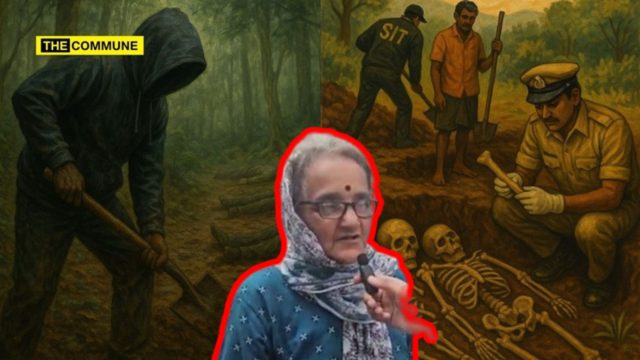
In a sensational twist to the Dharmasthala mass burial case, the Special Investigation Team (SIT) has arrested the “masked man” whose explosive allegations of mass graves had rocked Karnataka for weeks. He has now been identified as C.N. Chinnaiah alias Chennaiah, a native of Chikkaballi village in Mandya district.
Chinnaiah first surfaced in June 2025, claiming that he had buried bodies at 17 different locations in Dharmasthala. He even produced skeletal remains, including a skull, as supposed proof. His accusations ranging from murders to secret burials sparked large-scale excavations, drew national and international attention, and cast a shadow over the revered Dharmasthala temple.
Initially, the SIT refrained from arresting him after he sought protection under the Witness Protection Act, citing threats to his life. But once forensic examinations debunked his claims, his protection was revoked. Multiple cases, including filing false accusations, were registered. He was arrested, medically examined at Belthangady Government Hospital, and produced before court.
Sources said he has since confessed that his allegations were fabricated, and the SIT is now seeking his custody for further interrogation after already questioning him for more than 19 hours.
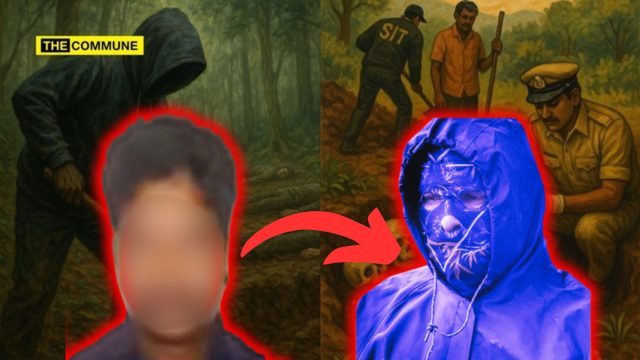
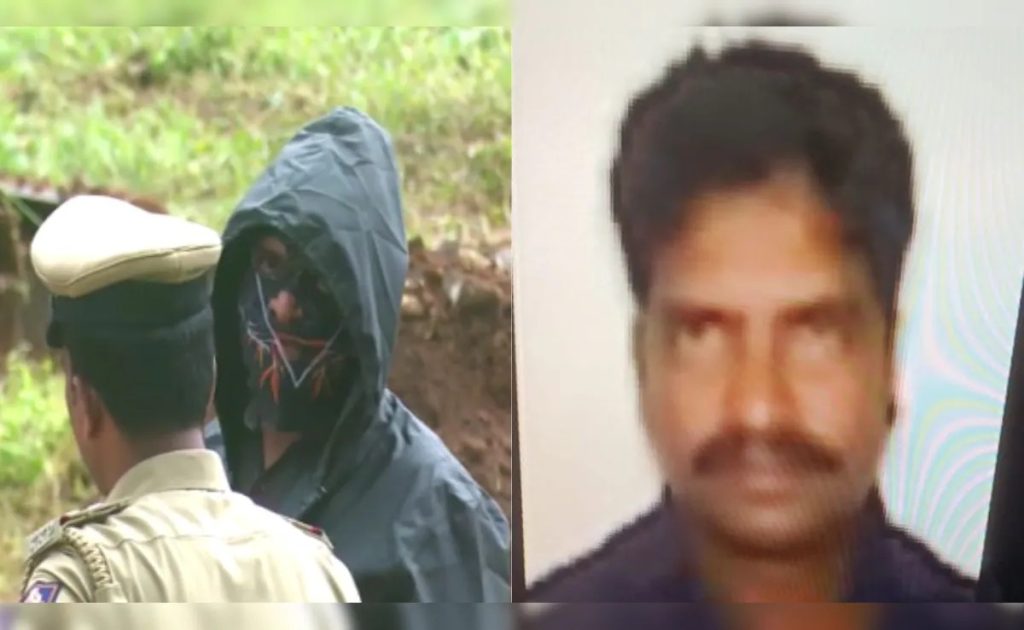
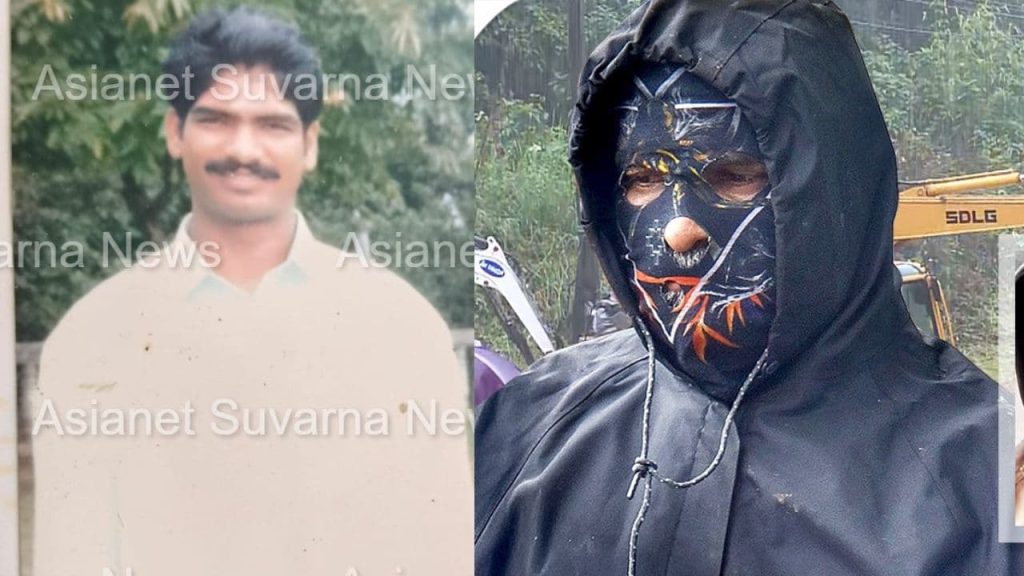
For weeks, Chinnaiah’s face was hidden behind a mask. On Friday, his photograph from years ago, when he worked as a sanitation worker in Dharmasthala, surfaced in the media, finally revealing his identity. Broadcasters including Asianet Suvarna News confirmed him as the same whistleblower who accompanied investigators during the high-profile digs.
Image Source: Asianet Suvarna News
False Allegations, Wasted Resources
His claims triggered frenzied excavations across Dharmasthala, but no evidence of mass burials was found. Forensic tests showed that the skull and bone fragments he produced were decades old and unrelated to his accusations.
Legal experts have noted that his fabricated testimony not only wasted precious investigative resources but also deeply distressed families of missing persons who briefly believed they might receive closure. The allegations, they said, also appeared designed to tarnish the reputation of Dharmasthala and its temple administration.
Chennai Gang Link
In a startling confession, Chinnaiah reportedly told the SIT that he was coerced by a Chennai-based gang in December 2023. He said the group pressured him to claim that legally sanctioned burials of pilgrims had actually been secret illegal graves.
The gang, he alleged, trained him to depose falsely in court, handed him old skeletal remains to use as “evidence,” and even coordinated his narrative with another complainant, Sujatha Bhat, who had filed a missing person case for her daughter.
Ex-Wife’s Testimony
Adding to the collapse of his credibility, Chinnaiah’s former wife spoke to reporters and accused him of lying for financial gain. Married to him from 1999 to 2006, she claimed he was abusive toward her and their two children, and that he worked as a sweeper in Dharmasthala, cleaning toilets.
“To avoid paying alimony, he lied in court about being unemployed during our divorce. He betrayed me,” she said, stressing that she had deep respect for Dharmasthala and that her husband’s claims were baseless.
Villagers Confirm Background
Residents of Chikkaballi village in Mandya corroborated parts of her account. They identified him as the youngest son of a grama panchayat employee, who had worked in civic jobs and at a local brick kiln. They recalled that the community even built him a house, which he later tried to claim solely for himself. He had also defaulted on a cattle loan and abruptly left the village in 2014.
SIT Investigation Continues
With Chinnaiah’s arrest and confessions, the SIT is now probing the alleged role of external actors, including the Chennai gang, in scripting and propagating the false narrative. Notices are expected to be issued to others connected to the case as the investigation deepens.
Subscribe to our channels on Telegram, WhatsApp, and Instagram and get the best stories of the day delivered to you personally.
In a dramatic turn of events, the Special Investigation Team (SIT) has arrested the anonymous whistleblower who had claimed that hundreds of bodies were buried in Dharmasthala. The man, who for weeks appeared in public with his face covered and sought protection under the Witness Protection Act, has now been identified as C.N. Chinnaiah alias Chennaiah, a resident of Chikkaballi village in Mandya district.
Chinnaiah first made headlines in June when he led investigators to 17 locations in Dharmasthala, claiming he had buried bodies there. He also produced skeletal remains, including a skull, as “evidence.” His allegations of mass burials shook Karnataka, raised questions about missing persons cases, and cast a shadow on the revered Dharmasthala temple, attracting both national and international attention.
Arrest After Witness Protection Revoked
Initially, police refrained from arresting him because he had sought protection under the Witness Protection Act, claiming he feared for his life. However, after forensic inquiries reportedly disproved his claims, the SIT revoked his protection and registered multiple cases, including for filing false accusations. He was then arrested and subjected to medical examination at Belthangady Government Hospital before being produced in court.
According to sources, Chinnaiah is believed to have confessed that his allegations were fabricated. SIT officials are now seeking his police custody to continue interrogation, after having already questioned him for over 19 hours.
Old Photo, New Identity
For weeks, Chinnaiah’s identity remained hidden. On Friday, his photograph, taken years ago when he worked as a sanitation worker in Dharmasthala, surfaced in the media. Asianet Suvarna News and other outlets revealed him to be the same “masked man” who had been accompanying investigators since June 2025.
Image Source: Asianet Suvarna News
Serious Fallout of False Allegations
The allegations had triggered a frenzy of excavations at multiple sites. However, officials found no evidence to support his claims. Forensic tests revealed that the skull he produced was not linked to the alleged burials, and skeletal remains recovered from two sites were not connected to the charges he made.
Legal experts and observers have pointed out that his false claims not only wasted valuable investigative resources but also inflicted deep emotional distress on families of missing persons, who believed they might finally find closure. The incident also raised serious concerns about attempts to malign the reputation of Dharmasthala and its temple administration.
Chennai Gang Allegedly Trained Him
A few days ago, the masked man confessed to the SIT that he was coerced by a gang in Chennai in December 2023 to fabricate allegations of illegal mass burials.
“They asked me how many bodies I had buried when I worked in Dharmasthala. I told them the truth: that I had legally buried the bodies of pilgrims who came for salvation, through the police and gram panchayat,” the complainant stated. “But the gang insisted that I should say that the bodies were buried illegally. They pressured me… they changed my mind.”
The complainant revealed that the gang brought him to Karnataka, trained him on what to say in court, and even provided him with the skull and bone fragments he submitted as evidence which forensic reports later confirmed belonged to a man who died 30 years ago. He further confessed that he was instructed to coordinate his false testimony with another complainant, Sujatha Bhat, who had filed a missing person report for her daughter.
Ex-Wife’s Testimony
Following this revelation, media personnel found his former wife in Karnataka. Speaking to the media, the woman stated that she married the masked man in 1999 and was together with him for seven years. During this period, she alleged, he physically assaulted her and their children. The couple has a son and a daughter. She claimed that he worked as a sweeper in Dharmasthala, performing tasks such as cleaning toilets, and denied any knowledge of alleged murders, rapes, or burials linked to the case.
“To avoid paying alimony, he lied in court about being unemployed during our divorce. He betrayed me,” she told reporters, adding that her mother took care of the children after their separation. She emphasized her respect for Dharmasthala, asserting that her husband’s claims about crimes in the temple town were false.
Residents of Chikkaballi village in Mandya taluk corroborated aspects of her account, stating that the masked man was a native of Mandya, the youngest of four siblings, and the son of a grama panchayat employee. According to villagers, he was employed in civic work and at a local brick kiln, and the community even built a house for him, which he later sought to transfer into his name. They added that he availed a bank loan to buy cattle but failed to repay it and left the village abruptly in 2014.
Subscribe to our channels on Telegram, WhatsApp, and Instagram and get the best stories of the day delivered to you personally.
The Supreme Court on Friday directed the Election Commission of India (ECI) to accept Aadhaar as a valid identity document for Bihar voters seeking re-inclusion in the ongoing Special Intensive Revision (SIR) of electoral rolls. The order has triggered sharp debate over the constitutional propriety of using Aadhaar, a residency-based ID that is also available to foreign nationals, as proof in a process governed strictly by Article 326 of the Constitution, which restricts voting rights to Indian citizens.
A bench of Justices Surya Kant and Joymalya Bagchi, while hearing a batch of petitions against the June 26 SIR notification, ordered the ECI to accept claim forms submitted online without insisting on physical documents. The court further said applicants could furnish any of the 11 documents already prescribed by the ECI, or alternatively, an Aadhaar card.
Court’s sharp remarks on parties
The bench came down heavily on political parties in Bihar, questioning why they had failed to assist the lakhs of voters whose names were deleted. The court noted that while individual MPs and MLAs had filed objections, parties themselves had done little on the ground despite appointing booth-level agents (BLAs). The judges asked all 12 recognised political parties in the state to be impleaded in the matter and directed them to submit status reports next week explaining their efforts to help affected voters.
“Voters appear more conscious than political parties,” the bench observed, directing parties and their BLAs to actively assist voters in filing forms for inclusion.
Aadhaar: Not Citizenship, Not Voting Right
The ruling has ignited constitutional concerns because Aadhaar, unlike a voter ID, does not establish citizenship. According to the Unique Identification Authority of India (UIDAI), Aadhaar is issued to any resident foreign national including visa or long-term visa holders, OCI card holders, and citizens of Nepal and Bhutan, who has lived in India for 182 days in the preceding 12 months.
UIDAI website says, “All resident foreign nationals (Indian VISA/LTV holder, OCI card holder and citizen of Nepal/Bhutan) who resided in India for 182 days or more in 12 months immediately preceding enrolment application date are eligible for Aadhaar enrolment as resident foreigner.”
The UIDAI’s own website clarifies: “Aadhaar is not a document of citizenship and UIDAI has been mandated under the Aadhaar Act to ascertain residency of a person in India for 182 days prior to applying for Aadhaar. Also, the Supreme Court of India in its landmark decision has directed UIDAI not to issue Aadhaar to illegal immigrants.” The Supreme Court itself has previously directed UIDAI not to issue Aadhaar to illegal immigrants.
Article 326 of the Constitution is categorical that only citizens of India can exercise the right to vote. Critics argue that by allowing Aadhaar to serve as a sufficient document for voter roll revision, the apex court risks blurring the line between residency and citizenship, raising the spectre of a constitutional contradiction.
Next steps
Senior advocate Rakesh Dwivedi, appearing for the ECI, urged the court to give the poll body 15 days to prove that no wrongful exclusions had taken place during the revision exercise. The bench fixed September 8 as the next date of hearing and said it would consider extending the timeline or staying the SIR process if the objections suggested mass disenfranchisement.
The final electoral roll is scheduled to be published on 1 September 2025.
Subscribe to our channels on Telegram, WhatsApp, and Instagram and get the best stories of the day delivered to you personally.
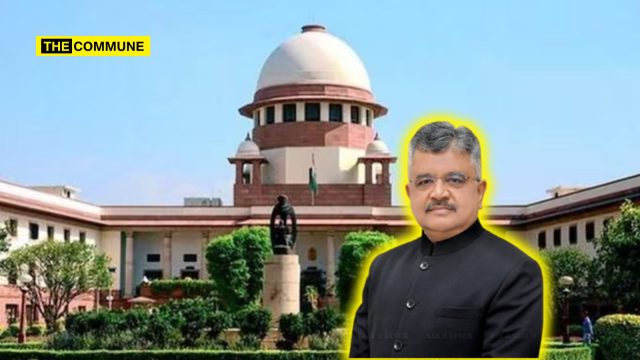
Solicitor General Tushar Mehta on Thursday, 21 August 2025, confronted the Supreme Court with a pointed analogy, asking whether the legislature could fix a timeline for the judiciary to complete a trial, while defending the governor’s discretion in acting on bills passed by state assemblies.
The remarks came during a hearing on the ongoing disputes between several states and their governors over delays in granting assent to legislation.
On the third day of the hearing, Solicitor General Tushar Mehta, appearing for the Centre, submitted that a governor’s options on a bill – whether to grant assent, withhold it, return it to the assembly, or reserve it for the President’s consideration, were “non-justiciable” matters that should be resolved through political mechanisms rather than judicial scrutiny.
Mehta argued before a five-judge bench comprising Chief Justice B R Gavai and Justices Surya Kant, Vikram Nath, P S Narasimha and A S Chandurkar that “there are hundreds of aspects that a governor examines while taking a decision on a bill and SC does not have the wherewithal to examine the validity of such considerations while arriving at a decision.”
This prompted the CJI to ask: “If a governor does not do what the Constitution mandates him to do and sits over a bill without taking a decision for years, should courts be powerless to examine such inaction? What will happen to the federal democratic set-up? What happens to the will of the people? And, what does an elected govt in a state do?”
Justices Surya Kant and Narasimha also questioned the implications of indefinite inaction. “The court may not go into the aspect of why a governor takes a particular action on a bill. But if the governor does not take any action for a very long period, can the situation be remediless? If the aggrieved state moves SC, should it keep silent? There cannot be a vacuum in the Constitution,” they observed.
Responding, Mehta said that constitutional impasses of this nature had historically been resolved through political channels. “There had been such impasses between governors and states. They were resolved through political statesmanship of the CM concerned, the PM and the President. Solutions have been found in the political set-up. If a timeframe is required to be prescribed for a governor to act on a bill, Parliament will decide,” he said.
The solicitor general added: “Every problem of the country need not have to be resolved by SC. The political set-up and heads of the other branches of governance are equally capable of resolving political issues through a collaborative exercise.”
While agreeing that courts must exercise restraint, the CJI cautioned against judicial overreach. “If SC, as custodian of the Constitution, finds a constitutional functionary refusing to discharge his/her functions without valid reasons, should it be powerless to act? Judicial activism should not become judicial adventurism or judicial terrorism. I have always said separation of powers must be respected,” Chief Justice Gavai remarked.
Mehta maintained that while the apex court had the authority to interpret the Constitution, it could not impose timelines where the Constitution was silent. He asked rhetorically: “If a trial in a criminal case is pending for decades and a person approaches the President saying justice has been denied to his son, should the President declare him innocent and end the trial? Can the legislature fix a timeline for the judiciary to complete a trial in a case?”
He further argued: “Whether the governor should grant assent, withhold, return the bill to assembly or reserve it for President’s consideration are all actions which are non-justiciable. There are no judicial standards by which the SC can test the validity of governor’s action on Bills. SC does not have the wherewithal to decide the validity of political decisions.”
Citing the principle of separation of powers, Mehta underlined that no organ of governance should intrude upon the core functions of the other. “The National Judicial Appointments Commission was unanimously passed by Parliament and ratified by two-thirds of the state and yet it was struck down by SC terming the presence of a single member from the executive in the panel for selection of judges as an interference in judicial independence,” he said, adding that if even one executive presence was deemed interference, it would be impermissible for the judiciary to impose deadlines on governors.
He concluded by stating that the deliberate silence of the Constitution on fixing any timeframe for a governor’s action on bills could not be altered by judicial intervention.
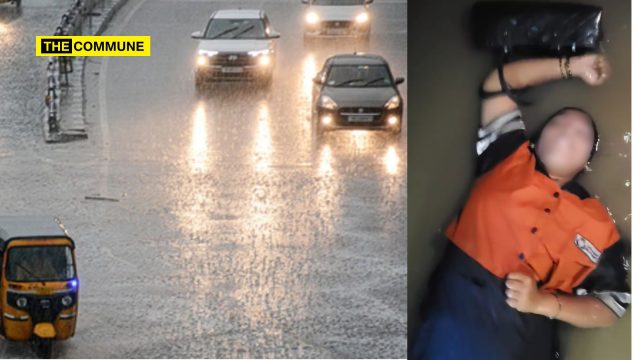
Chennai and several districts of Tamil Nadu, including Tiruvallur, Chengalpattu, Kancheepuram and Tiruvannamalai, received moderate to heavy rains overnight, leading to waterlogging in several areas.
In Chennai, a sanitation worker was electrocuted early on Saturday after stepping on a live electric wire that had fallen on a waterlogged street in Kannagi Nagar, police said.
The victim, identified as Varalakshmi, was carrying out early morning cleaning work when she came in contact with the submerged cable. She died on the spot. Police confirmed that she is survived by two children.
Residents of Kannagi Nagar said they had earlier raised complaints about exposed and fallen electrical cables in the locality, particularly on 11th Cross Street.
தமிழ்நாடு அரசின் அலட்சியத்தால் மேலும் ஒருவர் பலி
கண்ணகி நகர் பகுதியை சார்ந்த தூய்மை பணியாளராக வேலை செய்து வரும் திருமதி வரலட்சுமி அவர்கள் இன்று காலை வேலைக்கு செல்லும்போது மழை நீரில் உள்ள கேபிள் மீது காலை வைத்ததால் மின்சாரம் தாக்கி இன்று காலை 4 50 மணி அளவில் உயிர் இழந்தார்.… pic.twitter.com/zQNTUu0URU
Meanwhile, the heavy rains also led to the uprooting of a tree near Loyola College in Nungambakkam. Traffic police personnel and Greater Chennai Corporation workers removed the branches and restored movement in the area.
Officials said all subways had been cleared of stagnant water and appealed to the public to commute cautiously.
The Regional Meteorological Centre has forecast moderate to severe thunderstorms over Chennai, Tiruvallur, Chengalpattu, Kancheepuram, Tiruvannamalai, Villupuram and Nagapattinam districts in the coming hours.
Saturday’s downpour marked the second consecutive day of sharp showers in Chennai and its suburbs.
The woman at the center of a statewide mystery adding allegations to the Dharmasthala “mass burial” case, Sujatha Bhat, now identifies the missing girl Ananya Bhat as the daughter of a man named Aravind and Vimala Bhat, contradicting her own years of claims and adding a new layer of complexity to the SIT probe.
In a dramatic television interview that was telecast, on 22 August 2025, that has upended a major investigation, Sujatha Bhat, the woman who propelled the “missing Ananya Bhat” case into the public eye, has now declared that Ananya was never her daughter.
The revelation was made on Republic Kannada, where Bhat appeared for a highly anticipated interview. When asked by host Shobha Malavalli to clarify the truth about the case, Bhat delivered a bombshell statement.
“Ananya Bhat is not my daughter,” Sujatha Bhat stated unequivocally on air.
This assertion directly contradicts the narrative she has maintained right from the beginning of this controversy, in which she presented herself as the biological mother of Ananya Bhat, a girl she claimed went missing from Dharmasthala 22 years ago.
When pressed on the identity of the girl, Bhat identified a new figure in the mystery. “Ananya Bhat is the daughter of Aravind and Vimala Bhat,” she claimed, describing them as friends she met in Mangalore in 1985.
Bhat recounted a story of leaving her home due to unbearable torture and meeting Aravind and Vimala Bhat at a bus stand. “Aravind and Vimala saw me and asked why I was sitting there. I explained I’d left home. He took me to his house, kept me there for two days, and got me a job,” she told the host. She explained that she had left home because she could not bear the torture.
She said, “He took me to his house, kept me there for two days, and got me a job in another house, doing cooking and housework.”
It was during this time, she said, that she was introduced to a three-year-old girl. “Yes, there was a three-year-old girl named Ananya Bhat,” she confirmed, insisting the child was Aravind and Vimala’s daughter. “Yes, there was a three-year-old girl named Ananya Bhat. She was not my daughter. She was Aravind and Vimala Bhat’s only daughter,” Sujatha told the channel.
Sujatha Bhat Biggest Breaking News: ‘ಅನನ್ಯ ಭಟ್ ನನ್ನ ಮಗಳಲ್ಲಅರವಿಂದ್-ವಿಮಲಾ ಮಗಳು’ | Ananya Bhat Case
In a new and explosive twist to the Ananya Bhat case, Sujatha Bhat has publicly accused a news channel of threatening her to extract a confession, just moments after she retracted her story about a missing daughter.
The allegations emerged in a heated phone call, purportedly with a representative from Suvarna News, which was recorded and aired. During the call, a distraught Sujatha Bhat can be heard claiming she was coerced into giving an interview where she confessed to fabricating the entire story of her daughter, Ananya Bhat, under the influence of others. She questioned why the story was aired without her permission and asks the reporter to take it down.
The Accusation: “You Threatened Me”
In the audio, Sujatha Bhat vehemently challenges the channel for airing her confession without her final permission, alleging it was done under duress.
“I’m telling you that they threatened me to tell you his name,” Sujatha is heard saying. She repeatedly asserts that she had a specific agreement with the channel, stating, “I had told them to put this interview on after I went to the SIT and came back.”
Her most serious allegation claims the methods used to get her statement were intimidating. “They forced me to sit in a car and forced me to tell the names of these people,” she accused the channel’s representative.
The Channel’s Response: Denial and Defence
The news representative on the call consistently denies Sujatha’s allegations, insisting the interview was given voluntarily. The representative is heard responding, “No, madam, you gave an interview,” and later asks, “Are you scared, madam?”
When Sujatha complains about her ruined reputation, the representative turns the accusation back on her, saying, “If you force me, you will ruin your reputation.”
A Case Mired in Confusion
This latest development deepens the mystery surrounding the entire case. Sujatha Bhat initially captured national sympathy with her story of a daughter, Ananya Bhat, who went missing from Dharmasthala. She then publicly recanted, claiming on another YouTube channel that the story was a lie concocted for a property dispute, allegedly at the behest of individuals named Girish Mattannavar and T. Jayant.
However, she later retracted that confession as well, claiming it was made under pressure. The Special Investigation Team (SIT) probing the matter has found no evidence of Ananya Bhat’s existence and has issued a notice to Sujatha to appear for questioning and present any documents.
Subscribe to our channels on Telegram, WhatsApp, and Instagram and get the best stories of the day delivered to you personally.
In a stunning reversal, Sujatha Bhat, the Bengaluru-based woman who had captured public attention with her claims of a missing daughter named Ananya Bhatt, has now confessed that the entire story was a fabrication, allegedly concocted under the influence of others to stake a claim on a family property dispute.
The case, which has sparked widespread debate and a probe by a Special Investigation Team (SIT), took a dramatic turn with Sujatha Bhat’s public confession and subsequent retraction, creating a web of confusion.
The Confession: A Story Fabricated for Property
In an interview with the YouTube channel ‘Insight Rush’, a remorseful Sujatha Bhat admitted to lying. “I lied because Girish Mattannavar and T. Jayant told me to. Please forgive me, I made a mistake,” she stated. “I apologize to Dharmasthala, to the people of Karnataka, and to the people of the country.”
She claimed her motivation was a long-standing dispute over her grandfather’s property in Dharmasthala, which she alleged was donated to a trust without her signature. “I did this for my grandfather’s property… I should have got a share,” she said, pleading to be freed from the controversy.
Throughout her statements, Sujatha Bhat maintained that her grievance was with her family’s decision to donate the property, not with the Dharmasthala temple or its head, Veerendra Hegde.
In her emotional apology, she said, “I have not hurt the feelings of the people of Dharmasthala… They provoked me to do so… Please, enough is enough, I will live my life.”
Family Denial
Sujatha Bhat’s claims had earlier been vehemently denied by her own family. In an exclusive interview, her brother disowned her, stating they had been out of contact since she left home in 1988-89. He dismissed her story saying, “Everything Sujatha says is a lie. We do not know if she has a daughter. She ran away from home in 1988-89, and we have had no contact with her since. Any claims regarding children or marriage are false. We cannot believe her.” He also clarified that the family had willingly parted with the land in question decades ago and had no ongoing claims. He stated that their grandfather’s land had been legally donated by Shanga Shringaramma to Anantha Padmanabha Upadhya and later handled by their family. “We gave up our desire for it, sold some portions, and built a house with the proceeds. There is no need for Sujatha Bhat to take signatures or claim anything,” he stated.
SIT Investigation
The Special Investigation Team (SIT) probing the alleged mass burials and related issues in Dharmasthala has now issued a notice to Sujatha Bhat. The SIT has directed her to appear at the Belthangady office and submit all documents pertaining to her daughter, Ananya Bhat. Investigators are also collecting relevant records from Shivamogga, Bengaluru, and Udupi to verify the claims.
The SIT had found no evidence of Ananya Bhatt’s existence. No school, college, or medical admission records under that name were found. The only “evidence” ever presented was a single passport-sized photograph, which Sujatha has now declared “fake.”
A Retraction of the Confession
Adding layers of confusion, Sujatha Bhat later told ‘United Media’ that her confession was made under duress. Speaking to Asianet Suvarna News, Sujatha alleged that she was forced to give an interview inside a car and pressured to name certain individuals, saying, “They forced me to do this. I will say that I never gave it; you took it by force.” She expressed frustration that her interview was broadcast before she had returned from appearing before the SIT, stating that the release damaged her reputation.
Sujatha also said, “I had given an interview. Why did they broadcast it on before I went to the SIT and came back? Why did they broadcast the interview on without permission? They threatened me and said that I will have to do it. I will say that they forced me to take the interview.”
She described the circumstances in detail: “They forced me to take a statement in a car, tell me the name of these people, they forced me to do this, I will say that.” Sujatha repeatedly emphasized that the interview was broadcast without her consent and expressed frustration over the way it was handled.
The SIT has issued her a formal notice to appear for questioning and submit any documents related to her daughter. Investigations have expanded to include Bengaluru, Udupi, and Shivamogga.
The News Minute which was “championing the cause” of the women and especially Ananya Bhat, has gone silent. They have not reported about the masked man’s confession, nor have they said anything so far about Sujatha Bhat’s confession.
Subscribe to our channels on Telegram, WhatsApp, and Instagram and get the best stories of the day delivered to you personally.