
Breaking: SC wants stay on farm laws, wants to stall implementation till amicable solution is found
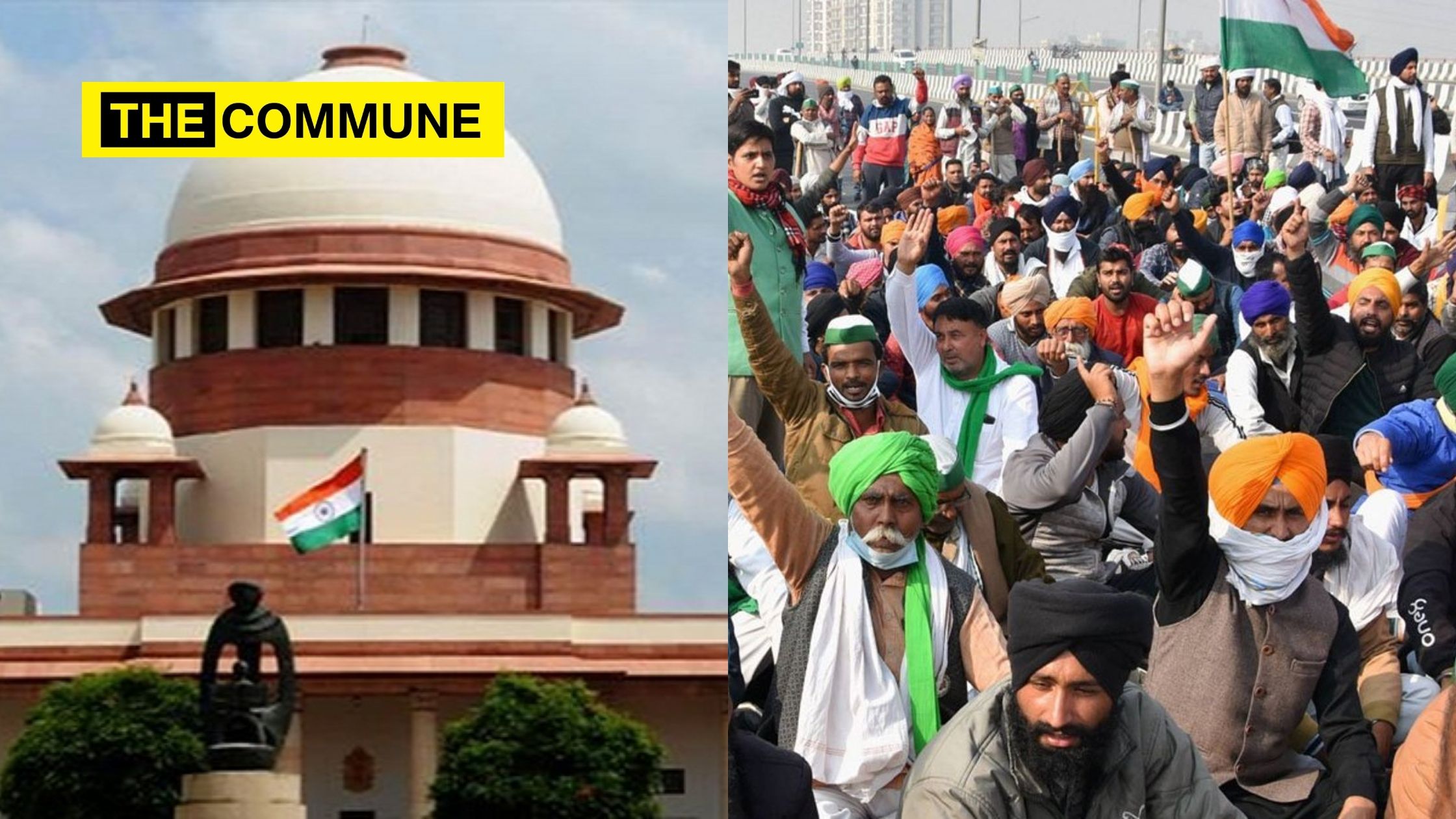
The Supreme Court which is hearing a petition on the three farm laws that were recently passed by the Parliament has signalled that it wants a stay on the farm laws and hold off implementation till an amicable solution is found.
The bench led by CJI SA Bobde is hearing a bunch of petitions seeking the removal of farmer protesters and petitions challenging the Constitutional validity of the three farmer empowerment laws.
CJI Bobde expressed disappointment with the way Centre was dealing with this episode. “What consultative process has been followed for farm bills that entire states are up in rebellion?”, the CJI asked.
The CJI added that the intention is to see there can be an amicable resolution to the problem. “That is why we asked you why don’t you put the farm bills on hold. You want time for negotiation. If there is some sense of responsibility showing that you will not implement the laws then we can form a committee with ICAR members to look into this. Till then you can continue to put the law on hold. Why will you insist on continuing the law anyhow”, the CJI said.
The Solicitor General submitted to the bench that many farmer organizations have extended support to the laws saying it was progressive to which the CJI observed that they may express their views before the committee.
“But you have to tell us whether you stay the Farm Acts or we do it. Keep it in abeyance. What is the issue?? We are not in favour of easily staying a law but we want to say don’t implement law”, the CJI said.
The CJI observed that people are committing suicides, suffering cold and went on to raise questions about why are old people and women present in the protest. “We don’t want to comment on the agitation”, the CJI said.
“We propose to form a committee and if government does not then we will stay the implementation of the farm acts.”, the CJI added.
Senior Advocate Harish Salve submitted that consensus has been achieved on MSP and that all other areas that farmers are not agreeing with the Centre can be resolved through judicial orders adding that the objectionable parts of law can be stayed. In the course of his submissions, he also highlighted how Sikhs for Justice, a Vancouver based organization has put up posters that 10,000 will be paid to anyone who joins the protest.
“Talks are breaking down because Centre wants to discuss point by point of law and farmers want the entire laws to be repealed. We will stay the implementation of the Farm Acts.”, the CJI observed.
The Supreme Court expressed concerns that there will be some incident which may breach the peace. “We don’t want anybodys injury or blood on our hands!” the CJI said.
The Attorney General submitted to the court that a law cannot be stayed unless its beyond legislative competence or violative of Fundamental rights of against any constitutional provision. “None of the petitioners have argued on this. Each one of this in support of farmers and Farm Acts are in their benefit.”, the AG argued.
The AG also pointed out that farmers in the southern part of India are not protesting as they have understood that these laws are of their benefit.
The CJI said that their actions should not be understood that they are protecting any law breaker. “If someone breaks the law they will face the consequences sequences. We are not encouraging breaking of law. We propose to pass this order to prevent loss of life and property”, the CJI observed.
The CJI also noted that the Centre was not handling the issue properly. “We have to take some action today. We don’t think you are being effective.”, the CJI said.
“We will make the atmosphere comfortable and conducive for talks. Till then the farm laws can be put on hold. Who is going to be responsible for blood shed? We need to uphold Article 21 as a constitutional court. What if some conflagration takes place.”, the CJI said.
Is TNPSC recruiting for government services or DK, DMK, VCK, Communist groups?
On 3rd January 2021, the Tamil Nadu Public Service Commission (TNPSC) conducted preliminary examination for recruitment to Group-1 services that include the post of Deputy Collector, Deputy Superintendent of Police, Assistant Commissioner (Commercial Taxes), Assistant Director of Rural Development, etc.
More than 2 lakh people had applied of which 1,31,264 candidates appeared for the examination, to compete for a total of 69 posts.
The TNPSC which usually makes news for its delay in announcing results, that sometimes take years to come, found itself in limelight because of this year’s question paper which has left many bewildered.
“Who brought Christianity faith to South India?”
“Which political association became known as Justice Party?”
“Which of the following idea does not fall within Thanthai Periyar’s definition of civilization?”
“The editor of Tamil daily Kudiarasu”
“Name the Chief Minister of Tamil Nadu during Anti-Hindi agitation in 1965”
“Where did C N Annadurai work first as a journalist?”
The General Studies paper had around 18 questions directly or indirectly on E.V. Ramaswamy Naicker (known as ‘Periyar’ by his followers) and the secessionist Dravidian movement.
Many critics of the Dravidian movement like journalist Rangaraj Pandey, appalled at this subterfuge attempt to impose Dravidian and Communist ideology, had put out a video on the kind of questions asked for an examination meant for recruitment into civil services, which is supposed to be politically neutral.
But, the kind of questions asked in the examination should not come as a surprise given the fact that the syllabus blatantly mentions “contributions of Thanthai Periyar and Perarignar Anna”.
The question paper also had a lot of questions on Thirukkural, the timeless work of Sage Thiruvalluvar. In fact, there are around 9-10 questions on Thirukkural. But there is nothing to feel reassured about it because the syllabus issued by TNPSC mandates the candidates to study the significance of Thirukkural as a ‘secular literature’.
Thirukkural, the ancient Tamil text that reflects the thoughts and values of Indic ways of life; a literary treasure which contains references to Hindu Gods like Brahma, Vishnu, Siva, Lakshmi, Yama, and Indra, a text that acts as a moral and ethical compass for human beings to follow, has been construed into a ‘secular literature’, thanks to the efforts of DK, DMK and Christian missionary forces who have placed their apologists in the academic sphere as well as in governance institutions of the state.
While there were around 10 questions on E.V. Ramaswamy Naicker, the question paper had just 1 question on the great nationalist poet Subramania Bharathiar.
M.C. Rajah who dedicated his entire life for the marginalized sections of the Tamil community gets marginalized as ‘options’ to be excluded.
Here is another important thing to note in the question paper – E.V. Ramaswamy Naicker, C.N. Annadurai and M. Karunanidhi are addressed by their popular sobriquet – ‘Thanthai (Father)’, ‘Arignar (Learned)’ and ‘Kalaignar (artist)’ respectively, while ‘Karmaveerar’ Kamarajar who laid the foundations for Tamil Nadu’s growth story is mentioned as just Kamaraj.
Here are some more things that substantiate the ideological bias in the question paper.
No questions were asked on ‘Tamil Thatha’ U.Ve. Swaminatha Iyer, the great Tamil scholar who the entire Tamil community is indebted to for his contributions to Tamil history and heritage.
No questions on the Pallavas, Cheras, Cholas and Pandyas and their architectural marvels but there are enough questions on Mughals and other Islamic rulers like Tipu Sultan.
Neither there were questions about freedom fighters like Velu Nachiyar, Kuyili, V.O. Chidambaram Pillai, Arthanareesa Varma, Tirupur Kumaran, etc in the questions about Indian National Movement. But Maulana Abdul Kalam Azad gets 3 questions for himself.
The standard of the question paper takes a nosedive with the presence of two questions that are neither relevant nor is part of the syllabus.
One is a question on the critically acclaimed and celebrated Tamil film ‘Pariyerum Perumal’. Now this film is definitely a must watch and is one of the gems that Kollywood has produced.
But what was the need for asking a question about it in TNPSC Group-1 services examination? Why not a question on ‘Tamil Thatha’ or Tirupur Kumaran instead?
Another question that definitely needs to be called out is the one on Su. Venkatesan, an incumbent Lok Sabha MP belonging to Communist Party of India (Marxist). If the intention was to ask a question on Tamil writers and their literature, there are so many who are admired across the spectrum like Kalki Krishnamurthy, Kannadasan, Balakumaran, Sujatha, Jeyakanthan, Jeyamohan, Sandilyan, etc., who have produced stellar works. What is the need to refer the book of a Communist here?
The cat comes out of the bag in the following question.
“Which ideology threatens Indian Unity?” for which the candidate has to choose the answer from the following options: a) Communalism; b) Communism; c) Democracy; d) Socialism; e) Answer not known.
If a candidate were to apply the principle of ‘choosing the most correct option’ and answers ‘Communism’, he/she will lose marks.
Now all this makes one wonder, if this is an exam conducted to recruit people for government service or into the DK, DMK, VCK and Communist groups?
It is conspicuous that the paper has been prepared by people who are heavily politicised and having the influence of ‘Periyarist’ and Communist organizations. Being ideologically or politically aligned is not a problem. But it is a matter of serious concern if a government body mandates that this is the ideology that one should read and subscribe to enter into service.
This kind of ideological indoctrination is not new in Tamil Nadu. For long, it has been said, written and ingrained in the minds of people that EVR was conferred with the title of “Socrates of South-East Asia” by the UNESCO. This lie was peddled for more than 40 years with several articles and research papers on EVR written based on this lie. This had found its place even in school textbooks of Tamil Nadu and was even asked as a question in annual examinations and TNPSC exams.
However, this award turned out to be a sham. An email response from the UNESCO office in Delhi had confirmed that no such award/title was given to E.V. Ramasamy Naicker. In fact, the sham shines in all its glory with the title of the award being “Socrates of South-East Asia”. India does not even fall under the South-East Asia grouping. This lie was rectified only recently when the state textbook development authority came out with new textbooks following the syllabus revamp.
This is the level of ideological brainwashing that has happened in the state for decades ever since the Dravidian parties rose to power. This has led to systematically placing Dravidian and Communist ideologues in academic and government bodies of the State, with the TNPSC being no exception.
The TNPSC draws its powers from Article 315 of the Indian Constitution that provides for establishing Public Service Commission in each State. The Chairman and other members of the body are vested with enormous power that they can be removed from office only by an order of the President of India on grounds of misbehaviour, that too after the Supreme Court has conducted an inquiry.
Such safeguards are put in place for members to perform their duties without fear or favour. But, this Constitutional body seems to have been hijacked by ‘Periyarists’ and Communists for long.