
Setting The Record Straight On Fuel Prices
When Prime Minister Narendra Modi held a video conference with the Chief Ministers of the states, he shared his thoughts that it would be pertinent on the parts of Chief Ministers of Maharashtra, Rajasthan, Telangana, West Bengal, Andhra Pradesh, Tamil Nadu and Kerala to reduce Value Added Tax (VAT) on petrol and diesel.
PM Modi said, “I request all states during the current global challenges, we should work as a team in line with the ethos of cooperative federalism.”
Central Govt’s Reduced Taxes On Its Part
As Diwali gift to the citizens of the nation, the Central Government reduced its excise duty on petrol & diesel by ₹5 and ₹10 respectively and he had appealed to the state governments to reduce VAT. All the BJP ruled states followed suit and reduced their components. Yes, states had to bear their share of loss. For instance, Gujarat and Kanataka had to forego a revenue of ₹4000 crores and ₹3000 crores respectively.
On the other hand, Maharashtra collected an excess of ₹3500 crores, Tamil Nadu earned ₹2400 crores and states like Telangana and AP earned over ₹1500 crores during the same duration.
The Prime Minister’s request has not gone down well with the opposition state CM’s like K. Chandrasekhar Rao, MK Stalin, Mamata Banerji and Uddhav Thackeray. Telanagana CM Chandrasekhar Rao said that the PM should feel ashamed for advising states to cut taxes. Similarly, as expected, Tamil Nadu CM MK Stalin made unwarraneted comments on the floor of the Assembly.
Breaking Down The Fuel Prices
Revenue earned by Central Government is less than ₹27.9 per litre on petrol and ₹21.8 per litre on diesel. If we calculate the 42% devolution of excise duty to states then the actual revenue per litre of petrol would be ₹22.6 and ₹21.22 per litre of diesel. (This calculation is arrived at keeping ₹12.4 for petrol and ₹9.8 for diesel as excise duty and reducing 42% as devolution to states.)
| Approximate Petrol and Diesel Price at Tamil Nadu | |||
| Petrol in Rupees | Diesel in Rupees | ||
| Crude Cost + Refinery Margins | 57.5 | 57.5 | |
| Central Government Tax | Basic Excise | 1.4 | 1.8 |
| Special Additional | 11 | 8 | |
| Agriculture Cess | 2.5 | 4 | |
| Road & Infra Cess | 13 | 8 | |
| Central Govt. Tax | 27.9 | 21.8 | |
| Central Government after 42% devolution | 22.6 | 21.22 | |
| Dealer Commission | 3.48 | 2.59 | |
| Freight | 0.2 | 0.33 | |
| TN Government Tax | Price Before VAT | 85.4 | 79.3 |
| 13% VAT | 11.1 | 8.72 | |
| Fixed Tax | 11.50 | 9.62 | |
| Total Tamil Nadu Government Tax | 22.60 | 18.34 | |
| Retail Selling Price per litre in Tamil Nadu | 111.68 | 100.56 | |
DMK Fails To Fulfil Its Promises
As indicated in the above table, it is clear that after reduction by Centre and BJP ruled state governments it is important for opposition ruled state to reduce the tax burden for people. People of Tamil Nadu must also remember the tall promises made in the DMK manifesto before elections that they would reduce ₹5 and ₹4 on petrol and diesel respectively once elected to power. They reduced only ₹3 on petrol and the Finance Minister of Tamil Nadu had the audacity to ask the media, “did we announce the date & time for reduction.” It is an altogether different matter that DMK has not bothered to fulfil many of its promises made in their manifesto like providing subsidy of ₹100 on LPG cylinder and giving ₹1000 for every woman in the household. These unfulfilled promises would haunt the Stalin Government soon.
Comparing Fuel Prices Of Different States
Apart from Tamil Nadu states like Rajasthan, Maharashtra and Telangana levy exorbitant VAT amounting to 31%, 26% & 35.2% which is resulting in high petrol and diesel prices. A cursory look at the prices across states would indicate the disparity in fuel prices in opposition ruled states as compared to that of BJP ruled states.
| State | Petrol | Diesel | Ruled |
| Mumbai (Maharashtra) | 120.51 | 104.77 | Opposition |
| Hyderabad (Telangana) | 119.49 | 105.99 | Opposition |
| Rajasthan | 118.30 | 100.92 | Opposition |
| Andhra Pradesh | 120 | 105.65 | Opposition |
| West Bengal | 115.12 | 99.83 | Opposition |
| Madhya Pradesh | 118.16 | 101.19 | BJP |
| Kerala | 115.37 | 102.26 | Opposition |
| Tamil Nadu | 111.68 | 101.41 | Opposition |
| Karnataka | 110.66 | 94.31 | BJP |
| Uttar Pradesh | 105.21 | 96.78 | BJP |
| Gujarat | 104.96 | 99.32 | BJP |
| Assam | 105.66 | 91.40 | BJP |
| Himachal Pradesh | 105.83 | 89.62 | BJP |
| Delhi | 105.41 | 96.67 | Opposition |
| Uttarakhand | 103.73 | 97.34 | BJP |
| Pondicherry | 104.65 | 93.02 | BJP |
This table clearly indicates the effect of reduction of state taxes in keeping the fuel rates low in the BJP ruled states but for the state of Madhya Pradesh. In fact, the impact of high diesel prices in opposition ruled states is clearly causing inflation in the economy since diesel rates impact the cost of food & vegetables. It is high time for the opposition ruled states to look at reducing the Value Added Tax (VAT).
No Value Addition By States But They Levy Value Added Tax
At this point in time it is paramount to ask the state governments on what is the value addition that states bring to fuel which allows them to add VAT. Since the procurement of crude is done by the central government, refining is done by companies and it is the oil marketing companies which fixes the prices and also appoints the retailer. Transportation is also not done by the state governments and hence it is time for the society to ask if charging as high as 35.2% VAT by state governments is justified without adding any value whatsoever.
The Governments of Telangana and Tamil Nadu have been making windfall of profits from the VAT collected from its citizens and it is absurd on their part to say that we should go back to the taxation followed by UPA regime.
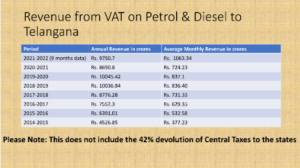
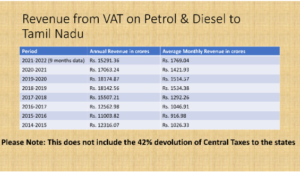
The above two table clearly indicate that neither of the states have seen dip in their revenues from VAT but for the pandemic induced lockdowns which affected the revenue across the globe.
Going Back To 2014
A point raised by regional parties like DMK and TRS also deserves attention. Finance Minister of Tamil Nadu PTR and all-powerful Telangana Minister KTR keeps shouting that central government is depriving states by charging cess which does not come under the shared pool with the states. At the outset this argument looks fair but on a deeper analysis this argument is bereft of facts.
It was the government led by Narendra Modi which decided to charge the Agriculture cess and Infrastructure cess for several reasons. One of the primary reasons for Agriculture cess is the fact NDA Government is directly transferring ₹6000/- per annum to every farmer and these funds are used for the same.
On the other hand, while the infrastructure cess is not shared with the state governments it is the state governments which gets hugely benefited from the national highway projects for which the infra cess is utilised.
What PM Modi Has Done For Telangana
KTR has the habit of complaining against the Infra cess while it is the state of Telangana which got hugely benefited since 2015 from the Ministry of Road Transport and Highways (MORTH). Following are some of the benefits which the state of Telangana received:
- National Highways Project increased by 99% in Telangana after Modi became PM
- 2525 kms of state highways have been converted into National Highways (NH) by MORTH thereby making Telangana one of the best states in terms of connectivity. We also know the pain of commuting in a state highway and pleasure of commuting in NH
- Under the PM Gati Shakti 5 corridors costing ₹22,706 crores have been included as high impact projects in Telangana
- ₹31,624 crores of work have already been sanctioned for Telangana
- ₹32,755 crores worth Regional Ring Road (RRR) have already been sanctioned. It is a 6 lane 330-Kilometer-long road which connects Hyderabad with other districts
What The Dravidian Stockists Will Never Tell You
If these are few development projects for Telangana the state of Tamil Nadu has been rewarded with several projects and some of them are:
- Modi Government has already spent ₹28,846 crores on building highways in Tamil Nadu
- ₹91,750 crores are sanctioned of which ₹39,863 crores worth of projects are already awarded
- 8 state highways are being upgraded to National Highways
- ₹3000 crores worth East Coast Road (ECR) project is sanctioned
- Chennai Port-Maduravoyal double decker worth ₹5965 crores were sanctioned by National Highways Authority of India on October 2021 (It is to be noted that this project was proposed during UPA 2 Government & foundation stone was laid by Former PM Manmohan Singh in 2009 but was later abandoned)
- Under PM Gati Shakti program a new defence corridor is coming to Tamil Nadu
- Under Bharatmala Pariyojana a Multi Modal Logistics Park (MMLP) is being developed at Mappedu near Chennai in partnership with Chennai Port Trust and Govt of Tamil Nadu
- Bengaluru-Chennai expressway & Chennai-Salem expressway projects are approved
- Project in VOC Port worth ₹7500 crores are implemented under PM Gati Shakti
- $130 Billion (₹9,75,000 crores) worth investments are made under Sagarmala Program which would unlock the potential of waterways. Tamil Nadu would be the major beneficiary of this project
- Under Sagarmala Program 6 mega ports are being constructed across the country and out of the 6 mega ports 2 of them are from Tamil Nadu which are Sirkazhi (Techo Economic Feasibility Report is under preparation) and at Kanyakumari where a major transhipment port is being built. Special Purpose Vehicle (SPV) was formed for this purpose in March 2019
- In fact, of the 6 mega ports 2 are from Tamil Nadu and 1 each at West Bengal, Maharashtra, Odisha and Karnataka. This fact busts the fake news that Modi Government only favours BJP ruled states.
Conclusion
The Infrastructure Cess is being utilised to make India a powerful economic super power which is self-reliant and progress is happening across the country. Parties like DMK & TRS are making irresponsible and irrelevant statements to vent their frustrations and it is sad to see that these statements are emanating from so called educated ministers. National Highways are constructed by Central Government and hence there is no need to share the Infrastructure & Agriculture Cess with state governments.
While the Modi Government can say with 100% transparency on the investments made by using the cess can the opposition ruled state governments share the value addition that they are bringing to the citizens by charging exorbitant value added taxes and also on the utilisation of VAT in developing their states.
Instead of complaining the opposition ruled states must heed to the advice given by Prime Minister Narendra Modi by reducing the VAT and ease the burden of citizens.
Click here to subscribe to The Commune on Telegram and get the best stories of the day delivered to you personally.
Tirade Against Ilaiyaraaja Tells A Lot About ‘Dravidian Model’ Of ‘Social Justice’
Imagine someone born in a quaint village along the foothills of the Western Ghats, struggling for a square meal, having no support of any kind, and yet defies all odds through his talent to achieve unimaginable heights.
That’s R. Gnanathesikan, revered world over as ‘Isaignani’ (musical genius) Ilaiyaraaja whose music continues to heal souls.
Yet, today the man is at the receiving end of the vitriol spewed by ‘Dravidian Stockists’ and ‘Ambedkarites’ who mouth about ‘self-respect’ and ‘social justice’.
And what was Ilaiyaraaja’s crime that he has to face music from these elements?
Expressing his views. Ilayaraaja had just expressed his views.
Ilaiyaraaja has written the foreword for a book titled ‘Ambedkar & Modi – Reformer’s Ideas, Performer’s Implementation’ in which he has appreciated several initiatives of Prime Minister Narendra Modi especially those concerning empowerment of disadvantaged communities and women.
He lauded the setting up of National Commission for Backward Classes, banning of Triple Talaq, and the ‘Beti Bachao Beti Padhao’ initiative of the Modi Government saying that these have brought in social transformation, something that Dr. Ambedkar would have been proud of.
In his foreword, Ilaiyaraaja also drew parallel between Dr. Ambedkar and PM Modi saying “Both these striking personalities succeeded against odds that people from socially disempowered sections of the society face. Both saw poverty and stifling social structures from close quarters and worked to dismantle them, but both are also practical men who believe in action rather than mere thought exercises.”.
However, this foreword written by Ilaiyaraaja for the book has irked the supporters of the ruling regime in Tamil Nadu.
Those who identify themselves as ‘Dravidian Stockists’, ‘Periyarists’ and ‘Ambedkarites’ have been cancelling the musical maestro and even abusing him.
Head of Viduthalai Chiruthaigal Katchi (VCK) Thol. Thirumavalavan who is portrayed in Tamil Nadu as the sole voice of the Dalit community implied that Ilaiyaraaja might have been under pressure, robbing him of his agency to express his opinion.
‘Savukku’ Shankar, a self-proclaimed ‘journalist’ and a rabid rabble-rousing ‘Periyarist’, supportive of the DMK government in Tamil Nadu, dehumanized Ilaiyaraaja by calling him a ‘kuppai’ meaning ‘dirt’ or ‘trash’ in Tamil.
Former Lok Sabha MP and Tamil Nadu Congress leader E.V.K.S. Elangovan abused Ilaiyaraaja making casteist remarks saying “There are certain elements in Tamil Nadu today claiming themselves to be ‘king of music’. Everybody knows who is the king of music. Not everyone who plays the tabla can become a music composer”.
“Those who accepted the Communist ideology when they had no means to afford food and were living below the poverty line are today, after getting money and fame, are considering themselves to be upper castes. You know who I am referring to.”, the Congress leader said referring to Mr. Ilaiyaraaja.
It is pertinent to mention that Elangovan is the grandson of E.V. Ramaswamy Naicker (known as ‘Periyar’ by his followers).
Spokesperson of the ruling DMK cited a summon notice from GST authorities in an attempt to tarnish the ace composer’s image.
This is the treatment meted out by the so-called champions of free speech, democracy, and social justice, to a celebrated icon of music who had brought laurels to Tamil society.
And none from the Tamil film industry have even bothered to voice out in support of Ilaiyaraaja or atleast condemn the attack on him. Not even ‘Superstar’ Rajinikanth. Probably he is busy shooting for his next film with Sun Pictures.
Actor-politician Kamal Haasan whose film career too is inseparable from Ilaiyaraaja’s music may be apprehensive of coming out in support of Ilaiyaraaja given that Udhayanidhi Stalin’s Red Giant Pictures has acquired the theatrical rights of his next venture ‘Vikram‘.
Such is the stronghold of the ‘Gopalapuram gang’, that even self-made giants are not able to come out and defend one of their own.
If this is not fascism, what is?
But the Ilaiyaraaja episode reveals something that none of the ‘social justice warriors’ will talk about – the true nature of the ‘Dravidian Model’ of ‘social justice’.
Ilaiyaraaja faces vicious attack from ‘Dravidian Stockists’ because they know that none would come to his rescue as he hails from a disadvantaged community.
However, this shouldn’t come as a surprise given that the father of ‘Dravidian Stockists’ and the DMK have a history of perpetuating violence against Dalits.
When 44 agricultural labourers belonging to the Dalit community were burnt to death in the Keezhvenmani Massacre, the so-called ‘Periyar’ justified the violence saying wage is not something that can be demanded, but fixed by the market.
It is pertinent to note that the perpetrators of the massacre were from the dominant Naidu caste and the prime accused was one Gopalakrishna Naidu. E.V. Ramaswamy Naicker was a Balija Naidu.
The erstwhile DMK government on the other hand left in lurch the victims of the massacre for the sake of votes from the dominant communities.
A similar incident happened under Karunanidhi’s watch when labourers from the tea estates of Manjolai (mostly Dalits) were hunted down.
There are several such incidents that stands testimony to the anti-Dalit mindset of Dravidian Stockists.
M.C. Rajah, a leader from Dalit community, severed ties with Justice Party over its treatment of Dalits. Back then, the Justice Party was dominated by Naidus, Mudaliars and Chettiyars. Even today, these non-Brahmin ‘forward castes’ form the core vote bank of the DMK.
Dalit woman leader Sathyavani Muthu left the DMK due to continuous harassment and humiliation. Former MP, the late C. T. Dhandapani was publicly insulted on the basis of his caste by the then local minister Pongalur Palanisamy and his wife both of whom belonged to the Kongu Vellalar Gounder community.
Dalit leaders like Parithi Ilamvazhuthi who ironically defeated Sathyavani Muthu in 1984 elections quit the party in 2013 and joined the AIADMK citing lack of respect in the party. V.P. Duraiswami who is now with the BJP quit the party citing DMK’s treatment of Dalits.
Thus, the attack on Ilaiyaraaja is just another episode that exposes the anti-Dalit mindset of Dravidian Stockists.
Click here to subscribe to The Commune on Telegram and get the best stories of the day delivered to you personally.