Home Blog Page 1018

Devotees Besiege Ramanathasamy Temple Condemning Temple’s Administration

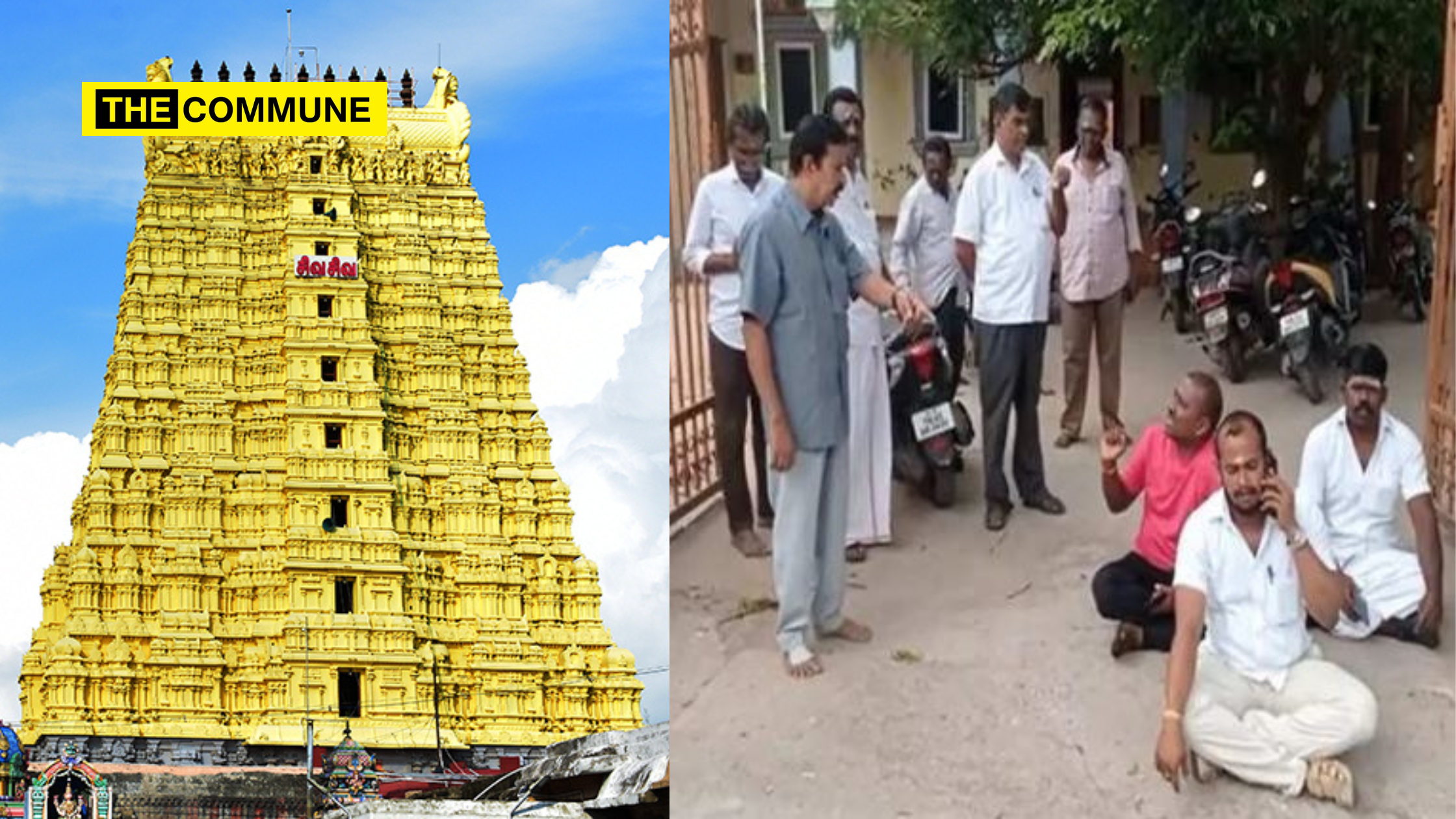
Accusing the temple management of insulting local devotees in the Rameswaram Ramanathaswamy Temple, devotees and the general public, including an AIADMK councilor, besieged the temple office and staged a protest.

The world-famous Ramanathasamy temple in Ramanathapuram district attracts thousands of devotees on a daily basis and tens of thousands during festivals and holidays. The temple is situated in Rameswaram, one of the Pandyan sites where Devaaram hymns were sung.

In the Ramayana, Rama fought and killed Ravana in order to rescue Sita from her kidnapper. To atone for his sin of killing a Brahmin and prevent the “Brahmahatti Dosham,” Rama dedicated and worshipped a sand lingam at this temple.

Rameswaram is also one of India’s 12 astrologically significant sites. According to the Puranas, Rama, who killed Ravana in the Ramayana, worshiped at this temple to atone for his sins. People from across the country flock to Rameshwaram for pilgrimage.

Since Rama worshipped Lord Eshwar, the temple is known as Ramanathaswamy, and the area is known as Rameswaram (Rama + Eshwaran).

Now at this holy pilgrimage site, there have been allegations that the temple administration has locked the temple premises at various locations and is not allowing the local public or pilgrims from outside to have proper darshan of the god.

In this case, the general public, devotees, and an AIADMK councilor laid seige to condemn the temple administration for disrespecting the devotees who had gone to the temple for worship on Monday. They engaged in a fierce verbal duel with the authorities causing commotion in the temple premises.

Later, the temple authorities negotiated with the protesters who were refusing to leave. As the situation in the temple became tense, police were called in even while the temple authorities were negotiating. The protesters have warned that if the temple administration does not change its arrogant attitude, they will take the protest to the next level.

(With inputs from Samayam Tamil)

Click here to subscribe to The Commune on Telegram and get the best stories of the day delivered to you personally.

 

NIA Arrests 9 Sri Lankan Inmates From Trichy Special Camp For Involvement In Illegal Drugs And Arms Trade

The Nation Investigation Agency (NIA) arrested nine Sri Lankans on Monday from a special camp for refugees in Tamil Nadu for their alleged involvement in illegal drugs and arms trade to revive the LTTE terror group.

The accused were identified as C. Gunashekharan alias Guna alias Prem Kumar, Pushparajah alias Pookutti Kanna, Mohammad Asmin, Alahapperumaga Sunil Ghamini Fonseca, Stanly Kennady Fernando, Ladiya, Dhanukka Roshan, Vella Suranka alias Gamage Suranga Pradeep, and Thilipan alias Dileepan.

A team led by SP Dharmaraj of the NIA, Kochi arrested the accused for drug trafficking and arms trafficking in Tamil Nadu and Sri Lanka in an attempt to revive the LTTE. They had been lodged at the special camp for their involvement in some other crimes.

After receiving approval from Trichy district collector M. Pradeepkumar, who verified the inmates’ case information, the NIA began the day-long interrogation. Later, NIA escorted the nine to Chennai to produce them in court.

In July 2022, the NIA filed a case in connection with the smuggling of drugs, arms, and ammunition from Pakistan to India and Sri Lanka in order to resurrect the LTTE.

Subsequently, an NIA team led by DIG Kaliraj Maheshkumar conducted a search on the premises of the Trichy special camp for foreign nationals on July 20. The NIA seized mobile phones, SIM cards, pen drives, hard drives, laptops, WiFi, and other electronic devices during the massive raid. The NIA found inmates with ties to the smuggling case.

The accused were arrested in connection with the seizure of narcotics and illegal arms on a boat intercepted near Vizhinjam Port. In 2021, defense forces intercepted a boat in the Arabian Sea near Kerala’s Vizhinjam Port. The boat contained 300 kg of heroin, five AK-47 machine guns, and 1000 rounds of 9 mm bullets, according to authorities.

It is noteworthy to mention that the DMK government released 16 Sri Lankan Tamil prisoners from the Trichy Special Camp on 2 July 2022, just days ahead of the NIA raid. The state government released the 16 Sri Lankans “after considering several aspects of their crime they were involved in”.

10 Sri Lankan Tamils were earlier released on 15 July 2021 by the DMK government.

Click here to subscribe to The Commune on Telegram and get the best stories of the day delivered to you personally.

“Zubair = Kasab + Bin Laden”: TN BJP Leader Brutally Takes Down Fake News Peddler Mohammed Zubair

In a brutal comeback, BJP Tamil Nadu leader Amar Prasad Reddy came down heavy on Alt News’ Mohammaed Zubair when the latter tried to take a jibe at him.

Amar Prasad Reddy had put a tweet hailing Tamil Nadu BJP leader K. Annamalai. In light of Argentina winning the FIFA World Cup 2022, Amar Prasad Reddy had juxtaposed the photos of Argentina football player Lionel Messi and Annamalai holding a calf with the caption “Both are the “Greatest of all times””.

Mohammed Zubair of Alt News, who has been caught peddling fake news a number of times, tried to take a jibe at Amar Prasad Reddy saying “Amar Prasad Reddy = Senthil + Vadivelu + Nagesh + Vivek + Goundamani.”

Senthil, Vadivelu, Nagesh, Vivek and Goundamani are well-known comedians and had made a name for themselves through their comedy tracks in several movies.

Zubair through the tweet had implied that Amar Prasad Reddy was nothing more than a comedian.

To this jibe, Amar Prasad Reddy came with a brutal back saying “Mohammed Zubair = Kasab + Osama Bin Laden”.

Mohammed Zubair, Co-Founder of propaganda website Alt News and a self-proclaimed “fact-checker” is a rabid Islamist known for peddling fake news. The various instances when Zubair and his partner Pratik Sinha peddled fake news can be found here. Zubair had earlier mocked Hindu Gods through his social media account.

Mohammed Zubair was elemental in dogwhistling and unleashing a campaign against former BJP leader Nupur Sharma which led the fanatic Muslims to hit the streets creating a communal frenzy.

Click here to subscribe to The Commune on Telegram and get the best stories of the day delivered to you personally.
How The Kashi Vishwanath Corridor Has Proven Well-Intentioned Skeptics Wrong

Three years ago as I landed in Kashi in March 2019, it stood at the crossroads of time. It was just a few days after Prime Minister Narendra Modi had laid the foundation for the Kashi corridor project.

The space which would eventually turn into the corridor was half a pile of rubble and half old and unkempt buildings that made it look like anything but the extended praangan of one of the most powerful and important Hindu shrines.

There were workers clearing what had now been reduced to dust and there were those who said ‘their lives were being trampled upon’.

But those working on the project spoke of its future form in terms of what all this was truly worth: the ease with which devotees will be able to take a dip in the Ganga and walk straight to see Vishwanath, their divine aura and devotion undisturbed and post-darshana too soak in the experience in a space and ambience conducive for ‘bhakti’.

At that time, it sounded all too utopian, given the grime around and the lanes outside of the arena of the corridor project still giving a glimpse of what it had to ‘undo’.

But there was one large image that was on a wall that came across as a huge reassurance: that of Maharani Ahilya Bai Holkar.

On a wall of a brick structure that faced a mosque, the poster had an image of Ahilya Bai Holkar holding a Shivalinga on her right palm, her left hand from below her ghoongat gently supporting it, and the flower offered atop it.

Next to it was text that read ‘Maharani Ahilya Bai Holkar — Restored the temple to its present form in 1780’.

It was as if she was watching the work that was underway. For it was she who not just built the current standing structure, but also revamped the ghats of Varanasi – both the Dashashwamedh as well as the Manikarnika ghat.

It was she who had envisioned and led the revival and reconstruction of various Hindu shrines and sites across the country from Gaya to Gangotri to Rameshwaram.

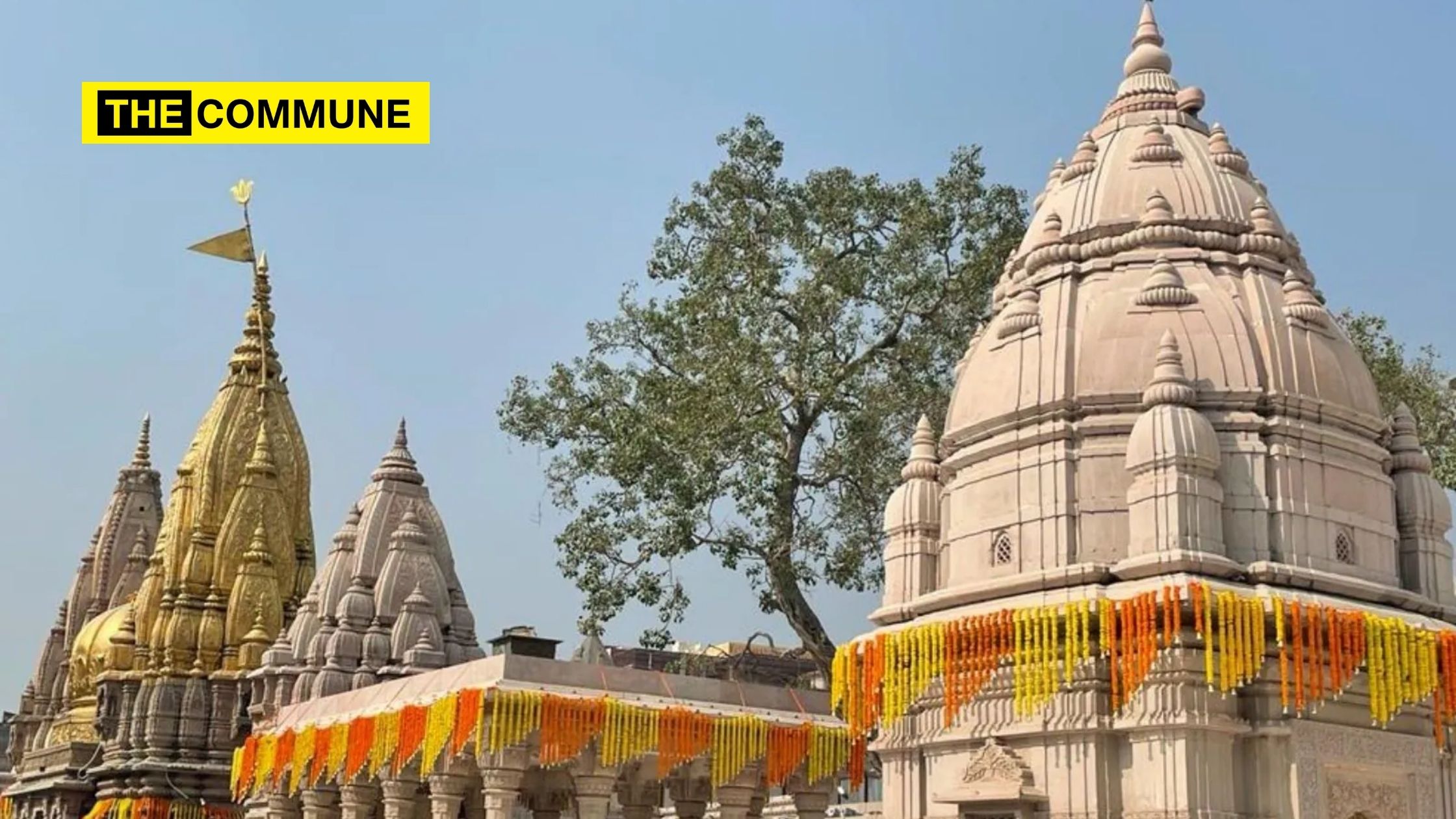
And three years since then, as I strolled up the Lalita ghat last month on the occassion of Dev Deepavali, and entered the corridor, the sight that greeted me felt like the project had accomplished not just what it intended to but also much beyond it.

It was a sense of civilisational relief for any Hindu – that between Ganga and Vishwanath stood just an inviting stretch, the corridor.

It was moving to watch the garlanded Rani Ahilya Bai Holkar sit glistening in stone and watching over pilgrims posing in front of her statue for selfies and pictures.

Thousands of pilgrims had passed by her statue that one day itself as they queued up to see Vishwanath and hundreds sat around post darshan simply absorbing what they had experienced, waiting, resting and just being there.

The pilgrims had queued up at the first security check after having deposited their phones and valuables and had the replica of the main shrine, the Chandragupta Mahadev Mandir for a backdrop.

Also known as the Manokameshwar Mahadev temple as according to a legend the deity fulfils the wishes of the devotees. Its transformation itself looked like the shrine had got one of its own fulfilled to begin with.

There were water filters for the thirsty, clean washrooms, locker rooms and a large expanse of pleasantly cool pink stone corridor for the pilgrims to simply rest.

And it is constantly being cleaned, is manned round the clock with security and almost leaves no room for fleecing by middlemen who earlier could make it hassle for those who sought to access Vishwanath.

People are much at ease and that is no mean achievement given that on certain days the footfall is said to have crossed five lakhs too.

Of course, there are also clothes drying, old men and women lying down without a worry; the neem saplings are not yet large enough to shield them from the sun but the structure around these trees-to-be turned into seats and benches, hosting the tired feet and letting weary spines rest.

And why all of this is to be lauded is because anyone who has visited Kashi even five years ago, knows that even having your feet clean as you head to the shrine was almost next to impossible.

As one enters and watches hundreds of people queue up by the minute, especially on festive days, it is heartening to note that there is not a speck of dust.

The temple’s extended landscape is as it should be— clean, pristine and devotional. Not dirty, dung-laden unclean serpentine lanes, dingy rest houses, stray animals hovering around, open drains.

Ask locals what has changed for the city and its dwellers, and they list how ‘Kashi Vishwanath Dham has become the growth engine of Kashi’.

As a ‘Banarasi’ entreprenuer Shashi Kumar tweets quoting various news reports, ‘Over 7.65 crore devotees have visited the shrine and around 100 crore worth donation received in the last one year. Kashi has left behind Goa as the most popular destination of India’.

He added saying ‘Hotels in Kashi witnessed 124 per cent growth in the last one year with room tariffs going upto Rs 1 lakh on festive occassions. A record 12 lakh people visited Kashi on Dev Deepavali, and 5 lakh on new year day alone’ expressing gratitude on behalf of everyone in Kashi.

On its first anniversary, the project prepares for a grand celebration, almost on the scale of the Mahashivaratri—with the ‘baraat’ of Mahadev transforming the ancient town into his wedding venue. That is a befitting commemoration for an effort that has facilitated devotion and dharma like never imagined in recent times.

This article was originally published in Swarajya and has been republished here with permission.

Click here to subscribe to The Commune on Telegram and get the best stories of the day delivered to you personally.
Sadhguru Spotted At FIFA World Cup Finals

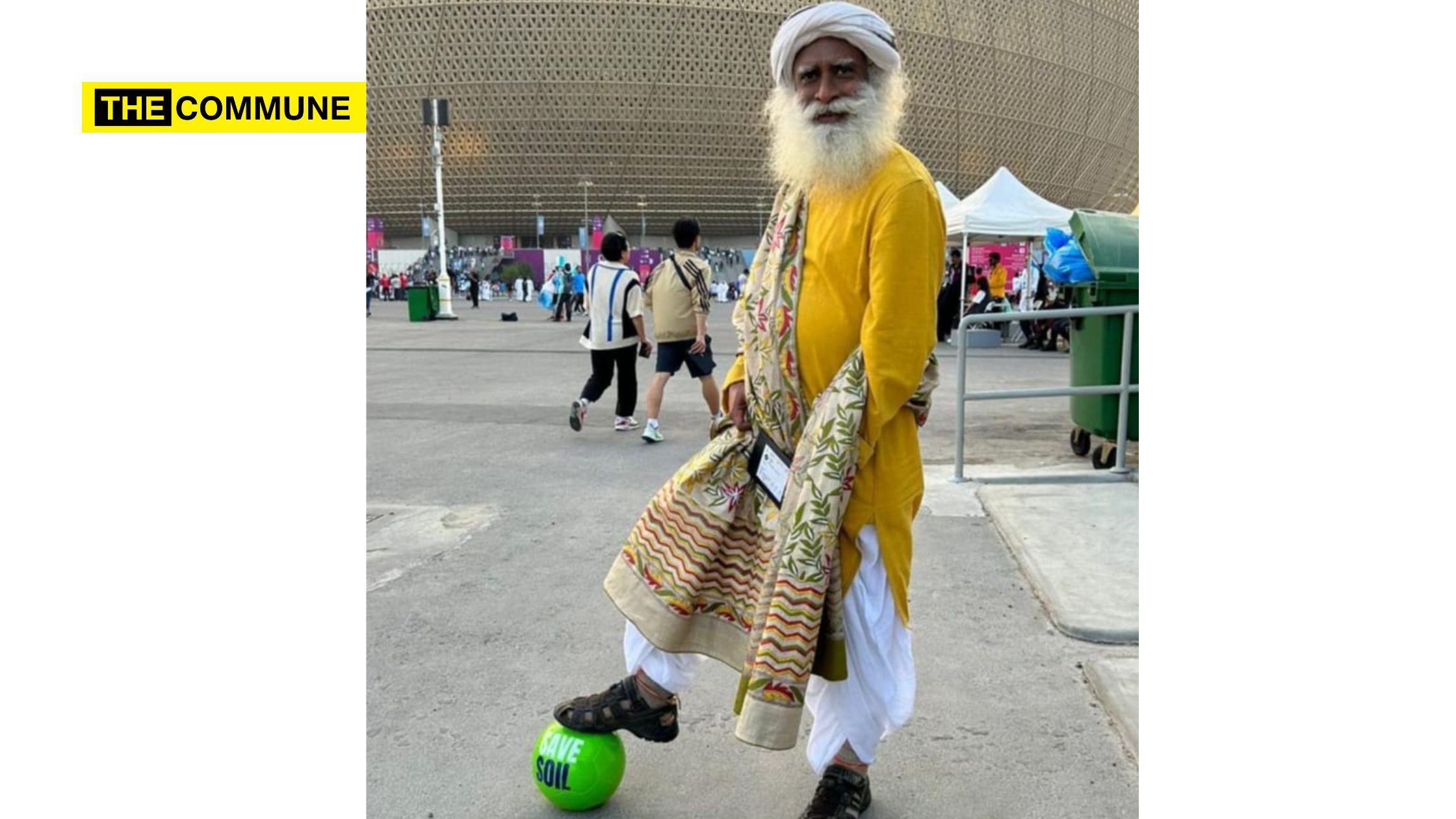
The FIFA World Cup Fever 2022 has swept football fans all over the world and Sadhguru seems no exception to it. The Indian yogi and mystic, was spotted attending the tightly contested finals between Argentina and France in Qatar.

Tweeting after the match, Sadhguru said, “A fitting finale. Football wins! Congratulations to Argentina & France on a truly high caliber game. -Sg”

The match, true to expectations, went down to the wire with Argentina beating France 4-2 on penalties.

Sadhguru who is spearheading the Save Soil Movement was also seen kicking the #ScoreforSoil campaign ball ahead of the match. The campaign, against the backdrop of the Football World Cup, encourages people to put up a video on social media of their best football shot and #ScoreForSoil in support of the Save Soil movement.

The Save Soil Movement is bringing the world’s attention to save the dying soil and is urging nations to mandate 3-6% organic content in agricultural soils around the world through policy-driven initiatives.

(This is an official press release from Isha Foundation. The Commune was not involved in creating this content.)

Click here to subscribe to The Commune on Telegram and get the best stories of the day delivered to you personally.
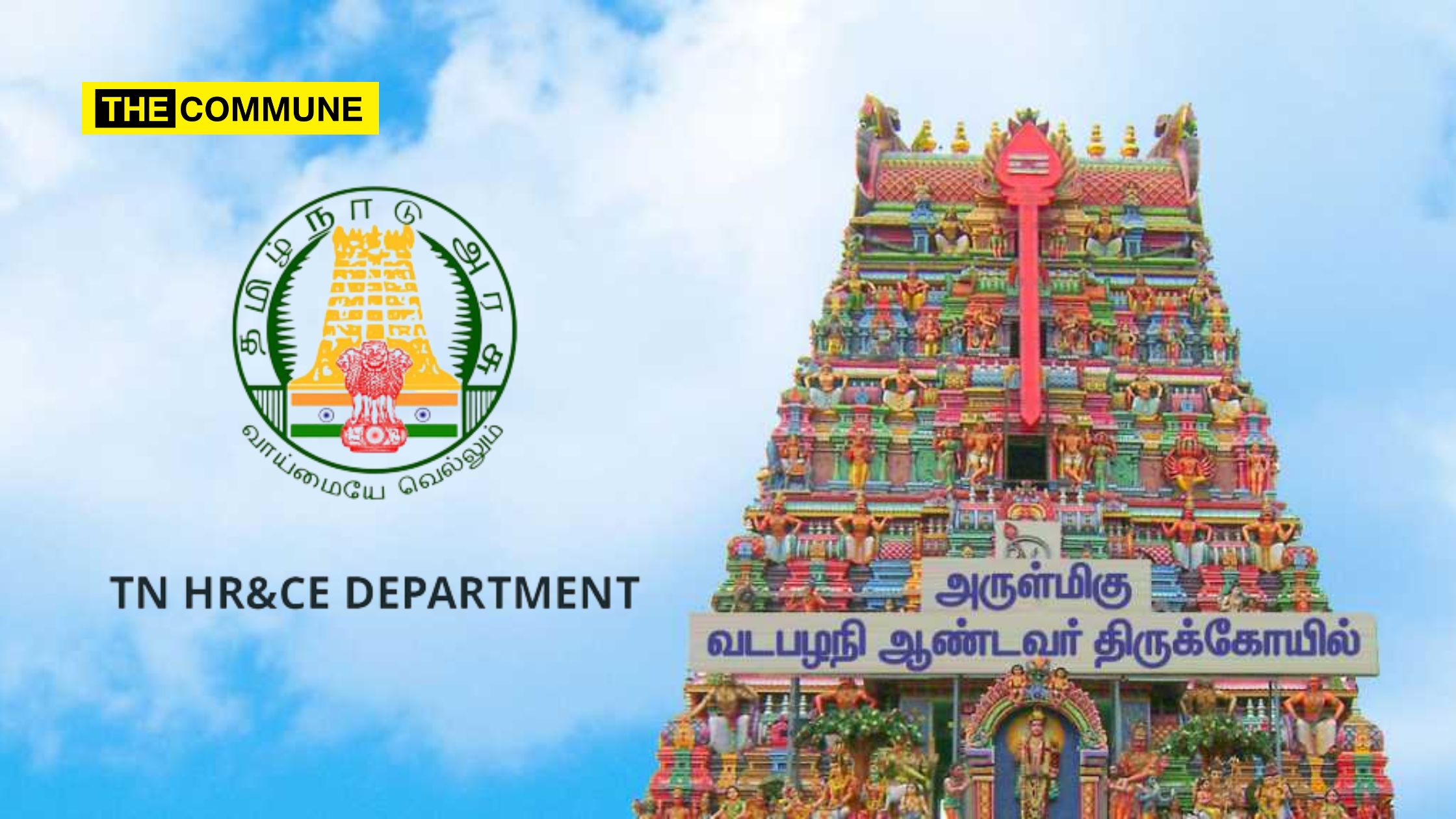
TN HR&CE Dept: A Den Where The Corrupt Mint Money In The Name Of God

Tamil Nadu, the land of temples. Many of them are ancient and are of rich heritage value.

But these temples have become a den for the corrupt government officials to swindle money from the devotee in the name of God. Even a sitting High Court judge can be duped and extorted by these corrupt officials.

Justice SM Subramaniam of Madras High Court had gone to the Vadapalani Murugan Temple with his family on 17 December 2022 without disclosing his identity.

He had paid ₹150 for three special darshan tickets but was given two ₹50 and one ₹5 ticket. ₹45 went swaha!

When he questioned about the irregularity, the temple staff behaved rudely. He and his family were intimidated and gheraoed. The judge had noted that would’ve been pushed out like the officials do with others had the police not intervened and disclosed his identity.

This is the plight of a judge who voices out against the corruption plaguing inside the temples, courtesy the HR&CE department.

This has once again put the issue of ownership of the temples in focus.

Who Should Control Temples?

The issue of temple “ownership” and management has been a bone of contention between the Government (several Indian state governments) and Hindu citizens (both common people and religious leaders) for a while now. At the centre of this contentious issue, is the Hindu Religious and Charitable Endowments Act (HR&CE), applicable only to Hindu places of worship, as the name suggests. To cut a long story short, many people argue that the existence of the HR&CE Act and a department that oversees the implementation of the Act, is contradictory to the fundamental rights of Freedom of Religion that the Constitution guarantees to every citizen as well as the “secular” character of the country, implying a separation of governmental oversight and administration from religious affairs including temple management.

Freedom of Religion as guaranteed by the Constitution, for all the faiths practiced in the country, includes the right to chosen beliefs, worship, donations and can be extended to the choice of where and how the donations are put to use. The ‘secular’ nature of the Constitutional framework, advocates against the State’s interference in any matter of religious affairs and an equal treatment of all religions. Yet, it is only the Hindu temples and charitable organizations, that are regulated by the HR&CE department. Churches, mosques and their charities, schools, hospitals etc are not monitored, regulated, legislated or controlled by the State.

A temple is the home of the deity and it is He/She who owns the temple. So, the HR&CE Department or for that matter the government or any legal entity doesn’t ‘own’ the temple. Every temple has a Dharmakartha (trustee) or a trust to manage the affairs of the temple. The HR&CE Department can enter a temple only if there is an allegation of mismanagement. So, the existence of HR&CE Department in many temples of Tamil Nadu is illegl and unconstitutional.

HR&CE: A Colonial Legacy

The history of the HR&CE Act helps us understand its original purpose and intention but does not put to rest, the argument that its very existence stands in stark contradiction to our Constitutional principles of religious freedom, religious rights and non-interference in religious matters. During colonial times, the British kept an eye on temple donations and resources through their Department of Revenue, recognizing the potential of temples as significant financial contributors to their
economic and military plans.

After much deliberations and some resistance from people, they advocated the formation of a “department” to oversee temple affairs including the financial aspects of temple management. With specific regards to Tamil Nadu (Madras Presidency), around 1840, the then British Government was ready to give up administration of temples. The British administration invited some of the prominent “mutts” of the time (Hindu institution/monastery/ashram), in the state to look after important temples and endowments.

The Heads of Mutts who took over the administration of these temples, were careful enough to ask for written documents or “Muchalikas” from the British Government, as an assurance that the temples would not be taken back from them. Large temples and important places of worship came under the control and ownership of these Mutts and the Mutts ran them ably and efficiently.The primary purposes of worship and utilization of funds meant for the upkeep of temples and conduct of rituals, were managed well. While a few temples were responsibly and efficiently administered by the Mutts, thousands of other temples in the then Madras Presidency were handed over to the respective private “trustees” with the then Madras government playing little or no role in supervising them.

In 1925, the Madras Hindu Religious Endowments Act, 1923 (Act I of 1925) was passed by the local Legislature, with the supposed objective of providing better governance and administration to certain religious endowments. The Act divided temples into what are known as Excepted and Non-excepted temples. Immediately after the Act came into force, its validity was challenged on the ground that the Act was not validly passed. For this reason, the legislature enacted the Madras Hindu Religious Endowments Act, 1926, Act II of 1927 repealing Act I of 1925.This Act was amended from time to time and contiued even after India gained Independence and started to follow its own Constitution. Thus, it can be seen that even in the pre-independence era, the Board had systematically consolidated its powers to take over and administer temples. This unwelcome, unfair intervention by the Government applied only to Hindu Institutions.

The Board also tried to take over the famous Shri Guruvayurappan Temple in Guruvayur (Kerala), Udupi Shri Krishna Temple under the management of Shri Shirur Mutt of Udupi and Shri Venkataramana Temple belonging to the Gowd Saraswath Brahmins in Mulkipetta of South Kanara district.These religious institutions challenged the takeover by the HRCE Board.

A new Hindu Religious Act was passed by the Madras Government, known as the Hindu Religious and Charitable Endowments Act, 1951. The Madras Government was heavily influenced by EV Ramasamy’s “Dravidian” model, proclaiming “rationalism” as the only Truth. While it encouraged atheism and propounded rationalism among the Hindus, it largely left the idiosyncrasies of Islam and Christianity alone. The modern day follower of this blantant discrimination among the religions, is Tamil Nadu’s DMK party.

The Government’s stand on the continuance of temple control, back in the day, was that social justice would be sacrificed at the alter of caste based practices, including entry into temples and participation in temple activities. Petitioners now argue, there is no need for such a fear, given the changed circumstances in current times and the constitutional rights/ guarantees of individual liberties in India’s post-Independence climate.

Is The HR&CE Department Doing Its Job?

Regardless of the Constitutional validity of the HR&CE Act and regardless of the Act’s purported purpose and intent in the 1950s and now, it is clear that in the absence of private control of temples, temple properties and possessions, it is the duty of the HR&CE department to survey all temples both in use and not in use, conduct regular audits of the maintenance and upkeep of temples, temple lands and undertake regular renovation work of temples in disrepair. In earlier times, all such work was done under the patronage of kings and queens, devout citizens, wealthy patrons or private, charitable trusts run by certain communities or religious leaders.

Our magnificent temples, many of them architectural wonders and heritage monuments, occupy a place of honor and pride in our history and culture. Our roots and cultural history are tied to our religious/temple history. Since the HR&CE department replaces a network of earlier patrons, it must be held accountable for the welfare of temples and temple properties, in all aspect of their existence. Many argue that it amounts to criminal negligence if the HR&CE department does not preserve monuments of our ancient culture- our temples. Of the many states, that have argued against the validity and necessity of the HR&CE Act in a modern India, which has made significant progress with social practices like the outdated caste system.

Tamil Nadu acclaimed as the Land of Temples or “Temple Nadu”, is at the forefront of several hotly contested, empassioned debates. The Tamil Nadu government continues to vociferously argue on the basis of caste-based reasons to which the petitioners counter that it is not relevant anymore. The government persists on the question of future ownership and management “to whom should the temples be handed over to?” The petitioners promptly reply, that they should rightfully be handed back to the Hindu community and henceforth be managed by religious leaders, community leaders or religious and charitable Trusts, just like the churches & mosques of the minority communities.

One of the consistent arguments of the petitioners, presented with clear, visual proof, is a depressingly long list of old, heritage temples of historical and archaeological importance, that lie in ruins today, despite numerous requests and reminders to the State government for their renovation and maintenance. Repeated claims of over 5000 temples lying in ruin, is a disturbing figure and a sign of a country, not appearing to be proud of its cultural heritage.

Over the years, there have been several reports of stolen temple property/ possessions including ancient idols, jewelry and art work, worth millions and later proved to have been stolen. While a few priceless artifacts have been traced and recovered, many pieces of exquisite craft work, representing our culture and history are still missing!

Popular, respected religious leaders of the community including Sadhguru Jaggi Vasudev, have requested a re-examination of the validity of the HR&CE Act and a reconsideration of its proclaimed purpose, which is no longer relevant in current times. Here’s a small list of temples from Tamil Nadu, in dire need of renovation and upkeep, among many, many more that ordinary citizens, netizens and bloggers are trying to bring to light.

-Shiva Temple, Thellur
-Thiruvilaiyattam Shri AnnamalaiyarTemple
-Nagampanthal Shri Nagalingeshwarar Temple
-Saanur Shri Boothalingeshwarar Temple
-Puduthurai Shri Tharaneeswarar temple
-Pagasalai Sri AdiKesava Perumal Temple
-Poundarigapuram Somanadhaswamy Temple
-Koogaiyur Karyampureeshwarar Temple
– Uzhavarapani Thiru Magaral Temple
-Mangudi Sivalokanadhar Temple
-Nellithope Perumal Temple

There are many smaller temples which doesn’t even have the wherewithall to do even one pooja in a day. In these places, it is high time the privileged members of the Hindu community do their bit in saving these temples.

End Note

Justice Subramaniam’s visit to the Vadapalani Murugan Temple is a God send. Looks like Lord Murugan himself couldn’t stand the atrocities being committed by the corrupt officials of the HR&CE Department. The HR&CE Minister P. Sekarbabu, instead of bringing his house in order, is busy in making arrangements for CM’s son-in-law to do ‘Kshatru Samhara Yagnam’ while putting the devotees to distress.

Click here to subscribe to The Commune on Telegram and get the best stories of the day delivered to you personally.
Conflict Of Interest? TN Sports Min Udhayanidhi’s Wife Runs Private Sports Firm

Since his father, MK Stalin, appointed Udhayanidhi as a minister in his cabinet, there has been no dearth of controversies.

Even though the DMK claims to practise rationalism, Udhayanidhi was appointed a minister on the last day of the Tamil month of Karthigai. The date and timing are crucial since they are auspicious by the Hindu calendar. The ceremony is taking place in Karthigai month because the upcoming Margazhi is considered inauspicious.

Then, another controversy erupted when the first time MLA and Minister Udhayanidhi was given a 10th position in the cabinet, far ahead of the Tamil Nadu Finance Minister PTR Palanivel Thiagarajan, who was placed at 27 in the list.

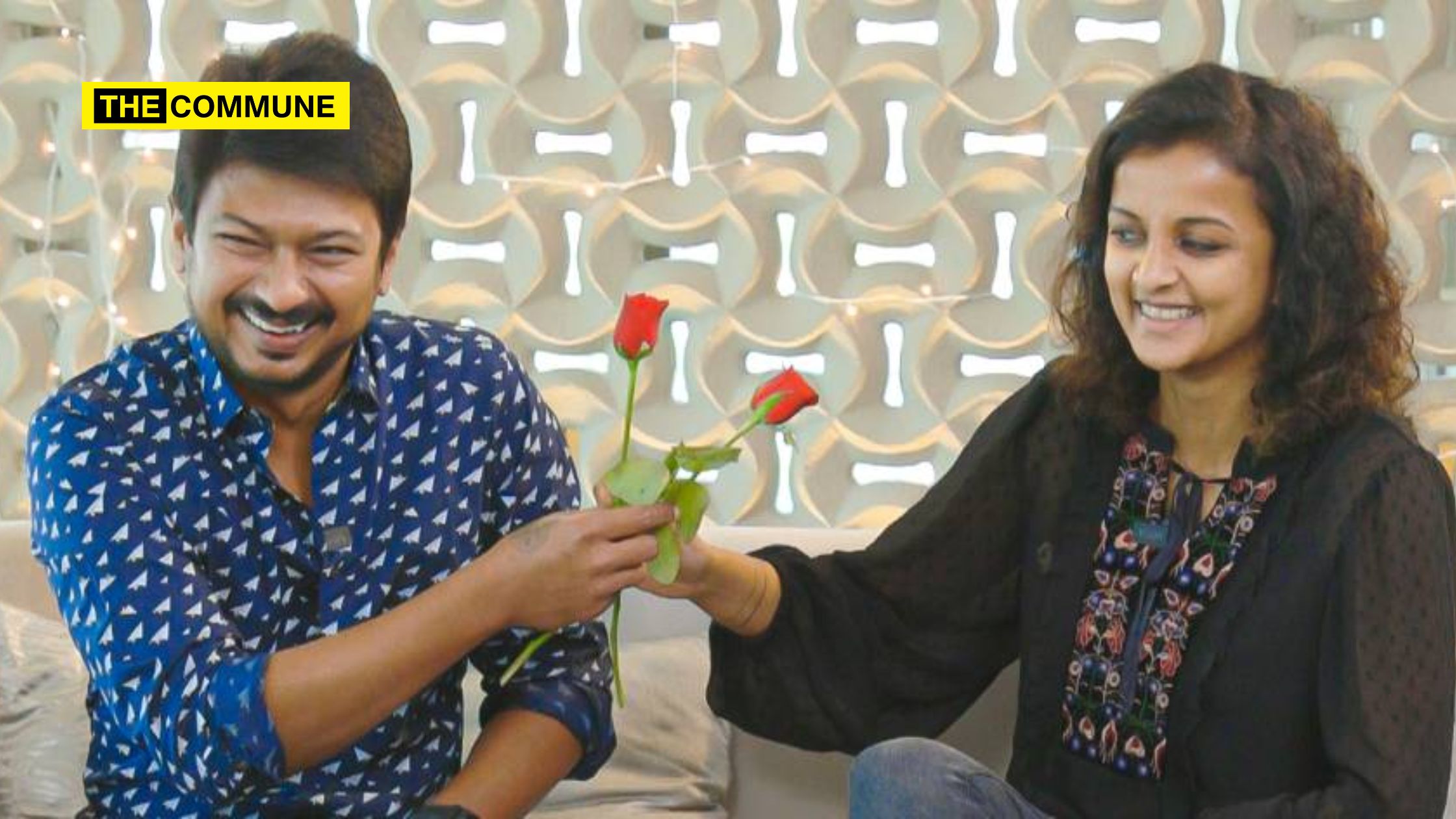
Now there is another controversy brewing with Kiruthiga Udhayanidhi, wife of Sports Minister Udhayanidhi Stalin, running a firm which is in the business of sports.

Political commentator ‘Savukku’ Shankar alleged Kiruthiga Udhayanidhi of running a private sports firm named Snow Sports Promotion Private Limited with her husband being a sports minister, citing a clear conflict of interest.

He stated in a tweet, “Udhayanidhi being Minister for Sports, his wife being a Director in a Sports promotion firm, is a clear case of conflict of interest. Stalin family’s greed knows no bounds.”

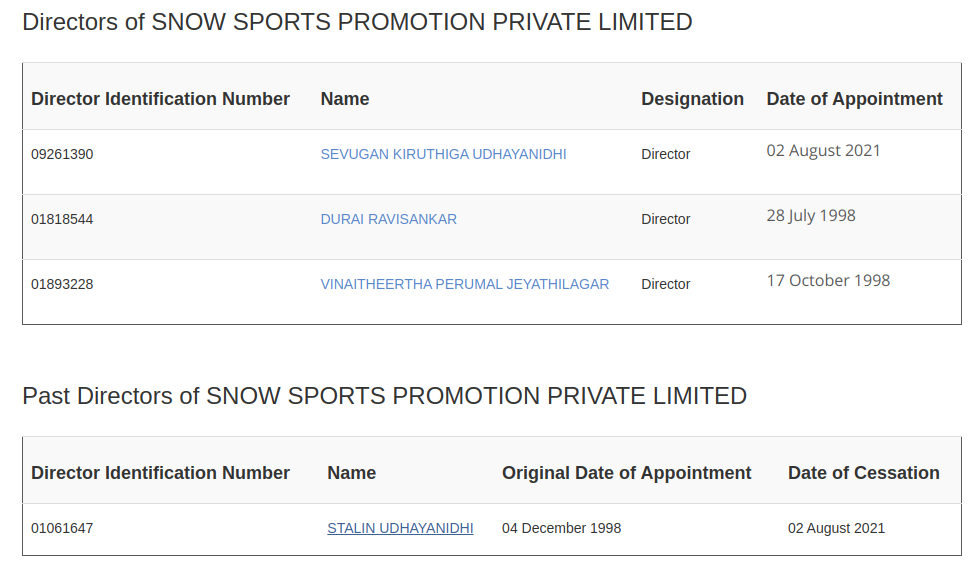
According to information filed with the Ministry of Corporate Affairs, Kiruthiga Udhayanidhi was appointed as the director of Snow Sports Promotion Private Limited on 2 August 2021, within 3 months of the DMK coming to power . She took over as director of the company from her husband, sports minister Udhayanithi Stalin, on the same day he resigned as director of the firm.

The company is located in Sun Rise Avenue, Sri Kapaleeswarar nagar, Neelankarai, Chennai and has an authorised capital of ₹1.5 crores and a paid up capital of ₹9,566,700.

It should be noted that two other companies, SNOW SPORTS PROMOTION LIMITED and SNOW HOUSING PRIVATE LIMITED, are also located at the same address and are also headed by Kiruthiga Udhayanidhi.

Click here to subscribe to The Commune on Telegram and get the best stories of the day delivered to you personally.
Vennikaaladi, The Devendra Kula Velalar Who Fought British Stooge Muhammad Yusuf Khan

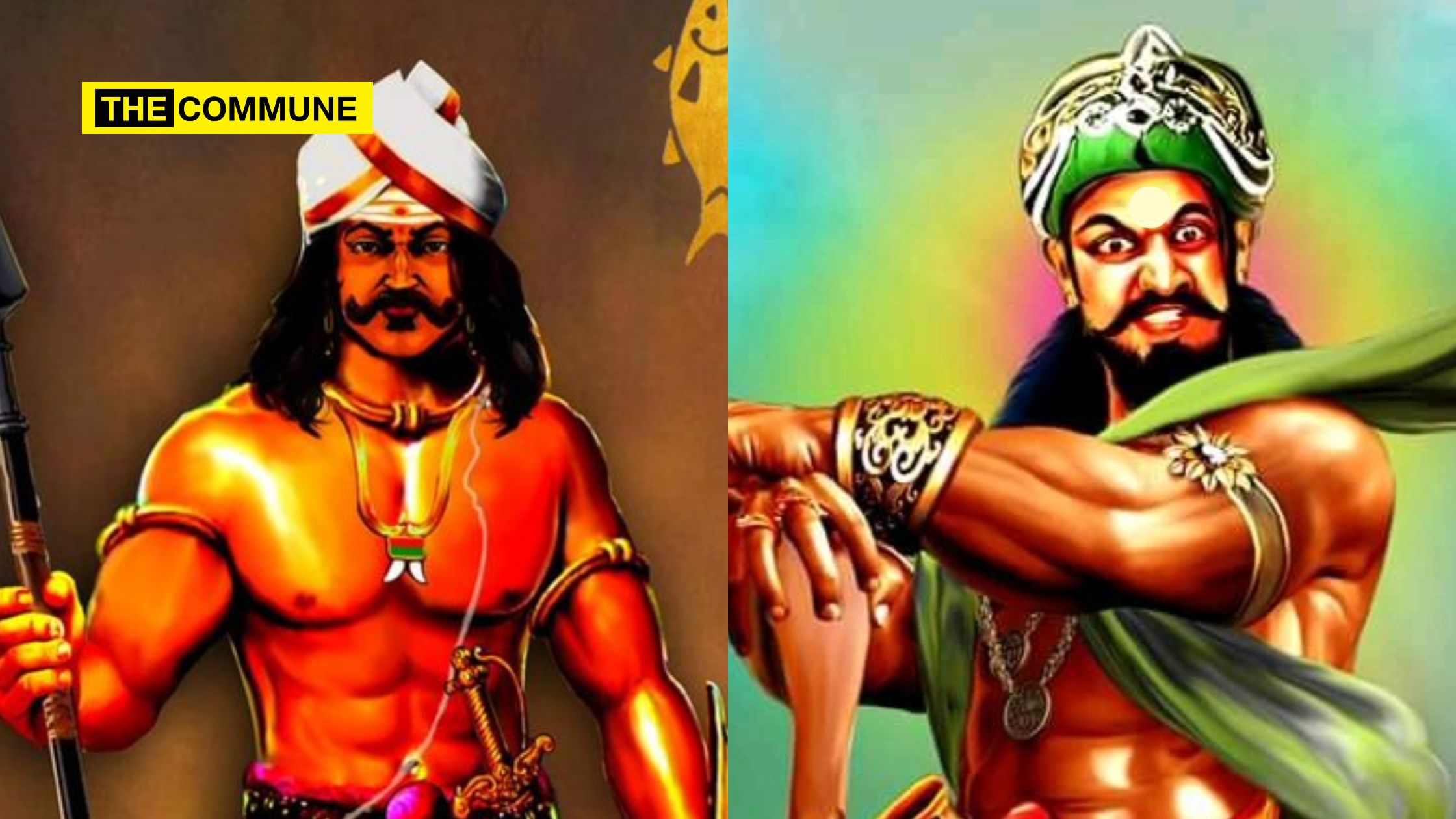
Many members of the Devendra Kula Vellalar clan served as soldiers during the period of the Palayakkars. The camp chiefs formed and managed regiments in their camp areas to protect their camps from the surrounding jungles and the increasing dominance of foreigners. Pulithevan (1715-1767), a Palayakar who ruled from Nerkaattan Chevalai (Nerkattumseval today) as his headquarters, maintained one such army.

Kaalaadi, a sub-division of the Devendra Kula Vellalar clan, has served in those regiments for generations and was given the name “Kaalaadi” because they were serving in the infantry. In Tamil, infantry is known as Kaalaatpadai – காலாட்படை.

The soldiers in the army who rendered extraordinary service were described as Periya Kaalaadi, Chinna Kaalaadi, Karaiyaalar Kudumbanar, Saattan Kaalaadi, Shankarakudaiyan, Maatukkudumpanar, Muthukutumpanar, Kattakkaruppanan. They also functioned in groups as units of larger soldiers.

It appears that the clan’s leader wanted that group to be associated with them because of the valour, fighting spirit, initiative, and honesty of their community and their leaders. One such veteran is the Periya Kaaladi popularly known as Venni Kaaladi who belonged to the sub-division of Devendra Kula Kaladi and served as the main commander of Puli Thevar’s Army.

Muhammad Yusuf Khan Alias Marudhanayagam

Maruthanayagam (1725 – 1764), born in a village called Panaiyur in British India, what is now in Nainarkoil Taluk, Ramanathapuram District of Tamil Nadu, was the commandant of the British East India Company’s Madras Army.

After converting to Islam, he took the name, Muhammad Yusuf Khan. When he became the ruler of Madurai, he was dubbed as Khan Sahib. He rose through the ranks of the Arcot troops to become a commandant of the British East India Company troops.

He was hired by the British and the Arcot Nawab to put down the Polygar (a.k.a. Palayakkarar) uprising in South India. When the Madurai Nayak rule ended, he was entrusted with the administration of the Madurai region.

Puli Thevar Vs British:

Pulithevar’s reign marked the end of the Pandya dynasty and the decline of the Nayak dynasty. It was a time of transition, with Arcot Nawabs encroaching on Tamil regions and the British entering into Indian politics.

The Palayakkar Puli Thevar recognized that the small Palayams were vulnerable to such large-scale regime changes, so he gathered all the villagers and made the them realise the importance of unity.

All Palayakkars avoided paying tax to the chieftains as per the Puli Thevar instructions. The Tamil region fell into the hands of the Islamic ruler Arcot Nawab as the power of Nayakkars weakened. It later passed into the hands of Maharashtrian kings, and then into the hands of the Islamic rulers. However, due to a feud between the Nawab of Arcot and another Muhammadan king, both factions tended to collect tribute separately from the Palayakkars in Tamil Nadu. Taking advantage of the discord between these two factions, the Palayakkars ceased paying taxes entirely.

The Nawab of Arcot sought the assistance of the British in this situation. According to their agreement, the Nawab of Arcot gave the British the authority to collect taxes. Since then, the British have engaged in direct conflict with the Indian kings. British army led by Colonel Alexander Heran, the Nawab’s forces led by Mabus Khan, the brother of the Nawab of Arcot, and the native sepoys led by Muhammad Yusuf Khan set out to attack the Palayakkars in 1755 as they refused to pay taxes.

Yusuf Khan, unable to defeat the army of Puli Thevar led by Periya Kaaladi, decided to attack them at night. Yusuf Khan’s troops decided to surround and fight the Nerkattumseval fort at night from the camp they had set up. Periya Kaaladi encamped on the forest road after receiving intelligence about Yusuf Khan’s secret attack and resisted the enemy. During the attack, he was wounded due to the attack by one of the enemy soldiers.

Despite the stomach being torn and the intestines coming out, he pushed it back in, took the cloth tied as a turban, and tied it along the gut before continuing to fight the war and defeating the opponents. Realizing that many more people were lurking in the forest areas and might attack in the next few days, he got on his horse and reported to Puli Thevan. He rode his horse to Puli Thevar and reported that the enemy had gone into hiding with the army in the forest and collapsed on Puli Thevar’s lap.

Devastated by his friend’s death, Puli Thevan erected a stone near the battlefield and named it “Kaaladi Medu.”

Napoleon’s forces were fighting to take the German city of Ratisbon in 1809. Napoleon stood on a nearby hill, looking down at Ratisbon. A small cloud of dust suddenly moved away from Ratisbon. Napoleon noticed a fleet approaching him. It was a young man on a horse who told Napoleon about the victory of the French forces at Ratisbon and that he hoisted the French flag himself. When Napoleon saw the wound in his chest, he said, “You are wounded,” and the brave young man fell down, saying, “No, I am killed.” This is the essence of Robert Browning’s poem ‘The Incident of the French Camp’.

While our history textbooks may have forgotten Vennikaladi, the man who died on Puli Thevar’s lap continues to live in the Tamil folklore similar to the poem ‘The Incident of the French Camp,’ which described the valor of a French soldier.

Click here to subscribe to The Commune on Telegram and get the best stories of the day delivered to you personally.
Namakkal Eggs Exported To Malaysia To Meet Shortage

Malaysian Agriculture and Food Security Minister approached the Indian Embassy at Kuala Lumpur, Malaysia seeking to export Indian eggs to their country as Malaysia has been facing shortage of table eggs for the past few months.  As chicken and eggs are part of their staple food, it is considered as a serious food security issue by the Malaysian Government.  Based on the Malaysian Minister’s request, the High Commissioner of India at Kuala Lumpur shot off a letter to the Union Government on 12 December 2022 detailing the shortage of eggs in Malaysia and their interest in importing the same from India.

The Agricultural and Processed Food Products Export Development Authority (APEDA) and the Animal Quarantine and Certification Services (AQCS) expedited the certification process and facilitated trial “First ever shipment of eggs” from Namakkal, Tamil Nadu to Malaysia.  Around 90000 eggs were air lifted from the Tiruchirapalli airport on 14 December 2022 which landed in Malaysia in the morning hours of 15 December 2022.

The exports are expected to continue once the trial shipment is approved and accepted by Malaysians.

(Published from PIB)

Click here to subscribe to The Commune on Telegram and get the best stories of the day delivered to you personally.
A ‘Watch’ful Protector Exposing The Corruption Under DMK’s ‘Watch’

On Sunday (18 December 2022), V. Senthilbalaji, the DMK Minister in-charge of selling liquor to Tamil Nadu people got personal with Tamil Nadu BJP President K. Annamalai levelling allegations about the latter’s watch.

In a social media post, the DMK Minister claimed “Annamalai, (referring him derogatorily) who claims to own just 4 goats as his property, is wearing a Rafale watch, which costs more than ₹5 lakhs of which there are only 500 wristwatches. If he can show the receipt of that watch in the next one hour, many commoners can also buy and enjoy.”

Calling Annamalai a ‘national disease’, the DMK Minister said “A ‘national disease’, sorry a ‘nationalist’ wearing a foreign watch, how come he rose to the level of wearing a watch worth ₹5 lakh?”

The Minister’s choice of words to refer to the BJP leader is indicative of the gutter level politics of Dravidian Stockists.

The rant by the DMK minister in-charge of liquor sales is indicative that he is rattled by Mr. Annamalai’s recent speech at Kovilpatti.

Annamalai’s message at Kovilpatti was loud and clear. Tamil Nadu is at the cusp of a political change. This is the age of politics by the common man, for the common man and of the common man. The space is slowly ceding away from the corrupt crocodiles of Dravidian Stockists.

Feeling the heat, the DMK seem to have stumbled Annamalai’s ₹4 lakh worth Rafale watch.

A Dare To DMK

Unlike Dravidian Stockist politicians who live a luxurious life by minting money under the table at the cost of the common man, Annamalai is a man who was a successful IPS officer, received a monthly salary and post voluntary retirement, he has been receiving a standard agricultural income. 

First things first, it has been clarified by Annamalai that the watch was bought by him in May 2021, the details of which he has announced to release in the coming days.

The watch costs 3.9 lakh (including import duty) and is the Rafale special edition which was made when India ordered Rafale aircraft and it has parts of Rafale aircraft.

According to Annamalai, the watch was bought to commemorate the occassion of India successfully purchasing the Rafale aircrafts from France. The watch may not be made in India but it is a memento of a rising India that has successfully added more firepower with Rafale aircrafts. Unlike the defence deals of Congress era, this deal happened without the involvement of middlemen like Ottavio Quattrocchi (Bofors) or Christian Michel James (Augusta Westland). Despite the Supreme Court of India categorically giving a clean chit to the Modi government, that the DMK is still harping on to this done-and-dusted deal is testimony to their political deficiency.

But Annamalai isn’t your usual politician on whom one can sling mud and get away. As he says often and is evident from his acitivities, he gives as good as he gets. Annamalai has announced that he would be furnishing all his lifetime Income Tax statements, photocopies of his bank account records for the last 10 years with every single income accounted for, details of movable and immovable properties worth more than ₹1 lakh that he holds, and the goats and cows he owns.

“If anybody can find 1 paise of property more than what I have declared anywhere in the world, then all of my property will be given to the Govt. Now I leave it to my TN brothers & sisters to decide whether they want to seek this from the DMK party leaders as well.” Annamalai has dared the DMK.

Does Senthilbalaji or any other DMK leader for that matter have the guts and the gumption or atleast an inch of self-respect to declare their sources of income and assets publicly?

His Attachment To Noble Cause

Arvinth, a BJP sympathizer from the USA who is also the coordinator of BJP Tamil Nadu’s USA Chapter shared an interesting anecdote that happened when he got a chance to host Annamalai during the latter’s recent trip to the US.

Annamalai apparently wanted to buy a winter jacket and was suggested the brands of Nike, Adidas and Columbia by Arvinth as the state of Oregon is known for its employee stores where the latest models are available at discounted price.

But Annamalai was particular about getting a jacket of the Patagonia brand. He got the Patagonia jacket from California, where things are a little expensive.

When asked ‘why Patangonia?’, Annamalai revealed an interesting bit of information. Patagonia’s billianaire owner Yvon Chouinard has given away his company’s profits into saving the planet. As a token of gesture towards this cause, Annamalai wanted to purchase the Patagonia jacket no matter its cost.

A Working Middle-Class At Heart

Krishna Kumar Murugan, a political researcher who also closely works with Annamalai, said that Annamalai is the typical hard-working middle-class person who saves money to spend it on something they hold dear.

Few of us who’ve known Mr. Annamalai well and have seen him from close quarters have witnessed how protective he is of his family. He and his wife don’t attend public events together, fearing overexposure and maintaining high standards of privacy. Though they do not appear in public together, attend events together, he ensures that he spends quality time with his family amidst his packed schedule.”, Krishna Kumar said.

Annamalai’s wife who did her graduation from PSG College of Technology, Coimbatore went on to do her masters from IIM Bengaluru post which she began her career with JSW Steel in 2009. She was a Business Planning manager at Hewlett Packard from June 2013 up until June 2021. She Co-Founded CoRE Talent and Leadership Development and has been running it successfully.

A ‘Watch’ful Protector Exposing The Atrocities Happening Under DMK’s Watch

Devoid of any issues, the Congress tried to portray Prime Minister Narendra Modi as corrupt by peddling allegations of corruption in the Rafale deal. But they failed miserably as the people of India never bought Rahul Gandhi’s claims. They may have a hundred complaints against the Modi government, but not one would question PM Modi’s honesty and integrity.

The DMK is trying to do the same with Annamalai who has had a clean career and a track record. Be it the Pongal kit scam, the Deebavali sweetbox scam, the Passport scam or the BGR Energy scam, Annamalai has been exposing the irregularities happening under the DMK’s watch. Now that the DMK has picked on Annamalai’s watch, bad time seems to have started for the DMK.

The clock is ticking!

Click here to subscribe to The Commune on Telegram and get the best stories of the day delivered to you personally.