Actor-turned-politician Vijay’s Tamilaga Vettri Kazhagam (TVK) stunned Tamil Nadu politics after winning 108 of 234 assembly seats in the 2026 election, ending decades of dominance by the DMK and AIADMK and becoming the biggest political disruptor in South India.
The result can be described as an “algorithm election,” pointing to TVK’s heavy use of digital campaigning, viral short-form content, AI-generated media and online fan mobilisation.
It is reported that TVK’s electoral strategy operated through a three-layer structure combining traditional fan-club networks with modern computational amplification.
Fan Clubs Became Political Distribution Networks
The first layer was built on Vijay’s long-standing fan infrastructure. Vijay has maintained organised fan clubs under the banner of “Vijay Makkal Iyakkam” since 2009. By the time TVK was launched in February 2024, the network reportedly consisted of nearly 85,000 fan clubs spread across Tamil Nadu.
These networks already functioned through local coordinators, WhatsApp groups and neighbourhood-level mobilisation structures. The campaign did not create these systems from scratch but instead transformed an existing cinema fandom network into a political communication machine.
This model can be seen as an evolution of Tamil cinema’s traditional MGR-style fan-club culture, updated with digital tools and social media infrastructure.
AI Images, Holograms And Reels Dominated Online Campaigning
The second layer of the campaign involved generative media and aggressive exploitation of short-form platform algorithms.
AI-generated portraits, edited videos and stylised campaign clips featuring Vijay circulated widely across Instagram, X, WhatsApp and YouTube Shorts during the election period. Much of the content reportedly spread without clear disclosure that it had been digitally generated or manipulated.
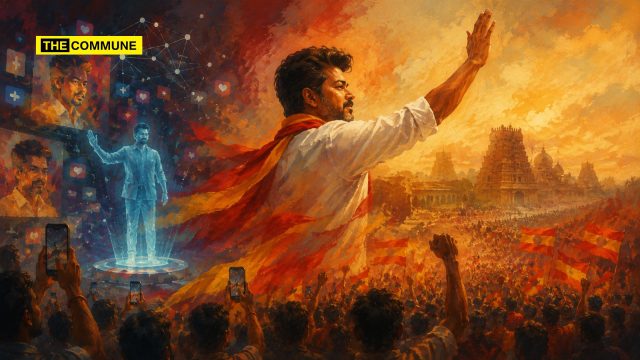
One of the campaign’s most widely circulated moments involved a hologram projection of Vijay at a rally in Kumbakonam. The hologram itself was less important than the way clips of it were rapidly remixed into memes, edits and short-form videos that spread across social media platforms.
He is a brilliant Scam Marketing Strategist .. 💥💯 pic.twitter.com/vNPd6nIg0D
— PSK (@shagul_psk) May 10, 2026
The campaign also reportedly adopted an intentional scarcity strategy. Unlike traditional Tamil Nadu campaigns centred around nonstop television appearances and large-scale media outreach, Vijay rarely gave extended interviews or appeared frequently on television during the election cycle.
This approach increased the online value of every speech clip, visual appearance or short campaign moment, making each fragment more likely to gain high engagement on algorithm-driven platforms such as Instagram Reels and YouTube Shorts.
Allegations Of Fake Accounts And Inauthentic Activity
The third layer involved allegations of coordinated inauthentic online behaviour.
Reports alleged that supporters of TVK had created fake social media accounts impersonating media organisations and fictitious news outlets in order to spread defamatory or misleading content targeting journalists.
The virtual warriors kept spreading fake covers of Frontline, India Today, and Vikatan.
Such activity fits definitions of “computational propaganda” used by institutions such as the Oxford Internet Institute, particularly where coordinated deceptive behaviour and fake digital identities are involved.
However, these people involved can be described as “supporters” rather than officially linked party operatives. Similar plausible-deniability structures have been observed globally in digitally driven political ecosystems, where unofficial supporter networks carry out aggressive online activity while formal political organisations maintain distance from them.
It remains unresolved whether the activity was centrally coordinated or emerged organically from supporter ecosystems.
A New Political Campaign Model
TVK’s campaign can be increasingly viewed as an example of how synthetic media, fandom culture and algorithmic distribution can reshape electoral politics.
Rather than relying primarily on conventional party machinery or legacy media dominance, the campaign appeared to combine emotional fan loyalty, decentralised digital communities and high-velocity meme circulation to create political momentum.
The TVK experiment may become a case study in how pre-existing entertainment fandoms can rapidly evolve into digitally amplified political movements capable of challenging entrenched party systems.
🗳️ A film star just won the biggest state election in South India using a playbook no political party wrote — but every authoritarian government has.
Here’s how Vijay’s TVK campaign weaponized computational propaganda, AI holograms, and 85,000 fan clubs to shatter Tamil Nadu’s… pic.twitter.com/jFTLDf9mj1
— Nordnomad (@arcot2arctic) May 9, 2026
Subscribe to our channels on WhatsApp, Telegram, Instagram and YouTube to get the best stories of the day delivered to you personally.