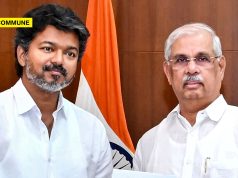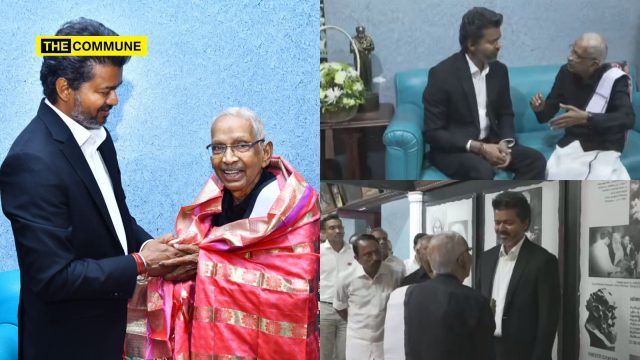
time in signaling where his ideological loyalties truly lie. Within hours of taking oath, Vijay visited Periyar Thidal in Vepery to meet K. Veeramani, the long-time chief of the openly anti-Hindu Dravidar Kazhagam. The visit included floral tributes to E.V. Ramasamy — a figure whose political legacy has long been associated with relentless attacks on Hindu beliefs, deities, scriptures, temple traditions, and Brahmin communities. Far from projecting a “new politics,” Vijay’s very first symbolic act as Chief Minister appeared to cement what critics have warned all along: TVK is merely a repackaged continuation of the DMK-Dravidian ideological ecosystem.
The optics are politically explosive because Veeramani is not just another Dravidian veteran. He was among the loudest voices at the controversial 2023 “Eradicate Sanatana Dharma” conference — the same platform where Udhayanidhi Stalin compared Sanatana Dharma to diseases that must be eliminated. Veeramani went even further by explicitly declaring that “Hindu religion” and “Sanatana Dharma” are one and the same, thereby removing any pretence that the campaign was merely against caste discrimination rather than Hinduism itself. Quoting from the 1916 text Sanatana Dharma: An Elementary Textbook published by Central Hindu College, Benares, Veeramani argued that the very identity of Hinduism was the intended target. His remarks, later reproduced in DK’s mouthpiece Viduthalai, left little room for reinterpretation.
Madam, how long will you fool people? Remember, this is SM age. Every utterance is recorded. FYI, this is the same stage where Udhayanidhi spoke about eradication of Sanatana Dharma. https://t.co/7rNleqGqrl pic.twitter.com/pBg3x89tvv
— Living Temples Of Bharat (@Saigeet36566874) February 17, 2026
For years, Vijay attempted to cultivate the image of a political outsider — someone distinct from the entrenched Dravidian order represented by the DMK and AIADMK. His supporters projected him as a cultural nationalist-friendly figure capable of transcending ideological extremes. But the speed with which he rushed to seek the blessings of Veeramani has shattered much of that carefully managed ambiguity. Critics argue that Vijay’s first major political outreach was not toward spiritual leaders, farmers, industrial workers, or ordinary citizens, but toward the ideological custodian of a movement infamous for mocking Hindu rituals, desecrating religious symbols, and framing Hindu traditions as obstacles to social progress.
The meeting also reinforces a growing perception that TVK’s “change” narrative was always cosmetic. Beneath the cinematic branding, emotional speeches, and anti-corruption rhetoric lies the same old Dravidian ideological framework — one that selectively targets Hindu faith and practices while demanding immunity from criticism itself. To many observers, Vijay’s actions suggest that TVK is not challenging the Dravidian establishment at all, but inheriting and repackaging it for a younger audience.
Supporters of Vijay may attempt to dismiss the visit as a routine courtesy call or an effort to acknowledge senior Dravidian figures. But politics is driven as much by symbolism as by policy. And Vijay’s symbolism on day one of his chief ministership was unmistakable. Instead of distancing himself from anti-Hindu rhetoric, he chose to publicly align with one of its most unapologetic champions. For many voters who believed TVK would mark a departure from divisive identity politics and ideological hostility toward Hindu traditions, the message could not have been clearer: TVK = DMK, only with a different face at the top.
Subscribe to our channels on WhatsApp, Telegram, Instagram and YouTube to get the best stories of the day delivered to you personally.