The defeat of the Dravida Munnetra Kazhagam government in the recently concluded TN polls has triggered an extraordinary outpouring from journalists and political commentators, many of whom are now openly accusing the regime’s media machinery of running a coordinated intimidation ecosystem for the past five years.
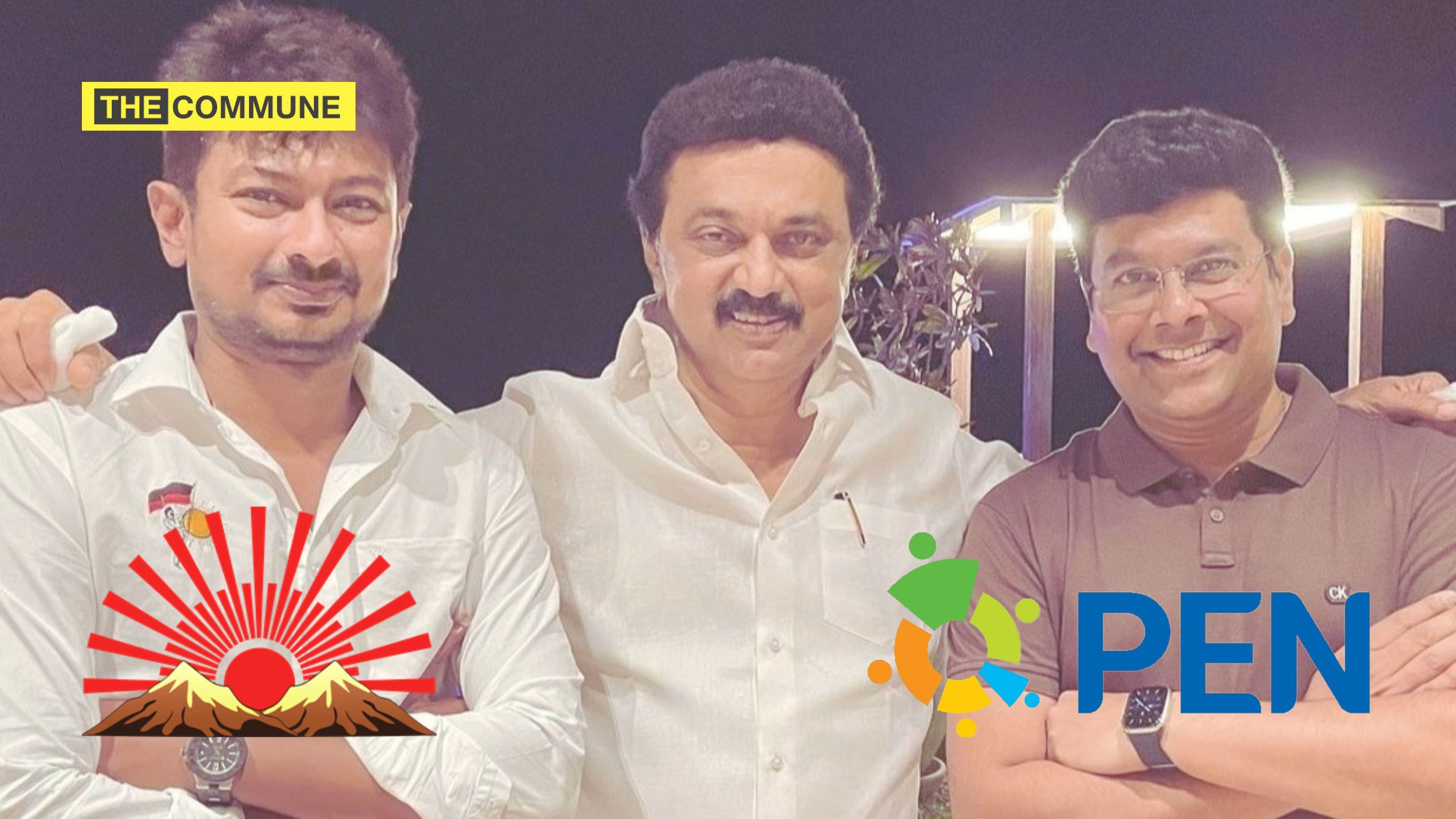
At the centre of the allegations is PEN, said to be controlled by V Sabareesan, son-in-law of MK Stalin along with the DMK’s IT wing leadership under PTR Palanivel Thiaga Rajan and later TRB Rajaa.
For years, the DMK projected itself as a “pro-people” government through aggressive public relations campaigns, carefully staged optics, and tightly controlled media management. But behind that image, journalists allege, operated a shadow ecosystem of online abuse, newsroom pressure, surveillance, and intimidation designed to silence criticism and enforce narrative discipline.
According to multiple journalists and commentators, PEN functioned less like a media platform and more like a political enforcement network. The method, they allege, was simple: if a journalist posted criticism of the government or questioned official narratives online, PEN-linked operatives would take screenshots and send them directly to editors, newsroom managements, or employers in an attempt to pressure, isolate, or discipline the individual.
The allegations burst into public view after Puthiya Thalaimurai Chief of Bureau, Stalin SP posted on X following the election defeat of the DMK: “Hereafter I can tweet whatever I think. PEN can’t intimidate me by taking screenshots and sending them to my office.”
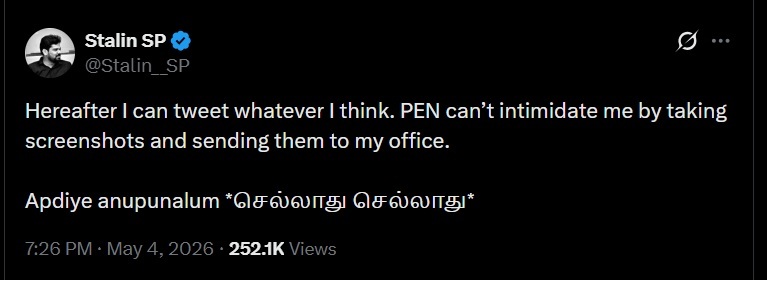
The post quickly went viral and was widely interpreted as confirmation of long-rumoured pressure tactics inside Tamil media circles.
Times of India journalist Omjasvin M.D. alleged that the “constant abuse and target of journalists writing critically against the govt” represented one of the “worst downgrades” of the DMK IT wing in recent years. He claimed that beyond routine trolling, dedicated online spaces had allegedly been created specifically to discuss, target, and tarnish journalists critical of the regime, and that many involved in those attacks operated with political backing from the party leadership.
The constant abuse and target of journalists writing critically against the govt was one of the worst downgrades of the #DMK IT wing in the last few years. Beyond comments, spaces were created for discussions to tarnish journalists. Many involved in these trolls and targeted… https://t.co/63XLJ6tW6A
— Omjasvin M D (@omjasvinMD) May 5, 2026
Another journalist Vinodh Arulappan went further, alleging that “under PTR, abuse became organised,” and claiming that teams existed solely to target critics using slurs and threats. “Earlier they were loafers, now, under TRB Raja they become thugs,” he wrote in a viral post reacting to the election results.
Under PTR, abuse became organised. A team existed solely to go after critics with slurs and threats. I know exactly who they are. Earlier they were loafers, now, under TRB Raja they become thugs. https://t.co/P4HsOsE18K
— Vinodh Arulappan (@VinodhArulappan) May 5, 2026
Vinodh Arulappan was also abused by PTR during the campaign period.
Casteist abuse was also targeted at journalists from the Brahmin community. PTR Palanivel Thiagarajan was adept at it. A journalist reminded people of the abuse she received from him on X.
Decorum and dignity…. https://t.co/MZIkX1NRic pic.twitter.com/II6pFkqgij
— Chandra R. Srikanth (@chandrarsrikant) May 5, 2026
Journalist Sandhya Ravishankar was also abused, targeted and threatened by the same PTR.
Decorum and Dignity..
clever/2 misleading is what put the Tamil people against you journos.. https://t.co/KzS9R1I4Yg pic.twitter.com/c0gxcgyTjD
— Reality Check India (@realitycheckind) May 5, 2026
The state’s Fact Checking Unit under former alleged fact-checker Iyan Karthikeyan also functioned as an unofficial censorship mechanism during the DMK’s tenure. According to several media insiders, access journalism, selective invitations, advertising pressure, and controlled information flows ensured that large sections of Tamil media remained dependent on the government’s goodwill. Stories embarrassing to the regime were buried, softened, or discouraged, while favourable coverage was amplified. So, what was shown to the public was a pretense that everything was rosy and shiny in Dravidian Model Tamil Nadu under the DMK.
The result was a media ecosystem where fear became institutionalised. Journalists who questioned the government risked online abuse, professional complaints, loss of access, coordinated smear campaigns, or pressure from management. Tamil Nadu’s media environment during the DMK’s rule was less an open press system and more a tightly supervised information order built around protecting the image of the ruling family and its political machinery.
With the DMK now removed from power after the 2026 Tamil Nadu Legislative Assembly election, journalists and commentators who remained silent for years are beginning to speak publicly. For many critics of the previous regime, the election result is not merely a political defeat for the DMK, but the collapse of what they describe as a carefully manufactured “photoshoot model, advertisement model government” sustained by intimidation, propaganda, and media control.
Subscribe to our channels on WhatsApp, Telegram, Instagram and YouTube to get the best stories of the day delivered to you personally.