The Bombay High Court on Wednesday, 29 April 2026, granted bail to 29-year-old Sharad Kalaskar in the murder case of atheist, rationalist and anti-superstition activist Narendra Dabholkar, citing prolonged incarceration and serious doubts regarding his identification as one of the assailants, as reported in OpIndia.
The order was passed by a division bench comprising Justices Ajay Gadkari and Ranjitsinha Bhonsale. Kalaskar has been directed to furnish a bail bond of ₹50,000. The court rejected a request by the Central Bureau of Investigation to stay the order for four weeks. Justice Gadkari stated, “Since we have already raised doubts over the identity of the applicant Kalaskar as the assailant, there is no question of staying this order.”
Court Flags Serious Flaws in Prosecution Case
The bench examined testimonies of key prosecution witnesses and highlighted inconsistencies that undermined the case.
One such witness, Kiran Kamble, stated that he was alerted by sounds resembling firecrackers but admitted uncertainty about the interval between gunshots during cross-examination. The trial court recorded that he was “not clear between the seconds and minutes.” The bench noted: “An omission that, ‘he had stated to police that, on hearing noise like firecrackers his attention was drawn towards the noise. I had also stated that, out of the two boys one was heighted and another was somewhat of short height’ has been brought on record. That, the time gap between the bullets was one to two minutes or one to two seconds.”
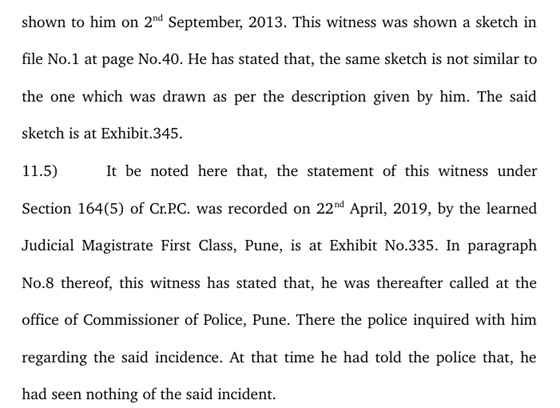
Kamble identified palm-sized photographs of suspects but admitted he could not discern identifying facial features. He stated the suspects had moustaches and were approximately 60 feet away from the victim, while he observed them from about 15 feet. The court further recorded, “The police had shown him sketches of persons in addition to the sketch drawn as per the description by him. This witness has admitted that he did not remember whether the sketch was shown to him on 2nd September 2013.”
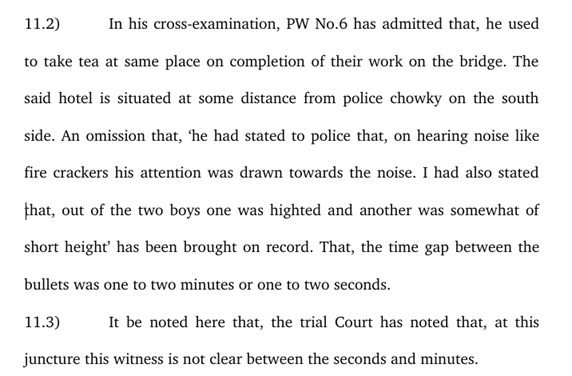
The witness also acknowledged that another sketch shown to him did not resemble the one based on his description. Importantly, his statement recorded before a Judicial Magistrate First Class in Pune on 12 April 2019, contradicted earlier claims. The court highlighted, “At that time, he had told the police that, he had seen nothing of the said incident.”
Second Witness Testimony Also Questioned
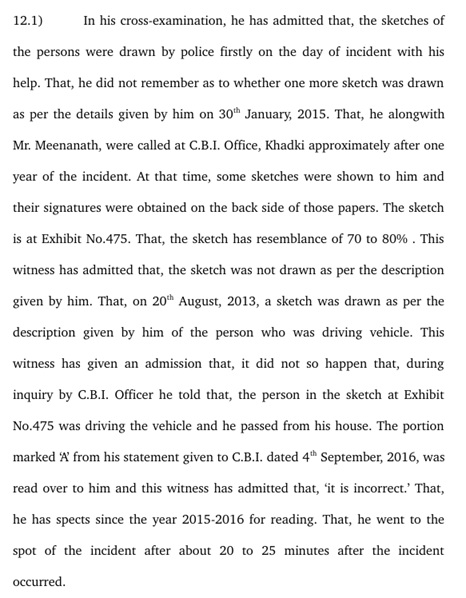
The court similarly scrutinised testimony of another key witness, Vinay Kelkar. He had identified two photographs out of a set of 10–12 shown by the CBI, claiming 80–85% resemblance with the suspects. However, during cross-examination, he admitted inconsistencies.
Kelkar stated that sketches prepared earlier did not accurately reflect the details he had provided. The court recorded, “This witness has given an admission that, it did not so happen that, during inquiry by CBI Officer he told that, the person in the sketch was driving the vehicle and he passed from his house.”
His earlier statement to investigators dated 4 September 2016, was read out in court, which he described as incorrect.
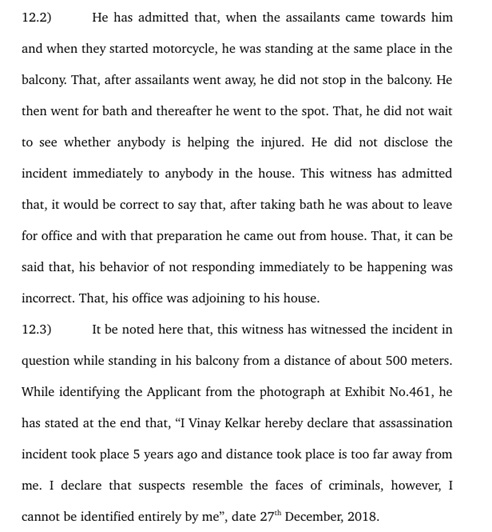
Kelkar admitted he went to the crime scene 20–25 minutes after the incident and did not immediately inform anyone. The bench observed, “He did not wait to see whether anybody is helping the injured. He did not disclose the incident immediately to anybody in the house.”
The court also noted that he witnessed the incident from a balcony approximately 500 metres away. In a later statement dated 27 December 2018, Kelkar stated, “I, Vinay Kelkar, hereby declare that assassination incident took place 5 years ago and the distance it took place is too far away from me. I declare that suspects resemble the faces of criminals, however, I cannot be identified entirely by me.”
Bench Questions Witness Conduct and Identification Process
The court observed that both eyewitnesses were “chance witnesses” and their conduct did not align with expected behaviour in such situations.
“Though they (witnesses) had seen the ghastly assault on the deceased (Dabholkar), both the witnesses chose to give preference and complete their daily chores of life and thereafter leisurely approached the police to give information. According to us, the conduct of these two witnesses is not of the men of common prudence and raises doubt in the mind of the court about their witnessing the incident.”
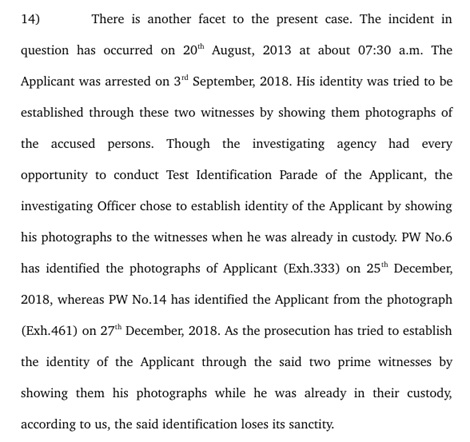
The bench also criticised the CBI for relying on photo identification instead of conducting a Test Identification Parade (TIP): “Though the investigating agency had every opportunity to conduct Test Identification Parade of Kalaskar, the investigating officer chose to establish identity by showing his photographs to the witnesses when he was already in custody,” the court observed, adding that such identification “loses its sanctity.”
Long Incarceration Cited as Key Factor
The court noted that Kalaskar had been in custody since 3 September 2018, amounting to over seven and a half years of incarceration across pretrial and post-conviction stages. Given the delay in hearing appeals, the bench ruled, “After taking into consideration the overall view of the application, we are of the opinion that, during the pendency of his appeal, the substantive sentence imposed upon him can be suspended and the applicant be released on bail.”
Background of the Case
Narendra Dabholkar (67), founder of the Maharashtra Andhashraddha Nirmoolan Samiti, was shot dead by two bike-borne assailants during a morning walk in Pune on 20 August 2013. The case was initially investigated by Pune Police before being handed over to the CBI in 2014 following a High Court order.
The CBI identified Sachin Andure and Sharad Kalaskar as the perpetrators. A Pune sessions court sentenced them to life imprisonment and fined them ₹5 lakh each on May 10, 2024, while acquitting three others – Dr Virendrasinh Tawade, Vikram Bhave and Sanjeev Punalekar citing lack of evidence.
Kalaskar subsequently challenged the conviction in the High Court and sought bail pending appeal.
Investigation Marred by Controversies
The case has been marked by persistent controversy, including what was described as a prolonged media trial. A sting operation conducted by former AAP leader Ashish Khetan and even a planchette session attempting to communicate with Dabholkar’s spirit were cited as part of the media narrative.
The organisation “Sanatan Sanstha” came under intense media scrutiny due to its opposition to Dabholkar’s proposed anti-superstition legislation.
The investigation itself was marked by procedural lapses, including improper evidence handling and failure to conduct identification parades as per protocol. Key leads remained unexplored, and critical evidence was either mishandled or disregarded.
Earlier, Vikas Khandelwal and Manish Nagori were arrested based on ballistic evidence linking them to the alleged murder weapon but were later released after the evidence was deemed inconclusive and witnesses failed to identify them.
The court also noted unresolved issues, including unexplained foreign materials found at the crime scene and the failure to conclusively trace the disposal of the murder weapon. These gaps raised concerns over whether the investigation suffered from incompetence or possible obstruction.
Subscribe to our channels on WhatsApp, Telegram, Instagram and YouTube to get the best stories of the day delivered to you personally.