When Lenskart founder Peyush Bansal took to X on 15 April 2026 to call the viral grooming document “inaccurate” and “outdated,” he may have expected the controversy to die down.
Hi, all. I’ve been seeing an inaccurate policy document going viral about Lenskart.
I want to speak directly that this document does not reflect our present guidelines.
Our policy has no restrictions on any form of religious expression, including bindi and tilak, and we…
— Peyush Bansal (@peyushbansal) April 15, 2026
Instead, it has intensified, with a ground report from an active Delhi store, a document dated the same month he claims to have “fixed” it, and now an activist claiming to possess video audit evidence of an employee being penalised for wearing a bindi as recently as 8 April 2026. The question is no longer whether the policy existed. The question is whether Bansal is telling the truth about when it stopped.
What the Document Says
The 23-page onboarding training document, pages of which have gone viral, contains the following explicit instructions for store-level employees:
- Bindi, kalawa (sacred Hindu wrist thread), and clutchers are prohibited
- Sindoor, if worn, must be applied in a very small amount and must not spread across the forehead
- Hijab and turban are explicitly permitted, provided they are black in colour — the hijab should “moderately cover up to the chest”
- Coloured gemstone rings are not permitted

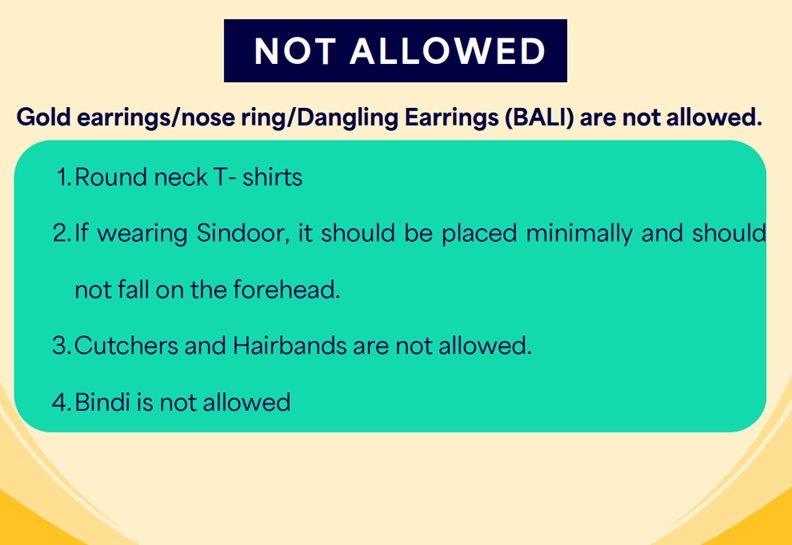
The asymmetry is stark and documented. Hindu religious symbols are either banned outright or subjected to restrictive conditions. Islamic religious attire is not only permitted but accommodated with specific, detailed instructions on colour and style.
Bansal’s Explanation and Why It Does Not Hold
Bansal issued two statements. In the first, on 15 April 2026, he called the document “inaccurate” and said it “does not reflect our present guidelines.” The problem: the document in circulation is dated February 2026. This is not a years-old relic from a different corporate era. It is a document issued to employees eight weeks ago.
On 16 April 2026, Bansal posted a follow-up adding what he called “more context”: “The document currently circulating is an outdated internal training document. It is not an HR policy. That said, it contained an incorrect line about bindi/tilak that should never have been written… When we discovered this on February 17, well before this became a public conversation, we immediately removed it.”
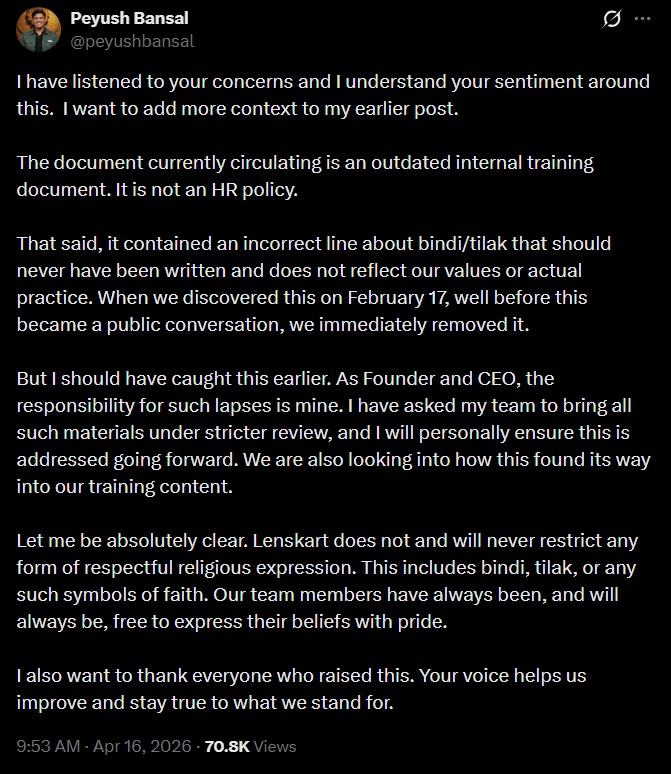
This statement raises more questions than it answers.
First: If Lenskart discovered the “incorrect line” on 17 February 2026 and “immediately removed it,” why does the document in circulation carry a February 2026 date? Was the correction made before or after distribution? If before, how did the uncorrected version reach employees? If after, which employees received which version?
Second: Bansal has not released the “corrected” document. There is no publicly verifiable evidence that a corrected version exists or was distributed. Asking the public to take his word for an internal fix, for a document that affects thousands of employees, is not transparency. It is a claim.
Third: A ground report by OpIndia from a Lenskart store in Delhi, conducted in April 2026, found that store employees are being actively governed by these exact rules. An employee, speaking anonymously, confirmed that staff who come to work wearing a kalawa or bindi are asked to leave for the day. Employees who insist on wearing a kalawa are instructed to hide it inside their sleeve so no customer or colleague can see it. This is not a policy that was “removed.” This is a policy that is operational right now.
When the ground reporter asked the employee how a kalawa makes someone unprofessional, the employee fell silent and could not answer.
The Video Audit Evidence
The controversy has now entered a new phase. Activist and writer Shefali Vaidya, one of the first to widely share the document, has claimed possession of what she describes as “irrefutable proof”: “I have irrefutable proof that Lenskart CEO Peyush Bansal is LYING when he says that the grooming code that says NO Bindi is ‘outdated’. I have proof of a video audit with the date 08/04/2026 where an employee was given a low rating for wearing a bindi. Will share in due course.”
I have irrefutable proof that @Lenskart_com CEO @peyushbansal is LYING when he says that the grooming code that says NO Bindi is ‘outdated’. I have proof of a video audit with the date 08/04/2026 where an employee was given a low rating for wearing a bindi. Will share in due…
— Shefali Vaidya. 🇮🇳 (@ShefVaidya) April 18, 2026
8 April 2026. That is seven days before Bansal’s first public statement. If the video audit evidence is authentic, it places active enforcement of the bindi ban within the same week that Bansal was claiming the policy had already been corrected and was not in use.
Vaidya has also flagged potential regulatory and constitutional dimensions noting that as a publicly listed company, Lenskart is not a private enterprise answerable only to its founder. She has cited a potential Article 15 violation – the constitutional provision prohibiting discrimination on grounds of religion and indicated she is prepared to share the evidence with legal counsel.
The Broader Pattern
In Lenskart’s case, the policy distinction is not subtle. Hijab, a distinctly Islamic religious symbol, is not merely permitted. It is accommodated with precise, written instructions: black colour, chest coverage, prescribed styling. Bindi and kalawa, distinctly Hindu religious symbols, are banned. Sindoor is conditionally permitted, provided it is invisible enough not to be noticed.
A store employee whose only job is talking to customers and selling eyewear is being asked to hide a thread tied around her wrist during a religious ceremony. No one at Lenskart’s headquarters has been able to explain what safety concern a kalawa poses in a retail conversation.
Peyush Bansal claims he built Lenskart as a company for Bharat, by Indians, for Indians. The employees who sell his eyewear in cities and towns across this country carry their faith and culture to work every day. Whether they were allowed to do so openly, or forced to tuck it away, is a question that a press statement cannot answer. Only the documents, the audits, and the testimony of those employees can.
Subscribe to our channels on WhatsApp, Telegram, Instagram and YouTube to get the best stories of the day delivered to you personally.