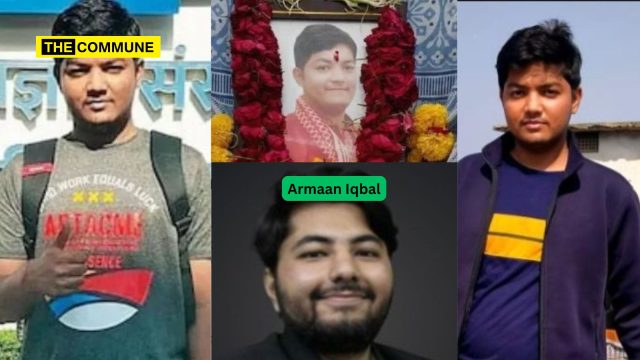
Three years after IIT-Bombay student Darshan Solanki fell to his death from the seventh floor of his hostel on 12 February 2023, a Sessions Court in Mumbai has finally framed charges against the accused, his batchmate Armaan Iqbal, as reported in Times of India. The trial begins 27 April 2026. And as it does, it is worth examining how a case with a one-line suicide note, no eyewitnesses, and an internal inquiry that found no caste discrimination became one of India’s most prominent “Dalit student atrocity” narratives.
What the Evidence Actually Shows
The prosecution’s primary evidence is a handwritten note found in Solanki’s room that read: “Armaan has killed me”. There is no mention of caste. No mention of discrimination. No mention of religion. A one-line note naming one individual.
The SIT that investigated the case arrested Armaan Iqbal and filed a charge sheet under Section 306 IPC (abetment of suicide) and Section 506 IPC (criminal intimidation). Notably, the SIT itself did not invoke the SC/ST Atrocities Act in its original charge sheet, a significant omission given the public narrative that had already framed the death as a caste atrocity. It was the Sessions Court that added the SC/ST Act charge at the framing stage.
The SIT investigation also found that Solanki and Iqbal had ‘patched up’ their differences before the incident. The conflict between them appeared to be personal, not systemic.
IIT Bombay’s Own Inquiry – No Caste Discrimination
IIT Bombay constituted an internal committee to examine whether institutional caste discrimination played a role. Its finding was unambiguous: no caste discrimination was involved. The committee pointed to academic stress and attendance issues as contributing factors.
This finding was immediately dismissed by activist groups and opposition politicians as a cover-up. That may or may not be true – internal institutional inquiries are not beyond reproach. But it is worth noting that the finding has never been formally contradicted by any independent judicial or regulatory body. The SIT’s own charge sheet, which ran to hundreds of pages, also did not establish systemic caste discrimination as the cause.
How the Narrative Was Built
Within days of Solanki’s death, the case was framed in national media as proof of endemic caste discrimination in IITs – a Dalit student driven to suicide by upper-caste peers. Protest marches were held. Parliamentary questions were raised. The family, understandably grief-stricken, was presented with a ready-made framework for their son’s death.
What received far less coverage: the accused is Arman Iqbal, a Muslim student. The conflict, per the SIT’s own investigation, was between two individuals – not a Dalit student and an upper-caste aggressor, which is the template the caste atrocity narrative requires. The SC/ST Act, designed to address systemic caste oppression by dominant-caste perpetrators, was being applied to an interpersonal conflict between a Dalit student and a Muslim student.
This does not mean Iqbal is innocent – that is for the trial to determine. It means the ideological scaffolding built around this case about ‘institutional Brahminical discrimination’, upper-caste hostility, the IIT as a site of caste violence does not fit the actual facts as established by the investigation.
The SC/ST Act charge is particularly significant legally. The Act’s provisions apply to offences committed on the grounds of caste identity – the prosecution will need to establish that Iqbal targeted Solanki because he was Dalit, not merely that Solanki was Dalit and Iqbal harmed him.
The Broader Pattern
The Darshan Solanki case is not unique in how it was handled. In recent years, a pattern has emerged in high-profile student death cases at premier institutions: the caste narrative is established in media before investigations conclude, activist framing precedes evidence, and any finding that complicates the narrative, like an internal inquiry finding no discrimination, is dismissed as institutional complicity.
This pattern does genuine damage to two things simultaneously. First, it damages the credibility of real caste discrimination cases, which are serious, documented, and widespread in Indian higher education. When a case that does not fit the template is force-fitted into it, and later unravels at trial, it hands ammunition to those who dismiss all such cases as politically motivated.
Second, it can deny justice to the actual victim. If Darshan Solanki’s death resulted from a personal conflict that escalated, as the SIT’s investigation suggests, then his family deserves justice on those terms, not a politically convenient narrative that may ultimately collapse in court.
Subscribe to our channels on WhatsApp, Telegram, Instagram and YouTube to get the best stories of the day delivered to you personally.