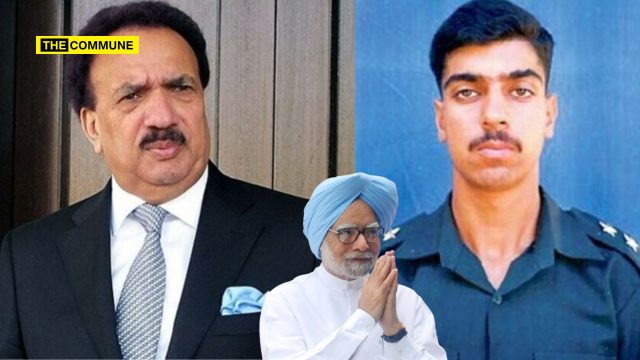
On 13 December 2012, Pakistan’s Interior Minister Rehman Malik landed in New Delhi on a three-day official visit, wrapped in the language of peace and bilateral goodwill. He held meetings, invited Prime Minister Manmohan Singh to visit Islamabad, and spoke about a new era of India-Pakistan relations. But before the ink dried on any of that goodwill, he was asked about Captain Saurabh Kalia – the 23-year-old officer of the 4 Jat Regiment who was captured alive by the Pakistani Army on 15 May 1999 during the Kargil War and returned three weeks later as a mutilated corpse.
Rehman Malik’s answer, delivered casually to reporters on Indian soil, was this: “When the fight is going on, on the border, we really don’t know whether he was killed by a Pakistani bullet or whether he died because of the weather.”
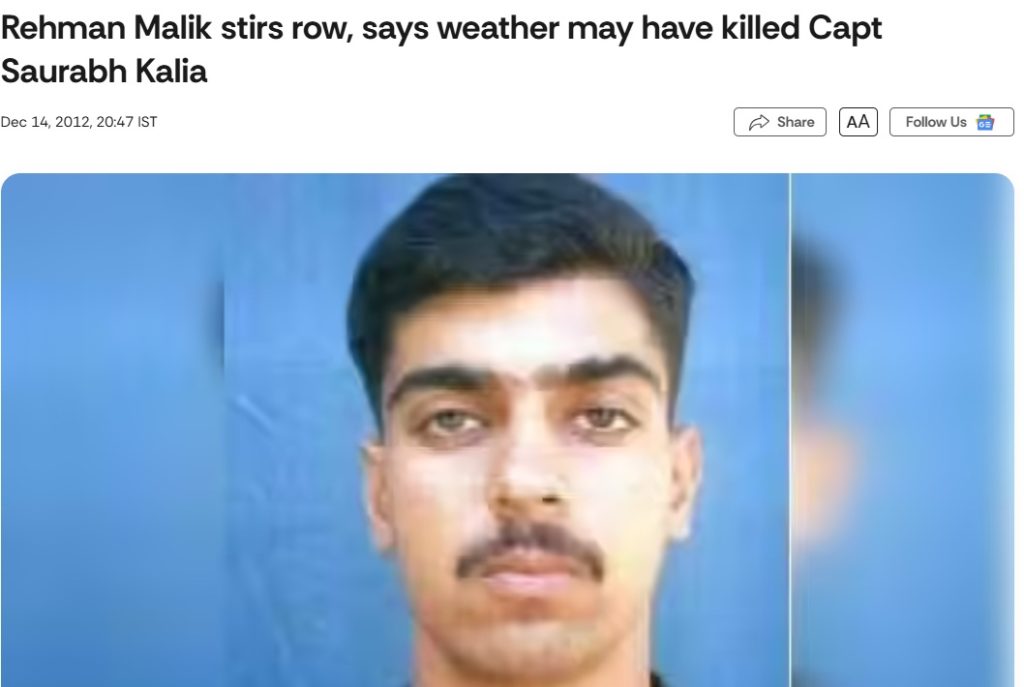
The weather. That was Pakistan’s official explanation for what happened to Captain Saurabh Kalia.
What the Postmortem Actually Said
The autopsy report on Captain Kalia’s body told a vastly different story – one that no amount of diplomatic language could erase:
- Multiple cigarette burns across the body, inflicted systematically
- Broken teeth, fractured skull, chipped nose, and punctured eyes – the eyes physically removed from their sockets
- Eardrums pierced with hot iron rods
- Penis and limbs amputated
Cause of death: All injuries were inflicted while he was alive. He was ultimately shot in the head – the final act, after every other torture had been exhausted.
The six men, Captain Kalia and five sepoys (Arjun Ram, Bhanwar Lal Bagaria, Bhopal Singh, Moola Ram, and Naresh Singh) were held for 22 days between 15 May and 7 June 1999. Every one of them was returned in this condition. This is not ambiguous. This is not attributable to weather. These are deliberate, systematic, prolonged war crimes – violations of Article 3 of the Geneva Convention on treatment of Prisoners of War, which Pakistan is a signatory to.
India’s Response: A Study in Failure
On the very same day Rehman Malik made his “weather” remark in New Delhi, the Supreme Court of India was hearing a petition filed by Captain Kalia’s father, Dr. NK Kalia, asking the government to take Pakistan to the International Court of Justice (ICJ) at The Hague.
The Supreme Court’s own words were telling: “We fully share your agony. But what is the role of the court? Can we direct India to take up the case with the ICJ?”
India’s response to Malik’s insult was to raise the issue in bilateral talks – asking Pakistan to take “action against those responsible”. The Pakistani side’s response to that request was not immediately known and was never publicly disclosed.
The UPA government under Prime Minister Manmohan Singh declined to take the case to the ICJ. The reason was rooted in a stunning irony: after the Kargil War, when India had shot down a Pakistani aircraft, Pakistan had wanted to take that case to the ICJ and India had blocked it, insisting the court could only hear a case if all parties agreed to approach it. India was now trapped by its own precedent, unable to use the same forum it had once shut Pakistan out of.
Meanwhile, Dr. NK Kalia was shuttled between government offices for years – the Defence Ministry told him the case had been sent to the Prime Minister’s Office, which said it was being “studied” by the External Affairs Ministry. No one took responsibility. No one acted.
The Insult Compounded
Rehman Malik was in India as an official guest of the Indian government – on a scheduled, formal diplomatic visit. He had not stumbled into India by accident. He was welcomed, hosted, and given press access on Indian soil. And on that very soil, while the Supreme Court was simultaneously hearing a case about Pakistani war crimes against an Indian soldier, he told the world that the torture and killing of Captain Saurabh Kalia may have been caused by bad weather.
Captain Kalia’s father called the statement “ridiculous“. Defence analysts called it “the ultimate insult”. The Indian government called it… the basis for continued bilateral talks.
That is the record. Pakistan committed a documented war crime. A Pakistani minister mocked it on Indian soil. And India, across multiple governments, chose process over justice – leaving a father, a family, and a nation’s soldiers without an answer.
Subscribe to our channels on WhatsApp, Telegram, Instagram and YouTube to get the best stories of the day delivered to you personally.