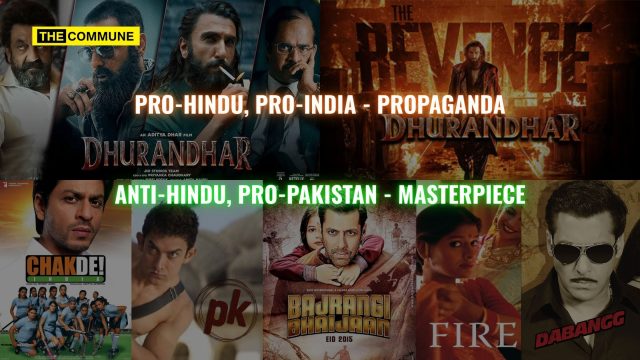
Every time a film like Dhurandhar dares to show Pakistan as an adversary or Islamic terror as a real threat, a familiar chorus kicks in: “propaganda, anti‑Muslim, pro‑BJP.” What they wanted to portray to you was that until recently, Hindi cinema was some neutral, secular, apolitical space. That claim collapses the moment you look honestly at what Bollywood has been normalising since the 1950s.
Turning Hindus Into The Default Villain
Take the 1995 Mani Ratnam film Bombay. The film was praised as a “balanced” take on the 1992–93 riots but look at the visual grammar in the scenes you pointed out. The Muslim heroine is content and relaxed until she sees a group of Hindu sadhus in a peaceful temple yatra; the background score tightens, the camera lingers on her fear, and the audience is invited to read saffron as a threat by default.
Propaganda before Modi Government
Protagonist of Bombay movie (muslim lady) was very happy untill he saw hindu saints in peaceful mandir yatra and she looks terrified like she have seen goons.
As an audience you Will feel she is unsafe here , BGM made it more believable pic.twitter.com/EXeK1S2BHN
— lakshman (@rebel_notout) December 18, 2025
Later, when polite Ram Mandir donation‑collectors come to her door, she trembles as if a mob has arrived.
Another scene where hindus comes to her door steps to collect donation for ram mandir and they asking very politely but again she is shivering like they will kidnap her.
So again makers want us to see hindus as villain. pic.twitter.com/DPEgYlb2UL
— lakshman (@rebel_notout) December 18, 2025
In another scene in the same film a Muslim character is selling bricks but the Hindu character ‘offends’ him by asking for bricks with the word RAM written on it.
Another scene where muslim character is selling bricks but hindu character comes and offend him by asking for bricks with RAM written on it. pic.twitter.com/XIT72ONHRc
— lakshman (@rebel_notout) December 18, 2025
Two communities may be clashing in the script, but the cinematic language trains you to see Hindus as the menace, Muslims as the nervous victims.
Two communities are fighting each other but look at here muslim character with audacity trying to confronting him and hindu character confessing it.
Makers badly wants audience to believe that hindus want fights but muslim dont pic.twitter.com/jmXsbtHHrw
— lakshman (@rebel_notout) December 18, 2025
This template repeats endlessly: Hindu symbols, temples, and sadhus are framed as sinister or regressive, while the Muslim figure is dignified, reasonable and unjustly persecuted.
From Begum Jaan & Rabbo To Radha & Sita
Deepa Mehta’s Fire openly credits Ismat Chughtai’s Lihaaf, a story about a Muslim begum and her servant Rabbo. In the original, the queer relationship sits inside a Muslim nawabi household. In the film, the names are changed to Radha and Sita, set in a Hindu home, borrowing directly from icons central to Hindu bhakti.
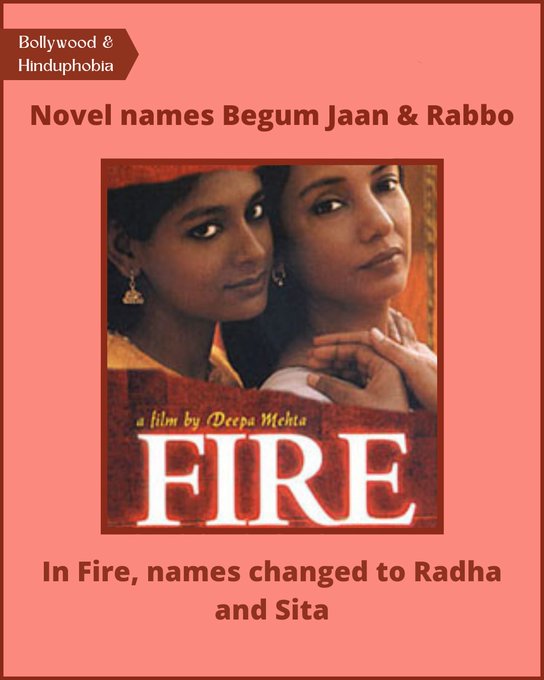
If this is “just creative freedom”, try to imagine the outrage if someone adapted a Hindu story and renamed the characters Aisha and Fatima to explore taboo sexuality. The decision is ideological: when you want to provoke and scandalise, you reach for Hindu names.
Real Muslims Scrubbed, Fictional Hindus Inserted
Consider Sherni. The real‑life case in Madhya Pradesh involved a forest officer K.M. Abharna and a notorious poacher Asghar Ali. In the film, the officer becomes Vidya Vincent, and the poacher morphs into Ranjan Rajhans, a kalawa‑wearing Hindu.

The broad plot is “inspired by true events,” but the communal identity of the villain is flipped. You are left with a textbook message: the problem is not Muslim lawlessness; it is Hindu corruption and patriarchy.
Similarly, Chak De! India draws heavily from the story of India hockey goalkeeper‑coach Ranjan Negi, who was vilified after the 1982 Asiad loss and later redeemed himself by coaching women’s teams. On screen, this becomes Kabir Khan, a Muslim falsely branded a traitor and hounded by a bigoted society.
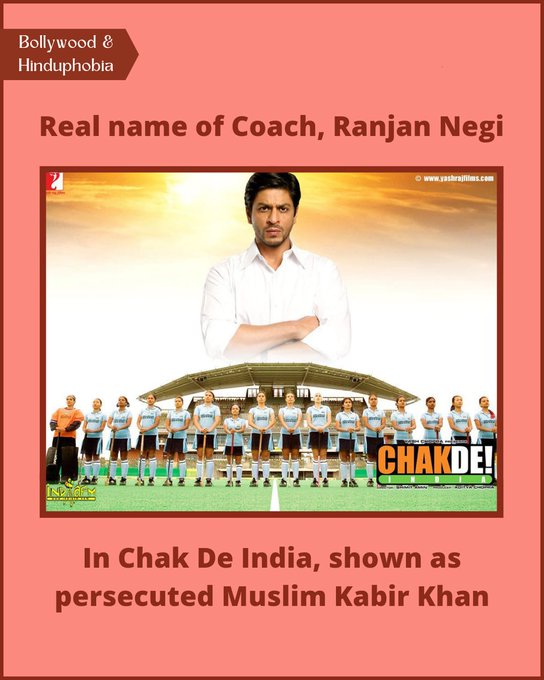
The structural injustice is real but the choice to recode a Hindu into a Muslim martyr, in a story about patriotism and suspicion, is not value‑neutral.
Mocking Deities, Sexualising Icons
The list of casual Hinduphobia is long and old:
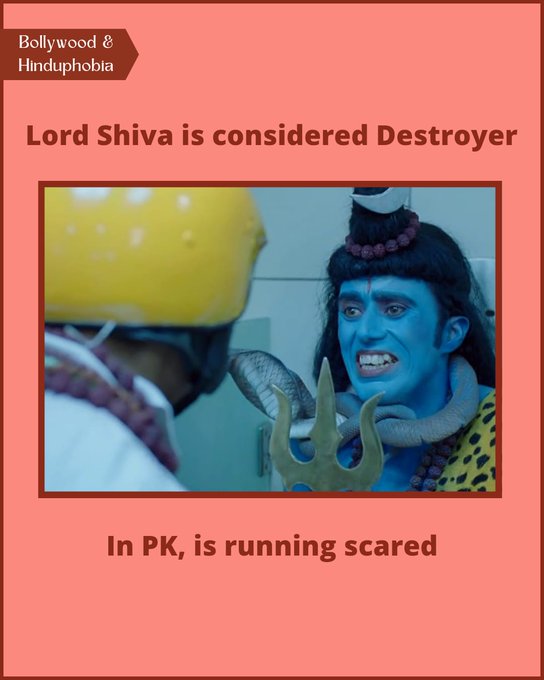
In PK, a man dressed as Lord Shiva is humiliated, chased and used as slapstick; petitions and PILs argued that the film mocked Shiva and ridiculed Hindu ritual specifically.
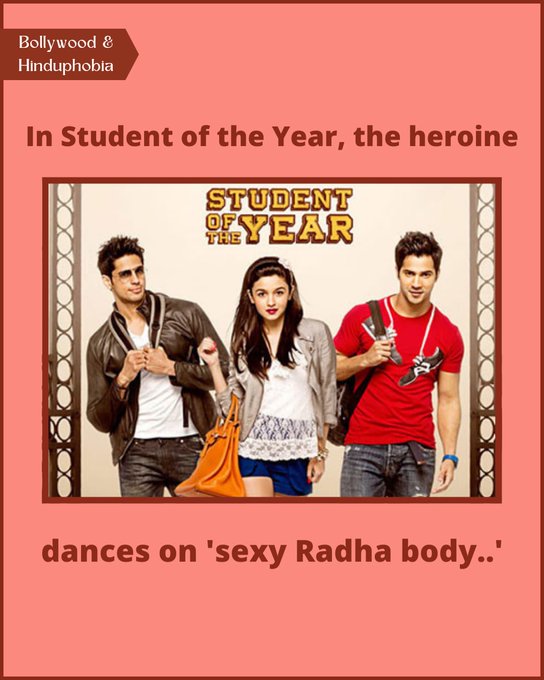
 In Student of the Year, a peppy dance track calls Radha “sexy”, which led to protests and demands for a ban from groups who saw it as a deliberate trivialisation of a deeply revered figure.
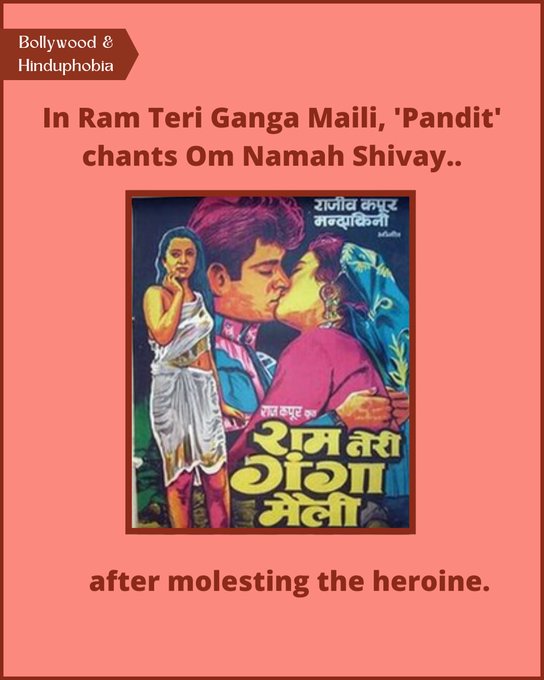
 Ram Teri Ganga Maili features a so‑called pandit molester chanting “Om Namah Shivay” after assaulting the heroine, reinforcing the now familiar formula: outwardly religious Hindu equals hypocrite and predator.
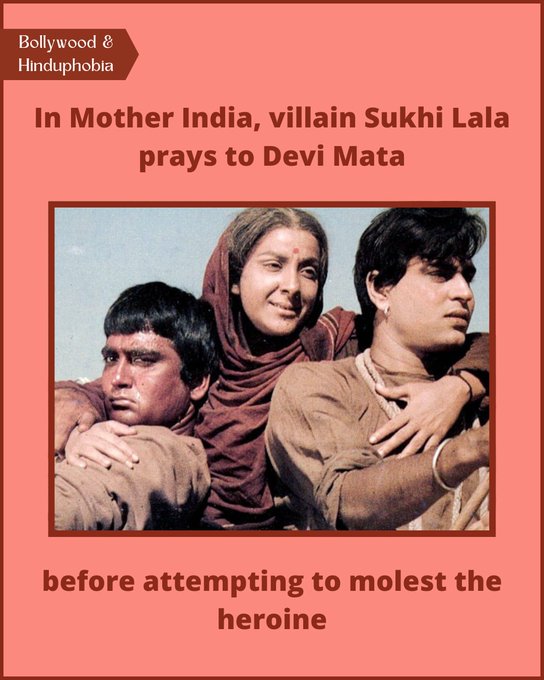
 In Mother India, the lecherous moneylender Sukhilala prays at a Devi’s shrine just before attempting to molest Radha, visually tying a Hindu worshipping a Devi, a Hindu deity to immorality, villainous character.
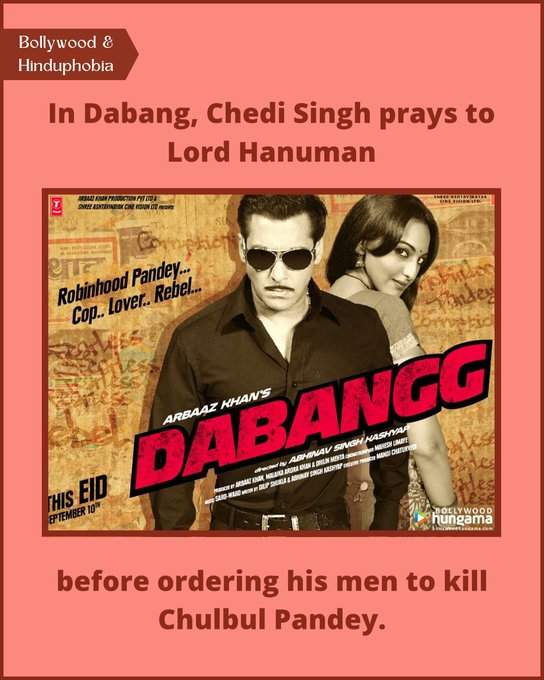
 In Dabangg, villain Chedi Singh prays to Hanuman before ordering a killing.
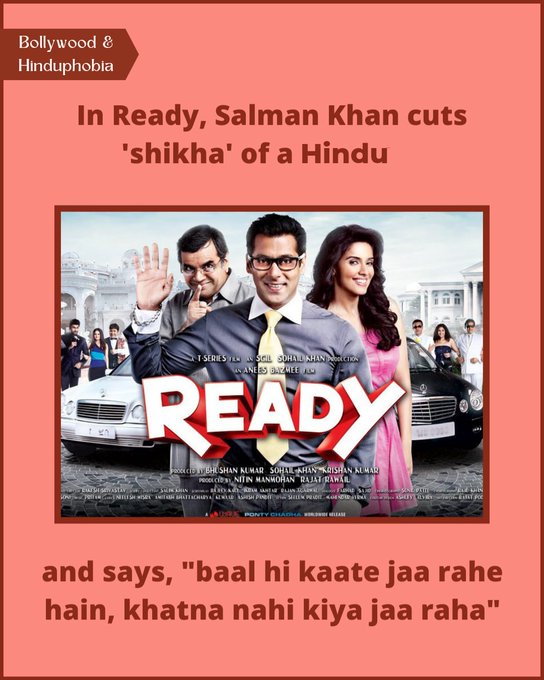
 In Ready, Salman Khan casually cuts a Hindu boy’s śikha and cracks the line, “baal hi kaate jaa rahe hain, khatna nahi kiya ja raha,” turning a sacred symbol into an anatomy joke.
 Over time, these are not random gags. They build a consistent association: Hindu ritual equals superstition or cover for violence; Hindu markers are safe to mock.
Selective Secularism In Symbols
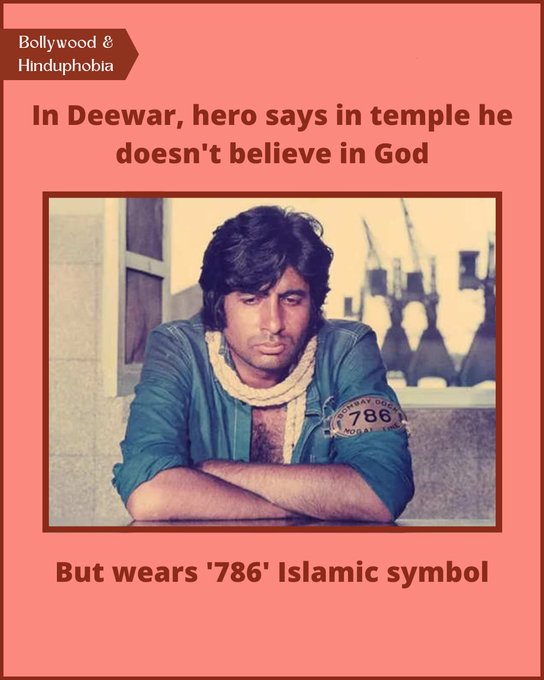
Older films did it more subtly. In Deewaar, Amitabh Bachchan’s character tells his mother in a temple that he doesn’t believe in God yet walks around with “786” prominently displayed, signalling a soft corner for Islamic symbolism.
The message is clear: rejecting your own dharma is “cool”; signalling another faith is noble secularism.
In Mother India and Ram Teri Ganga Maili, abuse comes from figures wrapped in Hindu religiosity; in Bombay and Chak De, moral clarity comes from Muslims wronged by Hindu prejudice. None of this would be a problem if similar liberties were taken with churches, mosques and maulvis. The asymmetry is the point.
Propaganda Didn’t Start With Dhurandhar
So, when commentators call Dhurandhar “propaganda” merely because it refuses to whitewash Pakistan’s role or Islamist terror, they are not defending artistic purity; they are defending their own monopoly. For decades, Bollywood has run a soft ideological programme:
- Normalise fear and suspicion of overt Hindu identity.
- Sanitise or invert real cases where perpetrators come from other communities.
- Use Hindu gods, symbols and priests as safe punchbags.
If Dhurandhar is to be interrogated for its politics, so be it. But honesty demands we admit that “propaganda” is not a 2020s invention. It has been built into scripts, casting, names and symbols since the black‑and‑white era. The difference today is that audiences have started to see the pattern and, increasingly, they’re not buying it on autopilot anymore.
(This article is based on an X Thread By Eminent Intellectual)
Subscribe to our channels on WhatsApp, Telegram, Instagram and YouTube to get the best stories of the day delivered to you personally.