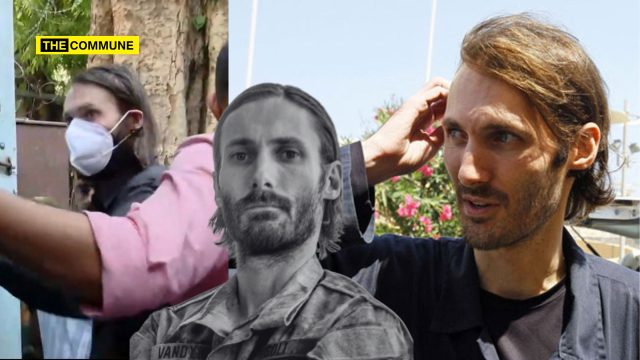
India does not often make the news for catching American mercenaries. It made that news on 13 March 2026, when the National Investigation Agency simultaneously detained foreign nationals at three airports: Kolkata, Lucknow, and Delhi in a single coordinated sweep. The man pulled off a flight at Kolkata by the Bureau of Immigration, then transferred to NIA custody, was a 46-year-old Baltimore native who had spent the better part of his adult life making himself useful in other people’s wars. His name was Matthew Aaron VanDyke.
❗️ India’s NIA Arrests Six Ukrainians, One American for Alleged ‘Terror Training’ in Myanmar – IANS
The accused have been detained on charges of ‘illegal entry, weapons and drone warfare training, and importing drones from Europe.’ pic.twitter.com/2uofIxbOdC
— RT_India (@RT_India_news) March 17, 2026
He was not alone. Six Ukrainian nationals, Hurba Petro, Slyviak Taras, Ivan Sukmanovskyi, Stefanik Marian, Honcharuk Maksim, and Kaminskyi Viktor were detained alongside him. On 16 March 2026, a special NIA court at Patiala House, Delhi sent all seven into eleven days of NIA custody on charges framed under the Unlawful Activities (Prevention) Act, 1967. The case against them, as laid out before the court, runs far deeper than a simple border violation.
❗️RT INDIA EXCLUSIVE – NAMED: American & Ukrainian Nationals Arrested For Alleged ‘Terror Training’ In Myanmar
The American named, Matthew VanDyke, has appeared in at least two films – one about his activities in Libya, and another about his ‘security’ firm, Sons of Liberty… https://t.co/68tmeaRBtI pic.twitter.com/pf5v8mfK4z
— RT_India (@RT_India_news) March 17, 2026
According to the NIA, the group entered India on tourist visas, flew to Guwahati, made their way south into Mizoram, a state that foreign nationals cannot enter without Restricted Area Permits and then slipped across into Myanmar. Their mission, the agency alleges: running “pre-scheduled training” for Myanmar-based Ethnic Armed Groups in drone assembly, drone operations, electronic warfare, and jamming technology. They are also accused of smuggling a substantial consignment of European-manufactured drones into Myanmar through Indian territory. The detail that converts this from a foreign policy embarrassment into a direct national security threat is the NIA’s allegation that these armed groups maintain operational ties to proscribed insurgent organisations active in India’s northeast, meaning the training VanDyke’s group conducted may not have been aimed solely at Myanmar’s military junta.
❗️RT INDIA EXCLUSIVE – NAMED: American & Ukrainian Nationals Arrested For Alleged ‘Terror Training’ In Myanmar
The American named, Matthew VanDyke, has appeared in at least two films – one about his activities in Libya, and another about his ‘security’ firm, Sons of Liberty… https://t.co/68tmeaRBtI pic.twitter.com/pf5v8mfK4z
— RT_India (@RT_India_news) March 17, 2026
Youngest in the Room, Then the Most Dangerous
VanDyke grew up in Baltimore and took his undergraduate degree in Political Science at the University of Maryland Baltimore County. He then secured admission into the Security Studies programme at Georgetown University’s Edmund A. Walsh School of Foreign Service, reportedly among the youngest candidates accepted into that cohort. His master’s thesis was an analysis of al-Qaeda’s strategic rationale for targeting the United States.
He applied to the CIA after graduation, clearing the analytical assessment, the drug screening, the psychological evaluation, and reaching the stage of meeting the team he would have joined at Langley. The polygraph ended it; his nerves produced inconclusive readings, and the agency declined to proceed. What followed this rejection is, in retrospect, either a tragedy or a farce depending on your sympathies: VanDyke spent a year at the beach, then mounted a Kawasaki KLR650 and pointed it toward North Africa.
Three Years Across the Arab World
The motorcycle journey that began in 2007 took him across Morocco, Mauritania, Tunisia, Libya, Egypt, Jordan, Syria, Turkey, and Iraq over roughly three years. He was travelling as a documentarian, trying to understand a region that his Georgetown thesis had told him Washington fundamentally misread.
Between 2008 and 2010, Iraqi security forces arrested or detained him twenty times. At least once, he and a colleague were hooded, beaten, handcuffed, and accused of running al-Qaeda-linked espionage. They were held in a Baghdad prison with an armed guard standing behind them. Iranian state media identified him as a Jewish American spy. He was neither Jewish nor, officially, a spy. During this same stretch, he also worked as a war correspondent for The Baltimore Examiner, embedding with American military units in Iraq and later at Forward Operating Base Baylough in Afghanistan – one of the most isolated US installations in that war.
Libya: Six Months in a Cell, Then Back to the Front
When the Libyan rebellion broke open in early 2011, VanDyke crossed the border illegally and took up arms with the anti-Gaddafi forces rather than simply filming them. He was quickly ambushed, wounded, and captured. For six months, Gaddafi’s security apparatus held him in solitary confinement across two of the regime’s most feared detention facilities. When rebel advances finally caused the prison system to fracture in August 2011, fellow detainees pried open his cell. He walked out and was installed at the Corinthia Hotel Tripoli as a guest of the National Transitional Council, the rebel government that was by then taking control of the capital. The arc from solitary cell to government guestroom took 72 hours.
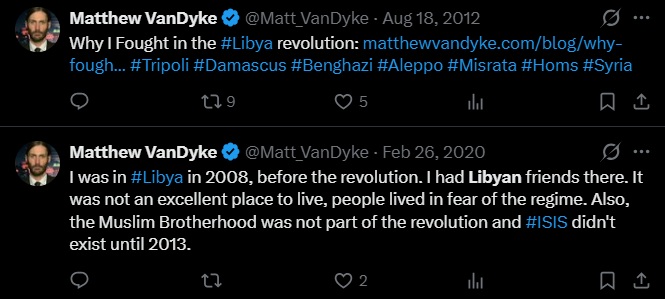
His Libyan experiences became the backbone of the documentary Point and Shoot, which won the Best Documentary Award at the 2014 Tribeca Film Festival and brought him coverage in the New York Times, the Washington Post, and the Guardian.
Syria: The Turning Point in His Mission
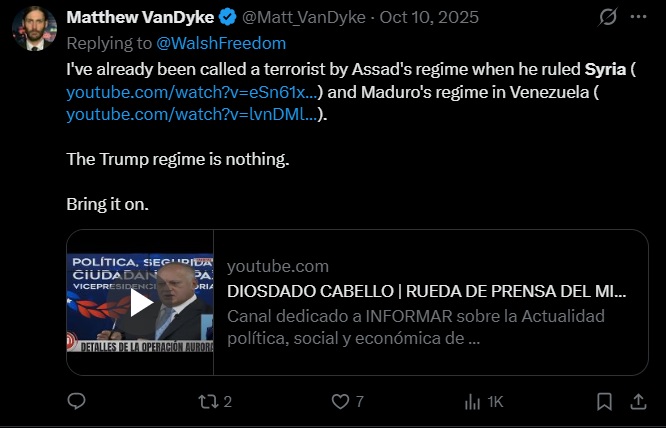
Syria came next, where he documented the civil war while simultaneously advising rebel factions on weapons and tactics. The Assad government responded by designating him a terrorist.
The event that gave structure to everything that came before was the ISIS execution of James Foley in August 2014, followed by that of Steven Sotloff in September 2014 – both journalists, both friends from Libya, both killed on video. VanDyke responded by building an organisation.
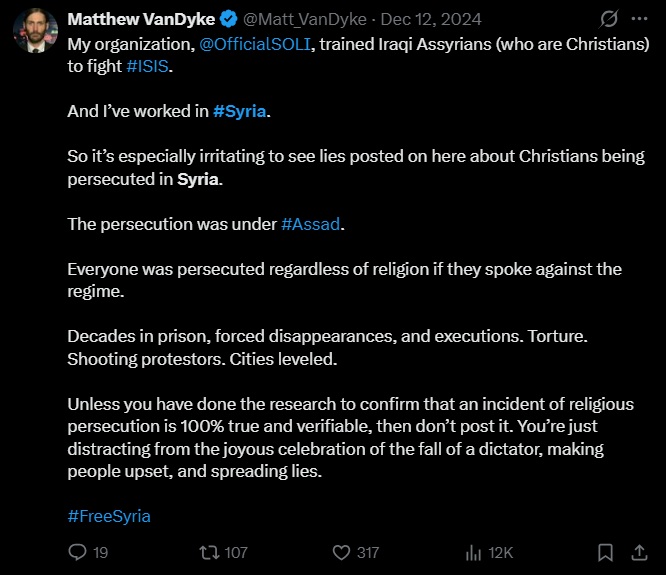
In October 2014, he registered Sons of Liberty International (SOLI) as a 501(c)(3) non-profit in the United States, with a mandate to provide security training, supplies, and consulting at no charge to communities facing terrorists and authoritarian forces. (Wikipedia) Its first operational deployment sent SOLI trainers to work with the Nineveh Plain Protection Units (NPU), an Assyrian Christian militia fighting ISIS in northern Iraq.
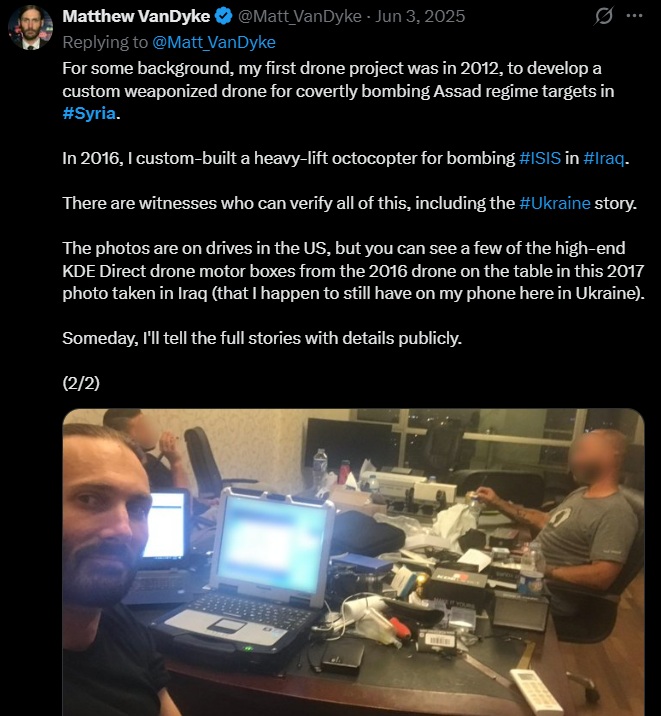
Here are some of his own admissions.
Ukraine: Where the Machine Became Institutional
Russia’s invasion of Ukraine in February 2022 gave SOLI a theatre of operations at a scale the organisation had never previously encountered. By March 2022, VanDyke had moved himself and the organisation to Ukraine – not merely in an advisory capacity, but enlisting in the Armed Forces of Ukraine as a regular combatant.
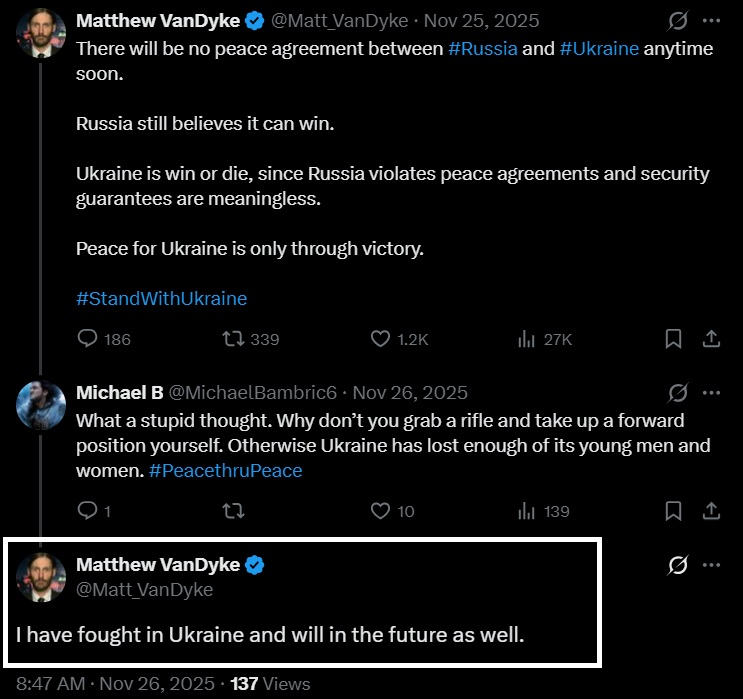

SOLI simultaneously scaled its institutional presence: frontline tactical instruction for Ukrainian units, battlefield adaptations development, and a structured programme to clear unexploded Russian munitions from recaptured territory.
Myanmar: The Next Theatre of Operations
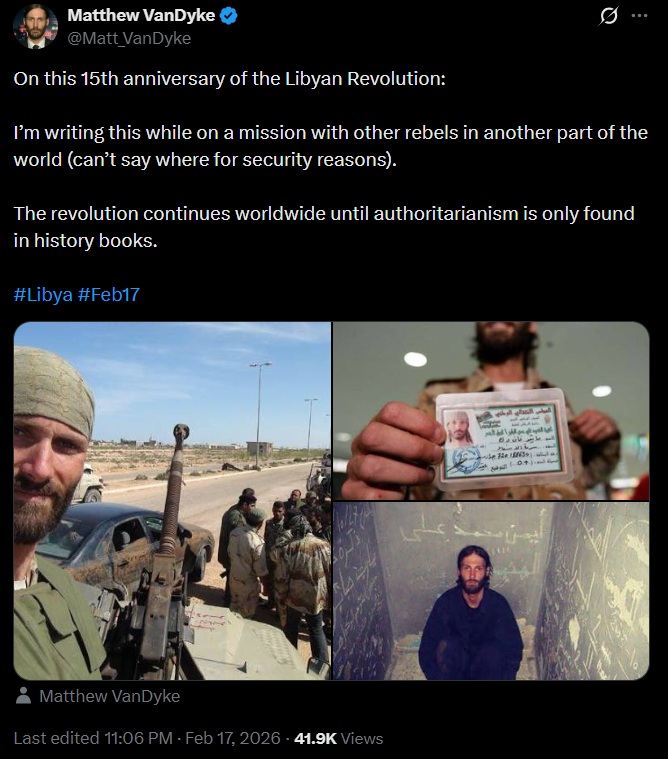
In January 2025, VanDyke posted on X confirming he had been conducting covert operations with a Venezuelan rebel commander since 2019, before expanding the target list explicitly: “To the leaders of Venezuela, Burma, Iran and other authoritarian regimes, we’re coming for you. Russia cannot protect you anymore.” Burma/Myanmar was not rhetorical. The Myanmar military junta of Min Aung Hlaing has been among Russia’s most reliable partners since its 2021 coup, receiving Su-30 fighter jets, Mi-38 helicopters, and surveillance drone platforms from Moscow in exchange for unconditional diplomatic support.
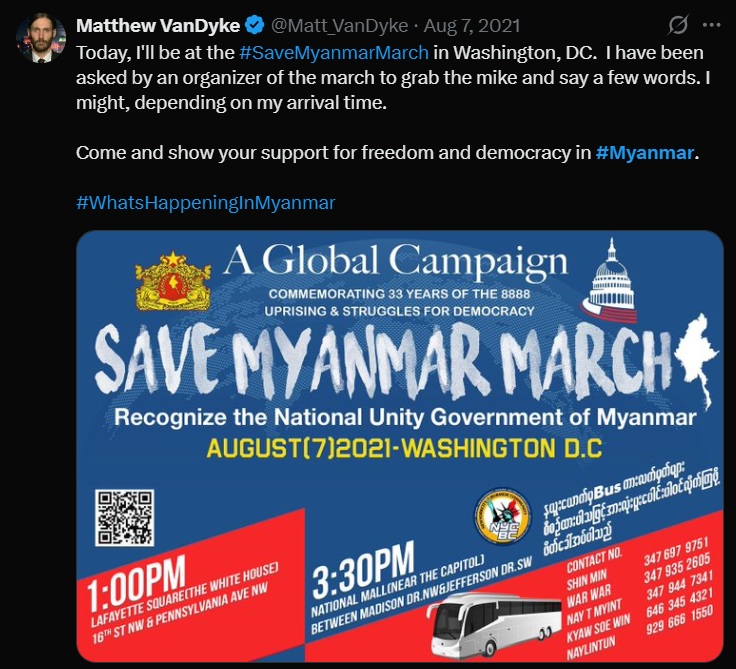
He has been talking about Myanmar since 2021, participating in marches to “Save Myanmar”.
Critically, Mizoram Chief Minister Lalduhoma had already flagged this threat to the Mizoram Assembly in March 2025 – warning that Ukrainian war veterans were entering Myanmar’s Chin State via Mizoram to train rebel groups, and that nearly 2,000 Western visitors had passed through Aizawl in the second half of 2024, almost none visible on city streets. Ukrainian special forces have also been documented fighting Russian-backed Wagner mercenaries in Sudan and Syria as part of Kyiv’s global strategy to stretch Russian resources.
Venezuela: The Covert Operations Template
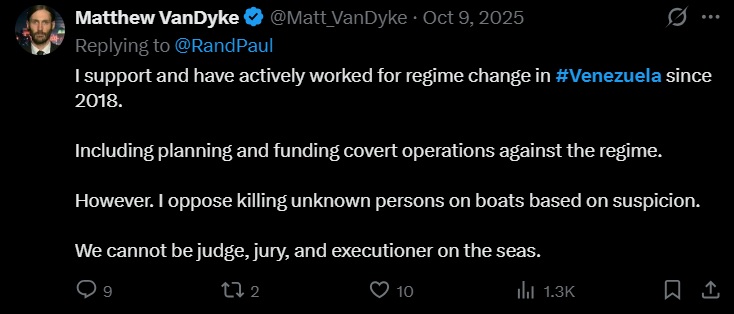
On 10 January 2025, deliberately timed to coincide with Nicolás Maduro’s disputed inauguration, VanDyke posted simultaneously on his social media handles, revealing six years of previously secret activity in Venezuela: “I’ve been running covert operations with a Venezuelan rebel commander since 2019. You’ve read about our missions in the media, such as Operation Aurora, but nobody knew who did it. The Venezuelan team and I agreed to reveal this today, on the day of Maduro’s inauguration, to let Venezuelans know that we’ve been fighting for you, and will continue fighting for you, until Maduro is defeated and democracy is restored.”
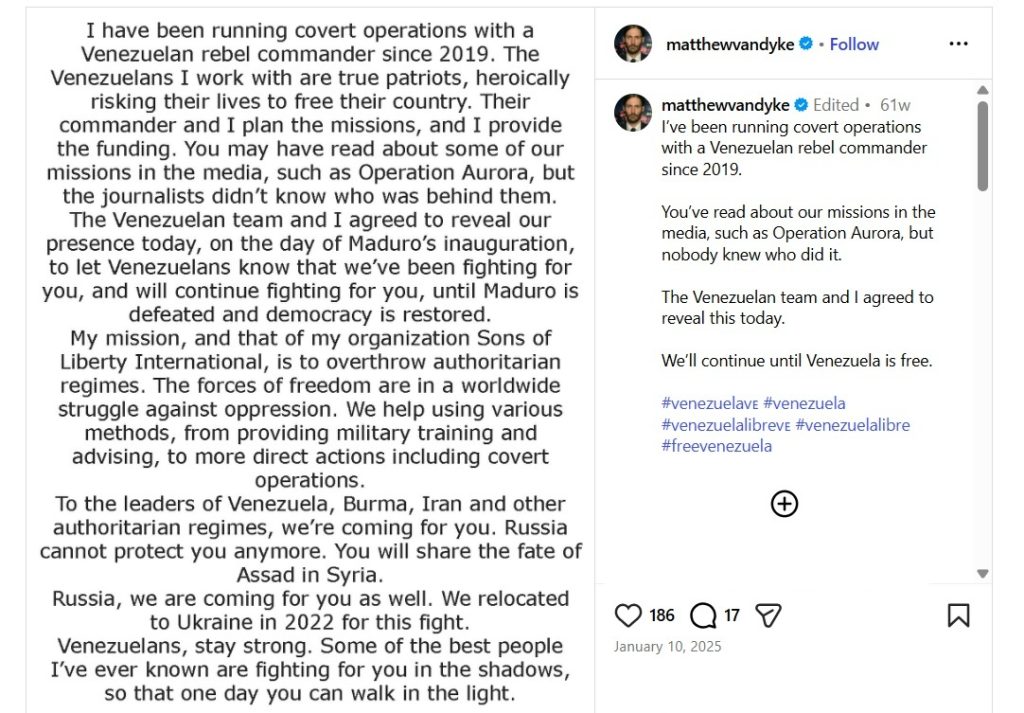
Operation Aurora had been reported in Venezuelan and international media at the time of its execution, but with no attribution – VanDyke’s post was the first public confirmation that he and SOLI were behind it. SOLI’s own website now lists Venezuela as an active mission, openly stating that it had been working to “restore democracy to Venezuela since 2018” and soliciting donor funds to expand future operations against the Maduro government.
Here are some other posts from VanDyke where he again admitted the Venezuela misision.
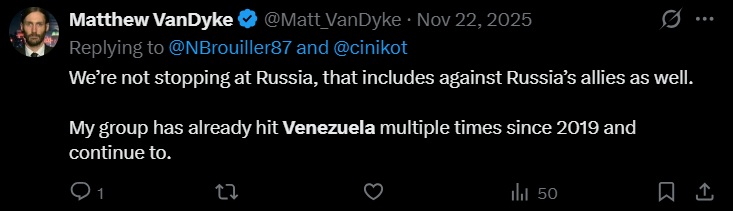
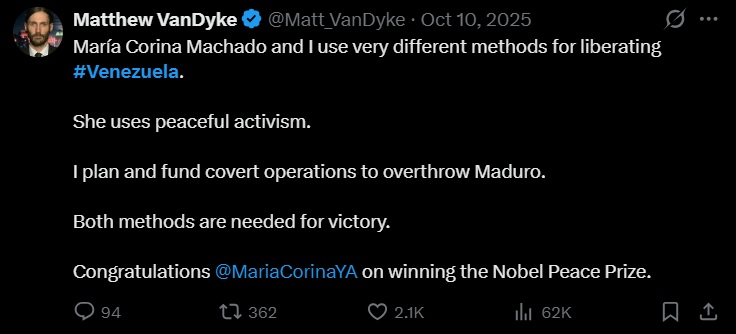
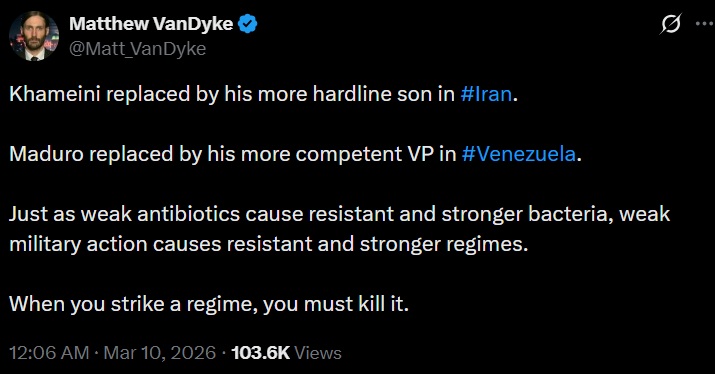
Just weeks before his NIA arrest, VanDyke posted again – this time criticising what he called the “weakness” of American operations in Iran and Venezuela, writing: “Just as weak antibiotics cause resistant, stronger bacteria, weak military action causes resistant, stronger regimes. When you strike a regime, you must kill it.”
The man posting that was, by that point, already operating in Myanmar. The Venezuela chapter matters enormously to the NIA case because it establishes a repeating operational template that predates Myanmar by years: identify a Russian-backed authoritarian regime, build a covert relationship with opposition commanders, fund and plan rebel operations in complete secrecy, and surface only when politically convenient – all while the journalists covering the fallout had no idea who was responsible. Venezuela (2019–2025), Ukraine (2022–present), Myanmar (2025–2026) – each theatre is a Russian ally, each operation follows the same architecture, and VanDyke had named Burma explicitly as a target in his January 2025 confession post, six months before Indian authorities pulled him off a flight at Kolkata airport.
India Pushes Back on Foreign Operatives
The NIA’s arrest does not resolve the question of whether VanDyke is formally a CIA asset. He has denied it himself, even while acknowledging how close he came to official membership. What the pattern of his career does establish is something arguably more consequential than a formal payroll connection: a private individual whose ideological convictions have aligned, across two decades and a dozen conflict zones, with the current strategic preferences of the American national security establishment and who, operating without official cover, provides Washington with the deniability that official operatives cannot.
India’s NIA has placed a border in his path that carried real consequences. He will likely spend the coming weeks in Tihar Jail, waiting for American diplomatic pressure to build. The NIA has eleven days and a case that reaches far beyond one American with a motorcycle and a cause.
A Mercenary or a “Freedom Fighter”?
VanDyke’s career defies easy classification. To supporters, he is a “freedom fighter” aiding oppressed populations. To critics, he represents a new class of ideological mercenaries operating in grey zones of international law.
His profile reflects a recurring pattern: embedding himself in conflicts aligned with Western geopolitical interests, often just outside official state sanction. While there is no public evidence linking him directly to intelligence agencies, his activities frequently overlap with broader strategic objectives associated with NATO and U.S. foreign policy.
VanDyke’s journey from Libya’s battlefields to Ukraine’s trenches and now to India’s custody illustrates a larger shift in modern warfare. Today’s conflicts are no longer confined to nation-states but involve networks of private actors, ideological fighters, and transnational alliances.
For India, the episode is both a warning and a precedent: in an era of globalised conflict, neutrality does not mean vulnerability.
Subscribe to our channels on WhatsApp, Telegram, Instagram and YouTube to get the best stories of the day delivered to you personally.