
The leftist cabal is hell bent on proving that the film The Kerala Story 2: Goes Beyond is nothing but fiction aimed at ‘demonising’ a specific minority community and that such things never happen, of all places, in Kerala.
The second instalment of The Kerala Story franchise opens with a scene of a young woman who had committed suicide by hanging and what was prominent in that scene was the girl’s head was tonsured.
Think this is fiction? Down to such specific details? Think again.
Let us rewind to 2015.
In Kochi, a 23-year-old postgraduate student named Anuja, a resident of Kalamassery and daughter of Ashok Kumar and Shailaja, was found dead in a rented apartment at Padamugal near Edappally.
Anuja was a postgraduate student at Maharaja’s College, Ernakulam, and had been living in the house with her live-in partner Khaleel P.A., also known as Saleem Ali. Khaleel, a 34-year-old man from Chavakkad, was already married and had two children, a fact that Anuja’s family later said had been concealed from them.
What investigators and locals claimed to have found inside the room immediately raised disturbing questions.
Sources stated that Anuja was discovered hanging inside the house with her head tonsured, with hair reportedly scattered across the floor beneath the body. Those who saw the scene alleged that bruise marks were visible on her face and other parts of the body, and that there were signs in the room suggesting that a violent struggle may have taken place before her death.
Members of an action council formed after her death alleged that Anuja’s head had been tonsured, with hair found scattered across the floor beneath the body. They also claimed that a razor believed to have been used to shave her head was recovered from the apartment. As reported in The New Indian Express, according to those present, drag marks were visible across the floor, and Anuja’s body was reportedly found hanging in a position where her feet were almost touching the ground, raising further suspicion about whether the death was staged.
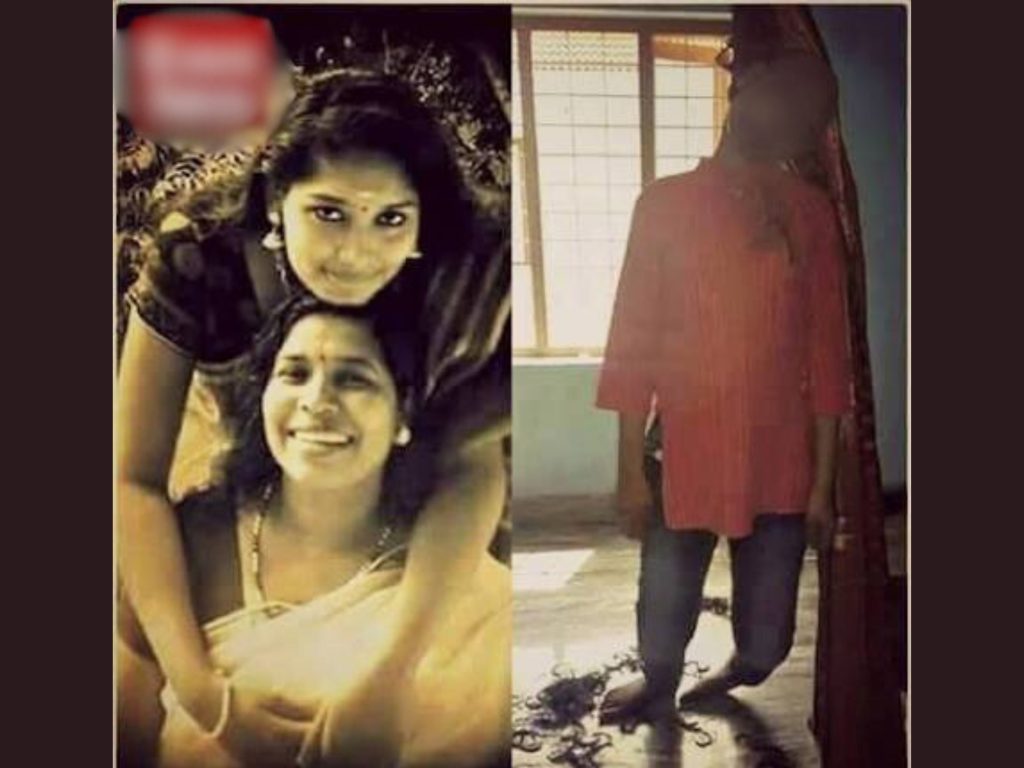
Her mother, Shailaja, publicly rejected the claim that her daughter had taken her own life. Speaking to the media, she described Anuja as a determined young woman who had repeatedly expressed that suicide was not an option for her and had been deeply focused on building a future through the civil services.
The family alleged that Anuja had been killed by her live-in partner, whom they identified as Valiyakath Khalim, whose original name they said was Salim Ali.
As reported in Haindava Keralam, suspicion quickly fell on Khaleel, a native of Guruvayur, who was taken into custody for questioning. Police sources indicated that Khaleel had a long criminal record and had been named in several serious criminal cases.
According to police sources, Khaleel was one of the key accused in the murder of BJP leader Manikandhan, and had also been named in connection with the murder of Subin, a CPM leader, and Shihab, a Congress leader. Investigators stated that he had been an accused in at least five murder cases and had previously served time in prison for involvement in criminal activities.
The relationship between Anuja and Khaleel had reportedly begun several years earlier. According to a petition submitted by her father to senior police officials, Anuja had first met Khaleel while studying BA Economics at Sacred Heart College in Thevara, after being introduced through a senior student named Mohammed Vassif.
The association later evolved into what was described as a business partnership, with the two travelling repeatedly to Attappadi, where they were said to have planned a goat-farming project on around 30 acres of land.
According to the family, Khaleel had professed love to Anuja and promised to marry her, eventually convincing her to enter into a relationship. Police sources later indicated that Khaleel had allegedly concealed the fact that he was already married and had three children, and that he had never legally married Anuja. Despite initial opposition from Anuja’s parents, the relationship continued. Family members later stated that Anuja had remained firm in her decision to be with Khaleel, which eventually led the family to reluctantly accept the situation. The couple subsequently began living together in a rented house in Kalamassery, where they reportedly stayed for more than two months before the incident occurred.
Investigators also stated that Khaleel frequently travelled to Ernakulam under the pretext of agricultural work in Attappadi, claiming to be involved in farming activities there.
Anuja’s father also stated that the family only learned Khaleel’s real identity after her death, alleging that he had introduced himself under a different name.
According to the family’s petition as reported in Times of India, Anuja had visited her parents on May 12, informing them that Khaleel had gone away on a business trip. On May 14, she reportedly received a phone call from him, after which she travelled the next day by auto-rickshaw to the Padamugal apartment. She called home to say she had reached safely and then her phone went silent.
Later that evening, around 9:30 pm, the family received a call from Kalamassery police station asking them to come immediately.
When they arrived at the apartment, they were told their daughter had been found dead.
Dissatisfied with the initial investigation, Anuja’s parents submitted petitions to the Kerala Home Minister and the Director General of Police, demanding a high-level probe. They alleged that there had been attempts to portray the case as a suicide despite what they described as clear indications of foul play.
Following these representations, the Kerala Home Department ordered that the investigation be transferred from the local police to the Crime Branch.
Officials said the Crime Branch would examine all aspects of the case, including the financial dealings between Anuja and Khaleel, their reported plans to purchase land in Attappadi, and the circumstances surrounding her death in the Padamugal apartment, as reported in Times of India.
As reported in The New Indian Express, the Crime Branch investigating the death of Maharaja’s College student Anuja in May 2015 stated that the case appeared to be a suicide by partial hanging. Forensic findings reportedly found no evidence of foul play. Crime Branch Assistant Commissioner V. Sunil Kumar noted that further analysis of the victim’s phone records and chemical examination of viscera and blood was still required before confirming the conclusion. Forensic expert Dr. P. Rema of Thiruvananthapuram Medical College stated that the body had only one ante-mortem injury on the neck, while poison was not visible in stomach contents. Another expert, Dr. B. Umadathan, said the position of the body and chair nearby supported partial hanging.
The case, which triggered widespread protests and demands for justice at the time, remains one of several controversial incidents cited in debates surrounding love jihad, coercive relationships, religious conversion allegations, and unexplained deaths involving young women.
Subscribe to our channels on Telegram, WhatsApp, and Instagram and get the best stories of the day delivered to you personally.