Actor-turned-politician Vijay has recently taken aim at the ruling DMK over the issue of statues funded with public money. But a closer look at his own past statements reveals a striking contradiction.
At a political meeting of his party, Tamilaga Vettri Kazhagam, in Thanjavur, Vijay criticised the decision to erect a bronze statue of M Karunanidhi, accusing the ruling establishment of using public funds to glorify its own family.
Addressing the crowd, Vijay referred to the controversy around the statue proposal and invoked a remark attributed to the Supreme Court of India questioning the use of public money for personal glorification. He argued that governments frequently cite financial constraints when people demand solutions to basic livelihood issues, yet funds appear readily available when it comes to erecting statues of political leaders.
Using a Tamil proverb, he compared the act to making sweets at one’s own house using ghee borrowed from a neighbour implying that public resources were being used to promote the legacy of a political family.
He said, “You tried to install a bronze statue of your father, the Supreme Court asked, ‘In whose glory are you spending the people’s money?’ Don’t make sweets for your own home using the neighbourhood’s ghee. When people need basic livelihood support, you say ‘financial burden’ but for statues, where does the money come from, sir?”
A Very Different Vijay in 2010
However, Vijay’s current criticism sits uneasily alongside remarks he made more than a decade ago.
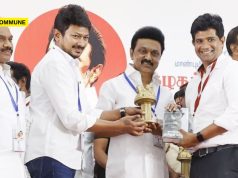
In 2010, at the “Paasathalaivanukku Paaraattu Vizha”, a Tamil film industry felicitation event organised to honour Karunanidhi, Vijay had openly expressed admiration for the DMK patriarch and even called for a statue to be erected in his honour.
Speaking at the event, Vijay praised Karunanidhi’s welfare initiatives and housing schemes for the poor. He noted that land was being provided and houses were being built for economically weaker sections and workers, describing it as an extraordinary achievement.
Vijay also said he had heard that the locality where these houses were being built would be named “Kalaignar Nagar.” But he argued that naming the area alone was not enough and suggested that a statue of Karunanidhi should also be installed there.
He went further, expressing a personal wish that the statue be unveiled during Karunanidhi’s centenary celebrations and said he hoped to stand alongside the veteran leader and admire the statue together.
He said, “Giving land and building homes for the poor is no ordinary deed – Kalaignar is doing this. Naming the locality ‘Kalaignar Nagar’ alone is not enough. I wish that a statue of Kalaignar be erected at that place. I hope that at his 100th birthday, we hold a similar function, and I admire that statue together with him.”
The Contradiction
The contrast between the two statements is difficult to miss.
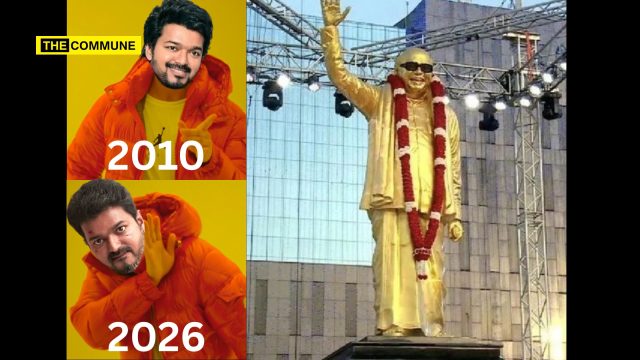
In 2010, Vijay publicly advocated the installation of a statue for Karunanidhi and spoke of celebrating it during the leader’s hundredth birthday.
In 2026, the same Vijay criticises the erection of statues honouring the same political figure and frames it as an inappropriate use of public funds.
The juxtaposition of his own words from 2010 and his recent remarks in Thanjavur has sparked questions about consistency.
If erecting statues of political leaders with public funds is unacceptable today, why did Vijay once openly urge that a statue be installed for Karunanidhi and hope to admire it with him at a future celebration?
முன்னாள் முதல்வர் கருணாநிதிக்கு சிலை… தவெக தலைவர் விஜய் அன்றும் இன்றும்…#TVK | #Vijay | #DMK | #Karunanidhi | #statue pic.twitter.com/vFhsPVAABe
— PttvOnlinenews (@PttvNewsX) March 5, 2026
Subscribe to our channels on Telegram, WhatsApp, and Instagram and get the best stories of the day delivered to you personally.