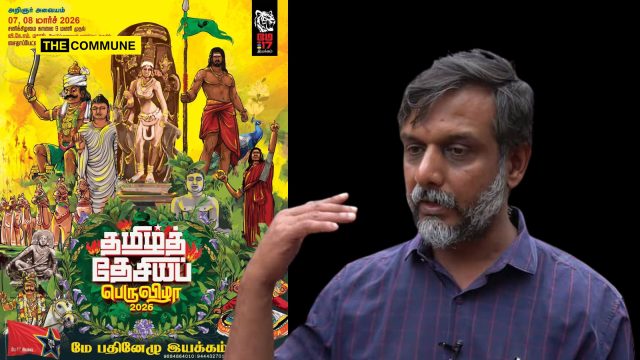
The May 17 Movement, a Tamil Nadu-based organisation that openly advocates for a separate Tamil state, is set to hold its third annual “Tamizh Desiya Peruvizha” (Tamil National Grand Festival) on 7-8 March 2026 at VKM Mahal, Saidapet, Chennai – in the heart of the state capital, with no interference from the Dravidian-model DMK government that ostensibly governs in New Delhi’s framework.
Who Is Behind This Event
The May 17 Movement was founded in 2009 by Thirumurugan Gandhi, named after the date of the final phase of the Sri Lankan civil war in which LTTE cadres were eliminated. The organisation explicitly advocates the “Liberation of Tamil Eelam”, a separate state carved out of Sri Lanka, and has demanded a UN-monitored referendum for Eelam’s independence. It operates on what its founder describes as “Ambedkarite, Periyarist and Marxist principles”.
In 2024, Thirumurugan Gandhi publicly demanded Tamil Nadu formulate its own separate foreign policy, claiming India’s existing foreign policy “is crafted for the benefit of Gujarati Banias and Brahmins”. He has faced sedition charges, Goondas Act detention, and multiple arrests, yet continues to operate freely in the DMK-governed state.
The Conference: Scholarship as a Vehicle for De-Hinduisation
What makes the 2026 edition particularly significant is the detailed session agenda which, read carefully, is not merely academic inquiry into Tamil civilisation but a structured intellectual framework to delegitimise Hindu religious identity among Tamil people.
The third conference’s theme is “Bhakti Movements and Hindu Religious Encroachment” (Bakti Iyakkangalum Indumatha Aakkiramippum). The sessions scheduled for March 7 include:
- “Vedas, Puranas, Caste, Sanatana – Hindu Religious Dominant Doctrines: Traps that Suppressed Tamils” – Speaker: Prof. A. Karunanandhan, former Head of History, Vivekananda College, Chennai
- “Schisms and Contradictions Within Saiva Faith” – framed as a study of internal divisions within Shaivism
- “Thirumal Worship in Sangam Era and Later Vaishnavism” – positioning Vaishnavism as a post-Sangam imposition on original Tamil religion
- “Tamil Deities Demonised by Hinduism” (Hindu Matha Kadavulaakkapatta Tamil Theyvankal) – Speaker: Poet Pa. Meenakshi Sundaram explicitly framing Hindu canonisation of Tamil folk deities as an act of cultural “demonisation”
The March 7 morning session on “Tamils and Religions” includes presentations on:
- “Jainism in Tamil Historical Record” and the role of Jain influence in Tamil society
- “Ancient Tamil Society and Buddhism” – specifically examining how Buddhist missionary activity reshaped Tamil belief
- “Ajivikas as Witnessed by Tamils” – elevating the extinct heterodox Ajivika sect as a “native” Tamil tradition
The March 8 session focuses on “Tamil Worship and Diversity” (Panmaitthuvam Potriya Thamizhar Vazhipaadu) and features a session titled “Dargahs in Tamil Nadu – History of Worship and the Footprint of Islam in Tamil Society”, delivered by S. Anwar, described as a writer, historian, and documentary filmmaker.
The Overarching Ideological Framework
Read in sequence, the conference agenda follows a deliberate arc: Hinduism is framed as a foreign imposition that suppressed, encroached upon, and demonised authentic Tamil religious identity. Buddhist, Jain, Ajivika, Islamic, and Christian traditions are presented as legitimate participants in Tamil civilisation.
The clear implication being driven home across two days is that Hinduism alone is the aggressor in Tamil religious history, while every other faith is a cohabitant deserving of equal or greater legitimacy.
This is not new territory for the May 17 Movement. Its earlier conferences followed the same template. The 2025 conference explicitly presented “Aryan Vaidika opposition history” from Thiruvalluvar to Vallalar, and from the Sangam era to Periyar – framing the entire arc of Tamil intellectual history as an anti-Hindu resistance movement.
The Irony of State Non-Interference
Tamil Nadu’s DMK government, which gleefully invokes “Dravidian Model” governance in national discourse, has allowed a separatist organisation with active separatist advocacy and a founder who demanded a separate state foreign policy to hold a two-day intellectual festival in the state capital, with prominent retired government officials, university professors, and former IAS-linked academics as speakers.
The same government that deploys police against Hindu seers, interferes in temple festivals under HR&CE diktat, and siphons temple funds, has no objection to a conference whose central agenda is positioning Hinduism as a historically oppressive force in Tamil society.
It is also the Deputy CM of the same Dravidian Model state government who called for the eradication of Sanatana Dharma.
The speakers list is itself a statement: retired government archaeologists, former university department heads, and former directors of state research bodies who are of the Dravidianist separatist ideology are scheduled to lend institutional credibility to what is, at its core, a politically motivated civilisational argument.
What This Means
The “Tamizh Desiya Peruvizha 2026” is not an academic festival. It is the third annual instalment of a structured, multi-year intellectual project by a separatist-aligned organisation to systematically dismantle the Hindu religious identity of Tamil people, presenting it as foreign, oppressive, and illegitimate, while elevating every other faith tradition as authentically Tamil.
That this is happening in Chennai, in 2026, with retired state officials as participants and zero governmental scrutiny, tells you everything about the ideological direction in which the Dravidian-model state is travelling.
Subscribe to our channels on Telegram, WhatsApp, and Instagram and get the best stories of the day delivered to you personally.