When R. Joseph Kennedy, a proud alumnus of Loyola College itself, filed a Right to Information application seeking details of Memoranda of Understanding (MoUs) signed by his alma mater with foreign universities, he expected a routine response. What he got instead was a nine-month wall of silence, institutional buck-passing, and a startling admission that has raised serious questions about how Tamil Nadu’s premier universities are managing, or failing to manage, foreign academic collaborations.
The story that has unfolded since is a textbook case of institutional opacity, regulatory failure, and the lengths to which public universities will go to avoid accountability.
The RTI That Opened a Can of Worms
Kennedy’s RTI application, filed with the University of Madras (UoM), the affiliating authority of Loyola College, Chennai, sought information about MoUs signed by the college with seven foreign institutions:
- University of Missouri, Columbia
- Avila University, Kansas City
- Ajman University
- University of Dubai
- Skyline University
- Sunway University, Malaysia
- American University of Sovereign Nations (AUSN)
The request was straightforward. Under UGC regulations, affiliated colleges are required to obtain prior approval from their affiliating university before entering into any foreign collaboration. UoM, as the regulatory authority over Loyola College, should have had complete records of each of these MoUs – their terms, their approvals, and their academic outcomes.
What followed was anything but straightforward.
The University That Knew Nothing
On 26th May 2025, UoM’s International Centre (ICOM) responded, not to Kennedy, but to Loyola College itself via letter No. ICOM/2025/Reg/2471. In a stunning admission, the ICOM office stated that it “presently holds no records or documentation pertaining to the signing, approval, or subsequent action relating to these MoUs by Loyola College.”
Read that again. The University of Madras, the very institution responsible for regulating Loyola College, admitted it had absolutely no knowledge of MoUs signed by the college with seven foreign universities.
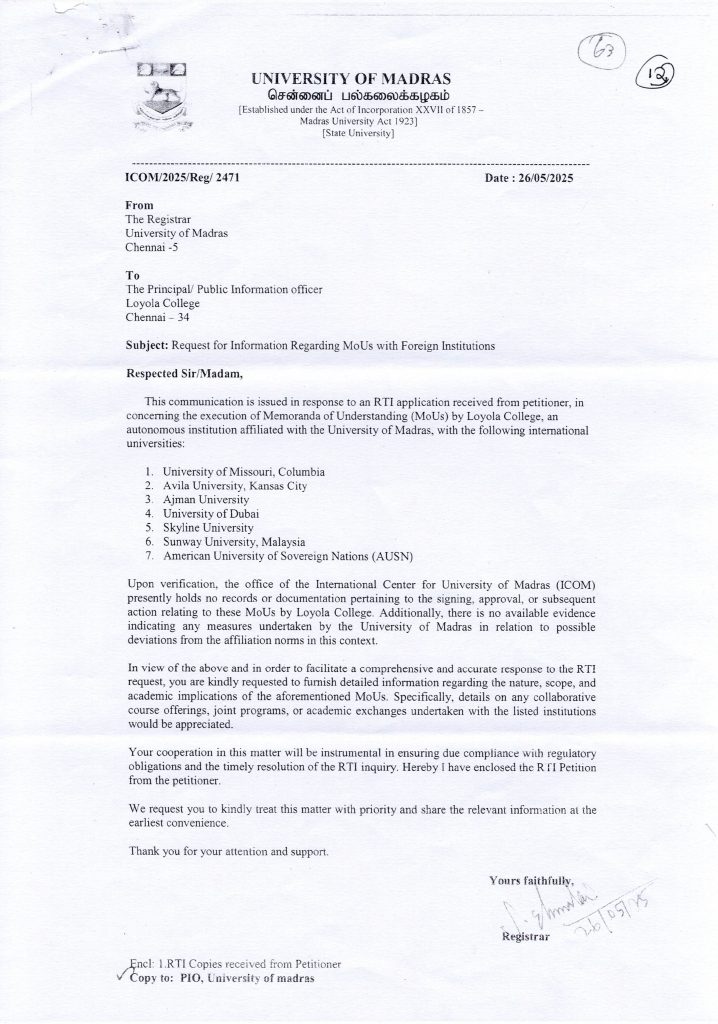
This raises a critical question: How were these MoUs signed with foreign institutions, some of them questionable, without the knowledge or approval of the affiliating university? Who authorised them? And why has no action been taken?
Adding insult to injury, Kennedy was not even copied in UoM’s communication to Loyola College. The RTI applicant was kept entirely in the dark about what was happening with his own application.
Nine Months of Silence from Loyola College
UoM’s letter to Loyola College, dated 26th May 2025, asked the institution to furnish detailed information about the MoUs. That was nearly nine months ago. Loyola College has not responded – not to UoM, and certainly not to Kennedy.
The silence is not an administrative oversight. Loyola College is an autonomous college receiving substantial government aid, making it a ‘public authority’ under Section 2(h) of the RTI Act, 2005, independently bound by the Act’s obligations. Ignoring the University Registrar’s own letter for nine months is not bureaucratic delay – it is wilful defiance of both its regulatory authority and the citizen’s right to information.
The AUSN Question: A University That Shouldn’t Be
Of all the seven institutions named in Loyola College’s MoUs, one stands out for particularly alarming reasons – the American University of Sovereign Nations (AUSN).
Kennedy’s concerns about AUSN are not those of a casual observer. As India’s representative to ECA Global (Ending Clergy Abuse) – an international organisation fighting institutional abuse by clergy, with members across 23 countries and 5 continents, he brings a uniquely informed and unflinching perspective to this fight. That he is now challenging a Jesuit-run institution’s opacity and regulatory failures is not lost on anyone familiar with his work. And AUSN, he says, does not come close to meeting any recognisable standard.
The facts bear him out. AUSN’s own website openly admits: “AUSN is not regionally or nationally accredited in the United States by traditional accreditation agencies.” This is not an allegation – it is a self-confession.
That Loyola College, a supposedly reputed institution affiliated to one of India’s oldest universities, signed an MoU with such an entity raises serious questions. What academic programs were run under this MoU? How many students participated? Are their credentials internationally valid? Did UGC know?
Neither UoM nor Loyola College has been willing to answer any of these questions.
A Pattern Madras High Court Has Already Flagged
The conduct of UoM in this case is not isolated. In a recent order concerning Madurai Kamaraj University (MKU), the Madurai Bench of the Madras High Court transferred a corruption case to the CBI after observing that the Directorate of Vigilance and Anti-Corruption (DVAC) had acted merely like a “post office” – forwarding complaints without independent inquiry.
The parallel is striking. UoM has done precisely the same thing – forwarded Kennedy’s RTI to Loyola College and then washed its hands of the matter, taking no follow-up action for nine months. When the highest court in the state has already condemned this pattern of behaviour in another Tamil Nadu university, it is deeply troubling to see UoM repeat it.
The TNIC Steps In – But UoM Still Drags Its Feet
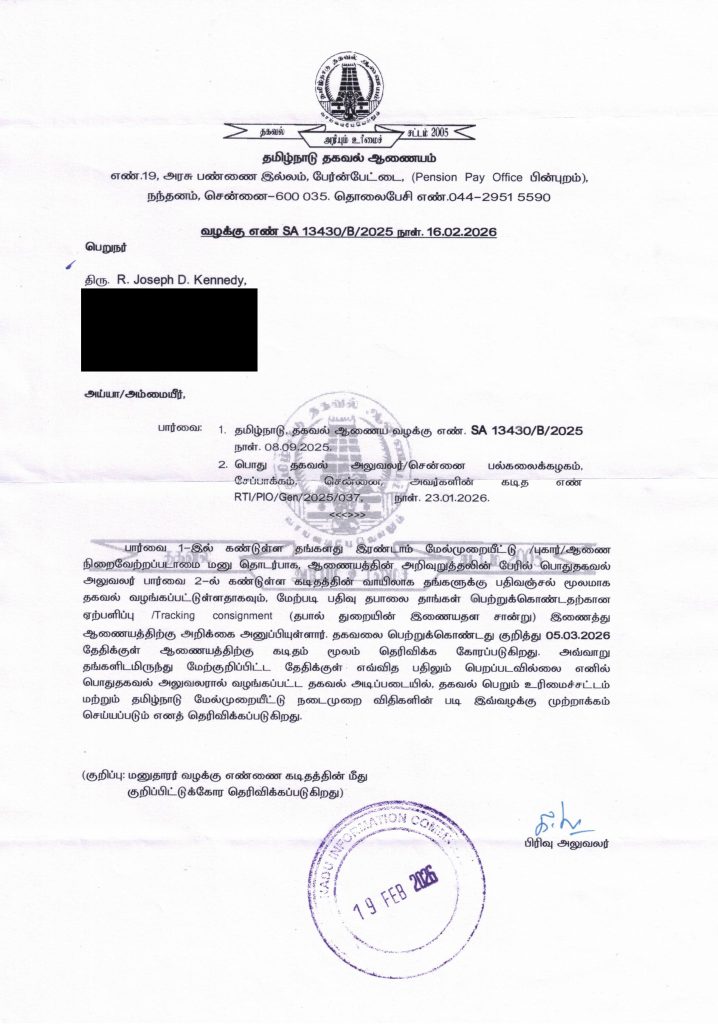
After UoM’s stonewalling, Kennedy escalated the matter to the Tamil Nadu Information Commission (TNIC). In an order dated 16th February 2026, the Commission ruled in Kennedy’s favour in Case No. SA 13430/B/2025, directing UoM to furnish the requested information by 5th March 2026.
Kennedy has now filed a comprehensive complaint with TNIC citing six specific grounds of violation, seeking not just compliance but also:
- A maximum penalty of Rs. 25,000/- against the UoM PIO under Section 20(1) of the RTI Act
- Disciplinary action against the PIO under Section 20(2) of the RTI Act for persistent and wilful failure to provide information
He has simultaneously filed independent RTI applications directly with both UoM and Loyola College, targeting the specific gaps exposed by UoM’s own admission.
The Larger Question: Who Is Watching Tamil Nadu’s Universities?
This case is not just about one RTI application. It is about a systemic failure of regulatory oversight in Tamil Nadu’s university ecosystem.
UGC has publicly warned institutions against entering into illegal or irregular foreign collaborations. Yet here we have an affiliated college that has signed MoUs with seven foreign institutions, including at least one that has no credible accreditation, apparently without its own affiliating university’s knowledge or approval.
If UoM does not know what its affiliated colleges are doing, who does? If Loyola College can ignore the University Registrar’s letter for nine months without consequence, what does that say about the state of academic governance in Tamil Nadu?
And if it takes a single citizen armed with an RTI application to uncover what institutional oversight has failed to catch, what does that say about the health of our public universities?
Subscribe to our channels on Telegram, WhatsApp, and Instagram and get the best stories of the day delivered to you personally.