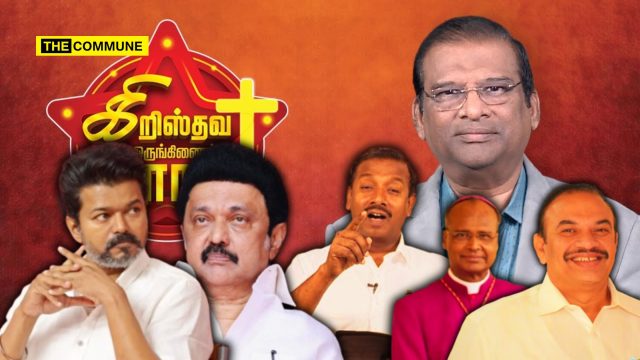
In December 2023, Tamil Nadu witnessed an unprecedented gathering — the ‘United Christian Conference’ — which brought together some of the state’s most influential Christian leaders, including Mohan C. Lazarus, Dr. Paul Dhinakaran, and Archbishop George Antonysamy.
The event was aimed to unite Catholics, CSI, Lutherans, Baptists, Methodists, and Pentecostals under a common theme of “one body in Christ” with interdenominational prayer and worship. The programme, heavily promoted online, emphasised unity, harmony, and spiritual “breakthroughs,” invoking biblical motifs such as the “walls of Jericho” falling.
DMK MLA and Christian Goodwill Movement founder Inigo S. Irudayaraj also attended the event indicating the political and social influence of this ecosystem.
The conference — and those behind it — deserves closer scrutiny to understand how evangelical networks, their political linkages, funding channels, and on-ground operations are increasingly shaping Tamil Nadu’s political landscape.
These evangelists, operating at the intersection of faith, education, and politics, seem to be orchestrating a coordinated strategy to consolidate Christian votes and influence Tamil Nadu’s governance. Let us take a quick look at a few of these rabid preachers and their various activities in this unfolding political drama.
Mohan Lazarus – The Inflammatory Evangelist
Mohan C Lazarus is the founder of Jesus Redeems Ministries, headquartered in Nalumavadi, Thoothukudi, and is one of Tamil Nadu’s most influential Pentecostal preachers. He is a significant theological and political force in southern Tamil Nadu, often noted for his controversial public statements and activism.
Hate Speech and Communal Allegations:
Lazarus has faced multiple criminal cases (FIRs) in Tamil Nadu for making anti-Hindu statements, such as describing Hindu temples as “abodes of Satan” and mocking Hindu deities. Charges brought against him included IPC Sections 153, 153-A, 295-A, 505(1)(b), and 505(2) (for promoting enmity, outraging religious feelings, and inciting public mischief). He also called other faiths “evil”.
In 2021, the Madras High Court quashed some FIRs after he issued an unconditional apology but explicitly cautioned that his extremist rhetoric could provoke “hatred, violence, and bloodshed.”
Political Interventions:
In 2022, videos circulated online of Lazarus praying for the defeat of the BJP in state elections, drawing criticism from political quarters.
COVID-19 and Social Responsibility:
During the pandemic, Lazarus was found encouraging followers to attend church gatherings amid lockdown protocols and spreading vaccine hesitancy propaganda.
“Vaccines, Booster doses and masks are all conspiracy of WHO and corporate companies, all this are done to intimidate and enslave you and keep you in fear its the work of Antichrist, proof for all this is in the Bible” #Lazarus the Unstoppable pic.twitter.com/3JygVlq1nQ
— Vishwatma 🇮🇳 ( மோடியின் குடும்பம் ) (@HLKodo) January 16, 2022
Activism and Sterlite Protests:
Lazarus was instrumental in mobilising Christian congregations against the Sterlite copper plant in Thoothukudi, where he called on believers to treat the factory as a “toxic” presence and agitated for its closure.
Funding and Regulatory Issues:
His organization, Jesus Redeems, was flagged for FCRA (foreign funding) violations. The associated US entity held about $190,000, according to public financial disclosures. Regulatory authorities also initially denied him a new passport because he failed to disclose his pending criminal cases.
In January 2025, MHA permanently cancelled the FCRA license Of Mohan Lazarus’ NGO Jesus Redeems over multiple violations.
Dr. Paul Dhinakaran: The Tycoon Preacher with a “Mini-Vatican”
Dr. Paul Dhinakaran, head of Jesus Calls Ministries and Chancellor of Karunya Institute of Technology and Sciences, represents the institutional arm of this influence, wielding significant financial and organizational power.
The “Karunya Nagar” Project: Allegations abound that Dhinakaran is trying to create a “Mini Vatican” in Nallurvayal village near Coimbatore. RTI investigations have revealed that numerous churches and prayer halls in the surrounding panchayats were constructed without official permission, indicating a systematic and unauthorized expansion.
Conversion Allegations and Targeting Tribal Community: His NGO, SEESHA, has been accused of using its mobile hospital services to lure tribal communities with freebies like clothes and gifts as a precursor to religious conversion. Protests have erupted over the renaming of villages and the affixing of Karunya’s name on government-built houses, leading to accusations of branding state welfare as Christian charity.
Financial Scandals and Political Funding: The Income Tax Department conducted major raids on Dhinakaran’s premises, resulting in the seizure of 5 kg of gold and the uncovering of ₹120 crore in unaccounted investments. There are unconfirmed reports that his organization, which receives foreign funding from countries like Canada, may have diverted funds to farmer agitations and certain Tamil Nadu political parties. He was also banned from holding a religious gathering in Jaffna, Sri Lanka, after appeals by local Hindu groups.
Used Children For “Healing” Event In Arunachal Pradesh: Dhinakaran held a three-day Jesus Calls Arunachal Prayer Festival in Arunachal Pradesh in 2023, attended by Chief Minister Pema Khandu and several ministers. During the event, Paul prayed for the state and government, referring to Arunachal as “God’s garden,” while Khandu praised Christian denominations for opposing money culture in elections and highlighted government grants to Christian institutions. Videos from the festival showed Paul performing “miracle healings,” including claims of making a wheelchair-bound girl walk.
George Antonysamy: The Political Archbishop
As the Archbishop of the influential Archdiocese of Madras and Mylapore, George Antonysamy holds significant sway, which he has wielded in overtly political ways, drawing accusations of violating the model code of conduct and mixing religion with politics.
Election Interference: During the 2024 Lok Sabha elections, he authored a guest editorial in ‘The New Leader’ magazine that sharply criticized the Union Government, accusing it of constructing a “mono-cultural nation” and destroying diversity. The editorial parroted DMK talking points, using terms like “Union government” and alleging that institutions like the Election Commission and courts were under government control. He explicitly called on Christians to vote to “protect this land” and “reject sectarian parties.”
Open Gratitude for Religious Representation: Following the DMK’s renomination of P. Wilson, a Roman Catholic, to the Rajya Sabha in May 2025, Archbishop Antonysamy publicly thanked Chief Minister M.K. Stalin in a letter. He explicitly highlighted Wilson’s “Roman Catholic” identity and thanked Stalin for “recognising the needs of our minority Christian community.” This act starkly contradicted the DMK’s publicly stated principle of not mixing religion with politics.
It is noteworthy that DMK MPs Dayanidhi Maran, Thamizhachi Thangapandian, and Kalanidhi Veeraswamy visited Archbishop George Antonysamy, who had recently faced allegations of influencing voters on religious grounds, just as the 2024 Lok Sabha elections following the results – DMK alliance had swept TN winning all 39 seats in the state.
Network of Influence: The Archdiocese controls a vast network of organizations, including educational societies, trusts, and NGOs like Caritas India, which critics argue should be investigated for potential violations of FCRA, FEMA, and PMLA regulations.
Anti-NEP Campaign: In 2020, he issued a circular mobilising protest against the National Education Policy. The circular included contact numbers of activist organisations such as People’s Watch.
Inigo Irudayaraj: The DMK’s Point Man
DMK MLA Inigo Irudayaraj, who also heads the Christian Goodwill Movement (Christuva Nallenna Iyakkam), functions as a direct political bridge between the party and the evangelical community.
Spreading Disinformation: At a youth camp organized by Mohan Lazarus, Irudayaraj delivered a speech filled with falsehoods. He falsely claimed that the UAPA anti-terror law was being used against Christians in BJP-ruled states. He also inflated a statistic, alleging that 6,500 Christian women were sexually assaulted in Gujarat, a figure wildly inconsistent with official NCRB data which reported 610 rape complaints for all women in the state.
The Political Nexus?
The activities of these individuals paint a picture of a deeply interconnected nexus. This alliance, critics argue, is now strategically aligning behind a new vehicle which is Joseph Vijay’s Tamilaga Vettri Kazhagam with the alleged end goal of placing a pliable Christian leader at the helm of the state government, fundamentally altering the political and religious landscape of Tamil Nadu. The allegations of “crypto-Christian” infiltration in the bureaucracy and the specific naming of Vijay’s backers from Christian educational institutions like Loyola College further fuel this narrative of a concerted, long-term political mission.
This Christian gathering that was convened seems to have been done with the explicit objective of uniting in support of Dravidianism, a political ideology that Hindus must now decisively reject and break away from to achieve their own unity. Under the guise of service through educational and medical institutions, and with the full backing of Dravidian and Communist parties, these forces are accused of engaging in deceptive conversion activities.
Actor Joseph Vijay, now parading as a politician, loves to project himself as a messiah of morality. Like a typical DMK lackey, he has been trying to brand RSS as a “divisive force” in Tamil Nadu.
It is hardly surprising he speaks that way — after all, he, his party, and his inner circle all come from the same mould – be it his father, his advisor Aadhav Arjuna (son-in-law of Lottery Martin), his another advisor is Jhon Arockiasamy, or his association with Atlee.
But if Vijay truly wants to speak of divisive forces in Tamil Nadu, he need not look beyond the missionaries and evangelists of his own religion. For decades, their actions, cloaked in the garb of charity and faith have fractured communities, grabbed lands, and stoked enmity.
Within this backdrop, a growing section of Tamil Nadu’s Christian groups appears to be viewing Vijay as a valuable political investment. With the DMK increasingly losing credibility among its traditional minority constituencies, Vijay offers them a fresh, culturally packaged, youth-friendly face through whom they can diversify their political bets. For evangelist networks, he represents a convenient blend of star power, moral posturing, and a tacit willingness to echo their narratives — making him an ideal long-term asset in Tamil Nadu’s shifting political marketplace.
Last Word
The DMK’s selective secularism, the rise of Vijay as a carefully curated “alternative,” and the expanding machinery of evangelical networks are not isolated developments — they are interconnected pieces of a larger political strategy.
If Tamil Nadu fails to recognise how this ecosystem is quietly manufacturing consent, capturing institutions, and scripting new political loyalties, the state may soon find its democracy subcontracted to forces whose allegiance lies far beyond its borders.
Subscribe to our channels on WhatsApp, Telegram, Instagram and YouTube to get the best stories of the day delivered to you personally.