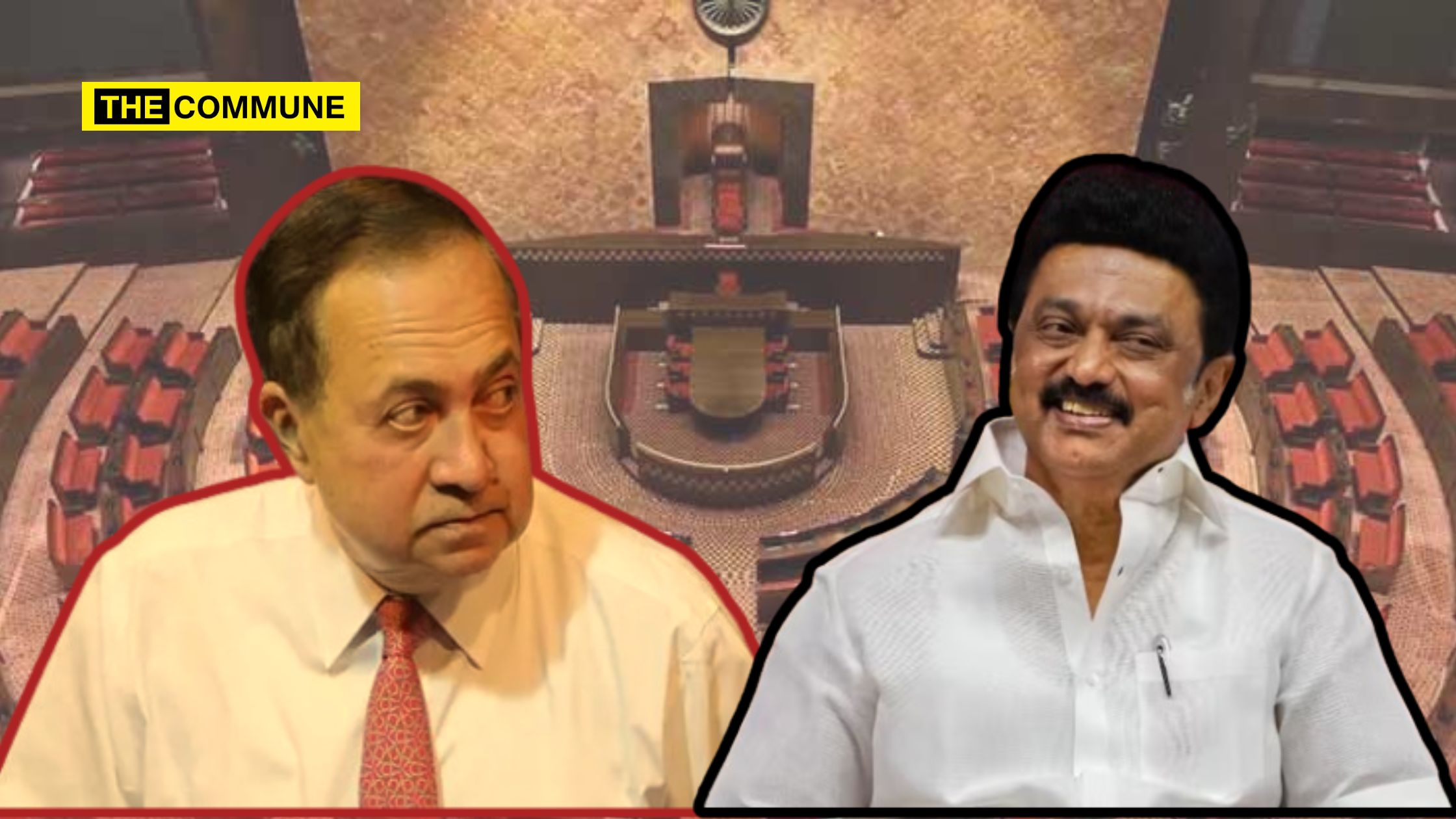
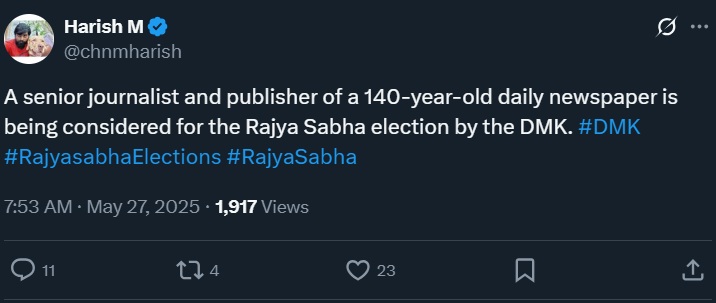
N. Ram, publisher of the 140-year-old The Hindu who hides façade of journalistic objectivity, long seen as a veteran voice in Indian media, now finds himself at the center of political speculation: the DMK is reportedly considering nominating him to the Rajya Sabha. It’s not a surprising development. For years, Ram has been less a neutral journalist and more a vocal mouthpiece for DMK propaganda — echoing the party’s positions, publishing Stalin’s op-eds, and attacking the Tamil Nadu Governor with near-synchronised precision.
Now, the line between newsroom and party war room is about to disappear entirely — with a Rajya Sabha seat as his reward.
Let’s take a look at how N. Ram could have manoeuvered his way to the ruling dispensation.
A Walking Companion, A Political Endorsement?
It was hard to miss Chief Minister M.K. Stalin’s gushing 80th birthday tweet for Ram, “Wishing a happy 80th birthday to my walking friend and thinking companion, @nramind… He interrogates the news, questions power, and stands firm for press freedom.”
Wishing a happy 80th birthday to my walking friend and thinking companion, @nramind, a towering sentinel of Indian journalism.
He interrogates the news, questions power, and stands firm for press freedom.
May his wisdom continue to ignite thought and guide public reason. pic.twitter.com/0AUVxgYdzJ
— M.K.Stalin (@mkstalin) May 4, 2025
But what Stalin conveniently left out is this: N. Ram hasn’t so much “questioned power” as selectively interrogated it — provided it wears saffron. When it comes to the DMK, however, Ram’s journalistic rigor morphs into enthusiastic cheerleading.
From publishing Stalin’s NEET opposition essays verbatim to praising his speeches at communist party congresses, Ram has turned The Hindu’s op-ed section into a second-rate DMK press release archive. And now, the reward for his loyalty may just be a seat in the Rajya Sabha — a fitting culmination of years spent camouflaging partisanship as press freedom.
Press Freedom For Me, Not For Thee
Like a true leftist, N. Ram has been ‘vocal’ about India’s ‘slide’ on the Global Press Freedom Index — blaming the Modi government for a hostile media environment, raids on journalists, and suppression of dissent. On World Press Freedom Day, he amplified Stalin’s own performative concern. He wrote, “An influential voice for press freedom — and against authoritarian curbs and suppression:”
An influential voice for press freedom — and against authoritarian curbs and suppression: https://t.co/Uo02WF8tYA
— N. Ram (@nramind) May 4, 2025
Yet, when DMK critics were jailed in Tamil Nadu for social media posts, Ram was curiously silent. Instead of questioning power in his own backyard, he offered cover — praising Tamil Nadu’s “credible” Tamil news media while ignoring the stifling of dissent within the state.
In an interview with BBC’s Stephen Sackur, praising TN “press freedom” he said, “There are still some exceptions. In the Indian languages, in Tamil Nadu, for example, where I come from, there are some perfectly credible television news channels, and maybe in West Bengal and other places as well.”
A Record Of Amplifying DMK’s Pet Causes
Ram’s bias isn’t subtle. Here’s a list of what he has amplified.
Glorified Stalin’s stance against the NEET exam with glowing commentary.
This well-reasoned editorial page article in The Hindu of February 9, 2022 by Tamil Nadu Chief Minister M. K. Stalin explains how and why NEET is unacceptable — and how The NEET Exemption Bill defends the right to education & social rights & upholds the State’s rights: pic.twitter.com/evUjQFi5K7
— N. Ram (@nramind) February 9, 2022
Championed resolutions undermining the role of the Tamil Nadu Governor, calling the Governor’s actions “childishness” and “cantankerous.”
Tamil Nadu Governor R. N. Ravi has once again demonstrated through his cantankerous “childishness” why he is such a political asset for the ruling party, the DMK! Tamil Nadu Chief Minister M. K. Stalin puts it coolly in context: https://t.co/Tje3q15WwX
— N. Ram (@nramind) January 7, 2025
Called Supreme Court rulings against the Governor a “historic victory” — not for the judiciary, but for Stalin personally.
Warmest congratulations on a historic victory in the Supreme Court of India for the DMK government headed by Chief Minister M. K. Stalin — and for the principles of federalism.
இந்திய உச்ச நீதிமன்றத்தில், முதலமைச்சர் மு. க. ஸ்டாலின் தலைமையிலான திமுக அரசுக்கும், கூட்டாட்சி…
— N. Ram (@nramind) April 8, 2025
Echoed DMK rhetoric that paints all opposition to their agenda as “chauvinism,” while painting Stalin’s own identity politics as “rational, intelligent, and principled.”
Here’s Tamil Nadu Chief Minister M. K. Stalin on the world of difference between chauvinism and a rational, intelligent, and principled pursuit of the democratic rights of the people. And he points a finger at the real chauvinists, a sorry bunch flailing hopelessly against the… https://t.co/u7WOgRuE27
— N. Ram (@nramind) March 6, 2025
And when tax raids were conducted on Stalin’s own son-in-law ahead of the 2021 elections, Ram rushed to cry foul: “Outrageous misuse of agencies of state!” So much for objectivity.
Extremely crude and outrageous misuse of agencies of state — what is the Election Commission of India doing in the face of these flagrant illegalities? “Tax Raids On DMK's MK Stalin's Son-In-Law, 4 Places In Chennai Searched” https://t.co/Hqfnfxih2L
— N. Ram (@nramind) April 2, 2021
Anti-India N. Ram
Let’s take a look at how The Hindu’s N. Ram has been blatantly anti-India. Be it doctoring documents relating to the Rafale deal or distorting India’s map by omitting Sikkim from it or peddling Pakistani propaganda amidst Operation Sindoor, The Hindu and N. Ram are responsible for peddling every single anti-India rhetoric.
Rafale
In the run-up to the 2019 Lok Sabha elections, Ram attempted to manufacture a Rafale “scam” aimed at discrediting the Modi government. On 8 February 2019, The Hindu published a selectively cropped defence ministry note to suggest internal opposition to the Rafale deal, portraying the Prime Minister’s Office as interfering in the process. What the report conveniently omitted was a handwritten note by then Defence Minister Manohar Parrikar calling the objections an “overreaction” and clarifying that both Indian and French leaderships were merely monitoring progress. ANI later exposed the full, unedited document, revealing that The Hindu had removed key portions, including date stamps and annotations, to mislead readers. When cornered, The Hindu claimed it published an earlier version of the note, a claim undermined by clear digital tampering.
Distorting India Map
The Hindu sparked fresh controversy with its 13 May 2025 edition after publishing a map of India that conspicuously excluded Sikkim. Featured in an opinion article about Catholicism in India, the omission triggered widespread backlash and accusations of anti-national bias.
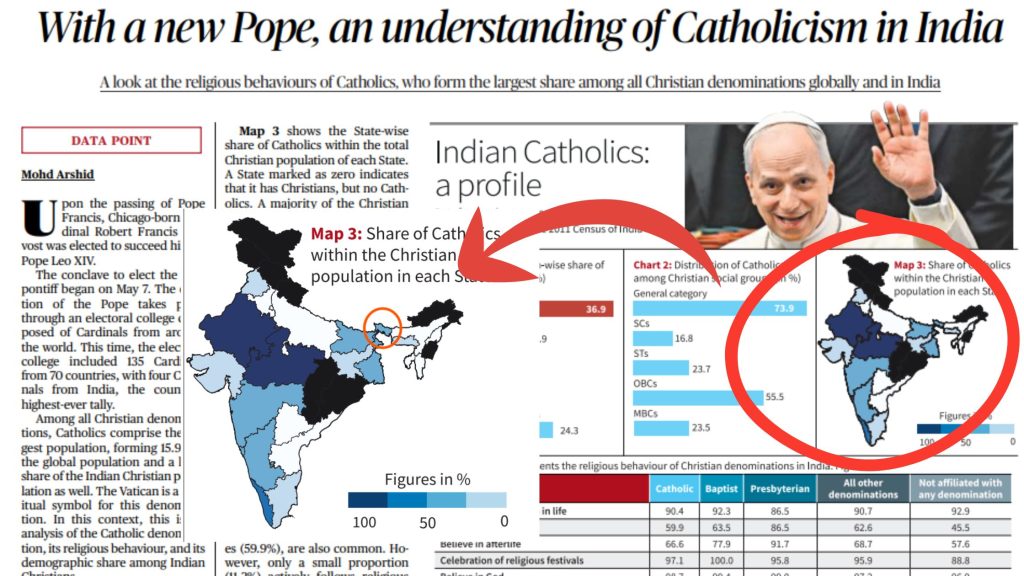
In response, The Hindu issued an apology, citing a “data input error” and claiming the mistake had been corrected in its online and e-paper versions. However, critics remain unconvinced, pointing to the newspaper’s history of controversial reporting — including a previous, unverified claim that Indian Rafale jets were downed by Pakistan, which was later retracted.
Vijaita Singh’s Coverage of Manipur: Irresponsible And Inflammatory
Beyond the Kashmir-Pakistan narrative, The Hindu’s Vijaita Singh’s reporting during the Manipur ethnic conflict stands out for its recklessness. Since violence erupted in May 2023, her articles have repeatedly highlighted unverified claims, inflammatory statements, and misleading headlines that have only deepened the rift between the Meitei and Kuki-Zo communities.
In March 2025, Singh quoted a protester who accused security forces of saying, “We are not Indians”—a claim that was later walked back by the protester themselves. Still, Singh chose to amplify the quote without context, potentially stoking anti-security sentiment in a state already teetering on the edge.
In January 2024, she authored a report claiming that “Meitei MLAs call for positive action,” which was later clarified by The Hindu itself to be factually incorrect. The resolution in question had not been passed exclusively by Meitei MLAs, as originally reported—an error with significant communal implications.
In another instance, Singh reported on Chief Minister N. Biren Singh skipping a North Eastern Council meeting, framing it as a rebuke of the central government. Once again, her narrative placed the state and Centre at odds during a period requiring collaboration and restraint.
Operation Sindoor: Amplifying Pakistani Propaganda
The latest controversy erupted following India’s precision counter-terror strikes, Operation Sindoor, targeting terror launchpads in Pakistan-occupied Kashmir. While the Indian Army emphasized the operation’s surgical nature, Pakistani media and propaganda networks immediately circulated false claims of retaliatory strikes and downed Indian jets.
Equally concerning was The Hindu’s now-deleted social media post falsely suggesting Indian jet crashes—a claim swiftly refuted by defense experts as mere fuel tank jettisoning. The post read, “Just In|At least three Indian jets have crashed in Jammu and Kashmir’s Akhnoor, Ramban, and Pampore areas, a government official told The Hindu, @vijaita reports.”
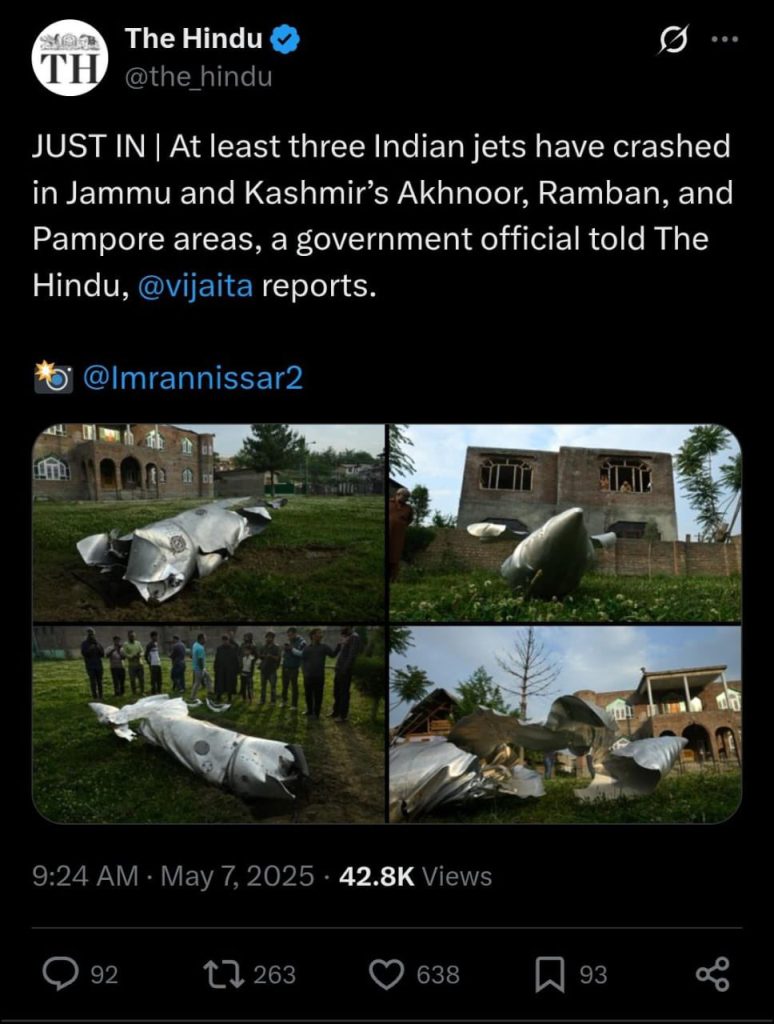
The publication’s quick deletion of the post, without clarification, only deepened suspicions of deliberate misinformation.
Pro-China The Hindu
The Hindu’ has long been recognized as an anti-Bharat media outlet. Both the publication and its journalists have repeatedly come under fire for publishing content that is not only openly hostile to India but also alarmingly aligned with China’s strategic interests. Over the years, the newspaper has solidified its reputation as a consistent mouthpiece for narratives that undermine India’s sovereignty, national security, and internal stability. Whether it’s border tensions, defense matters, or domestic policies, ‘The Hindu’ has habitually echoed adversarial positions—often mirroring China’s geopolitical agenda.
What makes this more dangerous is the blind and enthusiastic backing the paper receives from India’s liberal-left ecosystem. Despite clear evidence of its anti-national slant, this ideological cabal continues to defend and legitimize ‘The Hindu,’ enabling it to carry out its divisive agenda unchecked. Their uncritical support has only emboldened the newspaper to intensify its campaign against India’s national interest.
The Hindu published misleading stories like claiming three Indian fighter jets crashed in Kashmir (using images of fuel tanks as “evidence”), then quietly deleting the article.
The publication consistently echoed Beijing’s talking points on border disputes, portraying China’s military buildup positively, and downplaying Indian territorial concerns during LAC tensions and the Galwan clash.
They published multiple full-page Chinese government advertorials celebrating Communist Party milestones and China’s National Day, raising questions about editorial independence.
The Hindu was also seen praising China’s Belt and Road Initiative, defending Chinese military expansion in South Asia, and justifying authoritarian policies like religious crackdowns.
They have frequently criticized India’s foreign policy as weak while portraying China as a responsible global power and giving prominence to Chinese officials’ statements over Indian positions.
Additionally, the Chinese Ambassador’s 2022 visit to The Hindu’s headquarters highlighted the publication’s apparent closeness to Beijing.
From Leftist Publisher To Lawmaker?
For years, critics have accused The Hindu of harboring a subtle but consistent anti-India tilt in its editorial worldview — from whitewashing China’s actions to selectively reporting issues that align with Left-leaning narratives. Ram has personally backed stories that critics say have relied on dubious sourcing and narrative framing, particularly around Rafale and Pegasus. Now, with a likely Rajya Sabha seat in sight, the DMK may be about to formally reward one of their most faithful media amplifiers.
Loyalty Rewarded, Journalism Diminished
What we’re witnessing isn’t just another journalist entering politics. It’s the culmination of years of ideological convergence between N. Ram and the Dravidian model of politics — a worldview that sees the media not as a watchdog, but as a tool of cultural and political engineering.
As speculation builds over his potential nomination, the question isn’t just whether N. Ram will accept Stalin’s offer. The real question is: Was he ever outside the DMK tent to begin with?
Subscribe to our channels on Telegram, WhatsApp, and Instagram and get the best stories of the day delivered to you personally.