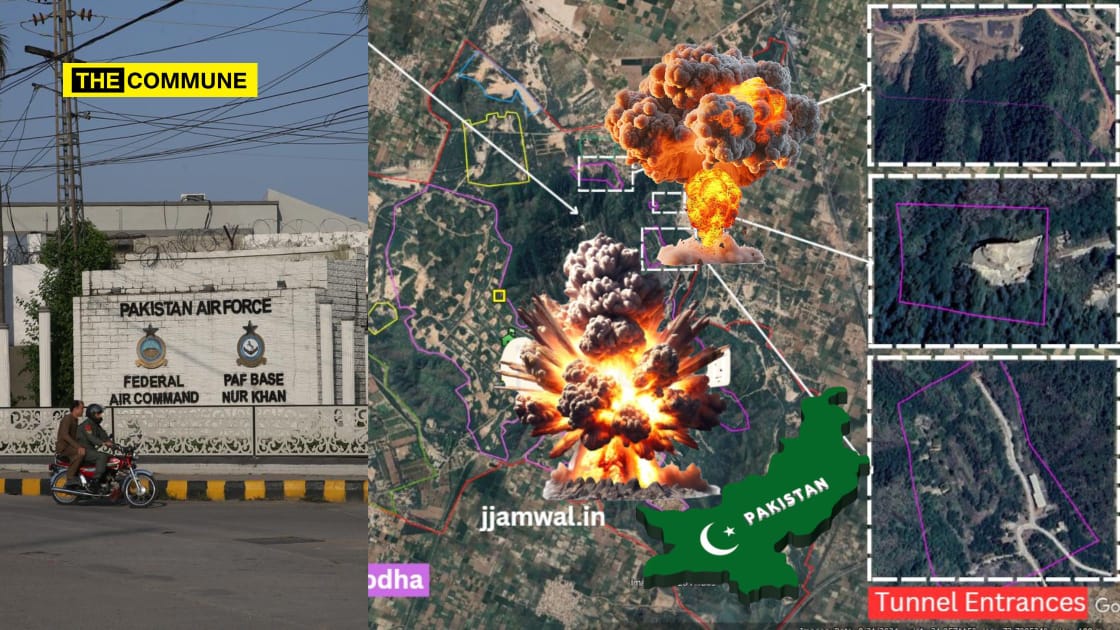
As tensions between India and Pakistan reached a boiling point, India’s missile strike on Rawalpindi’s Noor Khan airbase sent shockwaves through Islamabad, striking at the heart of Pakistan’s military and nuclear command structure. The strategically critical airbase, located dangerously close to Pakistan’s nuclear weapons control headquarters, served as a stark warning—India possessed the capability to decapitate Pakistan’s nuclear command authority if necessary.
The strike came amid escalating hostilities following a deadly terrorist attack in Kashmir on April 22, which killed 26 people, mostly Hindu tourists. India retaliated with precision strikes targeting terror camps, but the attack on Noor Khan marked a dramatic escalation. The airbase, a key transport and refueling hub for Pakistan’s air force, also lies near the headquarters of the Strategic Plans Division, the body overseeing Pakistan’s estimated 170 nuclear warheads.
New York Times reported, “One former American official long familiar with Pakistan’s nuclear program noted on Saturday that Pakistan’s deepest fear is of its nuclear command authority being decapitated. The missile strike on Nur Khan could have been interpreted, the former official said, as a warning that India could do just that.”
India’s strike on Rawalpindi’s Noor Khan airbase was Pakistan’s biggest nightmare coming true. India’s warning was that it had the full capability to decapitate Pakistan’s nuclear command authority.
From the New York Times: pic.twitter.com/tgFHIwEMU9
— Shubhangi Sharma (@ItsShubhangi) May 11, 2025
The move triggered panic in Islamabad, with reports suggesting Prime Minister Shehbaz Sharif hastily convened a meeting of Pakistan’s National Command Authority—the group responsible for nuclear decisions. While Pakistan’s defense minister later denied the meeting took place, the mere possibility underscored the gravity of India’s warning.
It is noteworthy that India struck nearly 11 air bases of Pakistan.
Brahmos was Fantastic!! pic.twitter.com/GYqzMIHVmx
— Mountain Rats (@mountain_rats) May 11, 2025
Fearing a rapid escalation toward nuclear conflict, the US is said to have intervened, with Vice President JD Vance and Secretary of State Marco Rubio engaging in urgent diplomacy. Their efforts, along with pressure from Saudi Arabia and the UAE, eventually led to a ceasefire announced by President Trump. However, the damage was done—India had demonstrated its ability to strike deep into Pakistan’s military nerve center, exposing Islamabad’s worst nightmare: the vulnerability of its nuclear command structure.
The message was clear. India’s surgical strike on Noor Khan was not just retaliation—it was a calculated signal that Pakistan’s nuclear deterrent could be neutralized if the conflict spiraled further.
India had also struck the Sargodha air base which according to reports holds underground nuclear storage under the Kirana hills. The hills have deep underground sites with atleast 6 visible entrances as evident from Google maps. This base was hit with multiple loitering penetrating munitions which must have made Pakistan shiver.
So, it is pretty clear that India holds knowledge of where Pakistan holds its nuclear weapons and has hit them where it hurts which is why Pakistan came begging for a ceasefire and its so-called Prime Minister desperately claimed victory when they clearly have stood naked before India.
Subscribe to our channels on Telegram, WhatsApp, and Instagram and get the best stories of the day delivered to you personally.