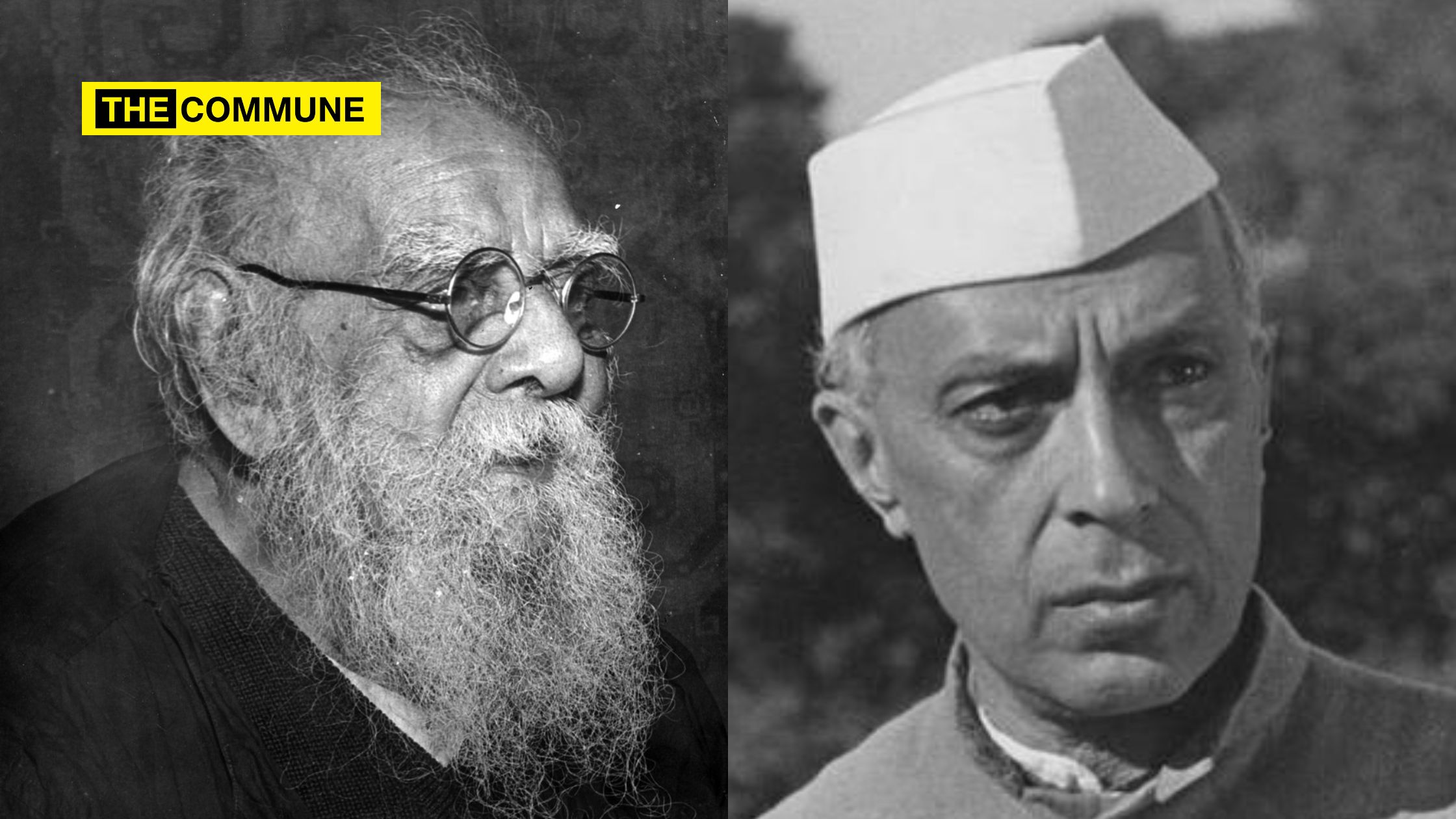
A speech delivered by Prime Minister Jawaharlal Nehru in Trichy in 1957, preserved in the Nehru Archives, contains some striking remarks on the Dravida Kazhagam’s agitation in Madras State. Nearly seven decades later, portions of Nehru’s speech remain relevant, particularly his sharp condemnation of the DK leadership’s rhetoric against the National Flag and the Constitution
On 9 December 1957, then Prime Minister Jawaharlal Nehru delivered a speech in Madras in which he launched a blistering attack on the Dravida Kazhagam (DK) agitation, accusing its leadership of promoting violence and insulting the National Flag and Constitution.
Speaking to a gathering in Madras, Nehru described the Dravida Kazhagam agitation as “one of the most remarkable and one of the most foolish agitations” he had encountered in India.
Nehru said the movement’s leader had made statements that, in his words, “cannot be forgiven and which cannot be tolerated.”
He specifically accused the DK leadership of openly speaking about murder and inviting people to kill others.
“Apart from actually talking in an unabashed manner about murder, inviting people to murder others, a thing unheard of in any civilized society, he has dared to insult the National Flag and the National Constitution,” Nehru said.
Calling these “unforgivable offences,” Nehru went further in attacking the character of the movement.
While discussing what he described as India’s varied social and historical development, Nehru contrasted the DK with India’s tribal communities.
“But I wonder if the Dravida Kazhagam in Madras is not more primitive than any primitive tribe in India because it talks in a language which is unheard of in civilized society.”
Nehru then described what he believed was the nature of the DK’s rhetoric.
“It is the language of murder. It is a language which should either lead one to the prison or to the lunatic asylum, because society cannot tolerate that language.”
He also said that no “civilized State” could tolerate a deliberate insult to the national flag and Constitution.
Nehru’s warning extended beyond the organisation’s leadership to its members. He said those who did not accept the national flag or Constitution were free to leave India.
“If anyone, if the leader or members of the Dravida Kazhagam do not like our Flag or Constitution, they are welcome to pack up and go from India to any other country they like.”
He followed this with an unequivocal declaration: “No one has a place in India who insults the Flag and the Constitution.”
Nehru stressed that he did not regard the issue as merely a dispute over Tamil Nadu politics, caste or regional interests. Instead, he framed it as a question of national unity and India’s honour.
“And this is not a question of Madras State. This is not a question of the politics of your State or the castes of your State — I want no castes in India, no classes in India — this is a question of India and India’s honour.”
He concluded with a warning that national unity had to be defended against movements advocating separation.
“And India’s honour will be defended by every Indian, wherever he may be.”
This morning, I stumbled upon Jawaharlal Nehru’s speech in Tiruchi on December 9, 1957 on The Nehru Archives (some contents of which are still relevant):
“…one of the most remarkable and one of the most foolish agitations that I am experiencing in India has recently started…
— Ramakrishnan T (@Rama_Krishnan) September 1, 2026
The remarks came during a period of intense political confrontation between the Congress establishment and the Dravidian movement in Madras State. Nehru’s speech is significant for the language he used to characterise the DK’s agitation — particularly his description of it as “more primitive than any primitive tribe” and its rhetoric as a “language of murder.”
Subscribe to our channels on WhatsApp, Telegram, Instagram and YouTube to get the best stories of the day delivered to you personally.