


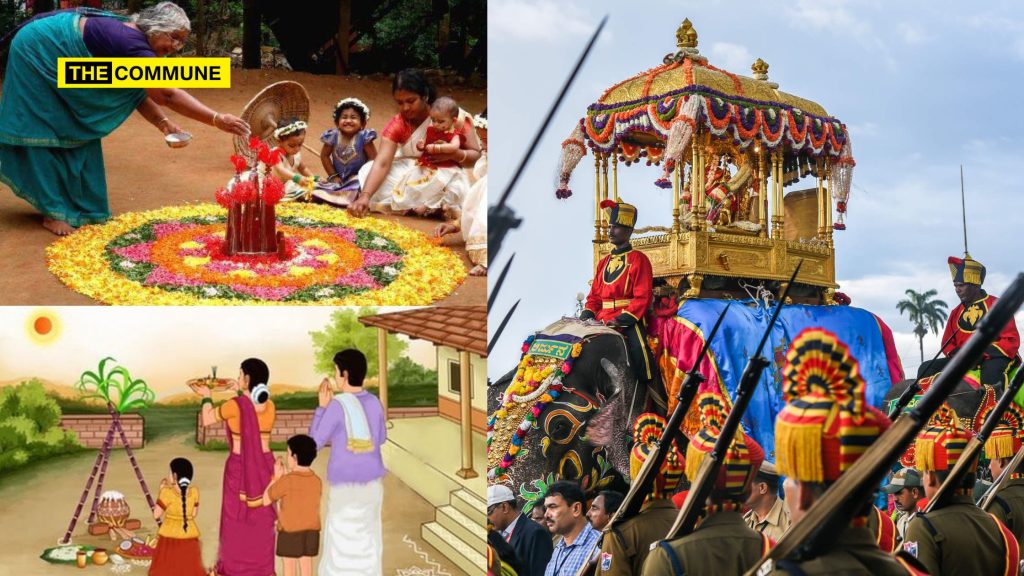
The mist-shrouded peak of Chamundi Hill has witnessed centuries of devotion. For generations, the rhythmic chants, the sacred fire of the homa, and the unwavering faith of millions have risen towards the sanctum sanctorum of Goddess Chamundeshwari, the divine protector of Mysuru. The Mysuru Dasara is not merely an event; it is the living, breathing heartbeat of a dharmic tradition, a grand narrative of the victory of good over evil that traces its lineage to the Vijayanagara emperors.
But today, a different sound echoes from the corridors of power in Karnataka. It is the sound of a deliberate, calculated dismantling.
The Congress government’s decision to have Banu Mushtaq, a Muslim author with a record of critiquing Hindu traditions, inaugurate the 2025 Mysuru Dasara is not an isolated event; it is part of a systematic secularization and distortion of Hindu festivals by a Left-Congress-Dravidianist axis bent on erasing their dharmic identity. This campaign to secularize Hindu celebrations, while painting them merely as “cultural” events, is a direct assault on India’s civilizational continuity.
Let’s examine this in detail.
Congress Decision To Invite Banu Mushtaq For Mysore Dasara Festival
The Congress government in Karnataka has chosen provocation over preservation. By inviting International Booker Prize-winning Kannada author Banu Mushtaq to inaugurate the 2025 Mysuru Dasara celebrations, it has thrown open a familiar question: Why is the political establishment so desperate to strip Hindu festivals of their dharmic identity?
Dasara is not a generic carnival. It is not just a “Naada Habba.” It is a Hindu Dharmic Utsava, rooted in the worship of Chamundeshwari Devi, the presiding deity of Mysuru. Every ritual, every procession, every symbol of Dasara points back to Devi, to the victory of dharma over adharma. The Vijayanagara kings celebrated it, the Mysuru Wadiyars revived it in 1610, and the royal family continues to lead its ceremonies. As far back as the 16th century, travellers like Domingo Paes were awed by the grandeur of Dasara – its religious core was unmistakable.
And yet, the Congress government wants us to believe that Dasara is “secular” – a cultural jamboree to be inaugurated by anyone, regardless of their faith or respect for Devi. Deputy Chief Minister DK Shivakumar even went so far as to say that Chamundi Hill and Goddess Chamundeshwari do not belong to Hindus.
By doing so, DK Shivakumar wasn’t preaching inclusivity. He was committing cultural appropriation. He was denying the very theological foundation upon which the festival stands. He was, in effect, saying that the reverence for Durga and the worship of the Devi are merely cultural artifacts, empty symbols to be filled with whatever meaning the state deems politically convenient.
In the 2023 video, Banu Mushtaq voices her sense of exclusion from Kannada cultural spaces. She says that though Kannada is celebrated as Bhuvaneshwari with flags and rituals, she as a minority woman was denied the chance to speak Kannada even at home. She likens her exclusion to seating “Kannada Amma” on a bench despite worshipping her as a goddess, calling it hypocrisy, cruelty, and a form of violence. Addressing Kannada leaders, she accuses them of sidelining her while glorifying the language through festivals and councils, stressing that her marginalisation began long ago and is now reaching completion.
The so-called Anti-Communal Task Force, the Hate Speech Bill, the Rohith Vemula Bill pushed at Rahul Gandhi’s insistence, the dubious Dharmasthala SIT, and now the Congress government’s decision to have Smt. Banu Mustaq – who has openly expressed her opposition to the worship of… pic.twitter.com/W8BqIWmfCa
— Tejasvi Surya (@Tejasvi_Surya) August 25, 2025
Chief Minister Siddaramaiah dismissed those objecting as “religious fanatics,” calling the festival a “celebration for all communities.” But the facts do not change:
The inauguration beginning with puja at Chamundi Hill is an act of worship. The royal family leading the rituals is not as a cultural performance, but as a dharmic duty.
The Kerala Blueprint: The Onam Precedent
Onam is a Hindu festival rooted in the Bhagavata Purana and other texts, commemorating the annual visit of King Mahabali, the benevolent Asura ruler, and the divine act of Bhagwan Vamana, an incarnation of Vishnu. According to Hindu scriptures, after the Devas lost their kingdom to Mahabali, Vishnu was born as Vamana to Aditi and Kashyap. During Mahabali’s Ashwamedha Yagna, Vamana asked for three paces of land. Expanding into Trivikrama, He measured the earth with one step and the heavens with another. With no space left, Mahabali offered his head, upon which Vishnu sent him to Sutala but granted him the boon of visiting his subjects once a year, celebrated as Onam.
Historical records like the 9th-century Chera copper-plates, the Malabar Manual, and writings of Francis Day, as well as Sangam literature, confirm Onam’s antiquity as a Hindu festival linked to Vishnu and Mahabali. The festival is observed with rituals, feasting (Onasadya), and cultural celebrations.
But the Left-ecosystem, in its relentless drive to create a deracinated, secular populace, systematically scrubbed it clean. Onam was stripped of its dharmic roots and repackaged as a generic “harvest festival” or a celebration of “Kerala’s culture.” The profound connection to Vamana and Mahabali was pushed to the background, replaced by boat races and flower carpets. The soul of the festival was surgically removed, leaving behind a hollow cultural shell – a template now being ruthlessly applied elsewhere.
The Secularizing of Pongal
In Tamil Nadu, the Dravidianist machinery has been working for decades on the same project. Thai Pongal, the joyous celebration of Makara Sankranti, is a pan-Indian festival of gratitude to Surya Dev, the farm animals, and the earth itself. It is Sanatana Dharma in motion—a philosophy of compassion and thankfulness towards all forces of nature.
Yet, the Dravidianist-Left cabal first rebranded it as a solely “Tamil” festival (Thirunaal), attempting to sever its bonds with the broader Hindu universe. Then came the next step: “Samathuva Pongal” or “Secular Pongal.” Churches across the state host events where the sanctity of the Sun God is replaced by the sharing of sweet pongal, transforming a sacred rite into a food festival. Imagine stripping Christmas of Christ and calling it a “Plum Cake Festival” – the absurdity lays bare the agenda.
Churches in TN celebrate the festival, often citing Vatican’s Second General Council, which endorsed adopting local cultural practices. The Catholic Church in Tamil Nadu officially included Pongal in its liturgy in the 1990s, presenting it as a festival of gratitude and unity. Preachers have justified Christian celebrations of Pongal by separating its “cultural” aspects from Hindu rituals, claiming it as a harvest festival aligned with Biblical teachings. Some equate it to Pentecost Day, while others view it as an opportunity for cultural integration.
Jallikattu, traditionally linked to Pongal, has also been incorporated into church festivities under the banner of “communal harmony” and pushed to be viewed through a purely “sporting” lens, divorcing it from its dharmic context.
Such selective appropriation reflects the missionary strategy of “inculturation”, the DMK and Church have been deliberately de-Hinduizing Pongal, stripping it of its religious essence while presenting it as a secular, cultural celebration.
The Navratri and Garba Appropriation
Even festivals like Navratri, centered on Goddess worship, face secularization attempts. The nine-night celebration honouring Devi Shakti (Mother Goddess) through various forms including Garba dance is being reframed as a “cultural” rather than religious event.
In Gujarat, Navratri begins with Aarti of Maa Amba and involves dancing (garba) around the Goddess’s idol as a form of worship. Yet “liberal” activists demand entry into Garba events for those whose faiths consider idol worship sinful, creating the absurdity of forcing Hindu religious spaces to accommodate those who fundamentally oppose Hindu practices.
Interference Into Hindu Festivals By Courts/Govts
Targeted bureaucratic restrictions such as curbs on idol heights, processions, timings, and locations or use of loudspeakers during Ganesh Chaturthi or the timing and limit to how much Hindus can burst crackers on Deepavali – such restrictions disappear and are never imposed on non-Hindu festivals.
The pattern is undeniable and repeats with mechanical precision: First, a festival’s dharmic roots are denied. Then, it is rebranded as a ‘secular’ or ‘harvest’ festival. Finally, those who object are smeared as ‘bigots’ or ‘fanatics.’ This is not inclusivity; it is erasure.
It happened with Onam in Kerala. It is happening with Pongal in Tamil Nadu. And now, it is being attempted with Dasara in Karnataka.
Why Hindus Must Resist
The controversy in Mysuru is therefore not an isolated event. It is the latest battle in a long-running war for the soul of Bharat. The breaking forces: the Left-Congress-Dravidianist ecosystem understand that to break a people, you must first break their connection to their gods, their history, and their festivals.
They want to reduce Dasara to a state-funded carnival, where the sacred rituals are mere cultural performances and the sanctum sanctorum is just a tourist spot. They want to erase the truth so eloquently stated by Mysuru’s royal scion, Yaduveer Wadiyar, that Dasara is a Hindu Dharmic festival rooted in the Shastra & Puranas.
Without Chamundeshwari, there is no Dasara. Without Vamana, there is no Onam. Without Surya Dev, there is no Pongal.
We must see this strategy for what it is: a conscious, malicious effort to secularize, sanitize, and ultimately sever our festivals from their Hindu roots. This Dussehra, as we celebrate the victory of righteousness over evil, we must also commit to protecting the very essence of our celebrations. We must reject the hollowing out of our traditions and assert, with pride and unwavering clarity, that our festivals are not mere cultural events. They are the timeless, dharmic heartbeat of a civilization that will not be silenced.
The time for polite silence is over. The theft must be called out.
Subscribe to our channels on Telegram, WhatsApp, and Instagram and get the best stories of the day delivered to you personally.