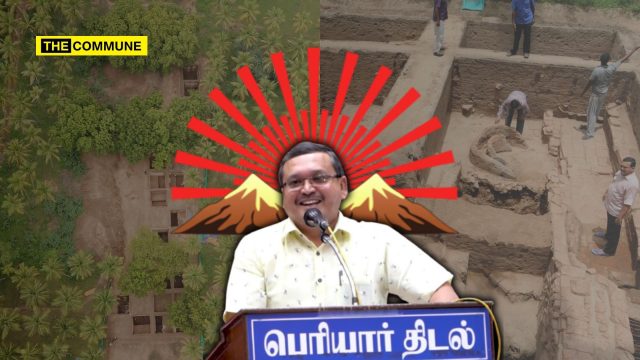
The Dravidianist ecosystem appears to be once again pushing its long-standing narrative of “North flourishes, South perishes,” this time using the backdrop of the Keezhadi excavation controversy. In May 2025, the Archaeological Survey of India (ASI) returned a 982-page excavation report submitted by archaeologist K. Amarnath Ramakrishna in January 2023, citing the need for technical revisions. The ASI raised concerns over dating estimates (like the proposed 8th–5th century BCE timeline), stratigraphic inconsistencies, mapping, and terminology.
However, instead of addressing these expert critiques and making the necessary clarifications, Ramakrishna stood his ground—defending his methodology based on stratigraphy and radiocarbon dating. This defiance has sparked suspicion. Since his excavation efforts began, Ramakrishna has increasingly aligned himself with the Dravidianist separatist discourse such as Dravidar Kazhagam platforms, often amplifying their narrative through their platforms. Rather than allowing the data to speak through rigorous peer-reviewed publication, he has been seen leveraging this issue to promote a politicized Dravidianist agenda—frequently taking aim at well-established frameworks like the Harappan civilization, and in the process, undermining academic objectivity.
But first things first. Let’s bust the DMK’s rhetoric about the Central Government denying Keezhadi’s place in history.
Is The Central Government Trying To Suppress Keezhadi Findings?
If the Dravidianist claim is that the Central Government wants to suppress Tamil heritage, then it defies logic for the very same BJP-led government under Prime Minister Narendra Modi to have unveiled a comprehensive excavation report on Adichanallur, a major Iron Age burial site in Tamil Nadu. This site has a long history of archaeological interest—beginning with Dr. Jagor in 1876, followed by more in-depth excavations by Alexander Rea between 1899 and 1905, and later by Dr. Sathya Murthy in 2004–2006. Yet, the full excavation report wasn’t released until 2020, under this very government—clearly demonstrating that detailed and peer-reviewed archaeological work takes time.
As for the current Keezhadi controversy, the Archaeological Survey of India (ASI) has explained the process clearly, “Reports submitted after excavation go through a standardized vetting process. After receiving the draft report from the excavator, it is reviewed by subject matter experts. Their recommendations—whether technical, editorial, or scientific—are passed on to the author for revision. Only after these are incorporated is the report prepared for publication, typically under the Memoirs of the ASI (MASI) series.”
This same process was followed with the Keezhadi report. ASI states that suggestions were communicated to the archaeologist K. Amarnath Ramakrishna, but he has not incorporated them to date. Despite this, a section of the media continues to push a narrative suggesting suppression one that ASI has strongly denied as misleading and politically motivated. The ASI has emphasized that no report, no matter how significant, bypasses peer review, proofreading, editing, and final formatting. To claim that ASI is deliberately stalling the Keezhadi report is a distortion of standard academic procedure, designed to politicize the issue and cast the department in a negative light.
What Were The Experts’ Concerns?
The fourth phase of the Keezhadi excavation, conducted between 2017 and 2018, unearthed 5,820 artifacts. Unlike the first three phases, which were carried out by the Archaeological Survey of India (ASI), this phase was led by the Tamil Nadu State Department of Archaeology.
However, several prominent archaeologists have raised serious questions about the report’s scientific rigor and clarity:
- Dr. Bisnupriya Basak from the University of Calcutta expressed skepticism about the dating of the pottery sherds. She questioned whether the potsherds containing Tamil-Brahmi script truly came from the same stratigraphic layer dated to the 6th century BCE. She also cautioned that some of the markings may have resulted from the pottery-making process itself, rather than being deliberate script. “This unfortunately is not clear from the report and is very crucial,” she noted, highlighting the lack of transparent stratigraphic data.
- Dr. E. Harsha Vardhan of Dravidian University, Chittoor, echoed similar concerns, stating that the report does not provide sufficient scientific basis to confidently date the Tamil-Brahmi script to the 6th century BCE. He emphasized that drawing such conclusions from a single report is premature and lacking in academic robustness.
- Dr. Prabodh Shirvalkar, archaeologist at Deccan College, Pune, also pointed out that while Tamil-Brahmi inscriptions on potsherds are not unusual in the region, the Keezhadi report is opaque when it comes to key archaeological essentials—such as the exact dating of the sherds, their layering, and the associated cultural period.
- P.A. Krishnan, a former bureaucrat, has raised critical concerns about the methodologies used to date findings from Keeladi. He argues that relying on a single carbon-dated sample—in this case, a piece of charcoal dated to around 580 BCE is not a scientifically valid basis for drawing broad conclusions about the site’s age or historical significance. He points out that carbon dating only determines when the organic material, such as wood, stopped living—not when surrounding artefacts like pottery or inscriptions were actually created or used.
Adding context, T. Udhayachandran, commissioner of the Tamil Nadu Archaeology Department, explained that the Madras High Court had expressed dissatisfaction with the delay in publishing the excavation report. As a result, the team opted to release a version that focused only on select highlights, potentially leaving out detailed contextual data that is typically critical for expert validation.
Meanwhile, instead of engaging in constructive academic dialogue or addressing the feedback from experts, Ramakrishna has chosen to align himself with the Dravidianist political ecosystem, particularly the DMK, using their platforms to promote a narrative that fits their ideological stance. His findings, instead of moving forward through proper peer review, have become stuck in a political echo chamber—echoing claims that undermine established historical frameworks like the Saraswati/Indus Valley civilization.
Why Amarnath Ramakrishna Is An Arivalayam Gatekeeper Using Archaeology For Separatist Ideology
Archaeologist K. Amarnath Ramakrishna is often portrayed as someone who has unveiled the truths of ancient Tamil society. However, even he has openly admitted that he is a product of the Dravidar Kazhagam (DK), having been ideologically shaped by the movement from his student days onward. Given this deep-rooted affiliation—as intrinsic to him as blood—it’s reasonable to question whether such a figure can approach history with objectivity or data-driven analysis.
Indeed, rather than grounding his claims in hard archaeological evidence, Ramakrishna frequently leans on rhetoric, often appealing to emotional Tamil identity politics, stirring North-South divisions, and consistently dismissing Hinduism and its epics as mere myths to deride them. A pattern of this bias is evident across many of his public interviews.
In 2023, while speaking at Dravidar Thidal, he openly declared, “Speaking at the Dravida Kazhagam, speaking on the Dravidar thidal, speaking at Periyar Thidal, is something I consider a great honor. This is because I studied in the IAS coaching class right here. As a student who trained at this center’s IAS coaching class in 1997, I always consider this a matter of great pride. At that time, Professor M.F. Khan and Professor Kaliamoorthy managed that training center. I trained there, but I couldn’t become an IAS officer. However, I got the opportunity to join the Archaeology Department. I feel proud of that position too, because the Periyar Research Center, Periyar Thidal, is a place that speaks about humanity and serves as a guide for the whole world. I am extremely proud to be associated with it. For this, I want to express my foremost gratitude.”
Right after introducing himself as someone shaped by the Dravidar Kazhagam—a group that outwardly claims to be atheist yet often engages in selective pseudo-secularism while consistently targeting Hinduism—Amarnath Ramakrishna followed suit. As a product of this ideological ecosystem, he adopted the same pattern, using his platform to mock Hindu epics, question sacred sites like Ram Janmabhoomi, and undermine Hindu traditions all while avoiding similar scrutiny but praising of other belief systems similar to marx historians.
Amarnath Ramakrishna said, “Our professor very clearly explained who first taught us history. He said it was the Muslim rulers who lived during the medieval period who taught us this history. The autobiographies they wrote at that time were our first history books. Before that, it was all Puranas. Only stories based on the Puranas were told, and no historical facts were truly presented. Even if historical truths were embedded within them, the stories were made more popular. And even today, research is based on these stories. We’re researching the Mahabharata, we’re researching the Ramayana, but we’re not getting any archaeological evidence. That’s what makes it very difficult. It’s extremely difficult. Because when we search for archaeological evidence for the stories of the Mahabharata and Ramayana, they both stand in contradiction. That is today’s surprising news. They want to construct it in some way, but it’s proving to be an impossible task. It’s something that can never be constructed, that’s my opinion. This is because it’s a story.“
He then proceeded to mock the Ram Setu (Adam’s Bridge) and dismissed the significance of archaeological efforts related to sacred Hindu sites. Speaking critically about Ram Janmabhoomi, he asserted that archaeology cannot be used to prove the birthplace of a historical figure, implying that such claims lack any scientific basis.
He remarked, “I’m not denying that a temple existed there. A temple did exist. The place referred to as Ram Janmabhoomi is an archaeological mound. On that archaeological mound, there was a temple built in the 9th century. What we’ve found are parts of that temple, but there is no evidence whatsoever that Rama was born in that exact spot. That is the truth. Scientifically or archaeologically, it is impossible to prove that any individual was born in a specific location for any reason. I can’t say I was born here. There’s no evidence to prove I was born in this specific place. It might be recorded in oral tradition and literature, but archaeologically, we cannot retrieve any such evidence. However, temples did exist there. Those temples were from the 9th and 10th centuries. Based on the existence of those temples, our Supreme Court also delivers its verdict that temples were there. Therefore, the verdict is given that it is Ram Janmabhoomi.”
Then peddling Marx-historian theory he added, “The period when the religion called Hinduism developed was during the Gupta period. Before the Guptas, there was no prominence for Hinduism. If you look at that time, we would refer to it as the Brahmanical religion. It was the Brahmanical religion, the Vedic religion, that existed in India; there was no name like ‘Hinduism’. The name ‘Hinduism’ was given by the British. Before Hinduism, Buddhism and Jainism flourished here, and that is the absolute truth. We must ask why Buddhism and Jainism flourished here. We need to understand the reasons for their proliferation.”
In 2019, archaeologist K. Amarnath Ramakrishna attended a conference at the Annai Maniammai Hall in Chennai, a venue often associated with Dravidar Kazhagam events. During his speech, he appeared to use the platform to ridicule Hindu epics like the Mahabharata and Ramayana, commenting on ongoing efforts to locate and connect archaeological sites with these texts. He remarked dismissively, “In the North, they’re searching for sites related to Mahabharata and Ramayana. They won’t find them, but it’s a myth.”
He said, “We’ve been saying that our Tamil Nadu is a semi-tribal civilization. They used to claim there were no urban structures here, no governance, no monarchy. They’d say everything mentioned in your literature, in Sangam literature, was mere imagination. But no, that’s not the case. My opinion is that for almost 70 years, we haven’t done proper work in Tamil Nadu. For 70 years, no one has undertaken any work with a research objective. We’ve been speaking emotionally everywhere. We’ve been speaking emotionally about our language, without any basis or evidence to support our claims. Look even now, in the North, they’re searching for sites related to Mahabharata and Ramayana. They won’t find them, but it’s a myth. However, they are searching, searching, searching, and there’s even an effort to link them. But what can we do about all that? Because our Sangam literature is a people’s literature. It’s literature that talks about the lifestyle of the people. But there hasn’t been proper research about it. If you ask in Tamil Nadu, they’ll say we’ve only excavated burial sites. They’ve excavated almost 150 to 170 sites, all of them burial sites. In all these burial sites, you’ll only find evidence of a burial ritual, but you won’t know anything about how people lived, not a single system.”
Tamil Sangam texts can't be imaginary, as they claim, we haven't studied them, we only have emotional approach abt our language!"
"Even now in North, they are digging Ramayana & Mahabharata sites, but they can't find anything, bcoz they are myths".
Says Amarnath Ramakrishna.. pic.twitter.com/UR7nD73aH5
— Ethirajan Srinivasan 🇮🇳🚩 (@Ethirajans) October 9, 2019
In another Q&A session, an elderly participant asked a thoughtful question, “I’d like to know the similarities and differences in religion between the Indus Valley Civilization and Keezhadi Civilization?”
Archaeologist K. Amarnath Ramakrishna gave a curt reply, saying, “If you ask about things that aren’t available, how can I tell you? Because in the Indus Valley too, we only assume. That’s all.”
He then shifted into a narrative often associated with Western Marxist historians, downplaying any potential religious or cultural continuity with Hindu traditions. He said, “Was there a religion? Actually, in the Indus Valley Civilization, what we call ‘lingam’ is a symbol of a fertility cult. Similarly, there was Mother Goddess worship. But how can we confirm? We don’t have any concrete evidence like inscriptions to confirm. Similarly in Keezhadi also. Both are legacy. We have to try to find out, don’t, don’t poke the nose for searching of religion. It’s not needed. For us, culture means religion is one component of culture. Religion developed later. Let’s look at humanity first.” His core argument seemed to imply that neither the well-documented Indus Valley Civilization nor the Keeladi site contained any symbols or artefacts that could be associated with Hinduism, thereby rejecting any continuity between these ancient cultures and later Indic religious traditions.
He added, “Fear itself is devotion. Nothing else. From the day man came into existence and started to fear, that’s when it turned into devotion. We created that too. Religion was created by us; it didn’t come from anywhere. But when we look at historical records, these things came later.”
"God never made Tamil World"
Our @balakrishnan_28 Sir and Amarnath Ramakrishna Sir are our real pride… pic.twitter.com/CjgL2Bb3Cv
— Social Justice Forum (@SJForumindia) March 17, 2025
“We Shouldn’t Approach History From Indian Perspective”
Amarnath Ramakrishna views Indian history through the ideological lens of the Dravidar Kazhagam which is nothing but a separatist Nazi-style racial view of history.
He objects to a unifying Indian view of history saying that this was a land inhabited by different people of different identities.
“The different identities that we get through archaeological evidence should be separated and analyzed. Instead if we try to unite them, the resulting distortions in history will be a historic distortion. It will be contradictory to history.”, Amarnath says.
He further goes on to say, “We call ourselves as Indians today. Our view is that we shouldn’t approach history from an Indian perspective. We should approach history from a human perspective here,” which naturally limits his objectivity and data-driven approach.
Just as the Dravidar Kazhagam continues to promote dubious claims—such as branding E.V. Ramasamy Naicker as the “South-east Asian Socrates”—Ramakrishna too seems more invested in narrative-building than evidence-based scholarship. The real obstacle, therefore, is not the academic process itself, but a wilful refusal to engage with it honestly, turning what should be a rigorous archaeological inquiry into a politicised performance.
Peddling Aryan Vs Dravidian Narrative
Much like the Nazi obsession with glorifying a “pure” Aryan race, Amarnath Ramakrishna seems to be reading from the Dravidia(Nazi) playbook—only this time, trying to glorify a so-called “pure Dravidian race.” Speaking at the “Dravidian Historical Research Centre” at Periyar Thidal, one moment he claims that the Indus Valley Civilization was created by the Dravidian tribes. A few minutes into the same speech, he claims that the Indus Valley Civilization was built by people with ancient Ancestral South Indian (ASI) DNA mixed with Iranian farmer ancestry. But he doesn’t seem to realize the obvious contradiction: if it was a mix, how can it be a pure Dravidian race? In trying too hard to separate Tamil history from the rest of India, he ends up making no sense—even by his own logic.
He tries very hard to drive the Aryan vs Dravidian narrative, saying that the burial practice of Aryans is different from Dravidians—claiming that Aryans burn their dead while Dravidians bury them. The fact is, most prehistoric communities across the world practiced burial, and cremation evolved gradually over time with deeper religious, philosophical, and cultural developments. Even within ancient India, both practices coexisted depending on region, belief system, and caste. To reduce a complex evolution of funerary rites into a rigid racial binary is not only historically inaccurate, but also a deliberate distortion aimed at reinforcing separatist identity politics rather than genuine scholarship.
Is There A Hidden Agenda Behind The Keezhadi Excavations?
There appears to be cause for concern. Dr. B.S. Harishankar, a respected archaeologist and member of the Academic Committee at the Indian Institute of Advanced Study (Shimla), has alleged that the archaeological findings at Keezhadi are being manipulated. According to him, certain ideologically driven individuals, NGOs, and political figures are working to fit Keezhadi into a pre-determined narrative, even at the cost of tampering with or suppressing evidence.
Dr. Harishankar specifically names Father Jegath Gasper Raj—a Catholic priest and founder of the NGO Tamil Maiyam—as a key figure involved in influencing the excavation. Gasper Raj is known to be close to DMK MP Kanimozhi. U.S. security analysts Douglas C. Lovelace Jr. and Siobhan O’Neil have identified him under the name Gaspar Raj Maria Paulian in official crime records, accusing him of aiding the LTTE, which is classified by the U.S. State Department as a Foreign Terrorist Organization.
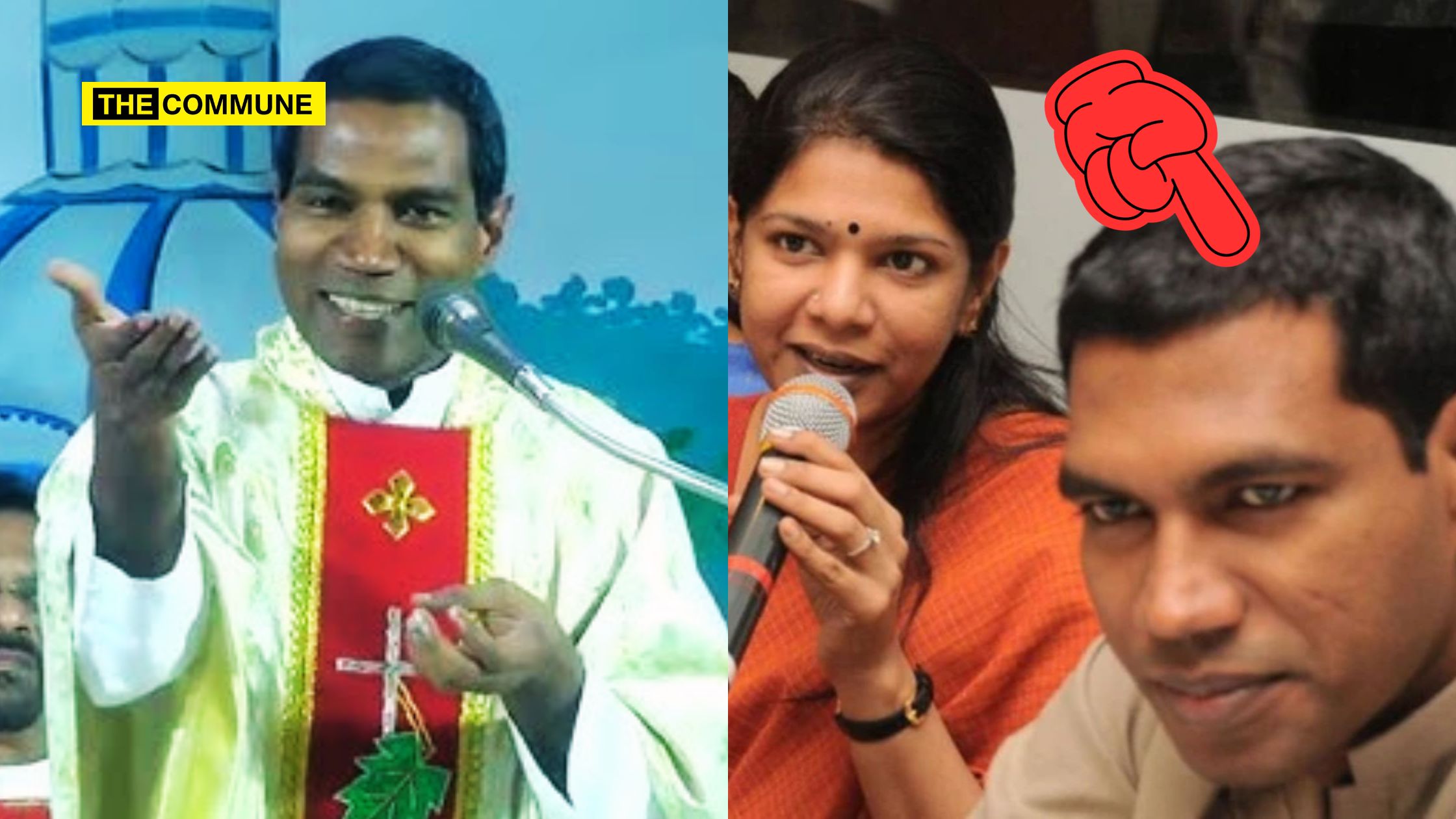
Dr. Harishankar alleges that Tamil Maiyam, with DMK backing, has interfered in the Keezhadi project. Notably, Kanimozhi and Gasper Raj were among the first to arrive at the excavation site after initial findings were announced. It was Kanimozhi who approached the Madras High Court to block the Archaeological Survey of India (ASI) from transferring samples to its authorized labs. This stay was only lifted after the ASI presented the necessary documentation.
According to Dr. Harishankar, the standard excavation protocols have been violated at Keezhadi. He points out that even Dr. T. Satyamurthy, a former Director of ASI and a senior archaeologist, was denied access to examine the findings. “Why such secrecy,” he asks in his detailed paper titled Global Interventions in Keezhadi Excavations, “when excavations across India are usually transparent?”
He warns that these efforts appear aimed at constructing a narrative of a separate “Dravidian civilization”, designed to fuel separatist sentiment. He also criticizes the decision to send Keezhadi samples abroad to Beta Analytics in the U.S., despite India having reliable carbon-dating facilities. “They seem to be pushing for distinct genetic findings to assert a separate Dravidian identity, which could then be used to justify secessionist politics,” he claims.
Dr. T. Satyamurthy, backing Dr. Harishankar’s observations, has called the entire process at Keezhadi suspicious and in need of investigation, stating plainly that “history should not be manufactured or assembled.”
An intelligence source tracking foreign funding has further claimed that Tamil Maiyam has received large amounts of international funds, allegedly intended to support a secessionist movement under the Keezhadi banner, with DMK support. The same source suggests that Christian theologists have entered the excavation sphere, mirroring earlier controversies such as the Pattanam site under the Muziris Heritage Project, which faced criticism for allegedly distorting South Indian history.
Prof. C. Issac, a member of the Indian Council of Historical Research (ICHR), has also expressed concern. He warns that if certain historians and groups succeed in linking Keezhadi with sites like Pattanam and ancient Rome, the entire historical narrative of the region could be altered. He further adds that the Tamil Nadu government’s move to establish a Keezhadi museum is part of a broader Dravida Nadu agenda long championed by the DMK.
Amarnath Not Excavating History But Sowing Seeds Of Separatism
When excavation becomes excavationism—driven not by science but by sectarian and political purpose—it risks eroding public trust in both archaeology and historiography. Keezhadi, under the stewardship of those with overt ideological leanings and political patronage, threatens to become less a discovery and more a dangerous tool of identity engineering.
The real question is no longer about carbon dates or pottery shards, but about who controls the narrative—and for what end.
Keezhadi is being transformed from an archaeological site into an ideological weapon—used not to illuminate the past, but to redraw cultural and political boundaries. Far from fostering unity, the DMK’s narrative risks deepening divisions and reviving fault lines long buried, all in the name of Dravidian racial supremacy
Subscribe to our channels on Telegram, WhatsApp, and Instagram and get the best stories of the day delivered to you personally.