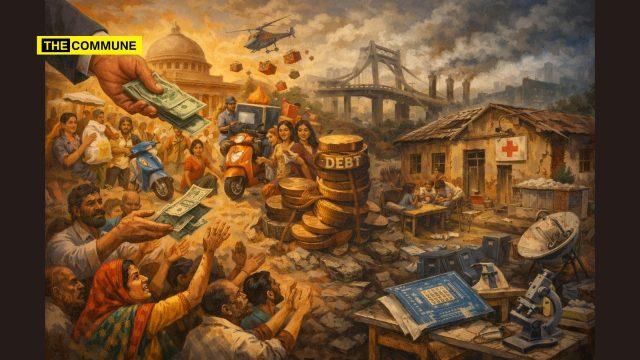
India is borrowing money to give it away and the bill is coming due in sectors that actually build nations: research, infrastructure, health, and education.
The Freebie Explosion Is Documented
This is not an opposition talking point. India’s own Economic Survey 2025-26, tabled by Finance Minister Nirmala Sitharaman, is the source. State-level unconditional cash transfers (UCTs): free cash with no conditions, no outcomes, no accountability, ballooned more than fivefold between FY23 and FY26, reaching ₹1.7 lakh crore this year alone. At least half the states running these schemes are already in revenue deficit – meaning they are borrowing money to give it away
What Is Being Sacrificed: The Numbers
India spends more on food subsidy alone (₹2,28,154 Cr) than on all of education (₹1,28,650 Cr) at the central level as of 2025. India’s R&D investment at 0.64% of GDP is less than one-fifth of South Korea’s, less than one-third of China’s.
- US: 3.48%
- China: 2.43%
- S.Korea: 4.91%
These are not abstract statistics – they represent the gap between a nation building its future and one consuming it.
The Fiscal Trap States Are Falling Into
The Economic Survey explicitly warns: “Unless deficits widen further, additional spending will crowd out resources for critical social and physical infrastructure”. The numbers back this up:
- States’ combined fiscal deficit has risen from 2.6% of GDP in FY22 to 3.2% in FY25
- 62% of state revenues are already locked into salaries, pensions, interest payments, and subsidies leaving barely a third for anything developmental
- 16 states have budgeted a gross fiscal deficit exceeding 3% of GSDP for 2025-26; 13 states exceed 3.5%
- States’ outstanding debt stands at 28.1% of GDP and a significant share of that debt is financing consumption, not assets
Thus, excessive spending on freebies reduces the funds available for essential infrastructure by shifting resources away from long-term capital investment.
What Productive Spending Looks Like – And Why India Isn’t Doing It
Brazil’s Bolsa Família, the model the Economic Survey itself recommends India study, gives conditional cash transfers: you receive support only if your children attend school and complete health check-ups. The outcome: human capital is built simultaneously with welfare delivery. India’s UCTs attach no such conditions. Cash goes out, nothing comes back.
The result is what the Survey describes as welfare that “substitutes rather than complements” investment in skilling, nutrition, and infrastructure. You get a vote. The state gets a deficit. The child gets neither a good school nor a good road.
The R&D Gap Is a National Security Issue
India’s ₹33,337 Cr R&D budget, already embarrassingly small, is now being further squeezed. The Economic Survey flags that India’s 0.64% of GDP R&D spend sits far below the global average, with the private sector contributing only 41% compared to 75-79% in the US, China, and South Korea. Meanwhile, the government has announced a new ₹1 lakh crore RDI Fund over six years, but this ambition sits in direct tension with the fiscal space being consumed by unconditional transfers every single year.
You cannot build semiconductor fabs, quantum computing capacity, and green hydrogen infrastructure on the fiscal scraps left after the freebie bill is paid.
The Bottom Line
The Economic Survey 2025-26, the Indian government’s own economic document, puts it plainly: “The expansion of unconditional cash transfers across several states has contributed to rising revenue expenditure, with implications for fiscal space and public investment at the state level.”
India is not too poor to invest in education, R&D, healthcare, and infrastructure. It is choosing not to – one election cycle at a time. Freebies win votes in the short term. They cost nations in the long term. The data is in. The question is whether any politician is willing to say it out loud.
Subscribe to our channels on WhatsApp, Telegram, Instagram and YouTube to get the best stories of the day delivered to you personally.