Across India today, a familiar anxiety is resurfacing.
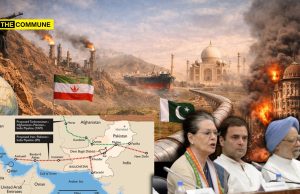
The war involving Iran has rattled global energy markets. Oil prices have climbed. LNG spot prices have spiked. Governments are watching fuel supplies closely. Analysts are asking how long the volatility might last.
India is not in a fuel shortage yet. Petrol pumps are not running dry, yet. Cooking gas cylinders are still reaching homes. But the conversation has changed.
Suddenly everyone is talking about energy security.
Television panels are asking why India still imports so much oil and gas. Social media threads are questioning why the country has not become “Atmanirbhar” in energy despite years of political promises. Critics of the Modi government are asking the same pointed question again and again:
Where are India’s domestic energy sources?
It is a fair question.
But it has a deeply inconvenient answer.
Because the truth is this: many of the domestic energy projects that could have strengthened India’s position were proposed years ago, especially in Tamil Nadu that were ultimately killed by protests.
Here is an example:
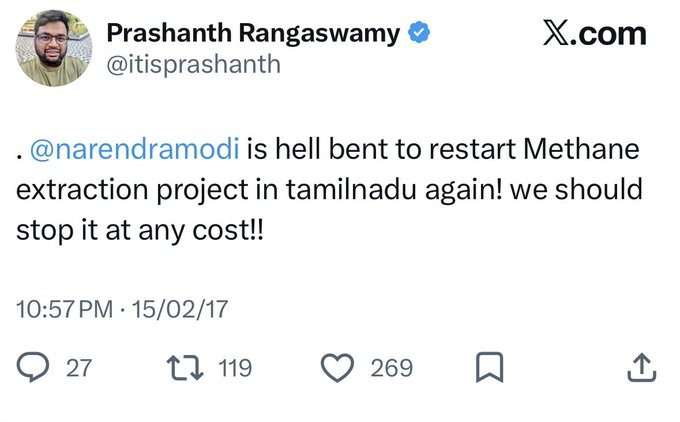
The Plans That Were Actually Proposed
In the mid-2010s, the Union government began pushing a policy aimed at expanding domestic hydrocarbon production. Under the Discovered Small Fields policy, oil and gas reserves identified but left undeveloped were opened for exploration and extraction.
One of the locations selected was Neduvasal in Pudukkottai district, part of the Cauvery basin – a region known for hydrocarbon reserves.
The logic was simple: India imports most of its oil and a large share of its natural gas. Developing smaller domestic reserves would not eliminate imports, but it could reduce vulnerability to global price shocks.
And Neduvasal was not the only effort.
The Mannargudi coal-bed methane belt had been identified as a potential source of domestic gas. And the GAIL Kochi–Koottanad–Bengaluru–Mangaluru pipeline was designed to transport LNG into southern industrial hubs, linking the Kochi terminal to districts across Tamil Nadu and Karnataka.
How Each Plan Was Buried
The Mannargudi Methane Project – 2016.
Protest networks mobilised across the Cauvery delta, flooding public discourse with fears of fracking contaminating groundwater. The Tamil Nadu Assembly passed a resolution against it. The Centre, caught in the political crossfire, cancelled exploration permits. Union Petroleum Minister Dharmendra Pradhan confirmed the cancellation on 10 November 2016. India’s most promising CBM belt, a 691 sq km block in Tiruvarur district, went silent. The gas stayed underground.
The Neduvasal Hydrocarbon Project – 2017 to 2020.
On 15 February 2017, the Cabinet Committee on Economic Affairs under PM Modi approved hydrocarbon extraction in 31 contract areas including Neduvasal. The agitation that erupted borrowed its energy from the Jallikattu movement — night vigils, celebrity endorsements, viral hashtags. The activist ecosystem around Thirumurugan Gandhi and his May 17 Movement was deeply embedded in the broader anti-extraction agitation across Tamil Nadu during this period, consistently opposing every Modi government energy initiative in the state. Not once did the protest leadership present an alternative energy plan. Not once did they disclose the tradeoff they were making on behalf of 80 million Tamil Nadu residents. By 20 February 2020, the Tamil Nadu government passed the Protected Agricultural Zone Act – permanently sealing the entire Cauvery basin’s hydrocarbon reserves behind a legislative wall. Celebrated as a victory for farmers. Recorded in history as the day Tamil Nadu locked away its own energy future.
The GAIL Pipeline – 2021.
Not a drilling project. Not an extraction operation. Just a pipe, carrying gas from Kochi into Tamil Nadu’s industrial districts. The same protest machinery mobilised again. A 70-foot pipeline right-of-way through agricultural land was declared a civilisational threat. Court petitions were filed. Political pressure mounted. The pipe that runs through nearly every other major Indian state, sanctioned by the Government of India as far back as 4 April 2011 stopped at Tamil Nadu’s border because the state government would not allow it through farmland.
Three plans. Three funerals. Conducted by the same people now asking where the plans are.
The Activists at the Centre
One of the most visible figures in these movements was Thirumurugan Gandhi, founder of the separatist May 17 Movement.
He played a prominent role in mobilising opposition to hydrocarbon projects across the Cauvery delta. Activist networks circulated campaign material, organised protests and amplified fears about environmental damage.
To supporters, these movements represented resistance against environmentally risky industrial projects.
To critics, they represented something else: a protest culture that opposed energy development without offering alternatives.
And that debate has returned today because the context has changed.
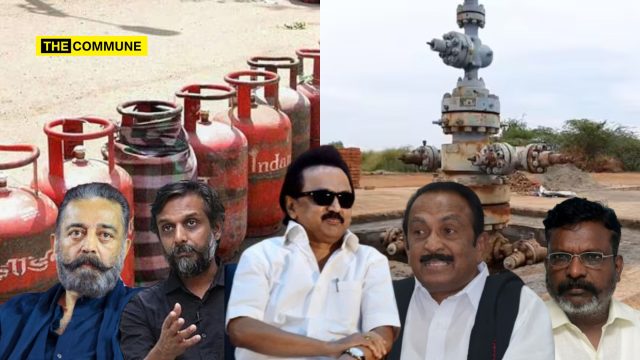
The protests were not sustained by activists alone. Key political leaders in Tamil Nadu quickly aligned themselves with the agitation. M. K. Stalin, Thol. Thirumavalavan, Kamal Haasan and Vaiko publicly opposed the Neduvasal hydrocarbon project, warning it would destroy the Cauvery delta’s agriculture. Their endorsements transformed what began as local resistance into a full-fledged political campaign against hydrocarbon exploration in the region.
The Convenient Amnesia of the Naysayers
Today, ‘critics’ are asking a familiar question: why has India not become energy self-reliant?
But there is an inconvenient fact they rarely mention.
In Tamil Nadu, they had names.
Neduvasal.
Mannargudi.
The GAIL pipeline.
These were not vague policy ideas. They were surveyed, funded and ready to execute.
And they did not die in Delhi.
They died at protest barricades.
Each project became a political target.
When Delhi proposed gas extraction, it was framed as “stealing Tamil land.”
When Delhi funded a pipeline, it was described as “destroying Tamil farms.”
The slogans changed. The outcome did not.
Block the project.
The Dravidianist media ecosystem amplified the protests, elevated activists into public heroes, and rarely asked the question that should have been unavoidable:
If not this, then what?
Where would India’s energy come from?
The Cost of Those Decisions
That question has returned in 2026.
India imported nearly 27 million tonnes of LNG in 2024, accounting for roughly half of its natural gas consumption. Global price volatility now directly affects domestic energy costs.
Petronet LNG has already issued force majeure notices to some buyers as supply tightens amid the Iran conflict.
The Question That Must Be Asked Loudly
So the next time someone posts an outraged thread asking why India has no domestic energy alternative – why we are still import-dependent after 10 years of Modi, ask them this:
Where were you in 2016 when the Mannargudi methane project was cancelled?
Where were you in 2017 when Neduvasal was blockaded?
Where were you in 2021 when the GAIL pipeline was stopped?
Were you at the barricades? Were you sharing the protest hashtags? Were you cheering the legislative ban as a victory for Tamil farmers?
Then you don’t get to ask where the plan went. You were the reason the plan died.
Atmanirbhar Bharat in energy was not just a slogan. In Tamil Nadu, it had coordinates – Neduvasal, Mannargudi, the GAIL pipeline corridor. It had engineers. It had funding. It had a timeline.
What it didn’t have was permission. Because permission was denied – loudly, repeatedly, and triumphantly, by the same voices that are today demanding to know why nobody planned ahead.
Who Killed India’s Domestic Energy Plans?
The Iran war is the trigger of a crisis, not the cause. The cause was built over years of systematically dismantling every domestic energy option that came within protest range – dressed up as farmer protection, environmental activism, and Tamil pride.
The gas is still underground.
The pipeline was never built.
The import bills keep climbing.
And the people who made these choices are still talking.
The activists who blocked these projects, led by figures like Thirumurugan Gandhi, helped ensure that those plans never saw the light of day. They cheered when the ban passed, they helped create the situation India now finds itself in.
Because right now, every Indian filling a cylinder, every farmer paying for diesel, every factory absorbing higher energy costs is living inside the consequence of those celebrated the protests.
The plan existed. Those ‘activists’ killed it. Now the same mouths are asking where the plan is.
Subscribe to our channels on WhatsApp, Telegram, Instagram and YouTube to get the best stories of the day delivered to you personally.