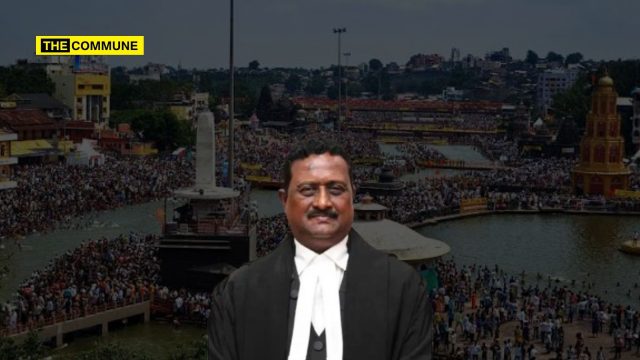
Supreme Court judge Justice Prasanna B Varale has raised concerns over the declining education budget and the closure of Marathi-medium schools in Maharashtra, saying that a fraction of the money allocated for the Nashik-Trimbakeshwar Simhastha Kumbh Mela could have helped save several of them, as reported in NDTV.
Speaking at the inauguration of ‘smart classes’ at a high school in Dhule district, Justice Varale said that 0.1 per cent of the expenditure allocated for the Kumbh could have been enough to prevent the closure of 100 to 125 Marathi-medium schools.
SC JUDGE PRASANNA VARALE: 0.1% OF KUMBH SPENDING COULD HAVE SAVED 125 MARATHI SCHOOLS
This “virtue signaling” will be applauded as some thing profound.
BUT WHY MANUFACTURE A FALSE CHOICE BETWEEN HINDU FAITH AND EDUCATION.
Crores flow into India every year for proselytisation… pic.twitter.com/7gfKc3Zxaz
— Rahul Shivshankar (@RShivshankar) August 25, 2026
The judge pointed out that the government allocates between ₹32,000 crore and ₹34,000 crore for the Kumbh Mela and around ₹11,000 crore for corridor projects. According to him, spending just 0.1 per cent of the Kumbh allocation, approximately ₹32 crore, could have helped save 100 to 125 Marathi-medium schools across the state that have shut down.
Justice Varale also spoke about his own education, noting that he studied up to Class 10 in municipal and Zilla Parishad Marathi-medium schools.
He said that studying in the regional language had never hindered his career and had instead broadened his perspective.
Speaking to NDTV later, Justice Varale said, “I have expressed what I truly feel in my heart.”
He added, “Children are the future of the country… Essential facilities must be provided for children in schools. Primary education and healthcare are fundamental rights of every citizen.”
The judge also expressed concern over the state’s education spending, noting that despite an increase in the student population, the education budget had continued to shrink instead of increasing. He pointed out that the allocation had failed to reach even 13 per cent for several years.
He cited the poor condition of rural schools and referred to an incident in which three female students at a school associated with a religious institution died from snakebites after being forced to sleep on the floor due to inadequate facilities.
But Why Pit Hindu Faith Against Education?
However, the comparison between education spending and expenditure on a Hindu religious festival raises a larger question: why manufacture a choice between Hindu faith and education?
Crores of rupees enter India every year through foreign and domestic funding for religious and proselytisation activities. If the argument is that religious expenditure should instead be redirected towards education, the same scrutiny should apply across religious communities, not only when the expenditure concerns a Hindu festival.
If Marathi-medium schools are closing, the immediate question should be why they are closing.
Declining enrolment, inadequate infrastructure, teacher availability, parental preference, administrative decisions and the wider shift towards English-medium education are structural issues that need to be addressed.
A Kumbh Mela expenditure figure does not explain why a Marathi school shuts down. Nor does reducing expenditure on a religious festival automatically solve the structural problems affecting government schools.
Justice Varale’s concerns about children’s education and basic school facilities deserve attention. But education should not be presented as being in competition with Hindu religious and cultural traditions. The State can and should provide both.
Subscribe to our channels on WhatsApp, Telegram, Instagram and YouTube to get the best stories of the day delivered to you personally.