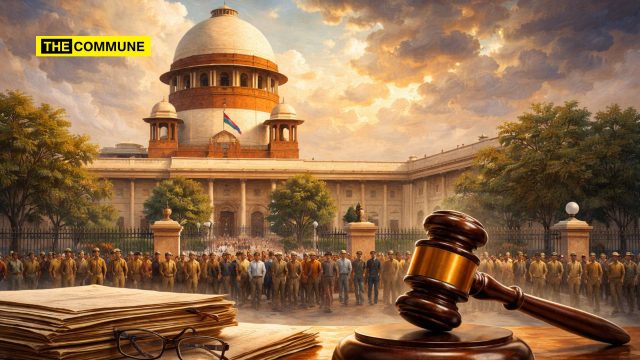
On 9 February 2026, the Supreme Court of India delivered a clear, unambiguous message to all state governments and especially to West Bengal that the integrity of India’s electoral process is non-negotiable. In ruling that there can be no obstacles to the Special Intensive Revision (SIR) of electoral rolls, the apex court reaffirmed a foundational principle of the Republic: free and fair elections are not subject to the whims of state executives or partisan convenience.
A bench led by Chief Justice Surya Kant, along with Justice Joymalya Bagchi and Justice Vipul M Pancholi, categorically rejected attempts to stall or dilute the SIR exercise. While granting West Bengal a limited one-week extension pushing the deadline from 14th February the Court made it abundantly clear that this was an accommodation, not a concession to obstructionism. “We will not allow any impediment to the SIR process,” Chief Justice Kant declared, adding that this must be understood by all states.
This statement gains particular significance in the context of the sustained resistance mounted by the Mamata Banerjee-led Trinamool Congress (TMC) government. The Chief Minister herself approached the Supreme Court, alleging that the Election Commission of India (ECI) was “targeting” Bengal and that the SIR exercise was designed to “bulldoze” the Bengali people. Such rhetoric, while politically emotive, collapses under legal and constitutional scrutiny.
At its core, the SIR process is neither an act of exclusion nor a political vendetta. It is a routine, but critical exercise aimed at cleaning electoral rolls removing duplicate entries, correcting discrepancies, and ensuring that only eligible voters are registered. In a democracy of India’s scale, especially in states with a long history of electoral malpractices and political violence, such revisions are not optional extras; they are essential safeguards.
The Supreme Court’s sharp questioning of the West Bengal government exposed a troubling pattern of delay and non-cooperation. Chief Justice Kant openly questioned why the state sent the names of over 8,000 Group B officers at midnight on 7th February, when clear directions had already been issued on 4th February. He also asked why there was a delay in providing officers to replace micro-observers, a move that could have been “approved” had it been done in time.
The Election Commission’s submissions were even more damning. According to its affidavit, the Bengal government was repeatedly unresponsive despite five formal letters outlining the requirement for experienced officials to act as Electoral Registration Officers (EROs). Out of nearly 300 officers demanded, only 64 with appropriate adjudicatory experience were provided. Given that EROs perform quasi-judicial functions deciding claims and objections this shortfall is not a procedural lapse but a substantive threat to electoral fairness.
Unable to secure adequate cooperation, the ECI exercised its constitutional authority to deploy micro-observers. This, too, was projected by the state government as an intrusion, despite the fact that micro-observers merely assist the process and do not issue final decisions. The Court clarified this distinction, reinforcing that the ECI’s actions were well within the bounds of law and necessity.
Perhaps the most serious aspect of the case was the Election Commission’s expressed concern over violence and intimidation. The Supreme Court’s decision to seek a personal affidavit from the Director General of Police speaks volumes about the gravity of the situation. West Bengal’s recent electoral history from panchayat polls marred by bloodshed to repeated allegations of voter intimidation provides ample context for these concerns.
Mamata Banerjee’s claim that the SIR process is “solely for elimination and not for inclusion” is a classic case of political misdirection. The same political establishment that has often been accused of facilitating illegal migration, nurturing ghost voters, and weaponizing demographics for electoral gain now seeks to cloak administrative scrutiny as cultural or ethnic victimisation.
This narrative is not only misleading but dangerous, as it undermines public trust in constitutional institutions.
The ECI’s affidavit pulls no punches. It accuses the Bengal government of “conscious and systematic efforts” to thwart the SIR exercise through “proper planning and concerted action.” The language is severe, but the circumstances warrant it. When a state government, ruling party members, and sections of the administration appear to act in concert to frustrate a constitutionally mandated process, it raises serious questions about democratic accountability.
The Supreme Court’s intervention, therefore, is not merely a procedural correction it is a constitutional course correction. By asserting that no state can impede the SIR process, the Court has reinforced the supremacy of the Constitution over political expediency. It has also sent a broader message: federalism in India does not mean feudal autonomy, and states cannot behave as electoral fiefdoms.
In an era where democratic institutions are routinely politicised, the judiciary’s firm stance is reassuring. The Election Commission, often accused sometimes unfairly of overreach, has in this instance acted squarely within its mandate to protect the sanctity of the vote. The Court’s backing strengthens its hand and restores institutional balance.
Ultimately, this episode is about more than West Bengal. It is about whether India will allow electoral processes to be sabotaged under the guise of regional sentiment and political victimhood. The Supreme Court has answered that question decisively. Democracy, it has reminded us, cannot be negotiated, delayed, or diluted least of all by those sworn to uphold it.
Dr. Prosenjit Nath is a techie, political analyst, and author.
Subscribe to our channels on WhatsApp, Telegram, Instagram and YouTube to get the best stories of the day delivered to you personally.