


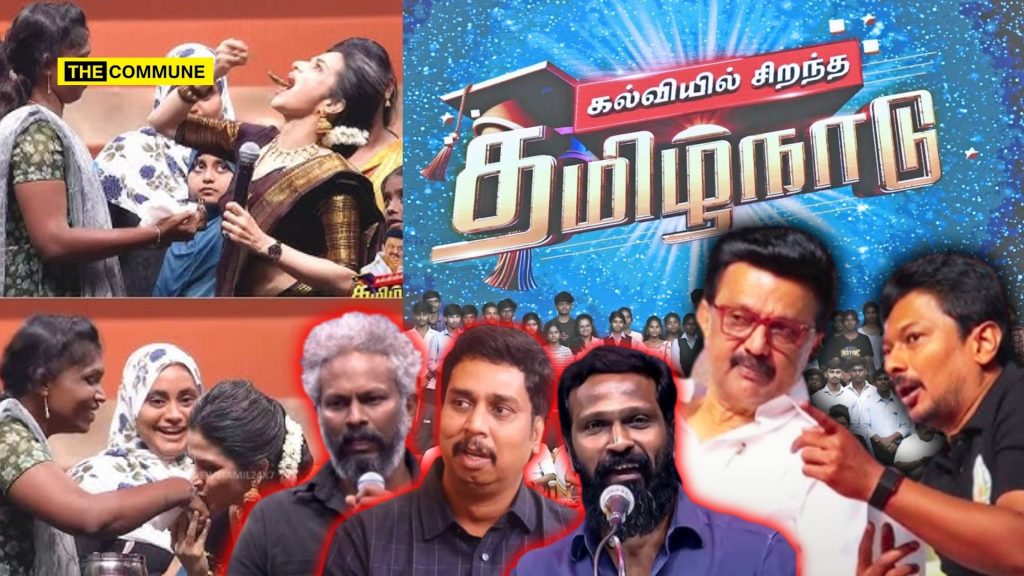
The DMK government’s latest showpiece event, ‘Kalviyil Sirantha Tamil Nadu’ (Tamil Nadu That Excels In Education), held on 25 September 2025 in Chennai, has come under widespread criticism for functioning less as a serious policy discussion on education and more as a glorified publicity campaign ahead of the 2026 Assembly elections. What was ostensibly an event to highlight educational progress in the state instead turned into a stage-managed performance dominated by film personalities singing lavish praise on the Chief Minister and promoting Dravidian ideological talking points with not a single academic, educator, or policy expert in sight.
While the event was positioned as a celebration of schemes like the Chief Minister’s Breakfast Scheme, Naan Mudhalvan, and Pudhumai Penn–Tamil Pudhalvan, the reality was far removed from genuine discourse. The lineup featured actors and directors such as DMK stooge filmmaker Vetrimaaran, Hate-Peddling Dravidianist director TJ Gnanavel, Sivakarthikeyan, Mysskin, and Thiagarajan Kumararaja, alongside Education Minister Anbil Mahesh, Deputy CM Udhayanidhi Stalin, and Telangana CM Revanth Reddy. The event was less about policy, and more about theatrics.
Performative Praise And Manufactured Sentiment
The tone-deaf extravagance peaked with television host Dhivyadharshini (DD), whose performance bordered on parody. In a cringe-inducing segment, DD gushed over the quality of sambar served as part of the Breakfast Scheme, like it was a food from Tamil Nadu’s popular restaurant chain. Her exaggerated delight complete with dramatic expressions and staged spoonfuls of sambar offered to ministers seemed especially hollow when contrasted with frequent reports of poor food quality in government schools.
One cook who spoke at the event claimed, “I’m the cook at the school. All three of my kids study there. For Pongal items, at home, we only use whatever vegetables we have. But at the school, it’s not like that. The government gives me all the supplies, so I can cook everything properly without any shortages. You’d like to taste it?”
Responding enthusiastically, Dhivyadharshini exclaimed, “Is there any? Please give me some, ma’am. Oh my! I never expected to get such a delicious sambar at this event. Come, ma’am. Let’s try it. Come here. Come to the center. So, is the sambar good? I hope I don’t faint. How is this morning breakfast sambar?”
Some of the students chimed in with excitement, saying, “It will be super.” To that, Dhivyadharshini reacted, “One is saying it will be like wedding sambar!” At this point, another woman interjected to add, “We serve sambar five days a week at the school.”
Dhivyadharshini appeared surprised and asked, “What? do you make sambar five days a week at the school?”
The woman replied, “We serve sambar five days a week at the school. We make it for every dish. We have to make sambar for the children. At home, we might only make it once, but at school, we make it every day.” Another woman joined in to say, “Even those who used to dislike sambar have started eating it with great fondness. We make sambar all five days, and they never get tired of it, ma’am.”
Overwhelmed with joy, Dhivyadharshini said, “Ma’am, you’ve said so much, I have to taste this sambar,” and then made an overly dramatic expression of delight while eating it, adding, “Oh my goodness! The sambar is genuinely amazing! Ma’am, keep this hand that you used to cook, ma’am. This is for you (kissed), and this is for our CM. Sir, if you make a sambar like this, I’ll go back to primary school and study again. It’s that good. Is there any guest who would like to taste it? The Minister is here. Sir, would you like to taste it? We’re down here, would you like to come up? Please come up, sir. Mathiventhan is our honorable minister. Come, sir. Please try it. It would make you happy to try it. Yes, sir, for now, the sambar is all…”
It was an awkward spectacle sentimentality without substance. When the minister sampled the food, he simply said, “Super, oh super!” to which Dhivyadharshini playfully added, “We give him one spoon, but the minister is eating two spoons. Thank you sir.”
Despite the staged excitement, such moments only served to expose the theatrical nature of the event. With consistent reports of poor food quality including viral videos of students finding insects and lizards in their meals this media-driven PR spectacle felt disconnected from the actual conditions on the ground.
Star Power, But No Substance
The presence of film directors only reinforced the event’s PR-heavy agenda. C. Prem Kumar, for instance, quoted proverbs about learning and praised the CM’s call to “just study,” drawing comparisons between studying and self-respect.
Mediocre film ‘Meiyazhagan’ Director C Prem Kumar said, “I feel proud and I want to express my thanks. When we were of studying age, there was a proverb that was often recited, ‘Karkai Nandrē, Karkai Nandrē, Pichchai Puginum Karkai Nandrē’ (Learning is good, learning is good, learning is good even if one has to beg for it). They used to say that one must study, even if it means begging, because Tamil Nadu is a state renowned not just for rationalism but also for its literacy and educational heritage. So, we view education with such high regard it’s almost equal to self-respect. But today, we saw a message from our Chief Minister, Mr. Stalin Sir, in a video. He said, ‘Study, study, study. Just focus on your studies. I will take care of everything else.’ When anyone says words like these, we feel very encouraged. When the Chief Minister of our state says it, the importance of it is deeply understood. They are making all the necessary arrangements for this. Studying will be the only duty of the students. I am very proud of this, and thank you very much for giving me this opportunity.”
Another Dravidianist propaganda filmmaker TJ Gnanavel, known for peddling hate against Vanniyars and Brahmins in Jai Bhim, praised that the state’s education policies would have generational impact comparing the Breakfast Scheme to Kamarajar’s historic Midday Meal Schemes
He said, “Education is a matter with a very long-term vision. No one other than the government can provide it to the common people. Regardless of the era, if education is to fully reach the poor and downtrodden, it can only be accomplished by the government.
No matter what private organizations or private institutions do, the scale at which a government effort reaches the people is unmatched by anyone else. In that sense, a matter of great pride is that we can say it is Tamil Nadu that has sufficient and complete awareness about education, not just in South India, but across India itself. It has a half-century history. This didn’t happen easily. But today, the importance of education, starting from the time of Kamarajar up until the current period of our Chief Minister, has consistently been a key priority for all chief ministers. The Breakfast Scheme, the Naan Mudhalvan Scheme, the Pudhumai Penn Scheme, all these current programs are not just schemes; they are powerful programs capable of moving the next generation toward a beautiful and bright future.
Specifically, I truly believe that the Breakfast Scheme, similar to how Kamarajar’s Midday Meal Scheme brought about a huge change in education, will bring about a similar transformation. Why? Because the full impact of this scheme will only be understood ten years from now. It is not for today; it has been initiated today. When we look back at this scheme 10 to 15 years from now, I believe a similar phenomenon will occur with the Breakfast Scheme, just as people today say, ‘I was educated because of the Midday Meal Scheme started by Kamarajar.’ My heartfelt congratulations to the Tamil Nadu government for always taking the lead on good initiatives concerning education.”
DMK stooge Vetrimaaran as usual peddled his rhetoric against the Centre saying there is a systemic attempt to snatch education from people’s hands and sang paeans to the DMK government for resisting the same systematically.
“There are people who are working for us to not reach there. But we’ll go there and the attempt to do it is very grateful. We’ve to be thankful to (DMK govt) like the students….“, Vetrimaaran kept yapping.
But the most politically charged remarks came from Director Thiagarajan Kumararaja, who used his platform not to evaluate educational progress, but to advance an Aryan-Dravidian conflict narrative, drawing from ancient myths and caste-based grievances to paint a picture of historical educational suppression.
He also suggesting that central government policies are designed to prevent social mobility among the marginalized. His speech was a sweeping generalization, lumping everyone from Dronacharya and Kripacharya to Rajagopalachari into a lineage of Brahminical gatekeepers of education. He praised the DMK government as liberators, arguing that every scheme from bicycles to laptops was proof of their commitment to upliftment. While such rhetoric may appeal to the DMK’s ideological base, it reduces the complex issue of education to a binary us-versus-them framework, leaving no room for critical engagement or policy debate.
He said, “A Pandyan king wrote a poem about education 2,000 years ago. Mr. Balakrishnan has spoken about it in many places. The last four lines are very important, “Vetrumai porunthiya naarpaal ullum, Keelpal oruvan karpin melpal oruvanum avan kan padume.” (Even among the four castes, if a person from a lower caste learns, a person from a higher caste will seek him out)
Education has two qualities. One quality is what he is talking about now, if a person from a lower class gets an education, it will force a person from a higher class to respect and associate with them. This is the first reason. The second thing… What does education do is… mentioned in a song from the book Viveka Chintamani, “It cannot be taken by flood, nor burned by fire, nor taken by kings. It will not decrease when given.”
Why do we study? We study to get a good job, earn money, and take care of our family, parents, and children. If I give away one crore rupees to someone, they can live happily, but I will no longer have that one crore. But with education, when we earn money, the knowledge keeps me wise and also makes the receiver wise. The knowledge I have reaches them and makes them my equal or elevates me to their level. This is why from ancient times until now, people have been prevented from getting an education. This is a very, very important point. We must think about why we, who were so educated, lost our education in the middle.
There are two ideologies regarding education. One is the Dravidian ideology that everyone should be educated, and everyone should be intelligent. From the time of the Pandyan Neduncheliyan to the Bharathiyar in the last century, he also said, “Even though you build a thousand inns and a thousand temples…” and at the end of it he said that a greater virtue, a crore times greater, is to provide education to a poor person. Such a virtuous act is providing education. Now, what happened with the Aryan ideology? A boy who wanted to learn went to a teacher and asked to be taught, but he was asked what caste he belonged to and was refused. But when he taught himself archery and stood before him, the teacher took his thumb. When Karna wanted to learn from him, he asked Karna what caste he was and sent him away. When Karna asked Kripacharya, he lied and said he was from a high-class family to learn from him, but when Kripacharya found out he wasn’t, he cursed him, saying all the knowledge he learned would leave him one day, and he took it away from him.
From Dronacharya and Kripacharya to Rajagopalachariar, they have been preventing us from getting an education. But against this ideology, which says there should not be equality, a party and an ideology that says there should be social justice and equality is in power, and they are putting in place as many schemes as possible to make sure everyone gets an education. They provide morning meals, and there are programs like Naan Mudhalvan and Tamil Pudhalvan. They have a series of schemes to make sure everyone gets an education. They even provide laptops and bicycles to people for free. They want you to get an education and rise up. To prevent this, just as they asked for the thumb and cursed Karna with amnesia, they have now brought in a new education policy to stop you from studying. And because we said we would not accept this, they are refusing to give us the 2150 crores that are rightfully ours.
Now, when a party that we disagree with politically is in power at the union, the Chief Minister has worked hard to save the people of Tamil Nadu, like someone who has been thrown into water with their hands and legs tied yet still manages to swim and save others. I express my heartfelt thanks to this Chief Minister. Thank you.”
A Political Campaign in the Garb of Governance?
With film stars and celebrity hosts stealing the spotlight, poor children and teachers stood as mere props to milk their tragedy and emotions which was misconstrued for the DMK’s ideological posturing.
What remained was a shameless love-fest for the DMK’s first family, scripted and choreographed to perfection.
The fawning, the theatrics, and the shameless propaganda would give even North Korea a run for their money in staging over-the-top spectacles of blind devotion.
Subscribe to our channels on Telegram, WhatsApp, and Instagram and get the best stories of the day delivered to you personally.