


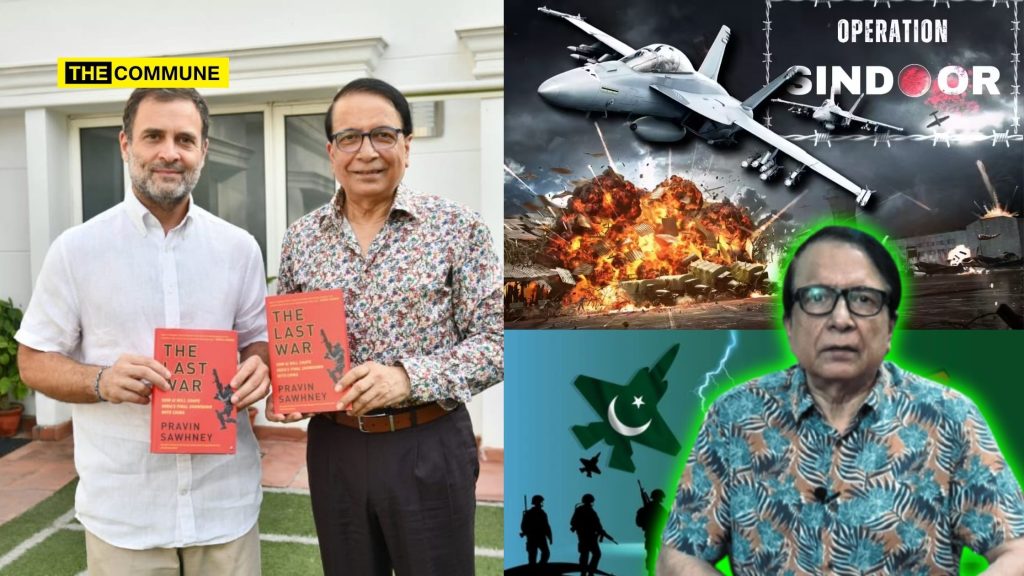
In a recent interview broadcast on The Wire, editor of “Force Magazine” Pravin Sawhney and journalist Karan Thapar offered commentary on India’s Operation Sindoor that has raised eyebrows for its strikingly pro-Pakistan tilt. During the discussion, Sawhney openly questioned the claims of the Indian Air Force, repeatedly casting doubt on the reported destruction of Pakistani aircraft while giving credence to Pakistani assertions of Indian losses.
The interview, aired on 6 October 2025, focused on statements made by Air Chief Marshal V.R. Chaudhari regarding India’s alleged downing of 12–13 Pakistani aircraft, including fighter jets such as F-16s and JF17s, a C130, and possibly airborne early warning aircraft. Sawhney told Thapar that these claims were “very hard to accept,” citing a Russian expert’s assessment that India’s S400 system cannot conclusively confirm kills of fast-moving fighters. He emphasized that only the downing of a slow-moving airborne early warning aircraft at 300 km could be verified.
Sawhney repeatedly stressed that the Air Force Chief’s claims were based on system intelligence rather than conclusive proof, implying that India’s reported strikes on Pakistani aircraft might be exaggerated. He also criticized the Chief for refusing to comment on Indian losses, describing this as “not befitting an Air Force Chief” and claiming it undermines India’s credibility internationally.
Shockingly, Sawhney went further to suggest that the world remains impressed by Pakistan’s air operations during the campaign. He cited Pakistan’s multi-domain air strategy and post-Operation Sindoor military diplomacy—including the Pakistan–Saudi Arabia strategic defense agreement—as evidence of Pakistani success, implicitly legitimizing Islamabad’s narrative while casting India’s performance as underwhelming. He highlighted press statements by Pakistani Lt. Gen. Khaled Kidwai, who claimed four Rafale aircraft were downed by Pakistan, noting that India’s silence on these claims would be interpreted globally as acquiescence.
Throughout the interview, Thapar allowed Sawhney’s arguments to flow unchallenged, framing questions in ways that amplified doubts about India’s military performance rather than interrogating the methodology or credibility of Pakistani claims. Sawhney repeatedly referred to Indian losses reported by the Chief of Defence Staff and Air Marshal Bharti, dismissing them as “fanciful stories”/“Manohar Kahaniyaan,” while simultaneously elevating Pakistan’s version of events without evidence.
Pravin Sawhney, The Wire Push Narratives Favorable To Pakistan – Says Pak Journalist
In September 2025, in a shocking admission aired on Pakistan’s Samaa TV, prominent Pakistani journalist Najam Sethi explicitly named several Indian media platforms and individuals whom he credited with advancing narratives favorable to Pakistan’s interests, often at the expense of India’s sovereignty and security.
In the video, now viral online, he says “In India, there are some very powerful things coming out in Caravan magazine. Similarly, in India, there are independent sources that provide challenging analysis. One such source is The Wire; it is something you should look at. There are many independent alternative news sources like this. Among military experts, there is Scott Ritter, who is an American Pentagon and defence analyst. Similarly, in India, there is Pravin Sawhney who does a great job, and he provides very powerful analysis. So, I can name a lot, a lot of sincere people. If you want, I can definitely make a list next time.”
Caravan Magazine, The Wire, Pravin Sawhney
– Pak journalist reveals Indian news sources serving Pakistani interestspic.twitter.com/GsokQHuY5v
— Pakistan Untold (@pakistan_untold) September 15, 2025
Karan Thapar Had Pakistani Handlers?
In an interview clipping from 13 years ago, journalist Madhu Trehan grilled Karan Thapar over allegedly having Pakistani handlers.
Thapar addressed allegations that some of his writings and commentary “push Pakistan’s agenda.” The issue arose when a politician reportedly told Trehan that Thapar, through his reporting and articles on India-Pakistan relations, often presented Islamabad’s point of view rather than India’s. The politician clarified that Thapar was not a spy, but that his articles reflected Pakistan’s perspective so consistently that it seemed he was advancing their narrative.
Thapar acknowledged that some of his articles did present a Pakistani point of view. However, he defended this practice, arguing that as an Indian journalist, it is important for the Indian public to be aware of how Pakistan views certain issues. He justified it by saying that showing Pakistan’s perspective is not the same as promoting it and that it was part of providing a full understanding of bilateral relations.
When pressed on whether this constituted pushing Pakistan’s agenda, Thapar denied being a spy and maintained that presenting Pakistan’s point of view was a ‘journalistic responsibility’. He admitted that occasionally his articles might appear to have favored Pakistan’s stance but framed it as an effort to inform Indian readers, not to serve Pakistan.
In essence, the interview left viewers with the impression that people like him were functioning as surrogate spokespersons for Pakistan rather than independent commentators on India’s defence operations.
So there you have it: Pravin Sawhney and Karan Thapar, along with The Wire, apparently moonlight as Pakistan’s spokespersons – all from Indian soil. Truth, objectivity, and journalistic duty? Clearly optional when one can peddle someone else’s talking points.
Subscribe to our channels on Telegram, WhatsApp, and Instagram and get the best stories of the day delivered to you personally.