


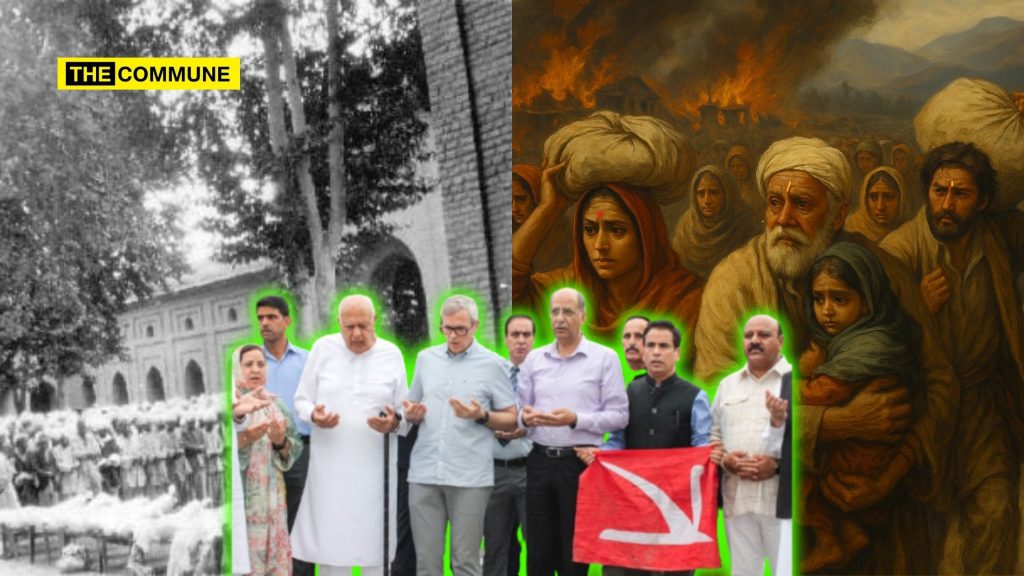
Jammu and Kashmir Chief Minister Omar Abdullah once again found himself embroiled in controversy as tensions escalated near the Martyrs’ Graveyard in Srinagar on the morning of 14 July. Security forces attempted to block Abdullah and his supporters from entering the site to pay tribute, despite a formal ban on such visits.
On 13 July 2025, the Srinagar police had denied permission for any processions or visits to the cemetery, placing several senior leaders under house arrest. The District Magistrate rejected the National Conference’s request for access to the Mazar-e-Shuhada, citing law and order concerns.
Defying the restrictions, Abdullah attempted to reach the site, resulting in a chaotic standoff with police. Videos of the incident widely shared on social media showed him climbing over a back gate to gain entry, which critics described as a political stunt.
This is the physical grappling I was subjected to but I am made of sterner stuff & was not to be stopped. I was doing nothing unlawful or illegal. In fact these “protectors of the law” need to explain under what law they were trying to stop us from offering Fatiha pic.twitter.com/8Fj1BKNixQ
— Omar Abdullah (@OmarAbdullah) July 14, 2025
Paid my respects & offered Fatiha at the graves of the martyrs of 13th July 1931. The unelected government tried to block my way forcing me to walk from Nawhatta chowk. They blocked the gate to Naqshband Sb shrine forcing me to scale a wall. They tried to physically grapple me… pic.twitter.com/IS6rOSwoN4
— Omar Abdullah (@OmarAbdullah) July 14, 2025
Abdullah had sought to commemorate the 22 people killed on 13 July 1931, when Dogra forces under Maharaja Hari Singh opened fire on protesters. Although the observance of Martyrs’ Day was discontinued following the abrogation of Article 370 in 2019, Abdullah seized the moment to revive the symbolic ritual and reassert his political presence in the Valley a region long plagued by deep-rooted communal divisions.
What The Day Means For Islamists
The observance of 13 July as Martyrs’ Day has less to do with honoring genuine sacrifice and more with political appeasement aimed at the Muslim electorate. The catch here is that both politicians in the Valley and separatist extremists align on this matter, using the remembrance of the event to keep communal tensions alive. The incident from 1931, often projected as a symbol of resistance against autocracy, is mired in communal overtones.
Until Article 370 was revoked in 2019, 13 July was an official public holiday in Jammu and Kashmir. The day marked the killing of 22 Muslims who had gathered outside Srinagar Central Jail, where a British cook, Abdul Qadeer Khan accused of sedition for inciting rebellion against Dogra rule was on trial. As the crowd swelled to several thousand, a confrontation ensued. Dogra police opened fire, resulting in multiple deaths.
While one version describes the crowd as peaceful and praying, others suggest they attempted to storm the jail, threw stones, and attacked officials, prompting the police to retaliate. The deceased were buried near the Naqshband Sahib shrine in Srinagar, which later became a site of political symbolism.
The Unspoken Hindu Carnage
The event, however, was not entirely peaceful. Reports indicate that what began as a protest escalated into violent riots. Mobs looted, torched buildings, and specifically targeted Hindu households in areas like Maharajgunj and Safakadal. Hindu women were assaulted, property ransacked, and several people were killed highlighting the communal nature of the unrest.
Hindu shops were looted, homes were torched, women molested, and several Hindus killed — this communal violence is conveniently omitted in the official narrative of “martyrdom.”
The crowd outside the jail was not just a peaceful assembly — inflammatory speeches were made, often invoking Islamic supremacy and calling for rebellion against the “infidel” Dogra rulers.
The sentiment quickly turned from political protest to religious frenzy, with Hindus targeted for being seen as symbols of the Maharaja’s administration. Several contemporary British and local reports from 1931-32 acknowledge that the violence quickly turned communal, targeting a specific religious community — Hindus.
Although over 300 rioters were detained, most were released under pressure from communal leaders.
These so-called martyrs were not innocent civilians — they were part of a mob that tried to break into a court/jail, which any government would have to respond to for law and order reasons.
Over the years, 13 July has been used by separatist and Islamist groups to stoke anti-India, anti-Hindu sentiments under the garb of “freedom struggle.”
Leaders like Sheikh Abdullah and later Omar Abdullah have used this date to build communal political capital while ignoring the actual victims of that unrest.
Historical Parallels: Echoes of Direct Action Day
Some commentators compare the 13 July unrest to the infamous Direct Action Day on 16 August 1946, in Calcutta. That day, called by the Muslim League and supported by Bengal Chief Minister H.S. Suhrawardy, saw widespread and targeted violence against Hindus. Armed mobs, equipped with voter lists, systematically attacked Hindu homes and businesses. The violence led to the murder, rape, and displacement of thousands, marking one of the bloodiest episodes in India’s pre-independence history.
Just as Direct Action Day was portrayed as a political assertion for Pakistan but resulted in massacre and chaos, the 1931 Kashmir uprising is also seen by critics as the foundation for radical Islamist separatism, often rebranded over decades as a freedom struggle by political dynasties like the Abdullah family.
Political Exploitation vs. Historical Reckoning
The return of the National Conference to power in Jammu and Kashmir in 2024 reignited efforts to restore 13 July as a state-recognized day of remembrance. However, the BJP firmly opposed any official recognition, calling it a distortion of history.
On 13 July 2025, police in Srinagar denied permission for any processions or cemetery visits, placing senior leaders under house arrest. The District Magistrate rejected the National Conference’s formal request for access to the site, citing law and order concerns.
Opposition parties like the TMC and DMK have jumped in to support such events, with critics alleging that their backing is aimed at consolidating Muslim vote banks. These critics argue that by doing so, these parties are indirectly encouraging separatist or extremist narratives under the pretext of defending minority rights, while turning a blind eye to the communal violence and complex historical realities associated with such commemorations
Subscribe to our channels on Telegram, WhatsApp, and Instagram and get the best stories of the day delivered to you personally.