Tamil Nadu has built a reputation as one of India’s major industrial and services-driven economies. Yet, over the decades, several high-profile infrastructure, industrial and scientific projects in the state have been stalled, delayed, suspended, redesigned or abandoned.
The reasons have varied. In some cases, farmers, fisherfolk and environmental groups have mounted sustained protests over land acquisition, ecology and livelihoods. In others, projects have been held up by litigation, administrative delays, changing policy positions, contractor issues and disputes between the state and central governments.
But a common factor behind many (if not all) of these protests appears to be a network of church-backed organisations, NGOs and activist groups that have played an outsized role in opposing major projects, particularly those involving land, mining, hydrocarbons, ports and industrial development. Such opposition, when combined with populist politics and the electoral pandering of rural and minority constituencies, has repeatedly made large infrastructure projects politically difficult to execute.
The Parandur airport controversy has brought that contradiction back into focus.
Parandur: The Latest Major Project To Be Dropped
On 24 August 2026, Chief Minister C. Joseph Vijay announced in the Assembly that the proposed ₹20,000-crore Parandur Greenfield Airport project would be dropped.
The project had faced prolonged opposition from farmers and environmental groups over the proposed acquisition of agricultural land and wetlands. The protests continued for around 1,000 days, eventually becoming a major political issue.
The government said the decision honoured Joseph Vijay’s pre-election commitment to the protesting farmers and environmental groups. Instead of proceeding with Parandur, it said it would expand Chennai’s existing airport with a proposed Terminal 5 while continuing to look for another location for a greenfield airport.
The decision immediately triggered political opposition. DMK leaders, including former Finance Minister Thangam Thennarasu, staged a walkout from the Assembly, while industry bodies warned about the consequences of delaying Chennai’s second airport.
CREDAI Chennai has argued that the absence of a second large-scale airport could constrain Chennai’s future growth and investment potential.
The Parandur decision therefore raises a larger question: how many major infrastructure projects can Tamil Nadu afford to sacrifice or indefinitely postpone in the name of protecting individual interests, particularly when the state is competing with neighbouring Andhra Pradesh, Karnataka and Kerala for investment and logistics infrastructure?
Chennai-Salem Eight-Lane Expressway
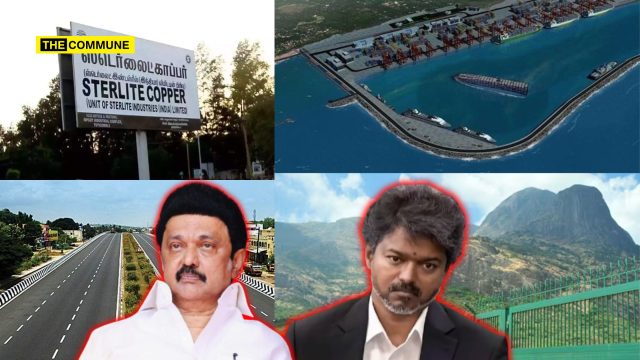
The proposed Chennai-Salem eight-lane expressway is another major example.
The greenfield, access-controlled highway was intended to substantially reduce travel time between Chennai and Salem and improve connectivity between two important industrial centres.
The project, however, encountered strong resistance from farmers across multiple districts. Protests and legal challenges centred on the compulsory acquisition of agricultural and forest land.
The project subsequently became locked in a prolonged legal and political deadlock.
The project has also become politically significant because TVK Minister Aadhav Arjuna recently claimed in the Assembly that he had worked behind the scenes to plan and organise the DMK’s protests against the expressway when the AIADMK was in power.
Sterlite: Environmental Protest, Political Fallout And Christian-Funding Questions
The closure of the Sterlite Copper smelter in Thoothukudi remains one of the most consequential examples.
The Vedanta-owned plant had an annual production capacity of around four lakh tonnes and was a major contributor to India’s copper production. The plant was shut in 2018 following prolonged protests over alleged pollution and environmental damage. The agitation eventually turned violent, with police firing killing protesters.
The closure had major economic consequences. Government data cited in the debate showed a sharp fall in India’s refined copper exports after the plant’s closure.
The environmental concerns surrounding Sterlite were not invented by political opponents. The plant had faced regulatory and legal scrutiny for years. The Supreme Court’s 2019 judgment restored the closure position after setting aside the National Green Tribunal order that had permitted reopening, while leaving the merits of the dispute to the Madras High Court.
At the same time, questions about the protest movement’s funding have been raised by the Union government and others.
In 2023, the Ministry of Home Affairs told Parliament that it had received complaints alleging FCRA violations by The Other Media, an NGO linked to organising protests around Sterlite. The government said the organisation had received ₹3.54 crore in foreign contributions between 2019-20 and 2021-22 and had utilised ₹2.79 crore. It also said that a questionnaire had been issued to the organisation seeking details of its activities and utilisation of foreign funds.
The Other Media, for instance, has been associated with environmental campaigns in Tamil Nadu. Its foreign-funding records include contributions from CORDAID, a Catholic development organisation based in the Netherlands, and Bread for the World, the development and relief agency of Germany’s Protestant churches, among other international organisations, indicating a Christian missionary support behind this protest.
Enayam: When A Deepwater Port Became A Religious And Political Issue
Perhaps the clearest example of development colliding with Church-backed mobilisation came in Kanyakumari.
The Enayam International Container Transshipment Terminal was envisaged as a major deepwater port under the Centre’s Sagarmala programme. At the time, the project was estimated at around ₹27,570 crore.
The proposal faced strong opposition from fishing communities who feared displacement and damage to their livelihoods. In 2016, hundreds of fishermen demonstrated against the project, with protesters claiming that around 13,657 fishing families, approximately 70,000 people, could be affected. Political parties, including the DMK, Congress, CPI(M), AIADMK and others, also participated in or supported protests.
Thousands later participated in a human-chain protest involving fishermen and residents from dozens of coastal villages.
But the opposition also had a distinctly religious dimension.
Christian priest Jegath Gaspar Raj, who has been associated with political causes aligned with the DMK, addressed a church gathering during the protests.
He questioned the need for an international container port in a district with few factories and described the project as a threat to the coastal communities.
“You are destroying 56 fishing villages… a scheme is being written to destroy the history, livelihood, future of coastal people. This is not just a challenge—it is a danger to a land lovingly created by God… It is our duty to stand up against the evil forces, the forces of the devil,” he said.
At another point, he appealed to the coastal community in explicitly religious terms, describing the coastline as land “created lovingly by God” and calling on the people to protect what he described as God’s creation.
The use of religious authority to mobilise opposition indicated how the Christian missionaries were behind yet another protest against the infrastructural development of the state.
Today, Kerala’s Vizhinjam port has demonstrated the strategic value of deepwater transshipment infrastructure. The contrast has inevitably revived the question of what Tamil Nadu might have gained had the Enayam proposal materialised.
Neutrino Observatory: DMK Chose Protest Politics Over Science
The proposed ₹1,500-crore India-based Neutrino Observatory (INO) in Theni became another major scientific project caught in Tamil Nadu’s politics of protest.
The underground laboratory, proposed in the Bodi West Hills, was designed to study neutrinos and was to be located approximately 2 km from the nearest village, with no conventional industrial activity, emissions or chemical discharge.
Despite this, the project faced sustained opposition over alleged threats to the Western Ghats, wildlife corridors and the local ecosystem.
The DMK actively backed the opposition. Its alliance partner Vaiko undertook a padayatra from Madurai to Cumbum against the project, which was flagged off by then DMK Working President MK Stalin.
The political campaign continued despite strong support from the scientific community. Nobel laureates Arthur McDonald and Takaaki Kajita, national scientific institutions and hundreds of researchers backed the project. Former President Dr APJ Abdul Kalam also strongly supported the INO and urged people to approach the issue through scientific reasoning.
The DMK government eventually took the opposition to the Supreme Court.
In February 2022, the Tamil Nadu government filed an affidavit stating that it would not permit the INO inside the Bodi Hills. Stalin also wrote to Prime Minister Narendra Modi seeking that the Centre drop the project. The government cited the Western Ghats as a “global biodiversity hotspot” and claimed the Bodi Hills formed part of a significant tiger corridor.
The irony was not lost: while the government invoked ecological protection to oppose an underground scientific laboratory, illegal quarrying across Tamil Nadu’s hills continues to cause extensive environmental damage.
The DMK government later also announced the withdrawal of police cases filed during the previous regime against those who had protested against the INO.
The project has remained effectively stalled for years.
The INO episode shows how a project backed by India’s leading scientists and Dr APJ Abdul Kalam became another casualty of political mobilisation and environmental protest in Tamil Nadu.
The Mannargudi Methane Project – 2016.
Protest networks were mobilised across the Cauvery delta, flooding public discourse with fears of fracking contaminating groundwater. The Tamil Nadu Assembly passed a resolution against it. The Centre, caught in the political crossfire, cancelled exploration permits. Union Petroleum Minister Dharmendra Pradhan confirmed the cancellation on 10 November 2016. India’s most promising CBM belt, a 691 sq km block in Tiruvarur district, went silent. The gas stayed underground.
The Neduvasal Hydrocarbon Project – 2017 to 2020.
On 15 February 2017, the Cabinet Committee on Economic Affairs under PM Modi approved hydrocarbon extraction in 31 contract areas including Neduvasal. The agitation that erupted borrowed its energy from the Jallikattu movement — night vigils, celebrity endorsements, viral hashtags. The activist ecosystem around Thirumurugan Gandhi and his May 17 Movement was deeply embedded in the broader anti-extraction agitation across Tamil Nadu during this period, consistently opposing every Modi government energy initiative in the state. Not once did the protest leadership present an alternative energy plan. Not once did they disclose the tradeoff they were making on behalf of 80 million Tamil Nadu residents. By 20 February 2020, the Tamil Nadu government passed the Protected Agricultural Zone Act – permanently sealing the entire Cauvery basin’s hydrocarbon reserves behind a legislative wall. Celebrated as a victory for farmers. Recorded in history as the day Tamil Nadu locked away its own energy future.
The GAIL Pipeline – 2021.
Not a drilling project. Not an extraction operation. Just a pipe, carrying gas from Kochi into Tamil Nadu’s industrial districts. The same protest machinery mobilised again. A 70-foot pipeline right-of-way through agricultural land was declared a civilisational threat. Court petitions were filed. Political pressure mounted. The pipe that runs through nearly every other major Indian state, sanctioned by the Government of India as far back as 4 April 2011 stopped at Tamil Nadu’s border because the state government would not allow it through farmland.
Three plans. Three funerals. Conducted by the same people now asking where the plans are.
Maduravoyal Elevated Expressway
The Maduravoyal-Chennai Port elevated expressway was conceived as a 19-km corridor connecting Chennai Port directly with the highway network and easing the movement of container traffic.
The project was halted for years after objections were raised over the placement of pillars in the Cooum riverbed.
The project was subsequently revived with a redesigned alignment, but the long delay illustrates how environmental, engineering and administrative objections can push major urban infrastructure projects far beyond their original timelines.
Chennai MRTS And The 500-Metre Missing Link Delay
The Chennai MRTS has also suffered from prolonged delays, particularly in completing the final link between Velachery and St Thomas Mount.
The remaining stretch was only around 500 metres, yet the project remained incomplete for well over a decade. After so many years, it finally became operational this year.
Land acquisition disputes, litigation and compensation demands from property owners contributed to the delay.
The case is particularly striking because a relatively small missing link can prevent the full benefits of an otherwise large public transport network from being realised.
Chennai Metro And Central Linkages
Chennai Metro Phase 1 eventually became operational, but its construction involved significant delays and cost escalations.
The project encountered challenges associated with underground tunnelling in dense parts of the city, structural handovers and contractor-related issues. The exit of international tunnelling contractors also complicated execution.
The Chennai Egmore-Central linkage and other urban rail connections have similarly faced delays related to land, construction and coordination.
AIIMS Madurai
The proposed AIIMS Madurai is another major project that has faced prolonged delays.
The premier medical institution was announced by the Central Government, but its progress was affected by issues including site selection, land-related processes and subsequent questions surrounding funding arrangements.
Speaking at a government event in Sivaganga on 31 January 2026, Stalin said the State had completed major institutions within four years, while the AIIMS Madurai project had remained pending for 11 years.
Responding to the claim, Annamalai said work on the project was progressing and questioned whether Stalin had ever visited the AIIMS site to review it. He alleged that the DMK government had delayed the project through land acquisition and administrative hurdles, including taking around 1.5 years to permit tree-cutting for construction.
Annamalai further accused the State government of providing “0% cooperation” to the Centre and said AIIMS Madurai would be completed and made functional soon.
The project became a political flashpoint between the state and Centre, with competing allegations over responsibility for the delay.
Tier-2 Airport Expansion
Airport expansion in Coimbatore, Tiruchirappalli and Madurai has also been slower than the state’s growing industrial and commercial requirements would suggest.
Land acquisition remains a major obstacle in several cases. Property owners have challenged compensation levels, resisted acquisition or sought higher market-linked compensation.
For an industrial state seeking to strengthen its Tier-2 cities, airport capacity is critical. Delays in acquiring land can therefore have consequences beyond the airport itself, affecting connectivity, tourism and investment. But where there is a will, there is a way. The successive governments do not seem to follow that.
Nanguneri SEZ: Two Decades Of Stagnation
The Nanguneri Special Economic Zone was conceived in the early 2000s as a major industrial and technology hub intended to transform southern Tamil Nadu into an electronics and manufacturing destination.
Instead, the project went through years of stagnation.
Promoter exits, land-use disputes and the absence of anchor investments prevented the SEZ from reaching its original potential. Various revival efforts have taken place over the years, but progress has remained piecemeal.
Nanguneri is an example of how Tamil Nadu can announce ambitious industrial projects but struggle to create the conditions required for sustained private investment.
ECR And Other NHAI Projects
Several highway projects, including portions of the East Coast Road and other National Highway projects, have experienced delays.
The reasons have included statutory clearances, land acquisition, utility shifting and coordination between central agencies and state-level administrative bodies.
Similar issues have affected portions of the Bengaluru-Chennai Expressway and other highway projects especially in Tamil Nadu – the rest of the expressway has been ready for a long time.
Again, these delays cannot simply be attributed to protests. Administrative coordination and land-related processes remain major structural bottlenecks.
The Pattern: Church, Politics, Protest
Across several projects, a recurring pattern emerges: church-linked organisations and activists mobilise local opposition, opposition parties amplify it, and governments either yield to the pressure or use the issue politically.
The pattern is visible, in different forms, in Sterlite, Enayam, the Neutrino Observatory, the Chennai-Salem Expressway and now Parandur.
The role of Christian organisations and clergy is particularly visible in the agitations, while successive governments and opposition parties have repeatedly backed or leveraged such movements when politically convenient.
The result has been a cycle of protest, political mobilisation, delay and eventual abandonment or redesign of major projects.
The 13% Vs 87% Question
Agriculture contributes roughly 11–13% of Tamil Nadu’s GSDP, while manufacturing and services generate the overwhelming share of economic output.
Farmers, however, cannot be reduced to a GDP percentage. Land acquisition directly affects livelihoods and families. At the same time, airports, ports, highways and industrial projects require land and are critical to the state’s economic future.
The problem arises when successive governments prioritise short-term political gains over long-term infrastructure planning, allowing organised opposition to repeatedly derail strategic projects.
The Bigger Question
Parandur is only the latest example of a much larger problem.
Tamil Nadu has repeatedly seen major projects caught in the same cycle: announcement, protest, political backing, litigation, delay and eventual redesign or abandonment.
Church-linked mobilisation, activist networks, opposition parties and governments have each played a role in this cycle at different times.
The question is no longer whether Tamil Nadu needs development. It does.
The question is whether the state will continue allowing political and organised pressure to determine which development projects survive.
Subscribe to our channels on WhatsApp, Telegram, Instagram and YouTube to get the best stories of the day delivered to you personally.