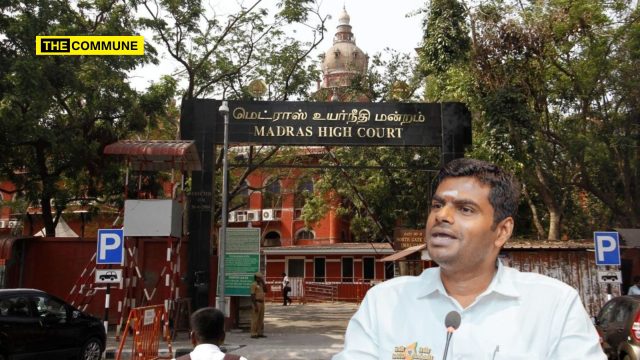
The Madras High Court on Thursday (24 September 2026) quashed a private complaint filed by Salem-based activist Piyush Manush against We The Leaders founder K. Annamalai over remarks he reportedly made during a press meet in 2023 concerning Pasumpon Muthuramalinga Thevar, as reported in The Hindu.
Justice G.K. Ilanthiraiyan allowed a petition filed by Annamalai seeking quashing of the criminal proceedings pending against him before a judicial magistrate’s court in Salem.
The complaint related to a statement attributed to Annamalai that Muthuramalinga Thevar had, in 1956, warned of performing ‘blood abhishekam’ for Madurai Meenakshi Amman if atheists continued to insult theists.
Annamalai was represented by advocate Arun C. Mohan, whose submissions the court accepted while allowing the petition and quashing the proceedings against him.
Complaint Over Remarks On Muthuramalinga Thevar
Piyush Manush had lodged a private complaint before the Salem court accusing Annamalai of making provocative remarks during the 2023 press meet.
The complaint alleged that Annamalai had committed offences under Section 153A of the Indian Penal Code (IPC), relating to promoting enmity between different groups on grounds including religion, race, place of birth, residence and language, and Section 505(1)(c), relating to making statements with intent to incite any class or community of persons to commit an offence against another class or community.
Following the complaint, the Tamil Nadu government accorded sanction on April 28, 2024, under Section 196 of the Code of Criminal Procedure (CrPC) for prosecuting Annamalai under the relevant provisions of the IPC.
The Magistrate subsequently took cognisance of the offences and ordered issuance of summons in February 2026.
Annamalai then approached the Madras High Court seeking quashing of the complaint and the criminal proceedings arising from it.
Counsel Says Annamalai Referred To A Historical Incident
Appearing for Annamalai, advocate Arun C. Mohan argued that his client had merely responded to comments made by DMK leader Udhayanidhi Stalin concerning Sanatana Dharma.
Explaining the context of the statement, Mohan told the court, “I, as any other politician in the country, had an opinion on the subject. In the course of stating my opinion on the subject… I had referred to a historically recorded incident involving Muthuramalinga Thevar and former Chief Minister C.N. Annadurai,” he said.
The counsel further submitted that there were several variations of the particular historical incident. However, he said the broad substance of the incident was that C.N. Annadurai had addressed a temple event and that Muthuramalinga Thevar had disagreed with his speech.
According to the submissions, the complainant appeared to contend that Annamalai should not have referred to the incident even if it was historically true.
Challenge To Magistrate Taking Cognisance
Mohan also argued that the Magistrate had taken cognisance of the private complaint without conducting a preliminary inquiry or providing an opportunity of hearing to Annamalai.
He further submitted that the complainant had failed to identify two discernible communities between whom Annamalai had allegedly attempted to create a divide by referring to the historical incident.
The proceedings had continued before the judicial magistrate’s court in Salem after the government granted the required sanction and the Magistrate took cognisance of the alleged offences.
After hearing the submissions, Justice G.K. Ilanthiraiyan allowed Annamalai’s petition and quashed the proceedings pending against him.
Subscribe to our channels on WhatsApp, Telegram, Instagram and YouTube to get the best stories of the day delivered to you personally.