


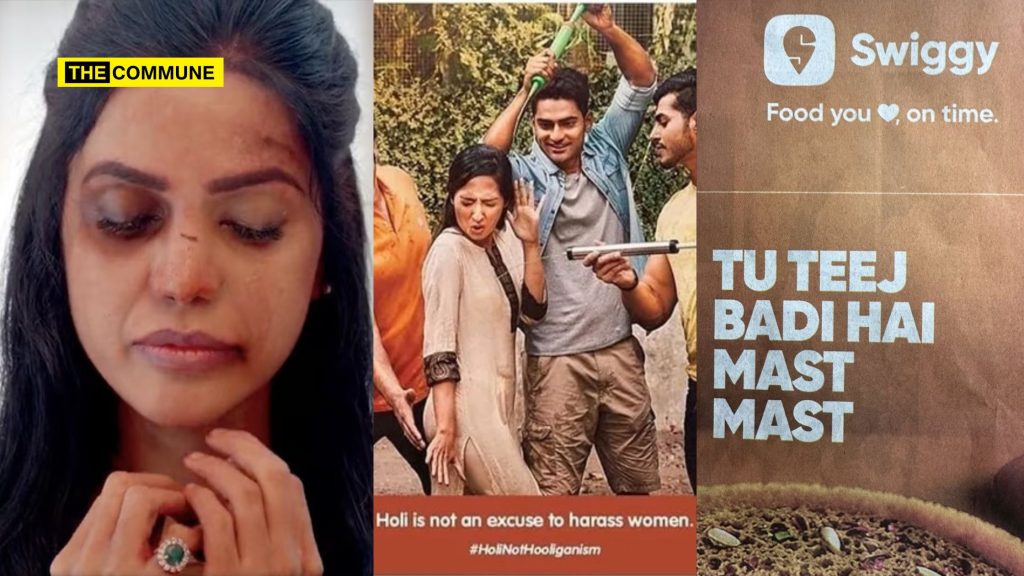
On July 27, 2025, popular e-commerce brand Swiggy ran an advertisement in the Jaipur Times to mark the Hindu festival of Hariyali Teej. The ad carried the headline: “Tu Teej Badi Hai Mast Mast.” The phrase, viewed by many as a crass distortion of a devotional occasion, sparked widespread criticism. Several Hindu organizations condemned the campaign, accusing Swiggy of vulgarizing a sacred festival that celebrates the divine union of Lord Shiva and Goddess Parvati.
This incident is not isolated. Between 2016 and 2025, at least 16 major corporate campaigns have come under fire for misrepresenting, mocking, or trivializing Hindu festivals and religious sentiments in the name of marketing. These include instances of cultural appropriation, suggestive slogans, and deliberately provocative imagery used during occasions like Diwali, Holi, Karva Chauth, and others – all sparking backlash for being insensitive and Hinduphobic.
This report compiles these 16 instances, raising serious concerns about the recurring pattern of disrespectful branding tactics targeting Hindu traditions for commercial gain.
#1 Swiggy’s Anti-Hindu Teej Ad
On 27 July 2025, food delivery platform Swiggy published an advertisement in the Jaipur Times with the headline “Tu Teej Badi Hai Mast Mast” to mark the Hindu festival of Hariyali Teej. The festival, which honors the sacred union of Lord Shiva and Goddess Parvati, was perceived to be mocked through the ad’s suggestive tone.
In the race to harness moment marketing, some brands are losing track. Teej Mata is worshipped on this auspicious day. It is not a meme material. #swiggy pic.twitter.com/ohuPBAltoi
— Shaani Nani (@shaaninani) July 28, 2025
The campaign has sparked strong backlash, with several organizations accusing Swiggy of insulting Hindu sentiments and using a sacred occasion for vulgar, attention-seeking marketing.
#2 JK Paper India Demeans Holi as Wasteful
In March 2023, JK Paper India, a paper manufacturing company, released an advertisement portraying Holi as a wasteful festival. The campaign drew sharp criticism for shaming a sacred Hindu celebration while the company itself engages in water-intensive paper production, contributing significantly to environmental degradation.
Transcript of @JKPaperIndia's Hinduphobic ad on #Holi
👉About 4 bln people around the globe live in water scarce areas
👉As many as 1 bln of these people live in India
👉While playing Holi, a person uses at least 2 buckets of water, which means about 30 liters of water is wasted pic.twitter.com/J1OXOxoKd5— 🇮🇳 🚩 Manish (@manishqj) March 10, 2023
The ad was seen as hypocritical and offensive, sparking accusations of Hinduphobia and selective targeting of Hindu traditions.
#3 Bharat Matrimony Calls Holi a Festival of Harassment
On 7 March 2023, Bharat Matrimony released an advertisement conflating Holi with sexual harassment, framing the sacred Hindu festival as unsafe for women. The ad, timed with International Women’s Day (which coincided with Holi that year), was widely condemned as Hinduphobic and misleading.
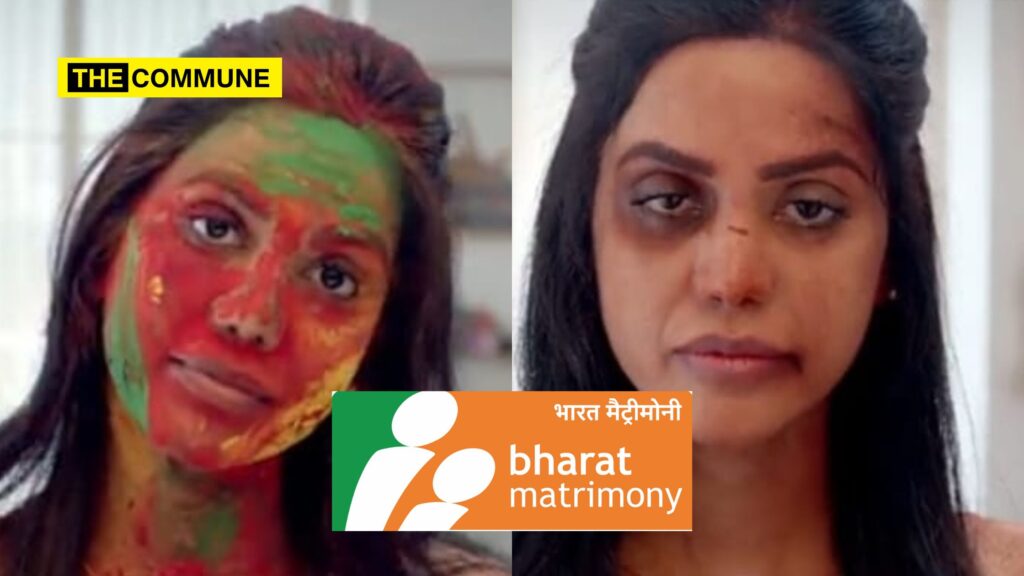
This Women's Day & Holi, let's celebrate by creating safer and more inclusive spaces for women. It's important to acknowledge the challenges that women face in public spaces and create a society that truly respects their well-being – today & forever.#BharatMatrimony #BeChoosy pic.twitter.com/9bqIXZqaXu
— Bharatmatrimony.com (@bharatmatrimony) March 8, 2023
Critics noted that while claiming to raise awareness about women’s safety, the campaign specifically demonised Hindu traditions, while remaining silent or reverent about other religious festivals. The ad remains on Bharat Matrimony’s official X profile, further fueling backlash over its perceived contempt for Hindu cultural practices.
#4 Swiggy’s ‘Holi Egg’ Billboard Sparks Hinduphobia Row
In March 2023, Swiggy faced backlash over a controversial Holi-themed billboard that read: “Omelette; Sunny side-up; Kisi ke sarr par. #BuraMatKhelo. Get Holi essentials on Instamart.” The ad, perceived as mocking Holi traditions, was widely condemned as Hinduphobic for equating the joyful festival with food wastage and disorder. Critics slammed the campaign for moralising against Hindu practices while trivialising religious sentiment. Following widespread outrage, including from public figures, Swiggy removed the billboard.
Swiggy starts campaign to give Hindus gyan on Holi. Starts massive ad campaign with hashtag: #BuraMatKhelo. Same company @Swiggy is also famous for sending non-veg items to some of their customers who are staunch vegetarians & had ordered veg items: Swiggy #BuraMatBhejo pic.twitter.com/ywqCpMuNRL
— Radharamn Das राधारमण दास (@RadharamnDas) March 6, 2023
#5 Viviana Mall Labels Holi as Hooliganism Risk
In 2020, Viviana Mall posted a Holi campaign on Instagram urging people to say no to “hooliganism,” claiming the festival had seen a rise in unsafe behavior. While masked as a message for responsibility, many viewed it as a veiled Hinduphobic swipe at Holi, portraying a joyous Hindu celebration as inherently disorderly.
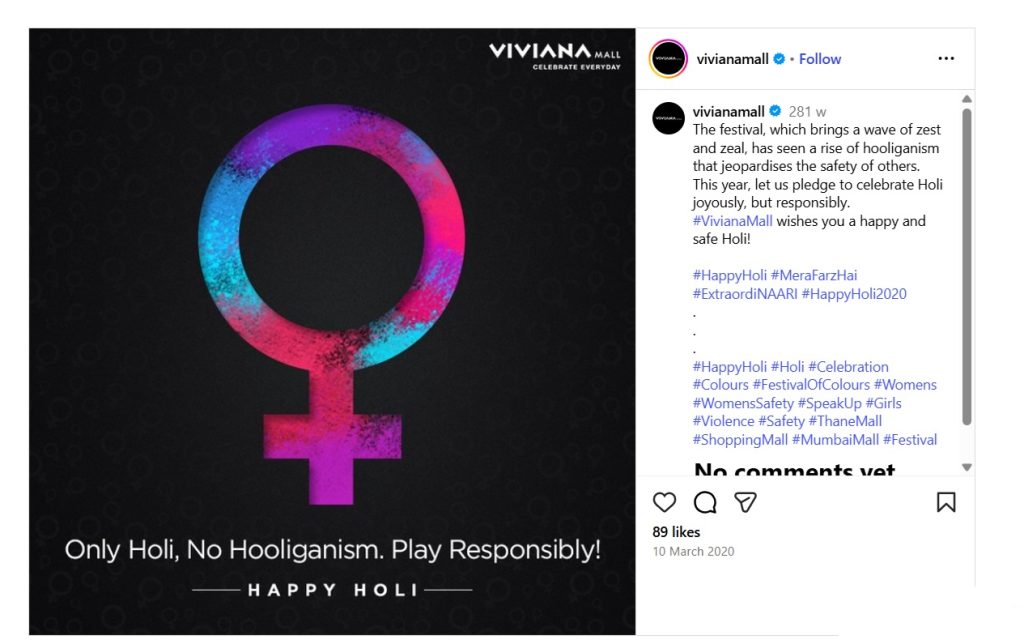

Critics argued that such concerns should apply universally and not be selectively imposed on Hindu festivals. The campaign, though couched in concern for safety, was seen as part of a growing trend of corporate narratives that subtly demean traditional Hindu practices under the guise of social responsibility.
#6 Livpure Mocks Holi as Wasteful in 2020 Ad
In March 2020, Livpure Pvt Ltd released an advertisement portraying Holi as a wasteful celebration. The ad featured children stealing water balloons from a shop and justifying the act by claiming they were preventing water wastage during Holi. The message implied moral superiority in sabotaging the festival’s traditional celebrations. The company faced backlash for shaming Hindu customs under the pretext of environmentalism. Notably, Livpure disabled comments on their YouTube video to suppress public criticism, a move widely interpreted as an attempt to avoid accountability for hurting Hindu sentiments.
#7 FBB’s 2020 Holi Ad Links Festival to Harassment
On 6 March 2020, FBB released an online video campaign featuring digital influencer Mithila Palkar, aiming to raise awareness about harassment. However, the ad took a controversial turn when it subtly implied that Holi enables inappropriate behavior. Palkar’s line, “par saath hi hogi thodi zor zabardasti, thodi ched chad, thodi manmaani”, was criticized for associating Holi with eve-teasing.
While the campaign intended to highlight consent, critics pointed out it needlessly vilified a sacred Hindu festival, reflecting Hinduphobic undertones. The message, they argued, could have been conveyed without painting Holi in a negative and culturally insensitive light.
#8 Surf Excel Ad Portrayed Holi As A Festival Where Hindus Harass People
In 2019, Unilever faced backlash for its ads that portray Hindu-Muslim harmony during festivals. One ad for Surf Excel detergent showed a Hindu girl protecting a Muslim boy from Holi colours so he could go to the mosque.
#9 Reliance General Insurance Portrays Holi As Festival of Harassment
On 1 March 2018, Reliance General Insurance launched a social media campaign that portrayed Holi as a festival marked by harassment. Through a series of Instagram posters, the company emphasized incidents of eve-teasing associated with Holi. One caption read, “Behind the joyous colors of Holi lies an unfortunate reality. Press and hold to find out what it is. And pledge to ensure this year’s celebrations are truly happy and safe for us all. #HoliNotHooliganism.”

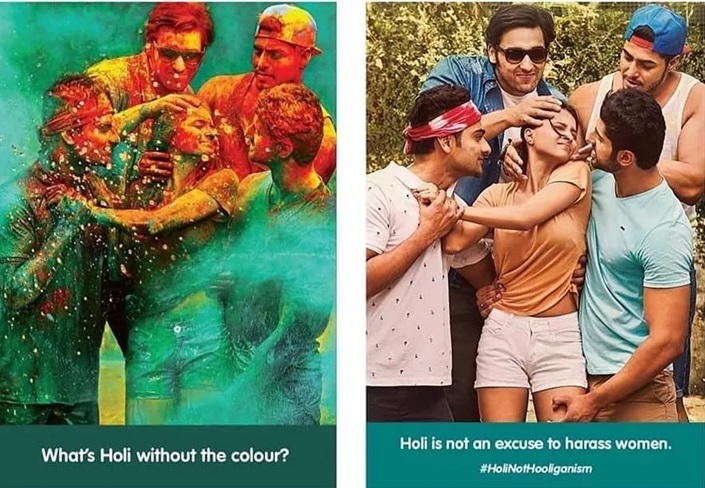

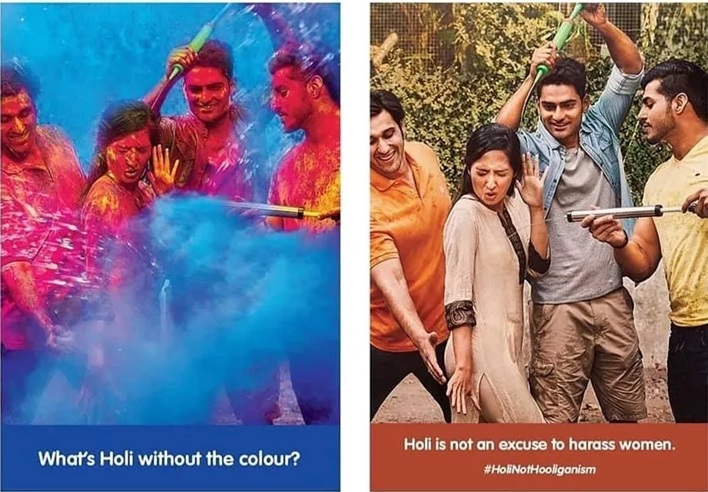
The campaign drew criticism for contributing to a growing trend among corporate brands of vilifying Hindu festivals through selective messaging.
#10 Deepavali As Smoke Festival – Priyanka Chopra & Radio City
Actors like Priyanka Chopra, who contracted asthma only during Deepavali, made her presence known by requesting every Hindu not to burst crackers to celebrate a green Deepavali.
Radio City used children and their love for crackers to promote a “smoke-free” Deepavali.
These are just a few advertisement campaigns and instances of secularization of the Hindu festival of Deepavali. Thanks to the constant virtue signalling, Hindus are rebelling more and more and celebrating Deepavali like it should be celebrated – with pomp, splendour, sweets, savouries, and lots of crackers!
#11 Deepavali As A Noisy Festival – Tata Motors, Saregama Carvaan
Since Deepavali is said to be a festival of lights, several brands came forward with ad campaigns gaslighting Hindus into not purchasing crackers. The noiseless Deepavali was one of the biggest campaigns that was run by several corporate houses. They gave excuses like make it safe for animals who get scared by the noise or make it noise-free for babies and elderly.
In 2020, Tata Motors launched the ‘Silent Diwali Film’ to promote a safe, pollution-free Diwali while encouraging viewers to adopt electric mobility for a sustainable future. The video contrasted the excitement of lighting firecrackers with the environmental harm they cause, showcasing nature’s beauty amid chaos. It emphasized that the loudest statement can be the quietest, highlighting the Nexon EV, India’s best-selling electric car, which operates with minimal noise.
The most recent one from the corporate stable is GRT group. In an advertisement in print and on their social media, they called for silence and care to make noise this Deepavali!

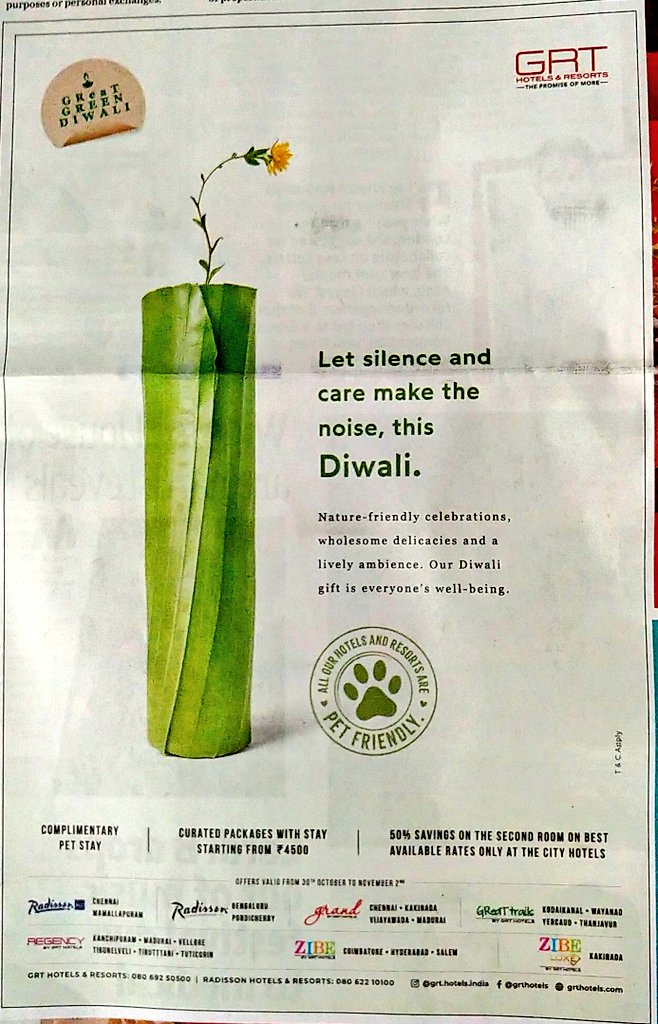
#12 Sexualizing Navratri/Durga Puja With Condom & Deodarant Ad (Manforce & Wildstone)
A Manforce advertisement featuring Sunny Leone on its poster was released during Navratri to promote condom sales in Gujarat. Later, due to public outrage, the company was forced to withdraw the ad following public outcry. The Confederation of All India Traders (CAIT) urged the then Union Consumer Affairs Minister Ram Vilas Paswan to act against Mankind Pharma and its brand ambassador for misleading consumers.
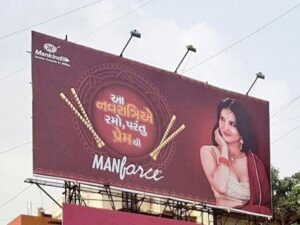

“Though they have not used the word condom in their banner but the intention is very clear as the combination of words like ‘play’, ‘love’ and ‘Navratri’ are coined above the large logo of Manforce“, CAIT National Secretary Praveen Khandelwal wrote in the letter. The hoarding showed Leone on one side staring at the text written in Gujarati, “Ya Navratriyon Ramo Parantu Prem Thi”- which translates to, “Play during Navratri but with love”, between two dandiya sticks and above the Manforce logo. “Their large banners in cities across Gujarat are shouting out to encourage youths to use Manforce condoms in the name of Navratri festival,” Khandelwal said. Terming the advertisement as “derogatory”, he further said: “This is a clearly irresponsible and immature attempt to boost sales by putting our cultural value system at stake.”
Wild Stone Advertisement Featuring Bengali Women (2007)
Deodorant ads often use sexual imagery and degrade women to extreme levels. Women, for years, have been protesting such obscene portrayals of their sexuality. Wild Stone deodorant was promoted in an advertisement that caused some controversy. Set amidst the backdrop of Durga Puja, it showed a married woman in traditional Bengali attire being drawn to fantasize about having intercourse with another man right after she bumps into him accidentally, courtesy of the “wild” fragrance. The Bengali community got deeply offended by such blasphemy and protested the defamation of their holy celebrations.
#13 Dabur’s Lesbian Karwa Chauth
In 2021, an advertisement by Dabur that showed a lesbian couple celebrating Karwa Chauth landed the brand in trouble. Dabur’s new ad for its bleaching product featured a lesbian couple preparing for their first Karwa Chauth. The ad aimed to normalise same-sex relationships, but it backfired. The LGBTQ community slammed the ad for endorsing a “regressive” festival and a fair-skin obsession. The ad offended both the supporters and the critics of Karwa Chauth. The former disliked the brand’s promotion of fair skin, while the latter denounced the festival as a backward practice.
Well done, Fem/Dabur!
A nice film for a traditional, often-criticized festival by an otherwise conservative brand. pic.twitter.com/gHBTca6jP8
— Abhishek Baxi (@baxiabhishek) October 22, 2021
Karwa Chauth has often faced scorn and ridicule from the liberals. Karwa Chauth has often been criticised by the left-liberals as a festival that promotes patriarchy. By contrast, they maintain a deafening silence when it comes to calling out traditions of other religions that are patently racist, misogynistic, and regressive.
#14 The Quint Labels Holi as ‘Terror’, Glorifies Other Religions
On 3 March 2017, The Quint published an article titled “Should we allow kids to unleash terror on the streets in the name of Holi?”, linking a joyous Hindu festival with violence and fear.

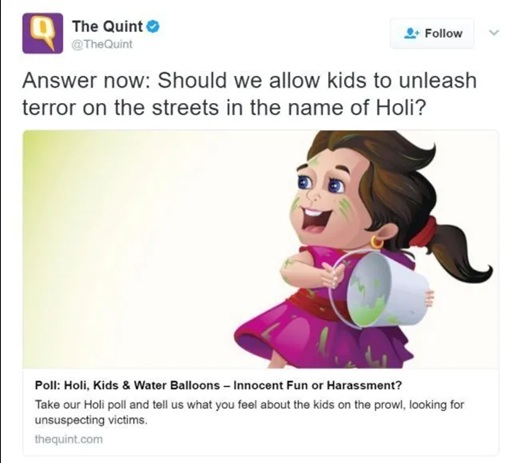
This aligns with a pattern of selective portrayal where The Quint praises Islamic traditions like Ramzan fasting but casts Hindu festivals such as Holi and Navratri in a negative light. While Eid is associated with harmony, Holi is framed as a gateway to “terror.” Such headlines suggest a consistent Hinduphobic bias used to attract engagement and appease its left-leaning readership.
#15 Finolex Ad Labels Holi As Wasteful
On 21 March 2016, Finolex Pipes and Fittings released a digital ad campaign that many Hindus found demeaning towards the festival of Holi. The 10-second video featured the line, “Every drop you save, adds color to someone else’s life,” implicitly framing Holi celebrations as wasteful. While presented as a water conservation message, the ad was seen as selectively targeting Hindu festivals under the guise of social responsibility. Several viewers criticized the brand for its patronizing tone and for singling out Holi, reflecting a broader trend of corporates adopting dismissive attitudes toward Hindu cultural practices.
#16 Domino’s Ganesh Ad Sparks Outrage Over ‘More-Ya’ Wordplay
On 7 September 2024, Domino’s India sparked outrage during Ganesh Chaturthi by emailing customers an ad that many Hindus found blasphemous. The poster featured a pun on the sacred chant “Ganapati Bappa Morya,” altering it to “More-Ya” to promote pizza.

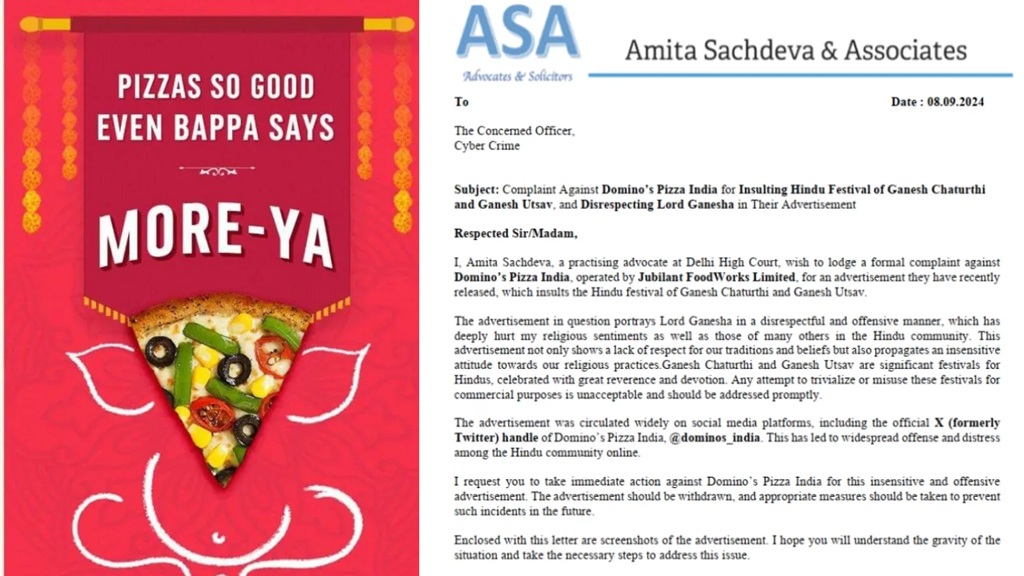
The image even depicted Lord Ganesha with a pizza as His head. Delhi High Court advocate Amita Sachdeva filed a formal complaint, calling the ad offensive and disrespectful to Hindu beliefs. She pledged legal action and shared her statement on social media. The campaign triggered widespread backlash online, with netizens calling for a boycott of Domino’s India.
Similarly, a brand named Ovenstory posted an image of Ganpati Bappa with pizza as His head.
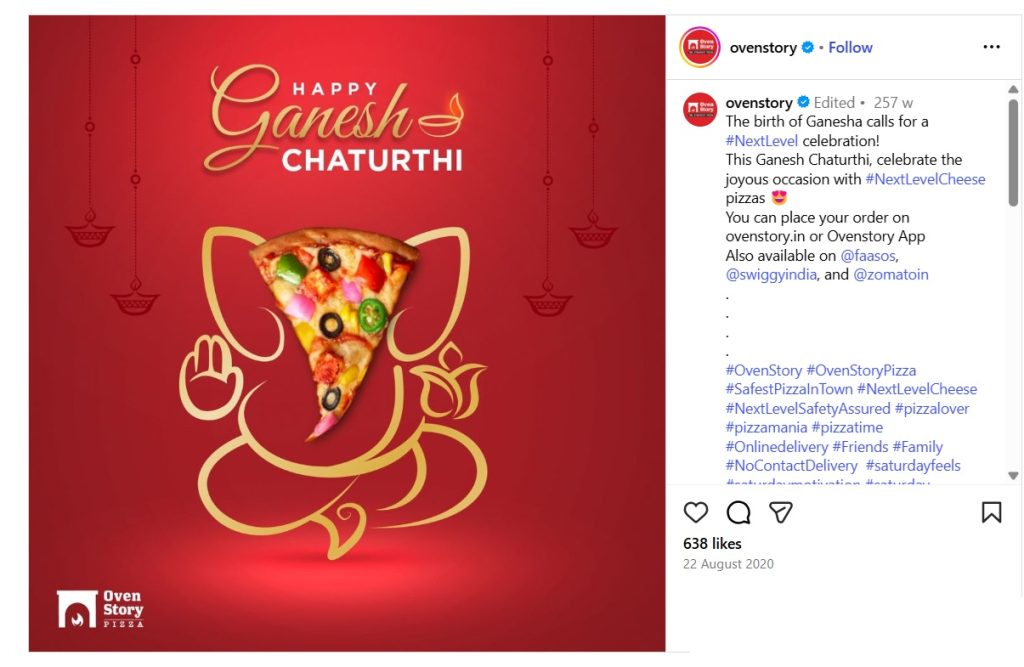

However, this one went unnoticed.
#17 Cracker-Free Deepavali By Tanishq
In 2020, Tanishq encountered significant backlash over a Diwali advertisement featuring actors Neena Gupta, Nimrat Kaur, Sayani Gupta, and Alaya F discussing the significance of the festival. Sayani Gupta’s call for a cracker-free Diwali upset many Hindus on Twitter, resulting in widespread criticism. In light of the negative reactions, Tanishq opted to withdraw the ad.
#18 Urduizing Deepavali By FabIndia
Fabindia drew backlash with its festive collection named ‘Jashn-e-Riwaaz,’ which used Urdu, the language associated with Islamic culture, to promote Diwali attire, sparking a debate over cultural misrepresentation. The ad was later removed from the platform.
Deepavali is not Jash-e-Riwaaz.
This deliberate attempt of abrahamisation of Hindu festivals, depicting models without traditional Hindu attires, must be called out.
And brands like @FabindiaNews must face economic costs for such deliberate misadventures. https://t.co/uCmEBpGqsc
— Tejasvi Surya (@Tejasvi_Surya) October 18, 2021
#19 Brooke Bond’s Hinduphobic Kumbh Mela Ad
In 2019, Brooke Bond faced criticism for an ad depicting a son abandoning his elderly father at the Kumbh Mela. Viewers condemned the storyline for misrepresenting the sacred Hindu gathering, portraying Hindus as neglectful and promoting harmful stereotypes.
Critics argued that the ad demeaned Hindu traditions and contributed to Hindumisia by using a revered cultural event as the backdrop for a narrative of cruelty and abandonment.
#20 Bisleri’s Waterless Holi Campaign Draws Ire
Bisleri, in collaboration with Mumbai Dabbawalas, ran a Holi campaign promoting waterless celebrations. Eco-friendly colors were distributed with tiffin boxes, and company reps handed out colors at toll booths.

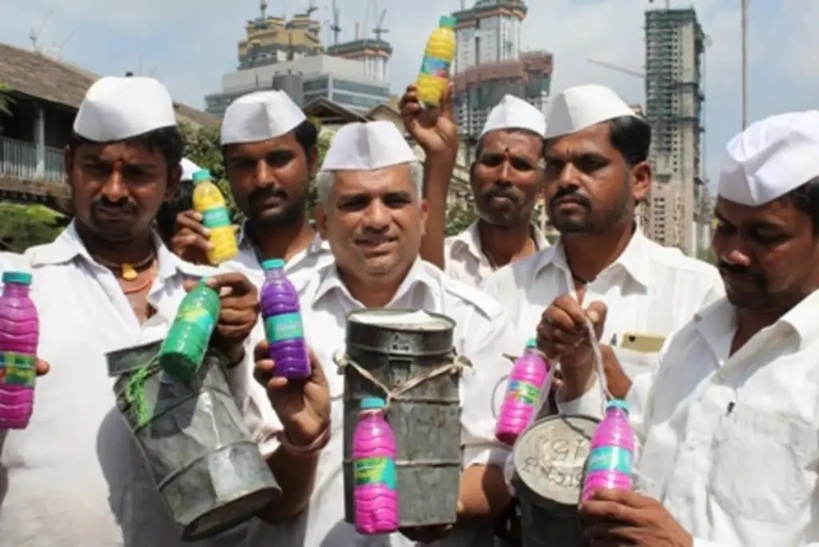
While framed as an environmental message, the campaign drew criticism for selectively targeting a Hindu festival and projecting Holi as wasteful.
Subscribe to our channels on Telegram, WhatsApp, and Instagram and get the best stories of the day delivered to you personally.