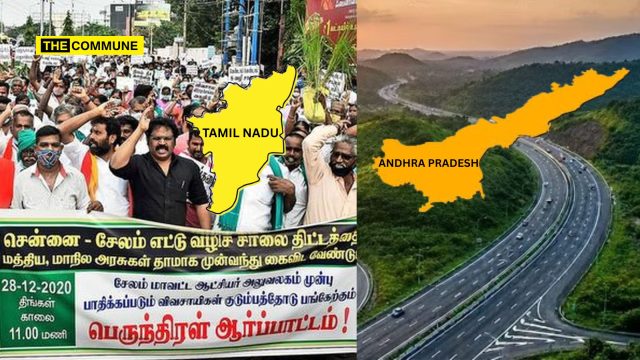
Andhra Pradesh is set to get a massive new greenfield highway connecting it directly to eastern India, with Chief Minister N Chandrababu Naidu announcing the Centre’s approval of the 1,107-km Kharagpur–Amaravati Greenfield Highway.
Taking to X, Naidu thanked Prime Minister Narendra Modi and Union Road Transport and Highways Minister Nitin Gadkari for approving the project. He said 457 km of the corridor will pass through Andhra Pradesh, connecting the state to eastern India, reducing logistics costs for farmers and industries, and creating new opportunities for industry, agriculture, trade and employment.
The four-lane greenfield highway will connect Kharagpur in West Bengal with Amaravati in Andhra Pradesh, passing through Odisha and covering a total distance of 1,107 km. The Andhra Pradesh stretch alone is estimated to cost around ₹32,000 crore.
The project is expected to strengthen Amaravati’s position as an economic hub by improving connectivity with eastern India and opening up faster routes for the movement of goods and people.
On behalf of the people of Andhra Pradesh, I thank Hon’ble Prime Minister @narendramodi Ji and Hon’ble Union Minister @nitin_gadkari Ji for approving the 1,107 km Kharagpur–Amaravati Corridor!
With 457 km passing through AP, this landmark project will connect our state directly… pic.twitter.com/Y5B7tcaZde
— N Chandrababu Naidu (@ncbn) August 23, 2026
The development comes against the backdrop of Tamil Nadu increasingly lagging behind its southern neighbours in the development of high-speed corridors and greenfield expressways.
Tamil Nadu Behind Its Southern Neighbours, Data Shows
The development comes against the backdrop of Tamil Nadu increasingly lagging behind its southern neighbours in the development of high-speed corridors and greenfield expressways.
Data tabled in the Rajya Sabha in July 2026 by the Ministry of Road Transport and Highways showed that Tamil Nadu had just 361 km of National High-Speed Corridors and Greenfield Expressways either completed or under implementation, as reported in DT Next. Of this, only 161 km had been completed, while another 200 km was under implementation.
The figures for neighbouring states were substantially higher.
Andhra Pradesh had 893 km of such corridors, with 308 km operational and 585 km under construction. Karnataka had 579 km, including 314 km completed and 265 km under construction. Telangana had 501 km, with 56 km operational and another 445 km under implementation.
The contrast is particularly relevant given that Tamil Nadu has a substantial 6,805-km National Highway network. Yet when it comes to large-scale high-speed and greenfield corridors, the state has struggled to match the pace of its neighbours.
Chennai-Salem: Tamil Nadu’s Shelved 8-Lane Expressway
One of the biggest examples is the Chennai–Salem Expressway, an ambitious 274-km, eight-lane greenfield project that was proposed to reduce travel time between Chennai and Salem to around three hours.
The project, however, ran into fierce resistance from farmers, environmental activists and enabled by parties like the DMK over land acquisition, particularly concerns surrounding fertile agricultural land. The controversy eventually resulted in the project being shelved.
The proposed expressway was intended to provide a faster connection between Chennai and western Tamil Nadu and was seen as a major infrastructure project for the region.
However, opposition to land acquisition ultimately prevented the project from moving forward as originally planned.
Land Acquisition Also Forced Other Projects To Be Scaled Down
The difficulties in acquiring land have also affected the scale of other major projects.
The Bengaluru–Chennai Expressway, for instance, was initially conceived as an eight-lane project, but was subsequently scaled down to a four-to-six-lane configuration amid land acquisition and budgetary constraints.
This has meant that while Tamil Nadu continues to add highway capacity, some of its most ambitious greenfield proposals have either faced delays, been shelved or been implemented on a smaller scale.
Andhra’s New Corridor To Link Eastern India With Amaravati
Meanwhile, Andhra Pradesh has continued to expand its highway ambitions.
The newly approved Kharagpur–Amaravati corridor will pass through West Bengal, Jharkhand and Odisha before reaching Andhra Pradesh, with the route connecting the eastern region to Amaravati. The proposed alignment covers areas around Cuttack, Visakhapatnam, Araku Valley, Paderu, Chintapalli and Jangareddygudem.
The Andhra Pradesh stretch is expected to provide a new high-speed route for agricultural and industrial goods, potentially reducing transportation costs and improving access to markets outside the state.
The project also adds to a growing list of major road infrastructure initiatives connecting Andhra Pradesh to other parts of the country.
Tamil Nadu Still Has Several Highway Projects Underway
Tamil Nadu, meanwhile, does have several major highway projects underway.
These include the 106-km Tamil Nadu stretch of the Bengaluru–Chennai Expressway (NE-7), the 44-km four-laning of the Tiruvallur–Tamil Nadu/Andhra Pradesh border section of NH-716, the 28-km Walajapet/Ranipet–Tamil Nadu/Andhra Pradesh border section of NH-40, and the 46-km Marakkanam–Puducherry section of NH-332A.
A 15-km Tiruvarur bypass on NH-83 is in the planning stage.
The 116-km Chittoor–Thatchur Expressway also passes through Tamil Nadu, with around 52 km of the project located within the state.
The Larger Infrastructure Race
The issue, therefore, is not that Tamil Nadu has stopped building highways. Rather, the July data highlights the state’s relatively slower progress in the specific category of high-speed corridors and greenfield expressways, particularly when compared with Andhra Pradesh, Karnataka and Telangana.
The Chennai–Salem Expressway remains a telling example. Tamil Nadu once had an ambitious eight-lane greenfield project that was shelved after prolonged opposition and land acquisition challenges.
Now, as Andhra Pradesh moves ahead with another 457 km of four-lane greenfield highway as part of the Kharagpur–Amaravati corridor, the contrast is becoming increasingly difficult to ignore.
For states competing for manufacturing, logistics, agriculture and investment, road infrastructure is not merely about reducing travel time. New expressways can determine how quickly goods reach markets, where industries choose to locate and which cities emerge as regional economic hubs.
Tamil Nadu said no to its proposed eight-lane Chennai–Salem greenfield expressway. Andhra Pradesh is now adding another major greenfield corridor to its infrastructure network.
Subscribe to our channels on WhatsApp, Telegram, Instagram and YouTube to get the best stories of the day delivered to you personally.