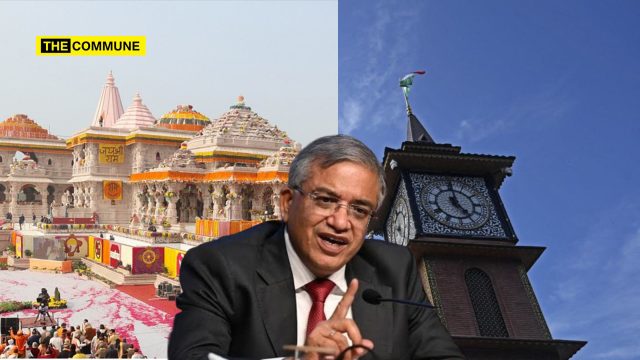
Gyanesh Kumar, who is facing scrutiny over reported disagreements within the Election Commission of India (ECI) regarding the Special Intensive Revision (SIR) of electoral rolls, had played an important bureaucratic role in two of the Narendra Modi government’s most significant decisions: the abrogation of Article 370 in Jammu and Kashmir and the establishment of the trust for the construction of the Ram temple in Ayodhya.
As reported in Economic Times, Kumar, a 1988-batch Indian Administrative Service (IAS) officer of the Kerala cadre, became India’s 26th Chief Election Commissioner (CEC) on 19 February 2025. Before taking charge of the poll body, he held several senior positions in the Union government, including in the Ministry of Home Affairs, where he handled matters relating to Jammu and Kashmir, Ladakh and Ayodhya.
His role in these assignments has drawn attention to his administrative responsibilities during two major political and constitutional developments under the Modi government.
Gyanesh Kumar’s Role In The Abrogation Of Article 370
Following the Pulwama terror attack in February 2019, Prime Minister Narendra Modi reportedly directed then Union Home Secretary Rajiv Gauba to initiate work on the government’s response concerning Jammu and Kashmir. Gauba subsequently assigned tasks to a small group of officers, including Gyanesh Kumar, according to an account of the episode in a book on the abrogation of Article 370.
One of the key tasks was to prepare the constitutional and legislative measures required to remove Article 35A and facilitate the abrogation of Article 370, which had granted Jammu and Kashmir special constitutional status.
The account describes Kumar as playing a significant role in keeping the preparations confidential. He reportedly worked on files that would ordinarily have been handled by junior officials and prepared 12 drafts of the proposed legislation as the government worked towards its objective.
On 5 August 2019, Kumar was tasked with obtaining the President’s signature on Constitutional Order 272. The order applied provisions of the Indian Constitution to Jammu and Kashmir and formed part of the legal process through which the Modi government moved to effectively render Article 370 inoperative.
The government subsequently introduced resolutions and legislation in Parliament to reorganise the former state into the Union Territories of Jammu and Kashmir and Ladakh.
The proposals were introduced in the Rajya Sabha on 5 August 2019, in a move that triggered protests from Opposition members, some of whom objected to the manner in which the proceedings were conducted. Parliament passed the measures, marking a major constitutional and political shift in the status of Jammu and Kashmir.
Kumar’s involvement in the preparatory work placed him among the senior bureaucrats who helped implement one of the Modi government’s most significant political decisions.
How Kumar Was Linked To The Formation Of The Ram Temple Trust
Kumar also held responsibilities connected to the establishment of the trust tasked with overseeing the construction of the Ram temple in Ayodhya.
On 9 November 2019, the Supreme Court delivered its verdict in the Ayodhya title dispute, paving the way for the construction of a Ram temple at the disputed site. The Court directed the Union government to formulate a scheme for the establishment of a trust to manage the construction and related arrangements.
In January 2020, the Union Home Ministry reorganised some of its internal security divisions, bringing the Ayodhya desk under Kumar’s charge. He was also handling matters relating to Jammu and Kashmir and Ladakh at the time.
The desk was involved in the process leading to the formation of the Shri Ram Janmabhoomi Teerth Kshetra trust, which was formally announced by the Union government in February 2020.
The trust subsequently took charge of the temple project and fundraising efforts. Donations were collected from individuals and organisations across the country to support the construction of the temple complex.
The trust’s fundraising drive reportedly mobilised more than ₹3,500 crore, reflecting the scale of public contributions towards the project.
Kumar’s administrative responsibilities during this period linked him to the government’s implementation of the Supreme Court-directed process for establishing the trust.
From Senior Bureaucrat To Chief Election Commissioner
After his assignments in the Home Ministry, Kumar served as Secretary in the Ministry of Parliamentary Affairs and later as Secretary in the Ministry of Cooperation. He joined the Election Commission as an Election Commissioner in March 2024 and became CEC in February 2025.
His appointment came under the 2023 law governing the selection of election commissioners, which replaced the Chief Justice of India on the selection panel with a Union Cabinet minister. The panel comprises the Prime Minister, a Union Cabinet minister and the Leader of the Opposition in the Lok Sabha.
Kumar’s tenure has since attracted political scrutiny, particularly over the ECI’s SIR exercise and allegations raised by opposition parties concerning electoral rolls. A report by The Indian Express alleged that fellow Election Commissioners Sukhbir Singh Sandhu and Vivek Joshi had formally objected on at least 14 occasions over 10 months to certain decisions and orders that they alleged had been issued without their knowledge. The ECI has maintained that its final decisions, including those relating to SIR, were unanimous.
Subscribe to our channels on WhatsApp, Telegram, Instagram and YouTube to get the best stories of the day delivered to you personally.