Newslaundry’s claim that it has “nothing to hide” and welcomes complaints is facing fresh scrutiny after two former employees publicly came forward with accounts of their experiences at the organisation, including allegations of a hostile work environment and serious concerns over how its Internal Complaints Committee (ICC) handled a complaint.
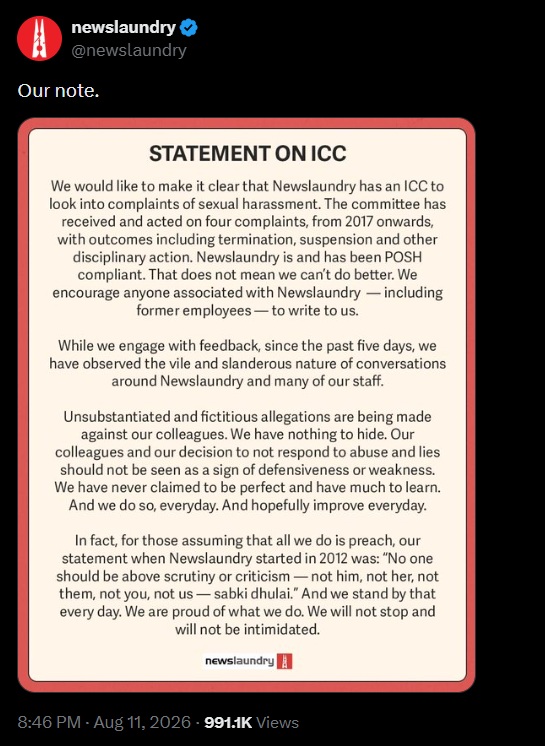
The accounts emerged after Newslaundry issued a statement defending its ICC, saying it had received and acted upon four complaints since 2017, with outcomes including termination, suspension and other disciplinary action. The organisation also invited former employees to write to it.
At the same time, however, Newslaundry described conversations surrounding the organisation as “vile and slanderous” and said “unsubstantiated and fictitious allegations” were being made against its colleagues.
The response has now been followed by detailed testimonies from former employees.
Former Reporter Details Hostile Work Environment
Former Newslaundry reporter Shivani Verma publicly responded to the organisation’s invitation, saying she was putting her experience “again” on record.
Verma said she joined Newslaundry as an intern in 2020 and described the following 10 months as “the worst days of my career”. She alleged that her manager, Chitranshu Tewari, would shout and scream during one-on-one calls and repeatedly make her feel that her work was not good enough.
“I remember being scared before 1-on-1s with him,” she wrote, adding that the experience affected her confidence and self-esteem.
Verma said she eventually raised the issue with Abhinandan Sekhri, after which an apology was made and the situation temporarily improved. According to her, however, the improvement lasted only about a month.
She also described an incident involving a story she wanted to pursue. Although the idea had been approved by Manisha, Verma alleged that Tewari objected to her approaching the editorial team without first seeking his permission.
She said she eventually resigned in June 2021 after the situation worsened. In her resignation communication to Sekhri, she said she explicitly raised concerns about the hostile work environment and its impact on her “productivity, efficiency and mental health”.
According to Verma, her resignation was accepted, but she did not receive any further communication regarding the concerns she had raised.
She said she subsequently struggled to explain to prospective employers why she had left Newslaundry after such a short stint.
Verma also stressed that she did not hold every Newslaundry employee responsible for her experience and acknowledged colleagues who had supported her.
But she took particular issue with the organisation now describing allegations as “fictitious”, “unsubstantiated” and “lies”.
“People who are coming forward deserve to be heard,” she wrote.
She added: “Just because the work an organisation does makes a difference, that doesn’t mean everything happening within its newsroom is above scrutiny.”
Since Newslaundry is now encouraging anyone associated with the organisation, including former employees, to write to them, here’s my experience (again), but publicly.
(long thread) https://t.co/q76xT5Oj7j
— Shivani Verma (@verma_shivani12) August 12, 2026
Earlier Anonymous Account Also Alleged Harassment By Tewari
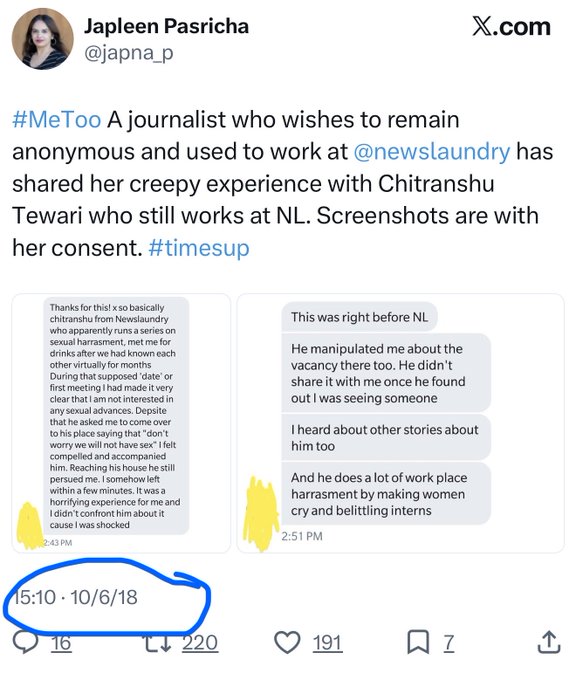
An earlier account from during the 2018 #MeToo era has also resurfaced, in which a journalist who wished to remain anonymous described what she called a “creepy experience” involving Chitranshu Tewari.
According to the account, Tewari allegedly pursued her after they had met and later invited her to his residence, where she said he continued pursuing her despite her lack of interest. She described the experience as horrifying and said she did not confront him about it because she was shocked.
In accompanying messages, the journalist also alleged that Tewari had spoken to her about a vacancy at Newslaundry and stopped sharing information about it after realising she was seeing someone.
The messages further alleged that she had heard “other stories” about him and accused him of creating a workplace environment where he made women cry and belittled interns.
Former Producer Calls Newslaundry “Toxic Workplace”, Says She Felt Unsafe Working Late
Former Newslaundry producer Bhadra Mahapatra also shared her experience at the organisation, saying the accounts of several former employees, particularly women, encouraged her to speak about her own experience.
Mahapatra said she had worked in other newsrooms before joining Newslaundry and described them as having “their share of toxicity”, but called Newslaundry “by far the most toxic place” she had worked, particularly when it came to safety.
She recalled being assigned to cover the JNU presidential elections during her first month of probation. As the assignment extended late into the night, Mahapatra said she left around 11 pm after informing her colleagues because she had to travel to Noida. According to her, her manager reprimanded her the next day, questioning who had given her permission to leave and telling her that she could not leave an assignment without his approval.
Mahapatra said the manager did not ask whether she had reached safely. She alleged that she subsequently stayed alone in the office to edit stories and took private cabs home after midnight. While the cab expenses were reimbursed, she said this did not address the safety concerns.
After feeling unsafe during one such journey, Mahapatra said she decided to use the metro and avoid staying at the office beyond 10 pm. She claimed that colleagues sometimes made backhanded remarks about her leaving “so early”.
She also described the organisation as feeling like “an all boys club”, where women were present largely for tokenism.
Despite her criticism, Mahapatra said she continued to appreciate Newslaundry’s work and had met supportive people there and learned a lot. “Great output of an organisation doesn’t mean we should ignore the working conditions of the place,” she said.
“I choose my safety over career, growth,” Mahapatra wrote. “I hope women employees aren’t forced to choose between safety or career. We deserve better.”
Many ex employees, especially women employees are sharing their experiences, and I am so proud of them.
It has encouraged me to share my ordeal as well.
P.s it will be a long thread. https://t.co/PF9qEsGnDb— bhadramahapatra (@bhadra_04) August 13, 2026
Former Employee Questions Newslaundry’s ICC Process
Another former employee, Priya, who had previously spoken publicly in connection with the controversy surrounding Newslaundry’s handling of a letter concerning the Tehelka sexual assault case involving Tarun Tejpal, also addressed the organisation’s latest statement.
Priya specifically questioned Newslaundry’s claim about its ICC.
She alleged that during her ICC hearing, one of the members “didn’t even bother to look at me, or engage with me”, adding that the process did not feel like a safe space.
She further said she was never formally informed about who constituted the ICC or who would participate in her hearing.
“I know there were 5 people. I am not sure if the 5th person was even part of ICC. I’m still not sure, it’s been 3 years,” she wrote.
More seriously, Priya alleged that she was never formally informed about the outcome of the proceedings or what action had been taken.
“I was never formally communicated about the judgment, what action was taken, and I still don’t know what was your redressal mechanism?” she said.
According to Priya, the experience itself was traumatic and left her feeling lost about what had happened and how the process worked. She said that experience discouraged her from approaching the ICC again when she subsequently faced what she described as “another trauma” at Newslaundry.
I was 23 when I joined Newslaundry. This is my note to you @newslaundry
And my experience with the your ICC.
— Priya (@phoenix_wing16) August 12, 2026
Former Employee’s Detailed Account Of Experience At Newslaundry
A few days ago, when the issue was boiling over, another former Newslaundry writer, Sayantan Ghosh, also came forward with a detailed account of his experience at the organisation.
Ghosh said he joined Newslaundry as a trainee journalist in 2016 after leaving a content-writing job in Bengaluru.
According to his account, the working environment he experienced was “extremely toxic”, particularly because of the language allegedly used by Abhinandan Sekhri towards employees.
He wrote, “The language used by Abhinandan Sekhri towards employees was deeply hurtful to me.”
Ghosh said colleagues had told him that such behaviour was simply “normal” in the media and that journalists needed to develop a thick skin.
He disagreed.
“But it was not normal to me.”
Ghosh compared his experience at Newslaundry with his earlier internships at The New Indian Express and The Telegraph, saying that he had not encountered editors abusing reporters or interns in the manner he claimed to have experienced at Newslaundry.
He recalled one particular incident after he had written a story concerning Section 66A.
“One day, after I wrote a story on Section 66A, the abuse was so harsh that I remember lying to the person I was reporting to and fleeing.”
He said he remained in Delhi for another week until his parents could arrange a train ticket, after which he returned to Kolkata.
Ghosh said he had considered writing about his experience several times but had been reluctant because he feared being bullied or intimidated.
“I knew how people could be bullied and intimidated, and for a long time I doubted myself.”
He concluded, “Today, as many people are talking I think it was important for me to speak up.”
I think it is time to speak up.
I joined Newslaundry as a trainee journalist in 2016—I cannot recall the exact month—with a dream. I had just passed out of college and wanted to do the kind of independent journalism I believed in. At the time, I was working as a content writer… https://t.co/DPIQsiW8Lj
— Sayantan Ghosh (@sayantan_gh) August 9, 2026
An ICC Existing On Paper Is Not The Same As A Safe Complaint Mechanism
Newslaundry’s statement prominently cites the existence of its ICC and says the committee has acted on four complaints since 2017.
But the testimonies now emerging raise a more basic question: what did that process actually feel like for the people who used it?
Verma’s account concerns an alleged hostile work environment and the failure to adequately address concerns she says were raised with senior management. Priya’s account directly questions the transparency, communication and functioning of the ICC itself.
Dismissing allegations as “fictitious” and “lies” while simultaneously inviting former employees to come forward is an obvious contradiction.
If Newslaundry genuinely wants scrutiny, the accounts of former employees should not be treated as inconvenient noise. They should be examined on their merits.
For an organisation that has built its public identity around scrutinising others and preaching from the pulpit, the scrutiny cannot stop at its own newsroom door.
Subscribe to our channels on WhatsApp, Telegram, Instagram and YouTube to get the best stories of the day delivered to you personally.