


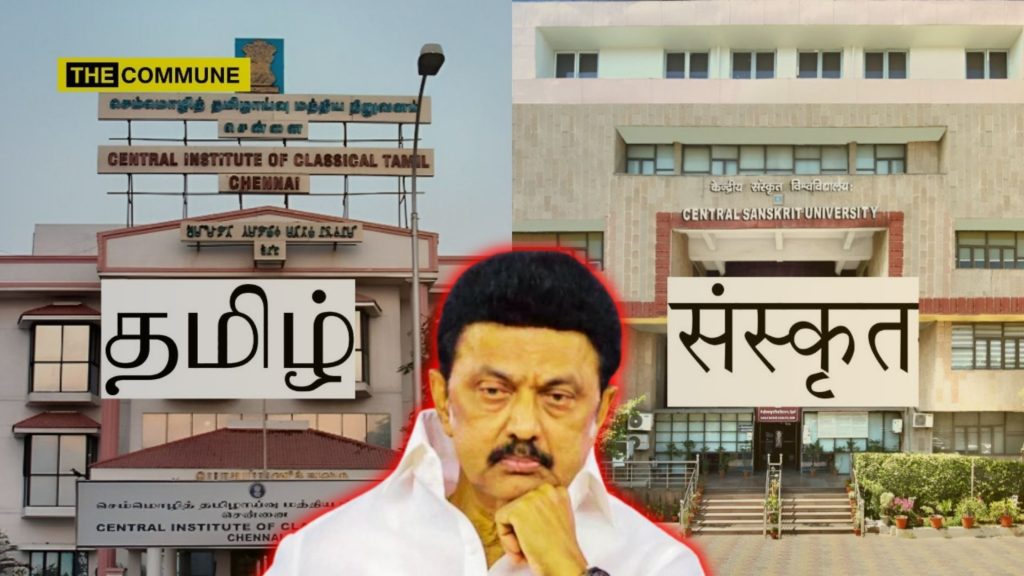
The unapologetic Dravidian camp continues to push narratives aimed at fueling resentment against the central government by repeatedly invoking Tamil identity and sentiments. This pattern began with accusations that the Centre was sidelining Tamil heritage, notably through a peer-reviewed article in a newspaper alleging that the Archaeological Survey of India (ASI) failed to properly recognize the Keeladi excavations — a claim that has since been discredited.
Now, their latest line of attack suggests that Sanskrit is receiving disproportionate funding compared to South Indian languages under the Ministry of Education. However, this claim omits key context: the funds in question are allocated to key 18 Central Universities including Central Sanskrit Universities (CSUs), established under the Central Sanskrit Universities Act, 2020, with campuses in New Delhi and Tirupati. Meanwhile, the Central Institute of Indian Languages (CIIL) in Mysuru continues its mandate to support and promote all Indian languages — including the four classical South Indian languages: Kannada, Telugu, Malayalam, and Odia.
A recent report has stirred controversy by revealing that the central government allocated ₹2,532.59 crore for the promotion of Sanskrit between 2014-15 and 2024-25 — a figure approximately 17 times higher than the combined expenditure of ₹147.56 crore for the other five classical languages: Tamil, Telugu, Kannada, Malayalam, and Odia. This information, sourced through a Right to Information (RTI) request and public records by Hindustan Times, was amplified by pro-DMK journalists such as Arvind Gunasekar, adding further fuel to the debate.
However, critics argue that this disparity needs to be seen in context. The central government runs three Sanskrit universities that were originally established in Congress era. Among the crucial three operating budgets for these institutions now range between ₹150 to ₹200 crore annually, accounting for nearly ₹1,500 crore over the past decade. Of the ₹2,345 crore reportedly spent on Sanskrit, this comprises the overwhelming majority.
In contrast, universities promoting regional languages are typically established and funded by the respective state governments, as Sanskrit is not the primary language in any of the states except Himachal Pradesh and Uttarakhand. The central government does provide limited financial assistance to such institutions, including support for specialized centers like the Central Institute of Classical Tamil.
Importantly, the trend of funding Sanskrit heavily is not new. During the Congress UPA administration (2004–2014), six Sanskrit universities were established in various states — including Assam and Andhra Pradesh, both governed by the Congress at the time. These institutions are state-run but affiliated with the University Grants Commission (UGC).
There is no substantial evidence to suggest a shift in funding policy under the current administration that disadvantages other classical languages. In fact, examining past budget allocations under the UPA dispels claims of bias. For example, in 2009–10, Sanskrit received ₹120.58 crore, while Tamil was allotted ₹9.75 crore and other classical languages received just ₹1.34 crore. In 2010–11, allocations stood at ₹119.15 crore for Sanskrit, ₹11.21 crore for Tamil, and ₹1.3 crore for the others. Similarly, in 2011–12, Sanskrit was granted ₹134.58 crore, Tamil ₹9.36 crore, and others ₹2.02 crore.
What’s more, during that very period, the DMK — which now vocally criticizes these funding patterns had six of its members serving as Union Cabinet ministers, yet raised no significant objections to the allocation disparities at the time.
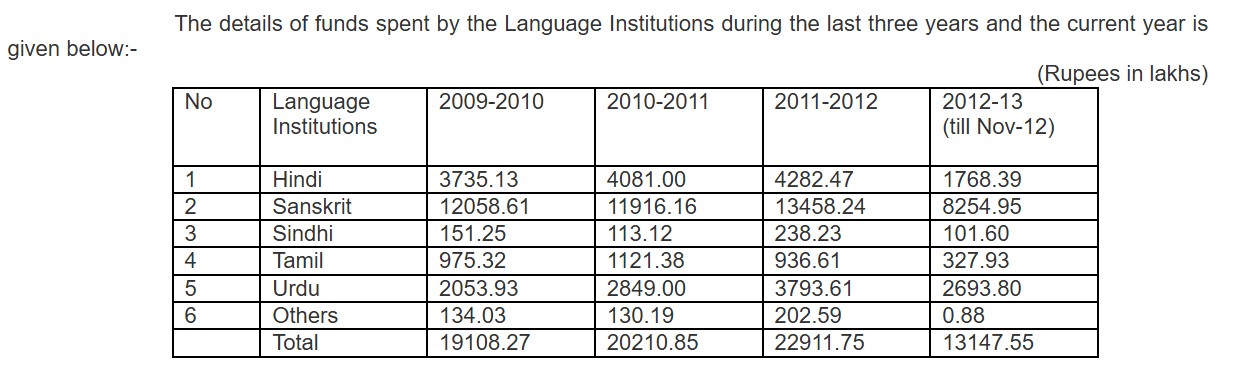

In many years, Tamil alone received more funding than Kannada, Malayalam, and Telugu combined — a fact supported by data. Unless the government chooses to either shut down the three central Sanskrit universities or begins establishing and funding similar institutions for other classical languages, funding disparities will naturally remain. Curiously, there was little public outrage over this imbalance during the UPA era, particularly between 2004 and 2011 — a period when these policies were already in place.
Contrary to the claims made by the Dravidianist ecosystem—particularly the DMK—there is currently only one university in Tamil Nadu dedicated solely to the study of classical Tamil: Tamil University in Thanjavur. This public state university, focused on advanced research in the Tamil language, was established in 1981 not by the DMK, but by former Chief Minister M.G. Ramachandran during an AIADMK-led government.
Additionally, the Central Government has taken steps to promote Tamil through the establishment of the Central Institute of Classical Tamil (CICT), which operates under the Ministry of Education. The CICT, originally announced in 2006, is tasked with the development and promotion of classical Tamil at the national level.
Central Govt.runs 3 Sanskrit Universities all started in the 60's and 70's . The budget for running these 3 Universities has increased to ₹150-200 crore for all 3 together per annum and this alone is almost ₹1500 crore over 10 years. Of the ₹2345 crore spent on Sanskrit over… https://t.co/zG3Y7Umr9k pic.twitter.com/pF5NLPBKTi
— Sumanth Raman (@sumanthraman) June 24, 2025
Yet, despite these institutions already in place, Dravidian parties continue to demand more central funding—without taking concrete steps to establish new universities or programs that would make Tamil a viable academic and economic option for students, educators, and researchers. Rather than building meaningful infrastructure, the issue is often reduced to political rhetoric, framed in opposition to the Centre’s support for Hindi and Sanskrit.
Subscribe to our channels on Telegram, WhatsApp, and Instagram and get the best stories of the day delivered to you personally.