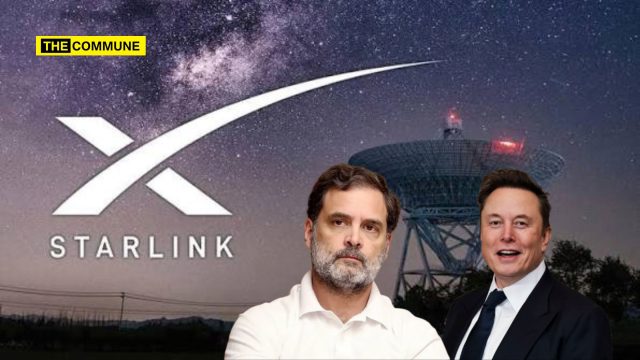
“Thank you, Rahul. This is indeed troubling.” Seven words from Elon Musk on 8 October, and a licence file sitting with India’s security agencies turned into a political weapon.
Musk had complained that powerful business interests were blocking Starlink in India, and he pointed straight at Mukesh Ambani. Rahul Gandhi replied within hours: “Welcome to India, Elon. Wait till you discover the other guy.” He named no one. He did not need to.
So in a single day the world’s richest man and India’s most prominent opposition politician were telling the same story to the same global audience: India does not have a regulator, it has a gatekeeper for oligarchs.
The government’s answer was dull, and it was correct. Security assessment is still under way for all three satellite licensees: Starlink, Bharti-backed Eutelsat OneWeb and Jio’s satellite venture. A preliminary approval is not a permission to switch on. And Musk declaring himself fully compliant is a press statement. It is not a clearance.
Here is my position, stated plainly. Nobody is owed a place inside India’s communications backbone. Not a celebrity billionaire, not a company with a friendly politician, not a vendor promising cheap internet. You earn that access by proving compliance to Indian authorities, on Indian terms.
The Man Asking For Our Trust
Start with the record, because Musk would prefer we start with the tweet.
On 26 November 2021 the Department of Telecommunications publicly warned that Starlink was taking bookings from Indian customers without holding an Indian licence, and ordered it to stop immediately. Read that again. The company’s first serious act in India was to sell before it was allowed to sell.
Then look at X. Fairness first: the blocking orders that cost Twitter ₹50 lakh in the Karnataka High Court in June 2023 were issued before Musk bought the company, and that defeat is not his. What came after is his. Under Musk, X went to court against Sahyog, the government’s content-takedown system. A single judge threw the petition out in September 2025. The fight goes on, and as recently as last month the Centre was accusing X of inadequate
cooperation while X insisted it complies fully with Section 69A orders and rejects the legal basis of Section 79 notices.
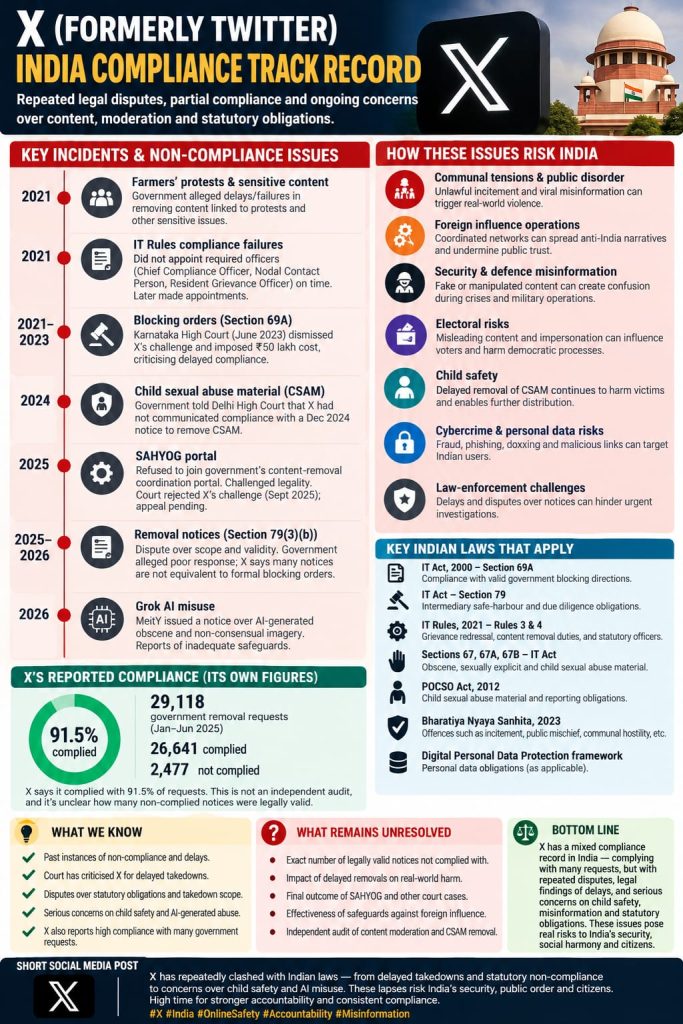
X is entitled to litigate. That is its right. But see the pattern for what it is: a man whose platform is in open, running combat with the Indian state over whose rules apply now wants that same state to hand him the sky. And when the state takes its time, he does not go to the regulator. He goes to his own megaphone.
One Man, Three Levers
A foreign newspaper can shape how India is described. A social platform decides what Indians see, what trends and what disappears. A connectivity provider decides whether you are online at all.
Elon Musk owns the second, wants a licence for the third, and through sheer reach commands a good share of the first. Add Grok, his AI system, which millions now ask for the “facts”. In this very row people were quoting Grok on Starlink’s pricing as if a chatbot owned by the seller were a neutral witness.
Watch how the levers worked this week. A licensing grievance was posted on X. It became an international headline about India’s investment climate. An Indian politician picked it up and made it a domestic attack line. And it lands on the table just as trade negotiators sit down. Four steps, one owner at the start of the chain.
The Missing Link. No single lever is the danger. The danger is one hand on all of them. Once the pipe, the platform and the narrative answer to the same person, he never needs to threaten India. He only needs India to remember who holds the switch. This is my reading of the pattern, not a documented plan, and I am stating it as exactly that.
The Switch Has Already Been Used
If that sounds theoretical, look at where the switch has already been thrown.
Myanmar, October 2025. SpaceX announced it had disabled more than 2,500 Starlink kits around suspected scam centres. Good riddance to the scammers. But note the two lessons. Starlink dishes had been feeding criminal compounds in a place where normal networks were restricted. And the company could kill thousands of connections from an office on another continent, at a moment of its own choosing.
Ukraine, 2022. A Reuters investigation, citing people familiar with the order, reported that Musk personally instructed that coverage be cut during a Ukrainian counteroffensive. The timing and motive remain disputed. The
capability is not. One man’s judgement was reported to have reached into a live battlefield.
July 2025. An internal software failure took Starlink down worldwide for about two and a half hours. Thousands of satellites, one point of failure.
Indonesia. New customer registrations were paused because the network ran out of capacity. So much for instant internet in every village.
Now put India’s map over that list. Ladakh. Arunachal. The Andamans. A cyclone on the Odisha coast. These are exactly the places where the argument for Starlink is strongest, and exactly the places where India can least afford a provider whose off switch sits in Texas.
Cheap Internet? Show Us The Tariff
The emotional pitch is that Starlink will connect poor and remote India. Fine. At what price?
Nobody knows. In December 2025 Starlink’s own India website showed ₹8,600 a month and ₹34,000 for the equipment. The company then withdrew the figures, calling them dummy test data from a configuration glitch. To this day there is no confirmed Indian tariff.
Jio, meanwhile, advertises home fibre from ₹399 a month plus GST. Fibre and satellite are different products, and no village on a mountain ridge is choosing between them. But the comparison tells you who this service is really priced for until proven otherwise. India is being asked to bend a security process for a product without a price tag.
And Then Rahul Gandhi Walked In
Opposition leaders should question whether Indian business houses get favours. That is their job, and Ambani and Adani are fair subjects of that scrutiny. But there is a difference between asking who benefits from a delay and cheering on a foreign applicant while Indian security agencies are still examining his file.
This is not a one-off. With Rahul Gandhi, personal enmity and party politics have always come first and the country second. Cambridge is the proof. In early 2023 he stood before a foreign audience at Cambridge University and told them that Indian democracy was under attack and that he himself was under surveillance. Days later in London he complained that the United States and Europe were oblivious to what was happening in India. He later insisted he had asked for no foreign intervention. But a man who takes his quarrel with his own government to foreign halls, and then laments that foreign capitals are not paying attention, has told us where his priorities lie.
Now he has found a new foreign audience, and this one owns a satellite constellation.
There is no evidence that Gandhi and Musk coordinated anything, and I am not claiming it. What I am asking is this: When Rahul Gandhi told Elon Musk to wait for “the other guy”, did he stop to ask what Starlink had still not satisfied in its security assessment? Did he ask whose data, whose border districts and whose disaster networks are at stake? Or was a jab at the government worth more to him than the answer?
The Pressure Will Not Come As A Threat
Reuters reports that Washington has pushed Starlink’s market access in trade discussions with India. That is on the record. A private company’s licence application is now an item of American commercial diplomacy.
The Missing Link. Nobody will ever send New Delhi a note saying “license Starlink or else”. It will come as a sequence. First the technology becomes attractive. Then the delay is framed as corruption. Then an Indian political voice confirms the framing. Then the licence appears as a line in a trade deal, and refusing it suddenly carries a price in tariffs and goodwill. I cannot show you an instruction that orders this sequence. I can show you that every step of it is already visible. Call it a deep state, call it ordinary great-power commerce: the effect on India’s room to say no is the same.
Let Him In On India’s Terms, Or Not At All
None of this is an argument for a ban. It is an argument for a price of entry, and India should name it without embarrassment:
Security oversight tested by Indian agencies, not certified by the applicant. Lawful interception under due process. Routing and data handling that can be audited. Every terminal traceable to an accountable user. Mandatory incident reporting. Continuity guarantees with penalties that hurt. Backup links and rehearsed recovery plans for every critical user. And the same rules for Bharti and Jio as for Musk, published openly, so that nobody can cry favouritism.
If Starlink meets that bar, let it serve the islands and the mountains, and welcome. If Elon Musk would rather fight the bar on X than clear it at the Department of Telecommunications, India has learned what it needed to know.
Digital sovereignty is not about who owns the satellites. It is about who can enforce the rules, and who keeps the lights on when the friendship ends.
AK is an IT professional with 25+ experience in BFSI sector. He is a Political Analyst and founder of @dharmic_indians. Also serves as Governing committee member of @AalayamKaappom foundation.
Subscribe to our channels on WhatsApp, Telegram, Instagram and YouTube to get the best stories of the day delivered to you personally.