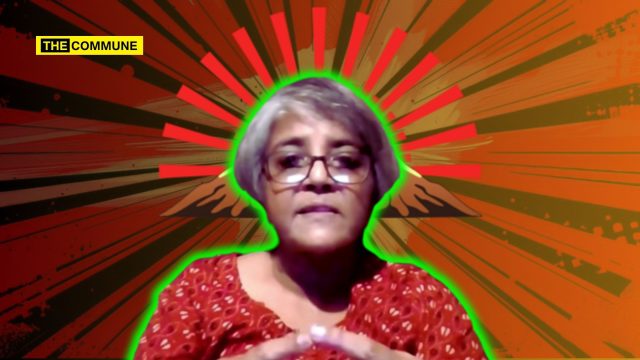
A recent episode of The News Minute’s “South Central” podcast, which positioned itself as a nuanced discussion on Hindutva, instead revealed a deep-seated bias and a troubling reliance on stereotypes from its panelists. The conversation, featuring academic V Geeta and ‘journalists’ Dhanya Rajendran, Anisha Sheth, and Sudipto Mondal, was less an analysis and more an exhibition of the very intellectual laziness and prejudice they claim to oppose.
For the section on RSS marches in Karnataka, the main guest Geeta was invited to spew her form of venom at Hindus and the RSS.
Selective Outrage: The Authoritarian Blind Spot
Geeta correctly identifies that fascism has two aspects: an authoritarian state apparatus and an ideology that builds consensus. She brilliantly uses the example of J Jayalalithaa’s rule in Tamil Nadu to illustrate an authoritarian state without the Hindutva ideology, citing the muzzling of the media and the crippling of democratic institutions. She says, “But Tamil Nadu has seen the reign of J Jayalalithaa. And we must not forget those years. Those years were the most authoritarian years in the history of Tamil Nadu. The different segments of time that she served as Chief Minister of the state. You’ll see how she systematically crippled all democratic institutions, including the media. I still remember the time KP Sunil of The Week was in the eye of a storm for having written something very critical about her. Then the government hit back, and over a period of time, Sunil found himself landing a job in Jaya TV. So, I mean, it’s a very interesting sort of approach that she had, not very dissimilar to what we see happening around us today.”
She further adds, “And I mean, I can quote so many things at point: every feature that you see that is part of the way the government at the centre functions today in muzzling speeches, cracking down on dissent, in defining what is legitimate and what is not. All of this has been precedence in Jayalalithaa-ruled Tamil Nadu, in NTR-ruled Andhra Pradesh, and Telangana in the past. Why I’m saying this is, fascism need not always be aligned with an ideology; it has two aspects, right? Hindutva has two aspects: one is an authoritarian state apparatus which goes all the way down and is seen as a good thing by sections of the population. And then an ideology which wants to draw more and more people into this consensus.”
This critical lens mysteriously vanishes when discussing the current DMK government under M.K. Stalin. She says, “Now in Tamil Nadu, you may not have the ideology, but you have the constituents of an authoritarian state, which has been put in place by Jayalalithaa during her several years in power in the state. And I don’t think that the DMK has rolled back those measures fully. And in some ways, they’ve layered them with a veneer of democratic practice, in some instances, they’ve sort of not worked with those constituents. I mean, their attitude toward the media is still relatively more open than in most parts of the country, but the fact is that you have these authoritarian resources at hand.”
She finds Stalin’s government “more open to the media” but her mouth is glued shut when people are arrested in Tamil Nadu for exercising freedom of speech! Where is her critique of the Stalin government’s treatment of netizens who get arrested for speaking against DMK? There have been multiple instances of police complaints and arrests of journalists and social media users for posts critical of the government. The recent example being the arrest of a septuagenarian YouTuber for a critical video regarding the recent Karur stampede or the filing of cases against journalists for their reporting.
Where is her condemnation of the state’s overreach in silencing dissent? By her own definition, the “authoritarian state apparatus” is alive and well in Tamil Nadu. Yet, she offers the DMK a free pass, merely saying they have layered Jayalalithaa’s measures with “a veneer of democratic practice.” This is a staggering failure to apply her own analytical framework consistently. If she condemns authoritarianism under the BJP and JJ, her silence on the DMK is a politically motivated omission.
The “Saffronization” Bogeyman Vs. The “Dravidian” Sanctity
Geeta expresses shock at the “saffronization” of Pondicherry University and private schools, framing it as an RSS infiltration. She describes the “Brahmanical Hindu ways” of elite Chennai schools as a problem.
Herein we see the Hypocrisy and logical fallacy of this so-called “academic”. What is the fundamental difference between “saffronization” and the long-standing “Dravidianization” of Tamil Nadu’s institutions?
For decades, Tamil Nadu’s government machinery, textbooks, and public discourse have been steeped in Dravidian ideology. If promoting a particular political and social ideology in educational spaces is wrong, then both are culpable. To label one as “infiltration” and the other as a “sense of place” is a classic case of partisan framing.
She claims the RSS’s script is “50 years old” and “banal.” Is the Dravidian movement’s script, which constantly recycles anti-Brahmin, anti-North Indian, and anti-Hindi rhetoric, any fresher or more nuanced? Both movements rely on historical grievances and identity politics. To mock one for its repetitive nature while giving the other a pass is intellectually dishonest.
The False Equivalence And The Lathi Anecdote
The discussion on the RSS’s use of the lathi (staff) is revealing. Geeta dismisses the idea of comparing an RSS march to a religious event but fails to provide a coherent reason why a lathi in a shakha is inherently more threatening than other symbols.
The lathi has been a traditional Indian staff used for centuries as a walking aid, in martial arts like Silambam, and by ascetics. To singularly assign it a malevolent, “weaponized” meaning only in the context of the RSS is a deliberate misrepresentation.
By this logic, should the swords carried in religious processions during festivals like Muharram also be uniformly banned from public spaces? If not, the focus on the RSS’s lathi is not about the object itself, but about the organization wielding it.
The “Circular Banality” Critique That Boomerangs
Geeta’s most potent point is her analysis of Hindutva’s “circular banality” – its reliance on endless repetition of the same themes (Love Jihad, Temple freeing) because it cannot admit historical change.
It is her own hypocrisy that undermines her entire argument. Does the Dravidian political space not suffer from the same ailment? How many elections have been fought and won on the same, tired tropes of “Hindi imposition,” “Brahminical domination,” and “protecting Tamil pride”? The Dravidian model’s political script is just as repetitive and reliant on stoking historical and social divisions.
When Geeta says, “We’re stuck in the circular banality more than them,” she accidentally stumbles upon the truth. The “secular-left” opposition, of which she is a part, has failed to create a new, forward-looking language. It remains trapped in a reactive mode, forever defining itself in opposition to Hindutva and thus, as she correctly fears, “fighting the battle on their terms.”
To be a truly critical public intellectual, one must be an equal-opportunity critic. V Geeta’s analysis fails this test. Her scholarship is weaponized against one side of the political spectrum while providing intellectual cover for the other. It was yet another episode of the four people making ‘banal’ comments inside their echo chamber.
Subscribe to our channels on WhatsApp, Telegram, Instagram and YouTube to get the best stories of the day delivered to you personally.