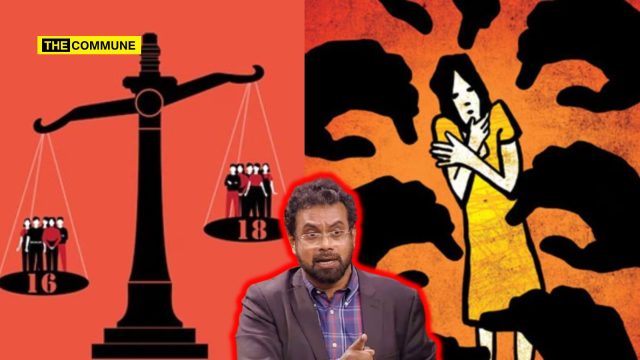
During a debate on amendments to the POCSO Act, CPI(M) Rajya Sabha MP John Brittas argued that the age of consent should be revisited and possibly lowered from 18 to 16, citing court observations about consensual adolescent relationships. He simultaneously stressed the need for children to receive early awareness about sexual abuse.
Brittas said that courts, including the Supreme Court, had faced difficulties when dealing with cases involving teenage boys and girls, remarking: “The age of consent under POCSO which is at present 18 years poses difficult questions… The MP High Court said the age should be reduced to 16.”
He argued that children and parents should be given structured awareness through schools, saying, “Proper awareness should be imparted… Many children do not know whether it is abuse or not.”
Brittas’ Speech Contradicts Himself
However, his own speech revealed a contradiction that has long surrounded the age-of-consent debate – If the core problem is that “children don’t know what abuse is,” then lowering the age at which the law recognises them as able to “consent” does not solve that problem – it deepens it.
POCSO is built on the premise that minors cannot meaningfully consent because they often cannot distinguish affection, pressure, fear or manipulation from consent. Brittas himself described how 70–80% of children remain silent out of fear, how abuse is often not recognised until adulthood, and how many victims are unable to articulate what has happened to them.
These descriptions directly underline the legal rationale for keeping the age of consent at 18: children who do not recognise abuse cannot simultaneously be treated as capable of informed consent.
Brittas also repeatedly emphasised that children are unaware of abuse, do not understand boundaries, cannot articulate violations, remain silent due to fear, and realise the nature of abuse only much later in life.
These points highlight a gap in awareness and education – not a gap in the legal age of consent.
Legally and logically, awareness is provided through curriculum and schooling; consent is a legal safeguard. One does not require altering the other. The law presumes minors need protection precisely because of the vulnerabilities Brittas described in detail.
POCSO’s current structure, upheld across multiple judgments treats the age of consent as a protective threshold, not an educational tool. Lowering it does not create awareness; it simply narrows the ambit of protection.
Brittas ended by urging a “victim-centric” reform of the law. But his argument raised its own unresolved question: If children need more education to recognise abuse, how does reducing their legal protection help them recognise it earlier?
Subscribe to our channels on WhatsApp, Telegram, Instagram and YouTube to get the best stories of the day delivered to you personally.