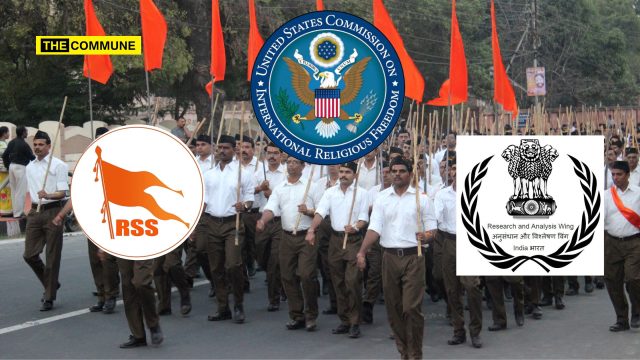
The United States Commission on International Religious Freedom (USCIRF) has, in its 2026 Annual Report, done something unprecedented – it has named the Rashtriya Swayamsevak Sangh (RSS), India’s largest and most respected cultural organisation, as a target for U.S. sanctions.
Every now and then the USCIRF publishes a ‘report’ defaming India. The November 2025 report was about “Systematic Religious Persecution in India” which read less as an objective assessment and more as a politically motivated dossier that ignores the foundational wounds of the Hindu community to paint a picture of unidirectional persecution.
In its 2026 ‘report’, they target the 100-year-old volunteer organization, the Rashtriya Swayamsevak Sangh.
What the Report Claims
The report claims that religious freedom conditions in India deteriorated in 2025, citing legislation, law enforcement practices, and mob violence that it says disproportionately affected religious minorities such as Muslims and Christians. It highlights the expansion and enforcement of anti-conversion laws in several states, which include stricter penalties and broader definitions of religious conversion. The report also discusses the use of laws such as the Foreign Contribution Regulation Act (FCRA), the Unlawful Activities Prevention Act (UAPA), and policies connected to citizenship and immigration enforcement, arguing that these measures have been used against minority communities and activists.
According to the report, the year also saw vigilante attacks and communal violence, including incidents involving mobs targeting Muslims and Christians, as well as violence linked to cow protection laws and communal tensions after a terrorist attack in Kashmir. It also raises concerns about detentions, deportations of Rohingya refugees, and expulsions of Bengali-speaking Muslims in Assam.
The report further discusses government actions affecting religious institutions, including the Waqf legislation and policies affecting religious educational institutions, which it says increased state control over minority religious bodies.
What USCIRF Recommended
The report urges the U.S. government to impose targeted sanctions on both the RSS and India’s Research and Analysis Wing (RAW) for their “responsibility and tolerance of severe violations of religious freedom”. The proposed measures include:
- Asset freezes on the organisations and their affiliates
- Entry bans into the United States for involved individuals
- Pressing India to allow U.S. bodies like USCIRF and the State Department to conduct in-country assessments of religious freedom conditions
- Linking future U.S. security assistance and bilateral trade with India to improvements in religious freedom
- Impose targeted sanctions on individuals or entities it believes are responsible for religious freedom violations.
- Restrict arms sales to India under provisions of the Arms Export Control Act.
In addition, it recommends that the U.S. Congress pass legislation requiring reporting on alleged transnational repression targeting religious minorities abroad.
What USCIRF Actually Is
USCIRF is not a neutral human rights body. It is a U.S. government-funded advisory commission with a well-documented track record of bias against non-Christian, non-Western civilisational contexts. Its commissioners have included individuals with documented ties to Islamist lobby groups, Pakistani American activist networks, and Christian evangelical missionary organisations.
Critically, USCIRF cannot impose sanctions. It has no legal authority whatsoever.
The Sources Behind the Report: Follow the Money
USCIRF’s India chapters do not emerge from neutral fact-finding. They are built almost entirely on inputs from a specific ecosystem of organisations:
The Indian American Muslim Council (IAMC), which openly celebrated this report and has historically advocated for designating the RSS as a terrorist group
Hindus for Human Rights, a U.S.-based group that consistently amplifies anti-Hindu, anti-India narratives under the cover of “human rights” language
Church-linked missionary bodies and Kashmiri separatist-adjacent networks
These are not neutral observers. These are organisations with a stated agenda: the delegitimisation of Hindu majoritarian politics in India. USCIRF launders their inputs into official U.S. government-adjacent reports, giving them a veneer of institutional credibility they do not deserve.
India’s Government Was Right to Reject It
India’s Ministry of External Affairs has consistently called USCIRF reports “biased and politically motivated” and “a deliberate agenda rather than a genuine concern for religious freedom”. In 2025, the MEA went further – calling for USCIRF itself to be designated as an “entity of concern”. That is extraordinary diplomatic language, and it is entirely justified.
India has a Constitution that guarantees equal rights to all citizens. India has an independent judiciary. India holds free elections. To compare India’s record to countries that USCIRF also designates as CPCs, countries where people are executed for apostasy, where churches are bulldozed by the state, where minority communities face genocide, is intellectually dishonest and geopolitically motivated.
In the end, the USCIRF report says far more about the ecosystem producing it than about India itself. An advisory body with no enforcement authority has attempted to place a century-old Indian volunteer organisation, the Rashtriya Swayamsevak Sangh, in the crosshairs of sanctions based on inputs from a narrow advocacy network.
Subscribe to our channels on WhatsApp, Telegram, Instagram and YouTube to get the best stories of the day delivered to you personally.