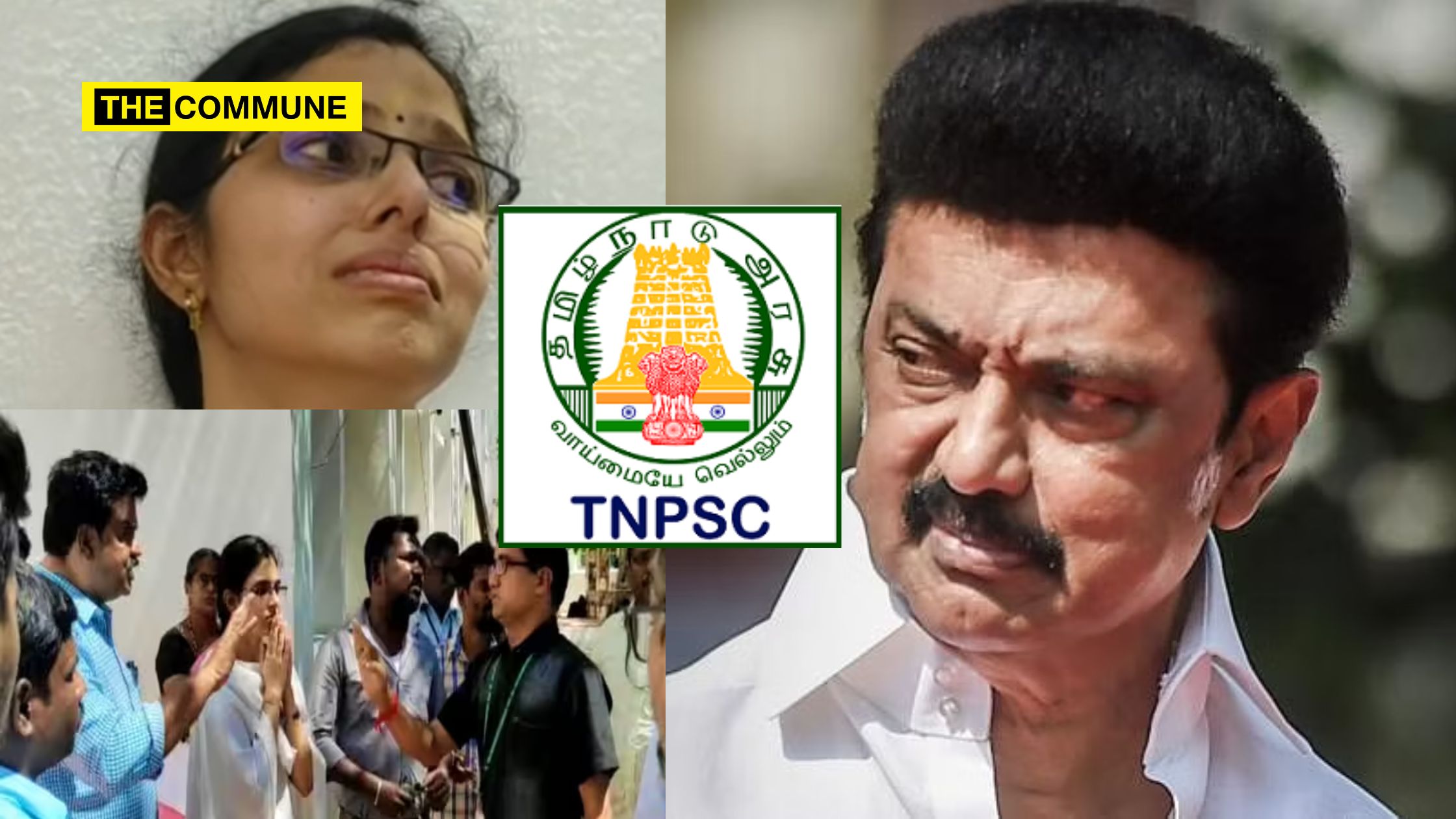
On Saturday (25 February 2023) morning, there was a commotion in several districts due to a delay in the conducting of Group II and Group II-A exam. The delay had occurred due to the incorrect distribution of question papers and answer sheets by the examiners.
On May 21, 2022, the Tamil Nadu Public Service Commission (TNPSC) held the Group 2, 2A preliminary examination for 5,529 vacancies. While 11,78,000 people applied for the exam, 1,83,285 did not take it. Approximately 9,94,878 people, or 84.44%, took the exam in Tamil.Though the TNPSC Group 2, 2A prelims results were scheduled to be released in June 2022, the results were not released until November 2022, for reasons known only to the Tamil Nadu government. 55,071 examinees passed the exam.
The TNPSC held the mains examination for the interview and non-interview posts in Group 2 on 25 February 2023. The exam which was conducted in 186 centres spread across 20 districts ended up in a fiasco with several candidates lamenting about their future. The exam was delayed due to some confusion in the distribution of question papers.
According to reports, after the examiners realized that the question paper and answer sheets were incorrectly distributed, the candidates were instructed to write the exam on an already written answer sheet, which was written by the person who received it during the previous incorrect distribution.
Furthermore, when the candidatess inquired about the incorrect register number on the OMR sheets, the invigilators misled them by claiming that those were dummy numbers.
TNPSC officials took back the question papers and answer sheets from the examinees and sent them out of the hall after realizing that the question papers and OMR sheets had been distributed incorrectly.
Some of the examinees who had phones outside the exam hall used them to look up answers to questions they remembered from the incorrectly distributed paper. It should be noted that only the question arrangements will differ from one examinee to another. The confusion and the resulting chaos caused outrage among students.
In this situation, TNPSC admitted to the confusion in the distribution of question papers and OMR sheets. TNPSC stated in a press release, “Due to a difference in the sequence of arrangement in attendance sheet order and question booklet order, there was a delay in the distribution of question booklets to the candidates.”
However, according to the department, the problem was quickly resolved, and examinations began in the centers shortly thereafter. Furthermore, the department instructed the respective districts to give the candidates extra time due to the delay in starting the exam in the morning session. Subsequently, the afternoon session examination was scheduled from 2.30 to 5.30 pm, added the press note. However, not all candidates in all centre’s were given the extra time.
Some students complained that some of the answers on the OMR sheets had already been filled in. They claimed that they could not correct answers on OMR sheets because the scan machine that corrects the OMR sheet would not allow it.
Many candidates who had spent more than a year preparing for the exam now face uncertainty. A video of a girl breaking down and lamenting about her future was covered by local media.
It is to be noted that this kind of blunder and mismanagement has never happened in the 9 decade history of TNPSC. By this episode, the DMK government has failed to provide equal opportunity in public employment according to Article 16 of the Indian Constitution.
Political leaders such as Tamil Nadu opposition leader Edappadi K. Palaniswami and PMK leader Anbumani Ramadoss chastised the DMK government for the lackasaidal attitude and in ensuring a fair conducting of exam.
“I strongly condemn this incompetent DMK government for failing to properly handle important exams such as the TNPSC exam, and I urge the ‘Vidiyaa DMK government’ (the DMK government that never dawned) to cancel the exam on conducted 25.02.23 and conduct a re-examination on another day in a proper manner,” Edappadi K. Palaniswami said on Twitter.
TNPSC தேர்வு போன்ற முக்கிய தேர்வுகளையே முறையாக கையாளத் தெரியாத இந்த நிர்வாகத் திறனற்ற திமுக அரசை வன்மையாக கண்டிப்பதுடன்,உடனடியாக 25.02.23 நடைப்பெற்ற தேர்வை ரத்துசெய்து, வேறு ஒருநாளில், உரிய முறையில் மறுதேர்வினை நடத்திட வேண்டும் என இந்த விடியா திமுக அரசை வலியுறுத்துகிறேன்.2/2
— Edappadi K Palaniswami-SayYEStoWomenSafety&AIADMK (@EPSTamilNadu) February 27, 2023
Click here to subscribe to The Commune on Telegram and get the best stories of the day delivered to you personally.
The Tamil Nadu police, which has not arrested DMK functionary Shivaji Krishnamoorthy who had abused and threatened to shoot down Tamil Nadu Governor RN Ravi with terrorists, went all the way to Gujarat to arrest a BJP cadre who had made satirical social media posts on Chief Minister MK Stalin and his father late Karunanidhi. No Action Against Man Who Abused & Threatened To Kill TN Guv
Since assuming power, the DMK has been going after its critics and other individuals who criticize the party and its leaders on social media.
The Tamil Nadu police arrested John Ravindranath alias John Ravi, son of Soundrarajan, after he tweeted taking jibes at DMK leaders MK Stalin and Karunanidhi.
John Ravi’s Tweets
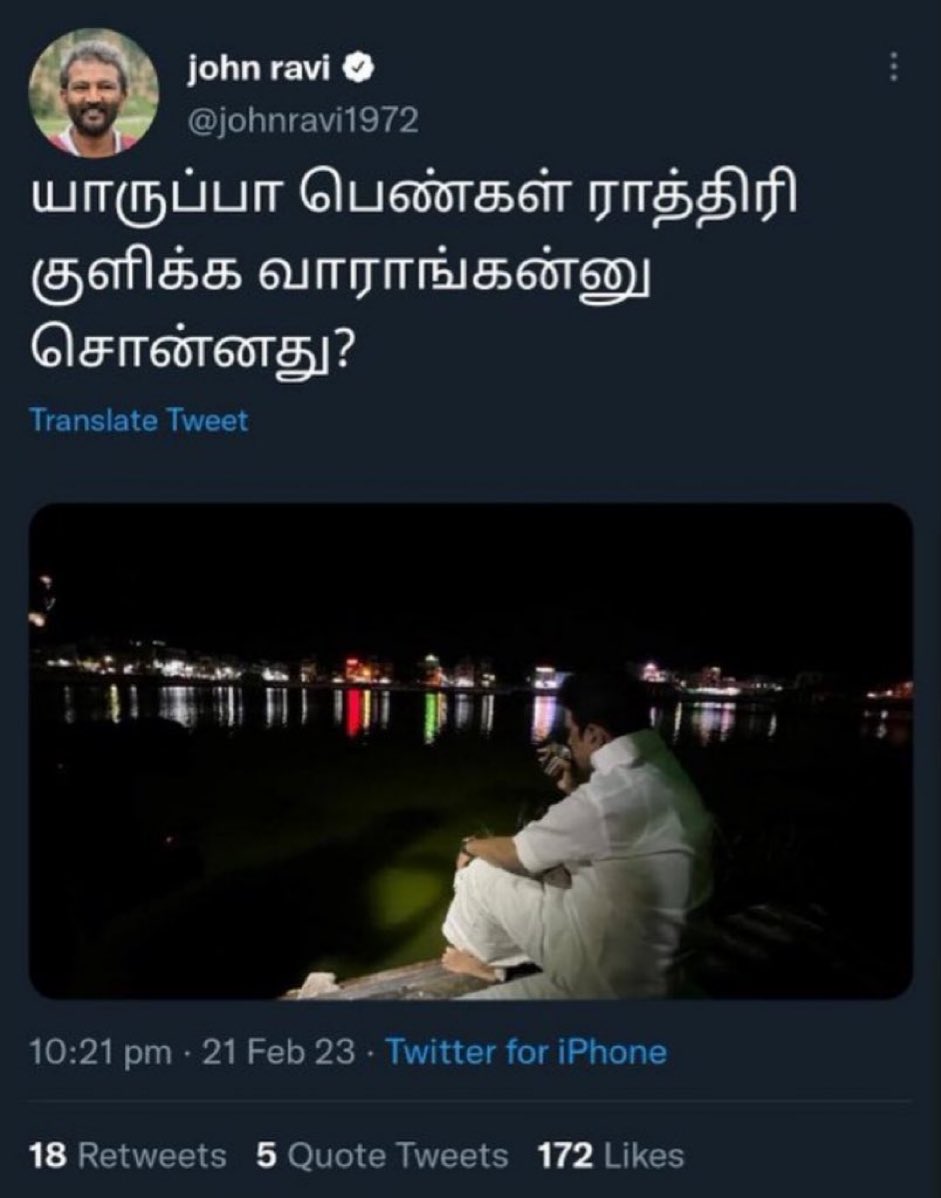
On 21 February 2023, John Ravi had posted s picture of MK Stalin sitting on the steps of Tiruvarur Temple tank with the caption “Who had said that the ladies are coming here to bathe at night?”
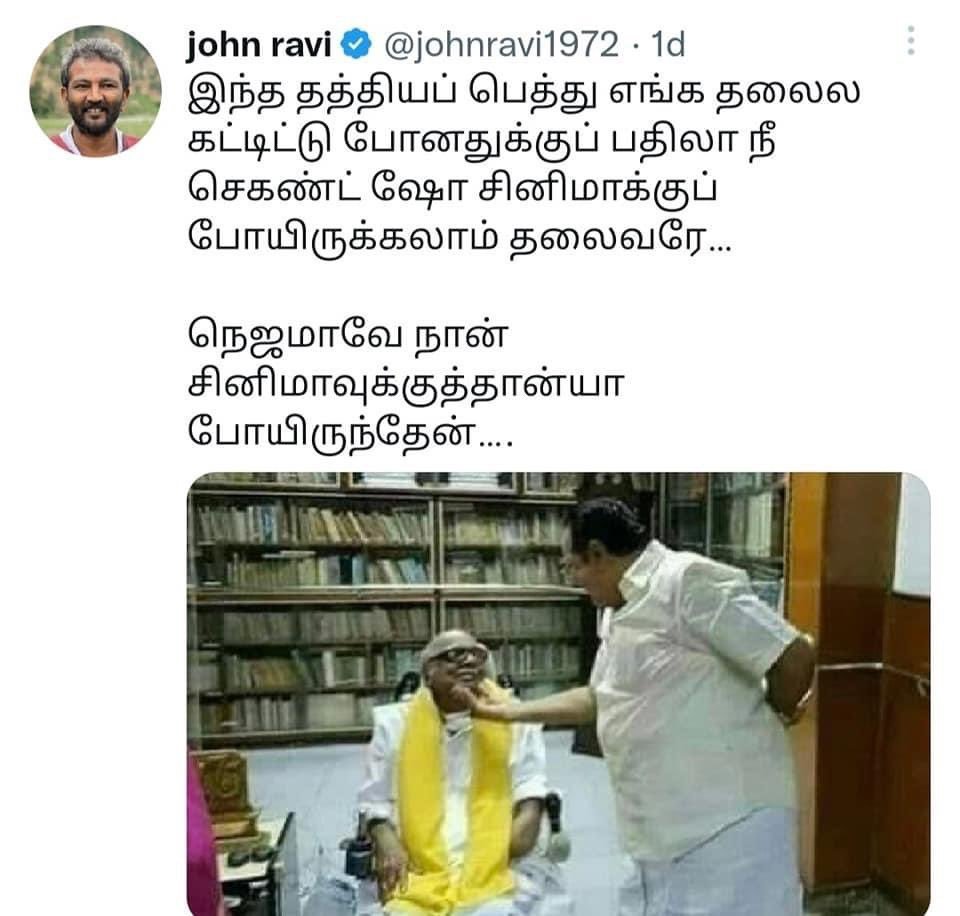
In another post, he had shared a picture where DMK Minister Duraimurugan can be seen holding Karunanidhi by the jaw with the satirical caption conveying a fictional conversation between the leaders.
Duraimurugan says “Thalaivare, you could’ve gone to second show cinema instead of giving birth to a nincompoop and burdening on our heads”, to which Karunanidhi replies “I had indeed gone to the cinemas”.
Tamil Nadu Police Or DMK’s Mercenary?
The privately run Twitter handle ‘ITW Reports’, run by the DMK IT Wing, filed a complaint against BJP cadre John Ravi. Following the filing of the FIR, John Ravi was apprehended by Tamil Nadu police, from Gujarat’s Veraval.
It is reported that the Tamil Nadu Police did not follow due process of law in filing of the FIR and during the arrest. Many noted that the police did not follow the Supreme Court’s Arnesh Kumar guidelines, which states that arrests should be made only when the punishment is more than seven years in prison.
It is said that the Tamil Nadu police allegedly broke into John Ravi’s offices in Thoothukudi, Kanyakumari, and Chennai without lawful authorization.
It is also claimed that 15 police officers knocked on the door of John Ravi’s house in Chennai when his daughter was alone late at night before arresting him. Tamil Nadu Police also asked John Ravi’s daughter, who had nothing to do with the case, to report to the Tharamani Police station in order to harass his family. However, after intervention by the BJP Lawyer wing led by Asuvathaman, the police backed off.
It is also claimed that the Tamil Nadu police did not notify John Ravi’s family about the cases filed against him and where he was being held.
In this situation, Hindu Munnani slammed the DMK government for arresting BJP cadre for a Twitter post but not arresting YouTubers like U2Brutus who abused Hindu gods and DMK leaders like Saidai Sadiq who had made obscene remarks against BJP leader Khushbu. No action has been taken against Shivaji Krishnamoorthy who had abused abused PM Modi, Tamil Nadu Governor RN Ravi and Annamalai despite complaint being filed by Raj Bhavan.
DMK’s Crackdown On Critics
Immediately after the DMK came to power, political commentator Kishore K Swamy was arrested on June 14, 2021, for allegedly ‘defaming’ DMK leaders MK Stalin, Karunanidhi and Annadurai. The arrest was made based on a complaint by a Kanchipuram DMK functionary.
Kishore K Swamy in his tweet had just quoted parts of a writing by Tamil poet Bharathidasan who had written about Annadurai saying that Annadurai took his niece to a wealthy man’s house to earn money.
Kishore K Swamy had also made several posts criticizing MK Stalin and his father M. Karunanidhi.
For this ‘heinous’ crime of criticizing DMK leaders, he was incarcerated and slapped with the Goondas Act languishing in prison for around 6 months.
In another similar case, Kalyanaraman of BJP Tamil Nadu was arrested for allegedly derogating Tamil Nadu Chief Minister MK Stalin and his late father Karunanidhi.
Kalyanaraman had in a tweet posted a picture of a page from a book which talks about V. Anaimuthu’s comments on EVR’S wife Maniammai quoting from another book titled “Periyar Kolgaiku Kuzhithondiya Dravidar Kazhagam” (Dravidar Kazhagam, the one which buried Periyar’s principles).
He had responded to a DMK executive on social media who had made derogatory remarks against Prime Minister Narendra Modi for which he was arrested and later released on bail following a protest by BJP cadres.
Dakshinamurthy alias Seethaiyin Mainthan, a YouTuber and a Tamil nationalist ideologue was arrested on October 15, 2021 for releasing a documentary that exposed the lesser known and hidden facts about E.V. Ramasamy Naicker also known as ‘Periyar’ by his followers.
An FIR was filed against Tamil magazine Vikatan, YouTuber Maridhas and political commentator ‘Savukku’ Shankar for speaking against G Square Realtors, a real estate company reportedly close to the DMK family.
Karthik Gopinath, a prominent Tamil YouTuber who runs the Ilaya Bharatham YouTube channel, was arrested by the Tamil Nadu police on Monday (May 30, 2022).
Click here to subscribe to The Commune on Telegram and get the best stories of the day delivered to you personally.
Dr. Dharavathi Preethi, a doctor and a post graduate student of Kakatiya Medical College, who had committed suicide allegedly due to the harassment by her senior Dr Mohammad Saif passed away on Sunday (26 February 2023) night failing to respond to the treatment.
Saif has been reportedly harassing Preethi since December 2022, a month after she joined PG Anaesthesia. She was discovered unresponsive in the MGM Hospital staff room while on duty. She reportedly attempted suicide by injecting anesthesia drugs unable to bear the harassment from Dr. Saif.
According to the reports, the incident happened on February 23 but the police arrested the accused on February 24. Police have filed a case under ragging-related laws and the SC/ST (Prevention of Atrocities) Act in addition to charges of abetment to suicide against the accused.
Junior physicians at KMC-Warangal have called for a protest over this incident. However, several medical professionals held signs that read, “Pray for Preethi, Stand with Saif” on Friday. In a statement, the Telangana Junior Doctors Association expressed solidarity with Preethi’s family while denouncing the accusations against Saif as untrue. Medical professionals have asked that allegations against Saif be withdrawn since they claim that interactions between senior and younger batches of medical professionals are routine.
But the police who examined the cell phones of the deceased and accused, concluded that Preethi had been subjected to harassment. They had however ruled out sexual harassment or a love angle.
Whatsapp chats revealed that Saif reprimanded Preethi for a specific incident. She told Saif, feeling personally offended, to mind his own business. “You are trying to insult me. In case you have anything to say, you should tell my HoD,” she added. The inquiry, according to the authorities, revealed several such occurrences.
Preethi was allegedly being made to put in extra hours by Saif, who reportedly spotted flaws in her work frequently. Dharavathi Narender, an SI in the Railway Police Force (RPF), Warangal, received a call from his daughter on Wednesday, complaining that Dr Saif, was harassing her to work extra hours and not permitting her even to go to the washroom during duty hours in the MGM Hospital. Following this, he spoke to the Mattewada police over the phone and asked them to look into the matter.
Meanwhile, the state government has announced an ex gratia of Rs 10 lakh. Health Minister T Harish Rao expressed his condolences over Preethi’s death.
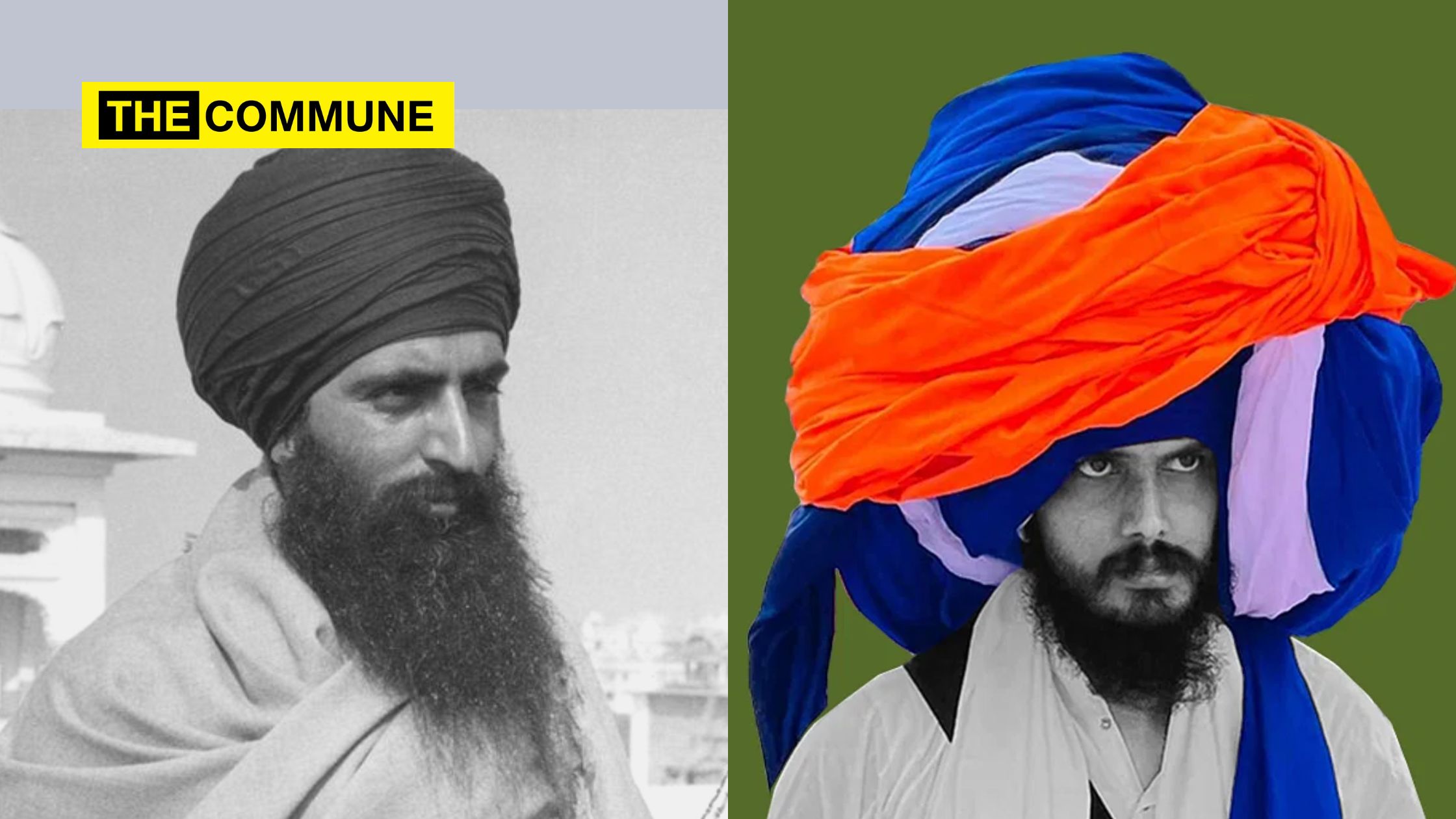
Recently, Khalistan proponent and self-styled Sikh preacher of the ‘Waris Panjab De’ group Amritpal Singh issued a threat to the Union Home Minister Amit Shah stating that the Khalistan movement should not be suppressed from flourishing. He also stated that if efforts are made to suppress their voices, then Shah will have a similar fate as former Prime Minister Indira Gandhi. This comes soon after scenes not witnessed in recent years had unravelled in Punjab. Hundreds of supporters of the radical leader, including several carrying swords and guns, clashed with police and stormed the Ajnala police station near Amritsar. They camped there until police “assured” Amritpal and his supporters that his associate Lovepreet Singh Tufan, arrested on charges that included kidnapping, would be released. These incidents add to the growing list of warning signs coming out of Punjab. The separatist tendencies of Khalistan movement are allowed to flourish in Punjab despite these warning signs. In this context we will look in to the history of Khalistan movement and understand how much of a significant threat it is to India?
Putting Khalistan movement in to perspective
The Khalistan movement is a Sikh nationalist movement that wants to create an independent state for Sikh people, via armed struggle or politics, inside the current North-Western Republic of India. Such a state existed in Punjab from 1709 to 1849. The idea of Khalistan was an idea first created in the 1940s, remained idle but was revived by an NRI seeking a separate homeland for Sikhs. In early 1980s, the movement had emerged as a major separatist movement, fed mostly by the bias of the Indian Government against Punjab in the case of Chandigarh and sharing of Ravi-Beas waters. There was intense political rivalry between Congress Party and the Akali Dal, Akali Dal was gradually gaining ground as the political representative of the Sikh community. Congress leadership of that time tried to divide the Akalis by propping up diverse groups of people within the Akali Dal. Jarnail Singh Bhindranwale led the Khalistan as an extremist movement, he was initially used by Congress to counter Akali Dal but later he was inspired by the Khalistan ideology and turned against the Indian government. The movement was fed on arms under the patronage of Pakistan’s ISI who was seeking revenge for the creation of Bangladesh. Bhindranwale emerged as the extremist voice of Sikhs, overruling the moderate voices of leaders, declared himself as the protector and arbiter of Sikh rights and acquired arms.
Demands for separate nation-hood for Punjab was carried out through violent protests and killings of high-profile persons in the Indian government. Operation Blue star was conducted to capture Bhindrawale in Harmandir Sahib Complex. The then PM Indira Gandhi was seen as an enemy of the Sikhs and two Sikh guards killed her in 1984. Her killing was followed by wide-spread riots against the Sikhs across India, the genocide of Sikhs across India fuelled more anti-India sentiment. From the early 1980s to early 1990s, Punjab went through a phase of wide-spread terrorism. Manifold extremist groups like the Khalistan Liberation Force, Khalistan Commando Force, Babbar Khalsa and umpteen others gained prominence and roamed around freely across Punjab. Sikhs being a patriotic group started to act against the protracted terrorist struggle and chose to side with the Indian nation, the then Punjab Police department succeeded in defeating the movement in the 1990s.
“Khalistan issue is a serious threat to India; it is high time that we start treating it as an issue akin to terrorism in Kashmir. Strict measures shall be taken against those who take up arms against the nation. Those who want to bleed India with ‘thousand cuts’ should not be spared in the name of vote bank politics.”
At the present, Khalistan movement is a dormant movement in India but it is slowly showing signs of resurgence. It does not hold much traction in the urban or local populace of Punjab. But the movement gets ideological support from Sikhs living in Canada, UK or USA. They pump money, ideological support to the struggle, ISI of Pakistan is still pumping money and effort in reviving the movement. The prolonged farm protests and propaganda associated with it gave a right condition for extremist elements to further their agenda. The rise of AAP in Punjab and the vote bank politics played by them has also complicated the situation.
Perfect concoction weak government and political appeasement
“The law and order situation in Punjab is collapsing. The state which abuts Pakistan is witnessing a sudden rise of extremist elements with visible support from abroad. What the Punjab need now is an effective government. The ‘green-horn’ government of AAP is struggling to contain the evil of separatism it unleashed for vote bank politics.”
The Aam Aadmi Party government in Punjab finds itself being ineffective against Khalistan elements in the state, or worse, unwilling to act against them after it buckled quickly as supporters of separatist leader overran a police station near Ajnala on Thursday. The charge has trailed the AAP since it made its first forays into Punjab in the 2017 Assembly elections. While that made no dent in the landslide the party got in the 2022 Assembly elections, a series of incidents since has exposed the weak and dangerous model of AAP governance. A month after Bhagwant Mann took over as head of the AAP government, Patiala was witness to a clash between pro-Khalistan activists and right-wing Hindu organisations. Days later, the parliamentary seat of Sangrur that Mann had vacated was won by pro-Khalistan leader Simranjit Singh Mann, president of the Shiromani Akali Dal (Amritsar). In November last year, a ‘Shiv Sena Hindustan’ leader was killed, with police blaming a “self-radicalised pro-Khalistani” youth. The past few months have seen the sudden rise of Amritpal Singh who returned from Dubai last year and now heads Waris Punjab De, an organisation founded by the late actor-activist Deep Sidhu. It was his supporters who twisted the arms of law and order forces in the state of Punjab.
Meanwhile, an agitation on the lines of the Singhu farmer stir, with tents planted for the long haul, has taken shape in Mohali, seeking the release of Sikh militants “who have completed their sentence”. All this coincides with regular pro-Khalistan marches and rallies across the state. Then there is the issue of political appeasement. In the eve of 2022 polls, Arvind Kejriwal had said that they will take a strong stand against the sacrilege issue of the Sikhs in the state. The AAP chief said that justice in sacrilege cases could be delivered within 24 hours. Never before heard in India, to win an election, the AAP chief chose to promise a law to radical elements which have eerie similarities to sacrilege laws existing in Muslim-Sharia countries of Pakistan or Saudi Arabia. If the AAP created its space in Punjab, and elsewhere, through clever use of social media, so has the pro-Khalistan lobby. It is via this that the Khalistan narrative has been kept alive and simmering, especially among the newer generation, apart from songs by popular Punjabi singers which have long flirted with themes of violence. The Sidhu Moose Wala phenomenon is also a part of this.
Besides, a lot more pro-Khalistan content remains floating on social media, over which in fact the AAP government has no control. Punjab was fooled by AAP’s promise of change. Despite his huge personal following, even CM Mann is struggling to establish himself as a dependable leader. The Mann government’s quick buckling to concede Amritpal’s demand will further the impression that it is too raw for crises such as this. Former CM Amarinder Singh, who has consistently talked of a threat of the rise of Khalistani elements and warned of Pakistan’s designs, repeated Thursday that what happened at the Ajnala police station was not a mere law and order problem. He said that it had “serious security implications for the state and the country”, and the Mann government was not equipped to handle the same. “Nip the evil in the bud,” said Punjab Congress chief Amarinder Singh Raja Warring in a statement, adding that the people had not voted for the AAP to push the state “back into the dark days of militancy”. But despite the unravelling incidents AAP government looks unable to stabilise the situation.
The law and order situation in Punjab is collapsing. The state which abuts Pakistan is witnessing a sudden rise of extremist elements with visible support from abroad. What Punjab needs now is an effective government. The ‘green-horn’ government of AAP is struggling to contain the evil of separatism it unleashed for vote bank politics. The Khalistan issue is a serious threat to India, it is high time that we start treating it as an issue akin to terrorism in Kashmir. Strict measures shall be taken against those who take up arms against the nation. Those who want to bleed India with ‘thousand cuts’ should not be spared in the name of vote bank politics.
(This article was originally published in The Pulse and has been republished here with permission.)
Click here to subscribe to The Commune on Telegram and get the best stories of the day delivered to you personally.
The Indian National Congress is holding its 85th plenary session this year at Chhattisgarh’s Nava Raipur from 24-26 February, 2023.
The plenary session is a meeting of key office bearers of the party from across the country. During the session, the party decides on its course of action and functioning with the All India Congress Committee (AICC) setting the agenda.
In light of this, tbe Congress party had released full paper advertisements in all leading newspaper and magazines of the country.
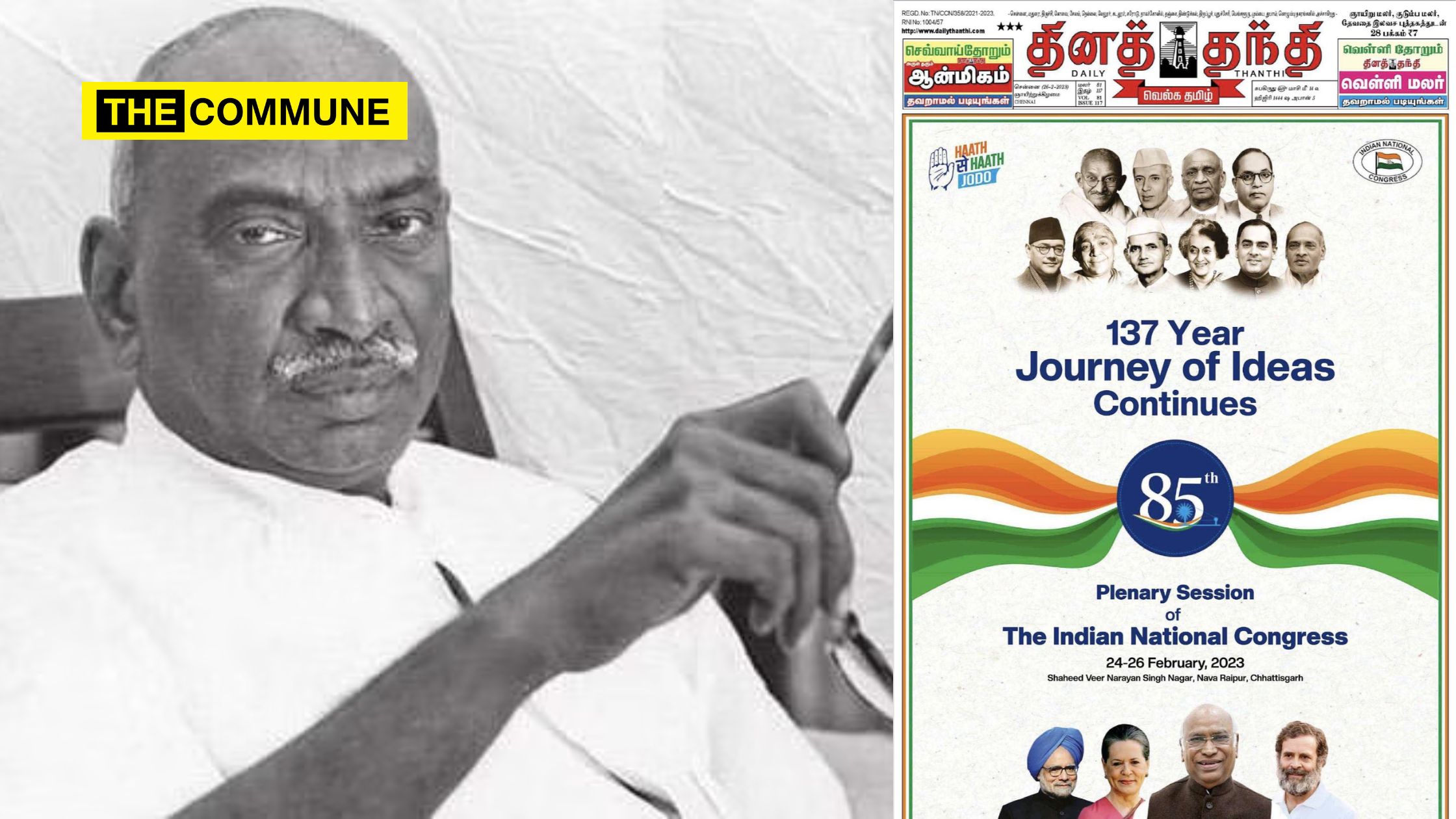
In this advertisement, pictures of Mahatma Gandhi, Jawaharlal Nehru, Sardar Vallabhbhai Patel, Dr. BR Ambedkar where present in the first row while pictures of Netaji Subhas Chandra Bose, Sarojini Naidu, Lal Bahadur Shastri, Indira Gandhi, Rajiv Gandhi and PV Narasimha Rao were placed in the second row.
At the bottom, pictures of Manmohan Singh, Sonia Gandhi, Mallikharjun Kharge and Rahul Gandhi were placed with the party president Kharge’s photo slightly bigger than the rest.
Many on social media pointed out the omission of ‘Karma Veerar’ K. Kamaraj, one of the tallest leaders of the Indian National Congress. He was widely acknowledged as the “Kingmaker” in Indian politics during the 1960s. He is known for effecting the Kamaraj Plan in 1963 where he proposed that all senior Congress leaders should resign from their posts and devote themselves to organizational work for the re-vitalization of the Congress. After Nehru’s death in 1964, Kamaraj successfully navigated the party through turbulent times. As the president of INC, he refused to become the next Prime Minister himself and was instrumental in bringing to power two Prime Ministers, Lal Bahadur Shastri in 1964 and Nehru’s daughter Indira Gandhi 1966. After his fallout with Indira Gandhi he founded the Indian National Congress (Organization).
Peter Alphonse, senior Congress leader from Tamil Nadu who was made the Tamil Nadu State Minorities Commission Chairperson by the DMK government expressed his disappointment with the omission of Kamarajar, Babu Jagjivan Ram, Maulana Abdul Kalam Azad among others.
“At least we should recognize the contribution of Islamic leaders to the freedom struggle and the Congress revolution. Perunthalaivar (Kamarajar) recognized the two Prime Ministers and protected the Congress. Annal Ambedkar was the protector of oppressed people. Babu Jagajeevan Ram is an unscrupulous Congressman.”, he said.
அகில இந்திய காங்கிரஸ் கமிட்டி ரெய்ப்பூரில் நடக்கும் மாநாட்டிற்கு முழுப்பக்க விளம்பரங்களை வெளியிட்டுள்ளது. காங்கிரஸ் பேரியக்கத்தின் முன்னோடி தலைவர்கள் மவுலானா அபுல் கலாம் ஆசாத், பெருந்தலைவர் காமராஜர்,பாபு ஜெகஜீவன் ராம் படங்கள் இடம் பெறாதது வருத்தமளிக்கிறது. pic.twitter.com/zsKW6KTKam
An old billionaire with a record of destroying economies and using non-state mechanisms to perpetrate state power in an unconstitutional manner and profit from such an imperialist enterprise.
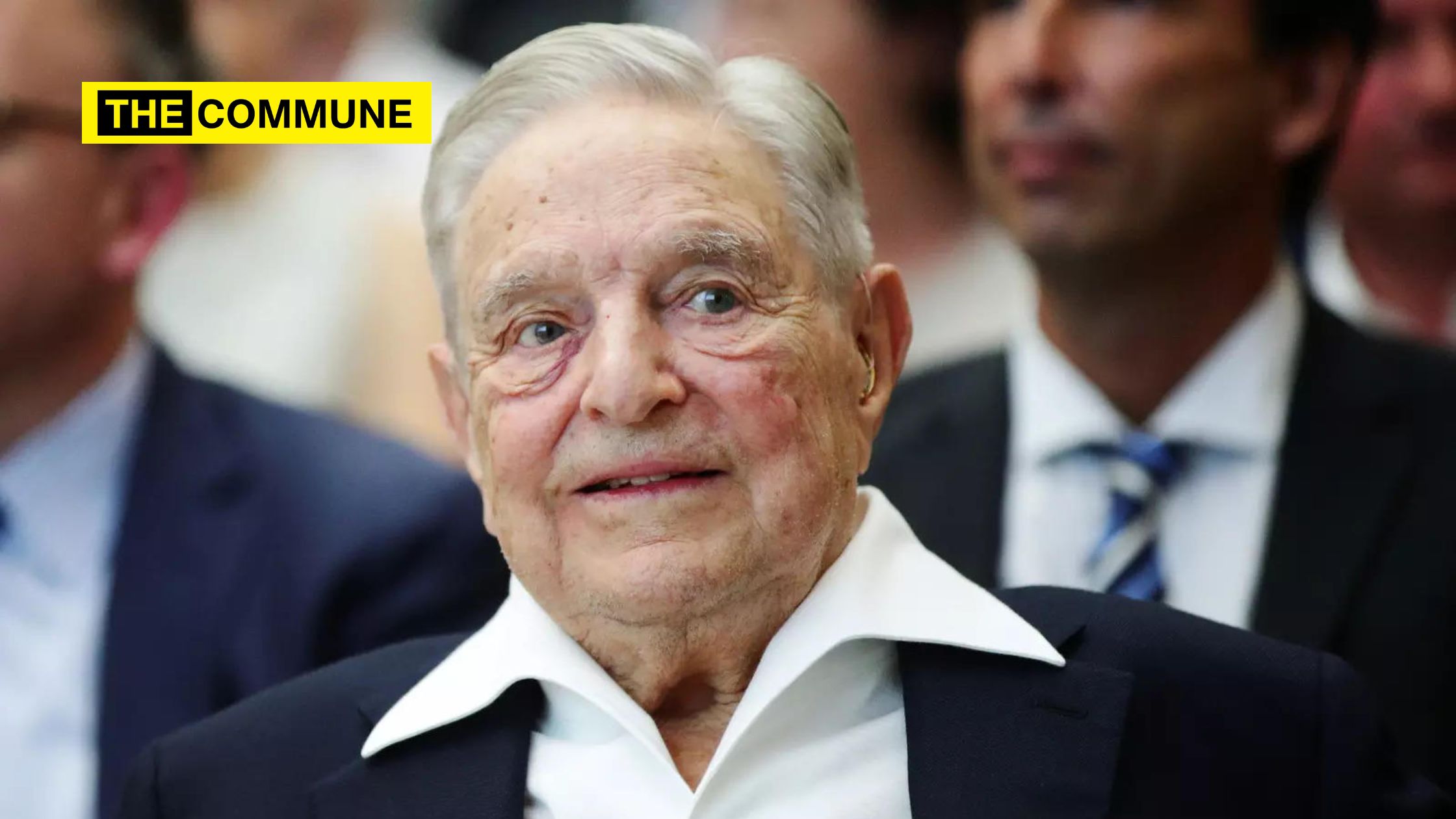
The man spouting inconsistent demented nonsense like – India is a democracy but its leader, Narendra Modi, is not – is George Soros.
Which is puzzling!
Narendra Modi won a democratic election in 2019 (as he did the one in 2014), which was the largest democratic election in human history with total voter numbers at 900 million.
Soros then asserts why he thinks Modi’s rise happened.
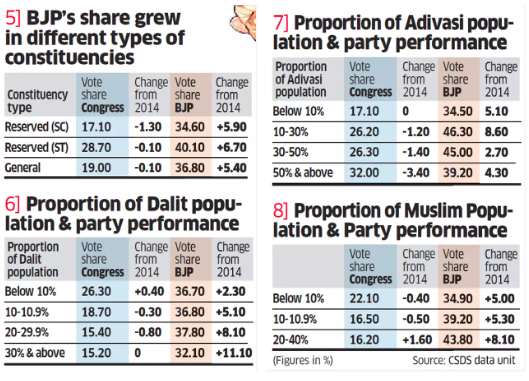
To understand the fake narrative that this old billionaire is trying to further, check the analytics of the vote share of Modi’s party. In the poor, the backward, the lower caste, and in Muslim majority constituencies. What do you find?
The BJP’s vote share in constituencies where, for example, the Muslim population is between 20-40%, was ~44%. Versus 16.20% in the case of the Congress party. And btw, it had increased by over 8% from the previous elections.
Either Indian Muslims are fools that they voted so overwhelmingly for a man, that George Soros believes incited violence against them!
Or he is spreading false propaganda?
It isn’t difficult to understand which of these is correct.
This Oldfag then goes ahead talking about how bringing down Modi will spread “democratic revival” in India.
No one in the Western world has managed to win an election with anything over a third of the size of the electorate that the 2019 Indian election had.
And yet, the Western press, the think tanks, and the anarchists like Soros have the gumption to throw words like democracy at India’s elected leaders.
Megalomaniacal delusion does not even cut it!
So let’s put this crap about democracy and all the rest of that nonsense aside. Western press, think tanks, anarchists, and establishments have no interest nor any locus standii on those things given their own record in their countries and the ones they have invaded.
Then what is it?
Soros was speaking at the Munich Security Conference. Its an annual conference on global security issues. A German official and publisher Ewald-Heinrich von Kleist started it at the peak of the Cold War.
So a bunch of Western establishment honchos come together in order to discuss the security of the world.
Interesting mantle.
So who gave them the contract for that? To decide for the security and moral situation of the rest of the world?
We will look at this fetish by expanding our time frame.
But before we go there, let us understand George Soros and his own agenda-setting.
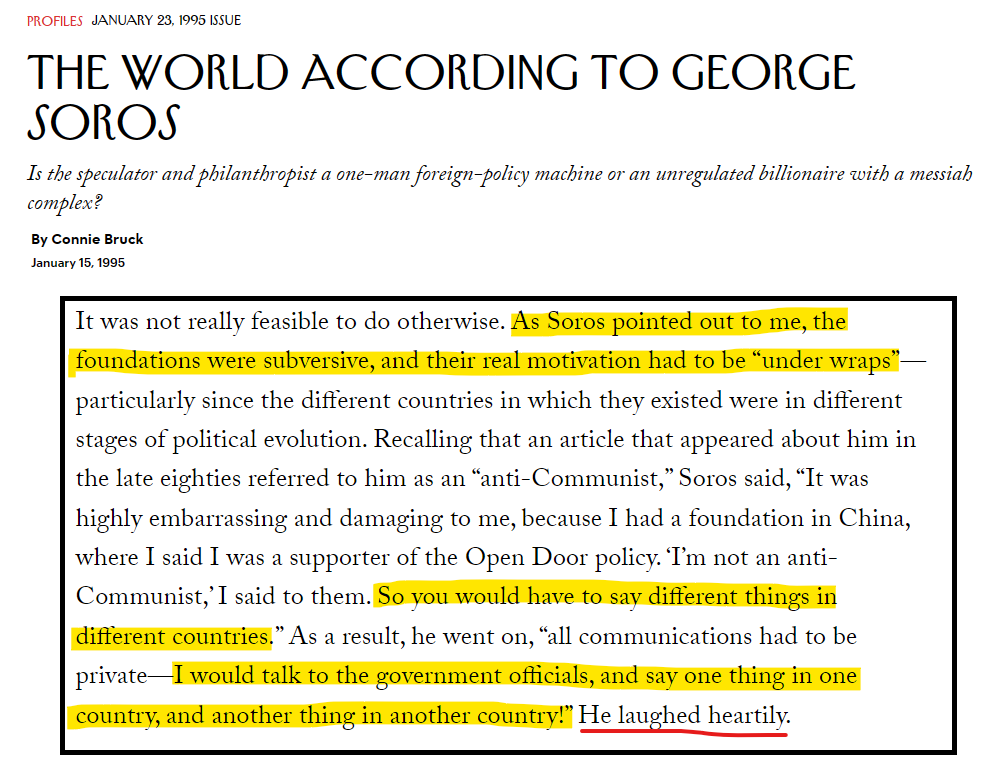
“I am subversive wearing masks” – the Real Soros
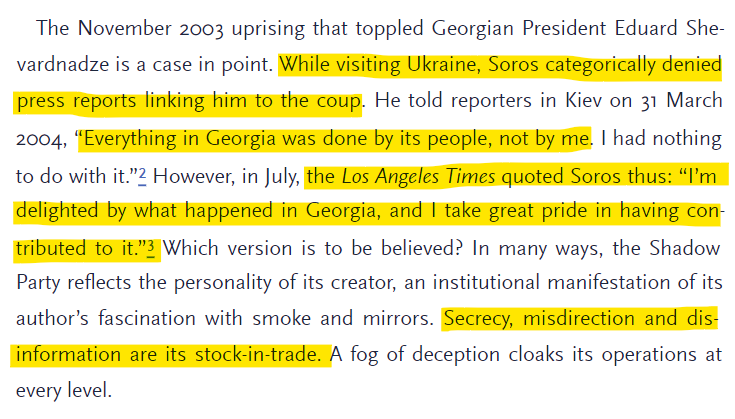
Per his own admission, his foundations are subversive. And he wears many masks while he indulges in double-speak to do what he believes he needs to do.
A tactic Soros used in Georgia to topple the government there and also in other “color revolutions”. He used deception, double-speak and subversion in Georgia and in Ukraine.
After he had brought the British pound down in September 1992, Soros gave an interview to Anatole Kaletsky of the London Times,to boast about his actions in that whole fiasco.
In Kaletsky’s article, Soros stated that, as the press had conjectured, his fund, Quantum, and several of its offshoots had bet roughly ten billion dollars against the pound (about nine billion of which was borrowed, in Soros’s customary leveraging). He also said that Quantum’s combined speculation, mainly against the pound, had garnered a profit of about two billion dollars. Soros became even more expansive, declaring that in the days before the pound’s collapse “we must have been the biggest single factor in the market.” (Source: The world according to George Soros / New Yorker)
Why did he boast so openly about his deeds?
Soros’ friend, Edgar Astaire, suggested that maybe he felt he was impregnable.
“George never wanted publicity, but he feels he’s past that—he feels he’s impregnable now.”
This man, who openly subverts countries, societies and economies often using his “Open” Societies and Foundations, has a messianic complex.
He admits to what Kaufman calls ”messianic” ideals: ‘‘I have had these illusions, or perhaps delusions, of grandeur and they have driven me.’‘ He has also said that his ”goal is to become the conscience of the world.” (Source: Who Wants to Be a Billionaire? / New York Times)
An imperialist in the garb of a do-goodism cloak and delusions of morally setting the world right for his own profits.
This is precisely how the Indian External Affairs Minister Dr. Jaishankar described the subversive interventions of George Soros.
But this isn’t the first time such a mentality and evil has raised its head in the world.
It has been the norm.
Sovereignty, Greed, And Poverty
The British Government in India passed an Elephant Preservation Act in 1879, which made it mandatory for individuals to get a license from the government in order to capture wild elephants. The very next year, the British promulgated another set of rules that covered the area of Keonjhar. British law was now applicable to that princely state.
Dhanurjai Narayan Bhanj Deo was the ruler of Keonjhar. He vehemently protested against this “encroachment” over his “sovereign right”. His argument?
he had an “absolute” right to capture elephants found within his territory without requiring a licence issued by a British Indian authority. (Source: University of Leeds)
Now one can argue that was where the maharaja’s nationalism came alive.
But did it?
He was fine when his entire kingdom was taken away by the British and servility for decadence was shoved onto him without a murmur. The only thing that disturbed him was his right to exercise his depraved lifestyle.
His “nationalism” started when his access to the unbridled right to depravity ended. By then, the lives and security of his people and the freedom of the nation had been pawned irretrievably.
By the time the nation and people would become free again, everything that he knew – his kingdom, his lifestyle, his progeny – would have been relegated to the footnotes of history. When the British left, Keonjhar (part of the Singhbhum-Keonjhar-Banei belt in Odisha) was and remains even now, as one the most backward districts in the country!
That is how the cookie crumbles.
Personal interests of greedy scoundrels who have their hands on the buttons of power become a weapon for the imperialists to rule other nations.
Weaponizing of weak kings and leaders to assert control over their states and people is the central precept of imperialists.
Western Paramountcy And Dangers Of Others’ Independence
The imperial enterprise was underlined by the inherent assumption by the Europeans and the West that they somehow had paramountcy over every territory and people on this planet. Even the universe, if they could help it.
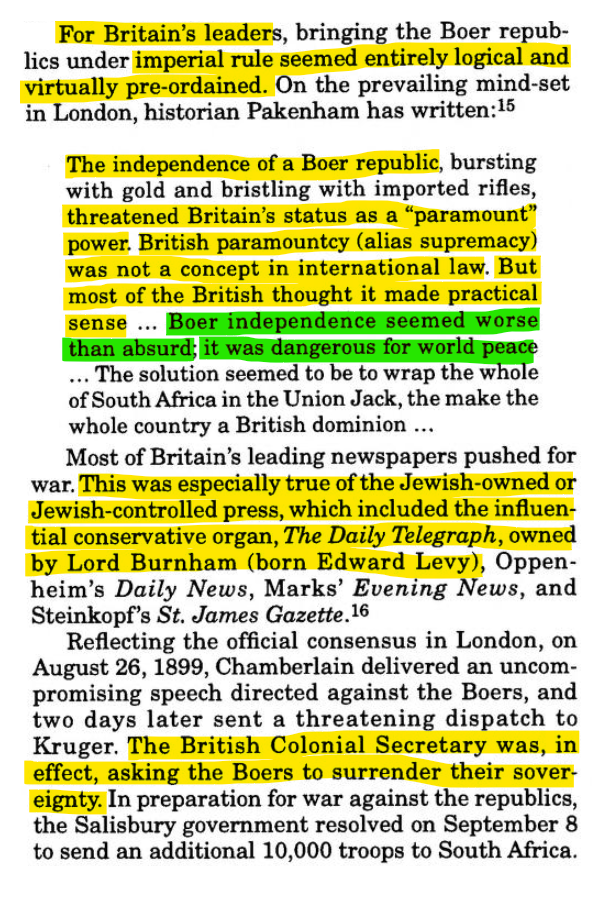
The way the British approached the Boers in South Africa showcased this very clearly.
Boer independence, in their eyes, was “dangerous for world peace,”because that “threatened” British paramount power, which incidentally made complete sense!
So the engagement with the Boers was only to push them to surrender their sovereignty.
Source: Journal of Historical Review (Volume 18, Número 3) – Institute for Historical Review
This right to paramount power over others was what the British imperialists asserted over India.
From Residency To Paramountcy
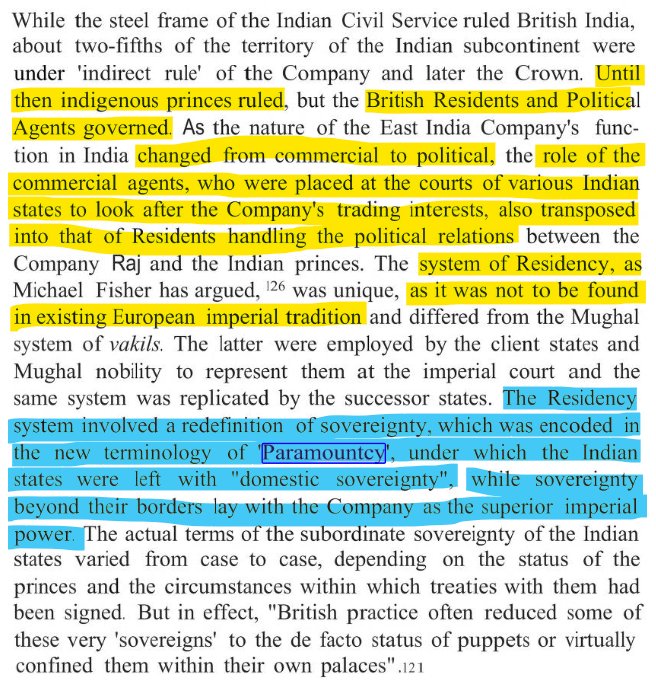
When Britain was merely trading, the representatives from that country would be commercial agents – also known as British Residents – who would look after the trading interests. This was a system of residency that the East India Company had in India. When the role of East India Company moved from Commercial to Imperial, this system of Residency morphed into the system of Paramountcy.
A representative of the British company was the new sovereign of the kingdom!
Source: From Plassey To Partition By Sekhar Bandopaddhya
The idea of paramountcy was developed in the first decade of the 19th century.
The first clear enunciation of the idea of paramountcy is to be found in Ochterlony’s letter to Metcalfe, dated March 21, 1820, in which he writes: “I hope His Lordship will in Virtue of his Power and Paramountcy forbid all future invasions of Surhoie and fix himself a sum which the Rajah must take”. In his Minute, 1825, Metcalfe speaks of the fact of paramountcy by which the British Government had itself the “duty as supreme guardians of general tranquillity, law and right to maintain the legal succession”. (Source: White Paper on Indian States / Wikisource)
You see, the doctrine of the paramountcy of the British over the Indian rulers was for the good of the colonized. It was to help the subjugated millions who had to be saved.
There was a growing body of opinion within the company that only British control of India could end the constant wars and provide really satisfactory conditions for trade; full dominion would be economical as well as salutary. (Source: “The ascent to paramountcy“/Britannica)
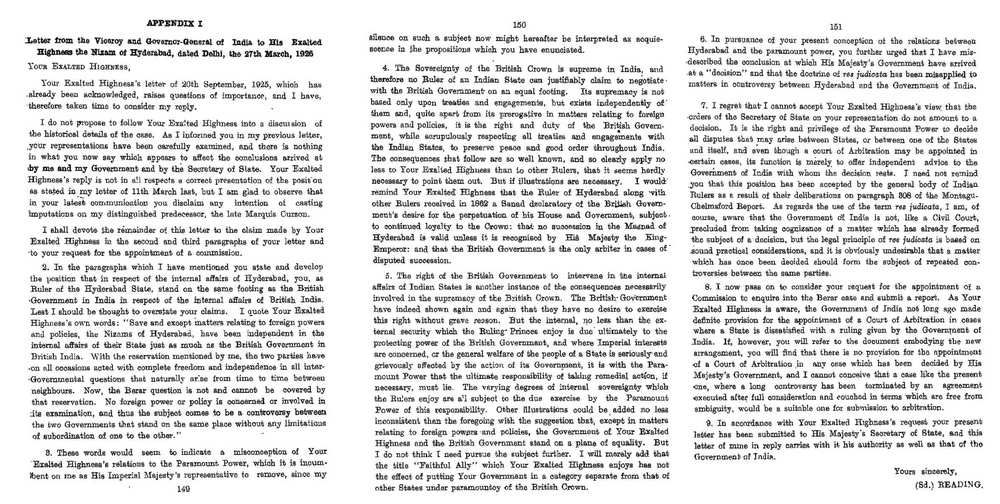
This doctrine of paramountcy was most elaborately described by Lord Reading in his famous letter to the Nizam of Hyderabad in a letter dated 27th March 1926.
Its argument is indistinguishable from what Metcalfe presented in 1825.
Lord Reading’s letter to the Nizam of Hyderabad (Source: White Paper on Indian States (1950)/Part 1/Growth of Paramountcy)
And, that is not any different from the argument shared by George Soros in terms of why he thinks his choice of rule and rulers stands paramount in the context of India, despite the country’s unprecedented status of democratic structure and framework.
To select a ruler for the greatest democratic state in the history of humanity is for George Soros a mark of “Democratic Revival”.
The sophistry of the words, the indelible mark of deception, and the burden of a white man’s moral supremacy in Lord Reading’s letter and the speech by George Soros are remarkable in their similarity. The argument is for the paramountcy of one man/group over another nation because, well, the paramount power of the colonizer is supreme and unquestionable.
The ethnocentric sense of superiority that underlined the British doctrines and methods of dealing with Indians and the kingdoms was deeply intertwined with the religious beliefs shaped by the theological assertions of their missionaries.
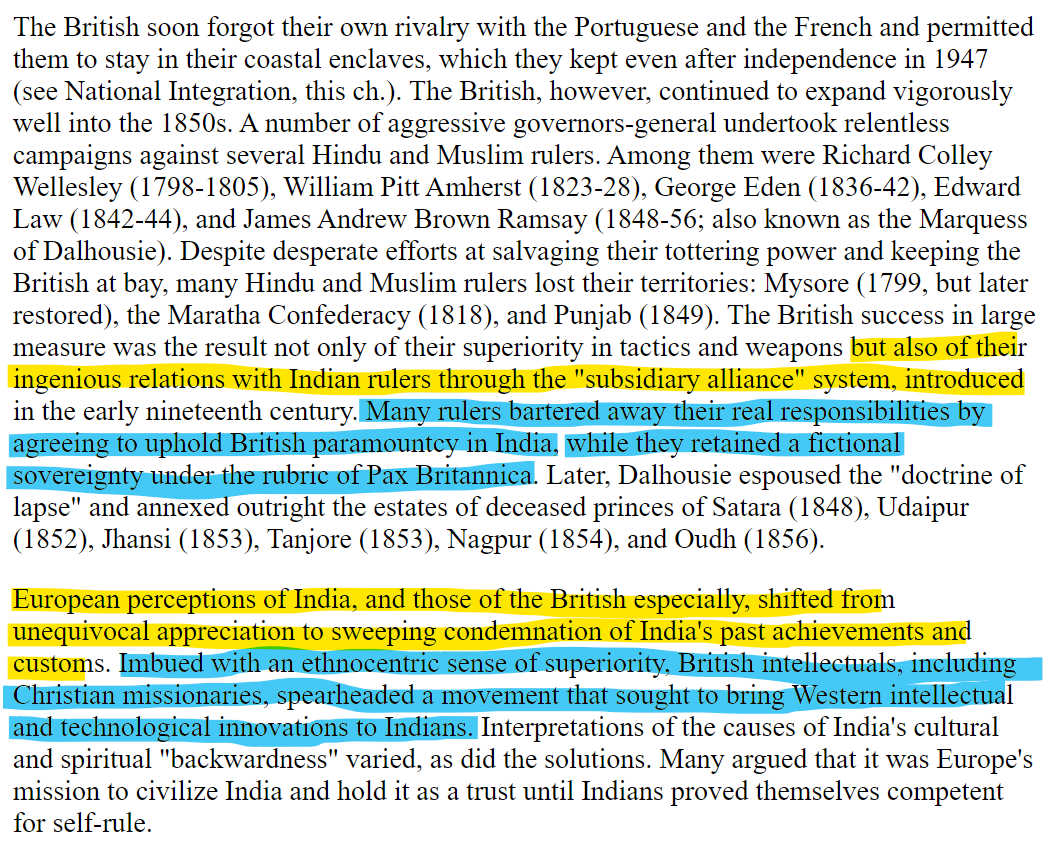
The Subsidiary alliance system was built upon the principle of British paramountcy by which the Indian kings accepted the power of the British rulers while retaining fictional sovereignty under the “rubric of Pax Britannica,” and ultimately was replaced by an outright rule using another surreptitious mechanism called the “Doctrine of Lapse.”
Source: Countrystudies
There is a pattern here.
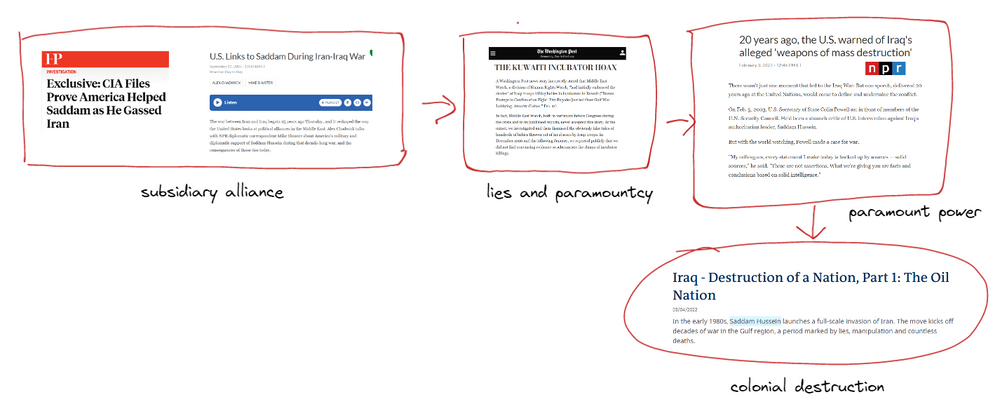
Creating an alliance for the support and security of the target state. Declaration of paramountcy. Creating structures to complete colonial rule and destruction (economic and social) of the target state.
How is that different from the democracy promotion programs?
When you look at the progression from the subsidiary alliance to the doctrine of British paramountcy to the doctrine of lapse, where what was touted as an alliance bore the seeds of colonial conquest, albeit, in altruistic language, you are forced to wonder about how the fundamental character of “democracy promotion” programs that end up in the destruction of the targeted states while the West, specifically America, gets the minerals and assets from those states.
Let’s just take the example of what happened in Iraq.
We have dwelled substantially on how “Democracy Promotion” is used by the US, via an institutional framework led by the National Endowment for Democracy to subvert other nation-states for its foreign policy objectives.
National Endowment for Democracy is a covert subversion program with the glaze of do-goodism that replaced covert operations by the CIA, which had gotten a bad name in the 60s.
Democracy Promotion was created as a tool for doing what the CIA was doing anyway during the Cold War. It became more pronounced post-Cold War days.
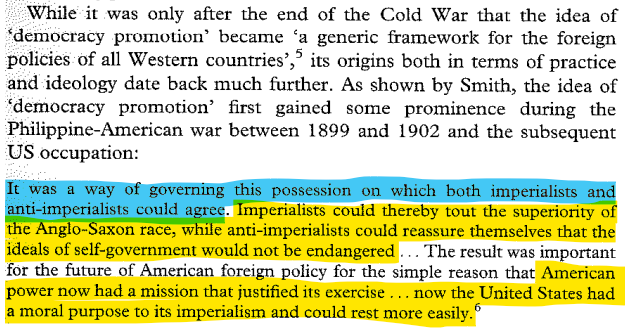
The way it was conceived and the manner of its narrative, it was meant to reconcile both, the imperialists and the anti-imperialists. One side believed in Anglo-Saxon supremacy and paramountcy, while the other loved the sheen of democracy installing the “white man’s burden” narrative.
Colonialism with missionary agenda was replaced by Imperialism with Democracy Promotion. NED’s activists were the new missionaries.
Source: “Promoting Democracy, Reinforcing Authoritarianism: US and European Policy in Jordan” (Cambridge University Press) by Benjamin Schuetze
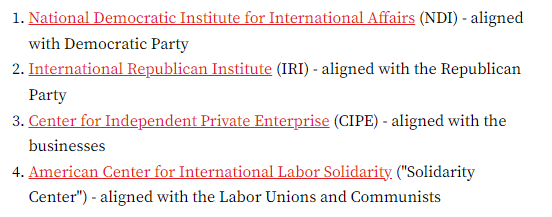
And for good measure, NED funnels its money via three organizations – covering every interest group with a voice in the US and beyond.
That is why it is difficult for those outside the US to fully comprehend how and why the farce of democracy promotion, with its very obvious and in-your-face imperial agenda is not challenged in the “greatest democracy”.
The reason – everyone is bought into this kool-aid.
Imperialism Via Democracy And Soros In Political Corridors
So when George Soros talked of “Democratic Revival”, when he was clearly talking about subversion, there is a context.
Soros had made serious and deep inroads into Washington DC on the back of his boastful remarks post-1992 Pound Sterling debacle during the Clinton era.
He cultivated relationships with the top bureaucracy in the State Department and the Treasury. In fact, he opened an office in DC that functions as Soros’ State Department!
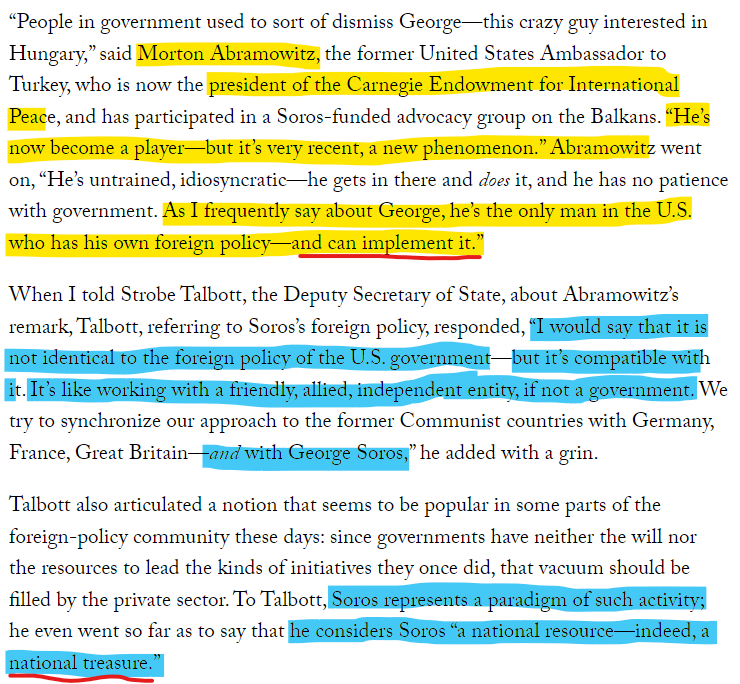
What is especially interesting is that Soros is now an extension of the US foreign policy. Specifically so in the Clinton-Obama-Biden establishment.
Source: “The World According to Soros” / New Yorker
An ally? A National Treasure?
Or a Non-state subversion machine of a State operation?
The ultimate prize of covert and overt machinations of state power of a democratic nation and the non-state actors it uses to unleash its imperial agenda is global control.
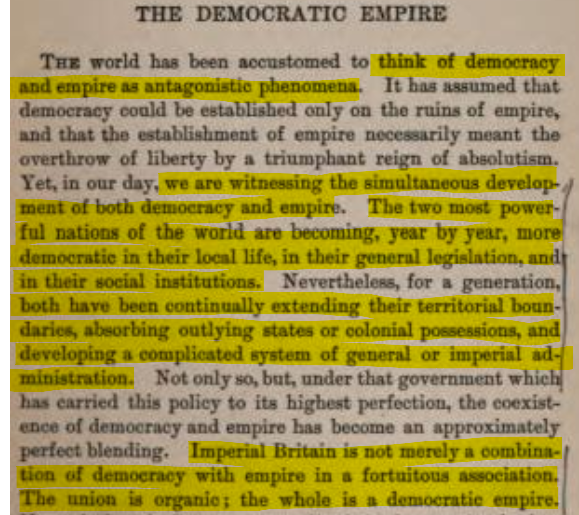
It has been called a Democratic Empire.
Democratic Empire – Oxymoronic Strategy Of World Domination
Source: “Democracy and empire; with studies of their psychological, economic, and moral foundations”
Democratic Empire has been defined thus.
A democratic empire is a political state which conducts its internal affairs democratically (i.e. with respect for its citizens and their collective will) but externally its policies have a striking resemblance to imperial rule. Democratic imperialism as such may in fact be a misnomer, as empires express themselves with aggression abroad and repression at home. The concept of a democratic empire can likewise be an instrument of social control as with ideology and ideological conditioning generally. (Source: Wikipedia)
Democracy and its supposed furtherance enable a power to wield imperialism in plain sight while creating grounds for deniability.
That is the power of “Democracy Promotion” by the National Endowment for Democracy (the new avatar of CIA covert operations) and the “Democratic Revival” agenda of George Soros, a subvertist by his own admission!
Video Corner: A “Balanced Car”
Sometimes it is interesting to peer into history and see how products have progressed over the years.
This is a Jam Handy film from 1935. It shows how a good passenger car ought to balance a number of attributes: speed, power, comfort, economy, etc.
To do this it starts by juxtaposing examples of those properties prevalent in the day: race cars at Indianapolis, an army tank, Sir Malcolm Campbell’s Bluebird LSR racer at Daytona Beach, and a custom-built GMC giant motor coach called Carcajou.
In the end, of course, the movie argues that Chevrolet models do the balancing act.
That year though Chevrolet had two models – distinct model lines that year, Standard (EC, 107-in wheelbase) and Master DeLuxe (ED/EA,113-in wheelbase).
(This article was originally published in Drishtikone and has been republished here with permission.)
Click here to subscribe to The Commune on Telegram and get the best stories of the day delivered to you personally.
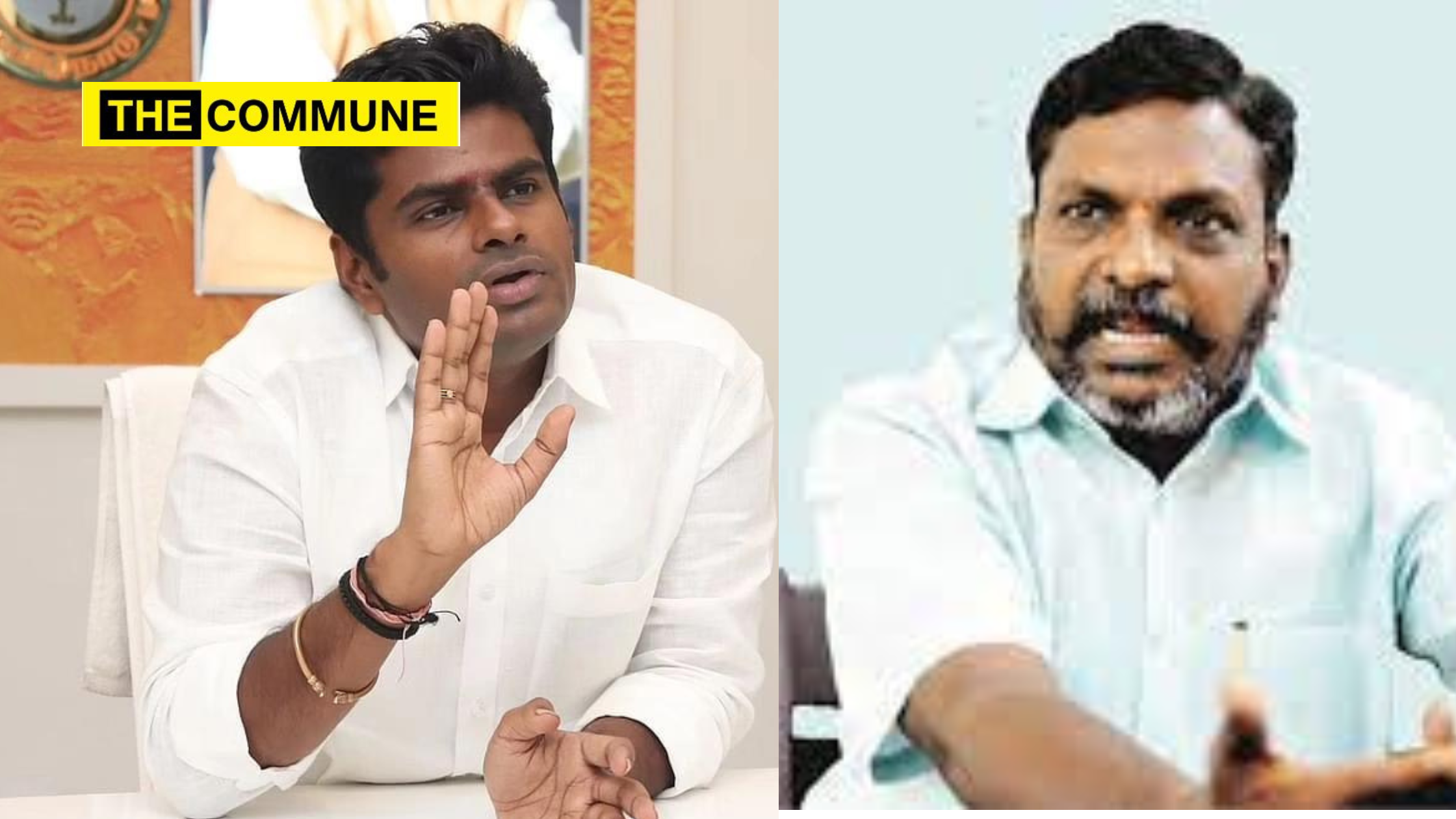
VCK Chief and Lok Sabha MP Thirumavalavan spread fake news by spreading an edited clip of a video of Tamil Nadu BJP President Annamalai that was more than ten days old.
On February 16, the Tamil Nadu Bharatiya Janata Party (BJP) led by President Annamalai staged a state-wide protest in front of all district collectorates against the alleged murder of an Indian Army soldier by DMK councilor Chinnasamy in the Krishnagiri district. The protest tomorrow was carried out by the members of the Tamil Nadu BJP Ex-Servicemen wing in their respective district collectorate.
BJP State Chief K Annamalai announced a Rs 10 lakh relief to Prabhu’s family on behalf of the party, and said the party would cover the soldier’s two children’s education expenses. Annamalai, joining several veterans at the day-long fast, said the ex-servicemen have demanded the State government to provide Rs 5 crore as compensation to the family of Prabhu, a government job for the deceased’s wife and “a public apology” from the Chief Minister M K Stalin.
While assuring other Army personnel serving on the border of safety for their families in Tamil Nadu, Tamil Nadu BJP President Annamalai stated, “We are announcing a ₹10 lakh relief to the family of Army man Prabhu to meet their immediate needs. We also cover your children’s educational expenses. We are doing this to send a message to Army servicemen serving on the border that the Tamil Nadu BJP stands with them even if the state government does not.”
Annamalai stated while assuring army personnel on the border, “You (Army men serving on the border) have guns in your hands with bullets inside. You have Modi, who will issue an order to shoot (Terrorist). You take care of your responsibilities, and the Tamil BJP will take care of the rest. Every Army soldier from Tamil Nadu serving on the border will proudly tell that the name on the front is more important than the name on the back, where the soldier’s name will be written.”
This video of Tamil Nadu BJP President Annamalai, on the other hand, was edited and posted by VCK Chief and Lok Sabha MP Thirumavalavan. The edited video gave the impression that Annamalai is inciting Army men to shoot down those they had problems with and that Prime Minister Modi was there to save them.
Posting the edited video, Thirumavalavan said, “How should we interpret one’s speech who asks Army men to shoot down people? Is it dumb bravery or immature behavior, or is it the culture of the Sangh Parivar that incites violence on purpose? Is Annamalai admitting that Modi, like him, is irresponsible?” He also urged the Tamil Nadu government to arrest and prosecute Annamalai for inciting violence.
'ஆர்டர் கொடுக்க மோடி இருக்கிறார்; சுட்டுத்தள்ளுங்கள்' என ஒருவர் பேசுவதை அசட்டுத் துணிச்சல் என்பதா? முதிர்ச்சியில்லா அரைவேக்காட்டுத்தனம் என்பதா? திட்டமிட்டே வன்முறையைத் தூண்டும் சங்பரிவார் கும்பலின் கலாச்சாரம் என்பதா? எதுவாயினும் இது தலைமைப் பண்புக்குரியதாகுமா? (1/2)@annamalai_kpic.twitter.com/djC6zMzes8
Soon after, BJP cadres and netizens shared an unedited video of Annamalai’s speech in support of the army men in the border, exposing the lies about Thirumavalavan.
Truth in this is, he said "TN BJP will give Rs.10 Lakh to Jawan's family and will pay expenses for his daughters edu, this is the msg to every soldiers in borders. You (Jawans at border) has gun with you, gundown (the Terrorist), TNBJP is with you".
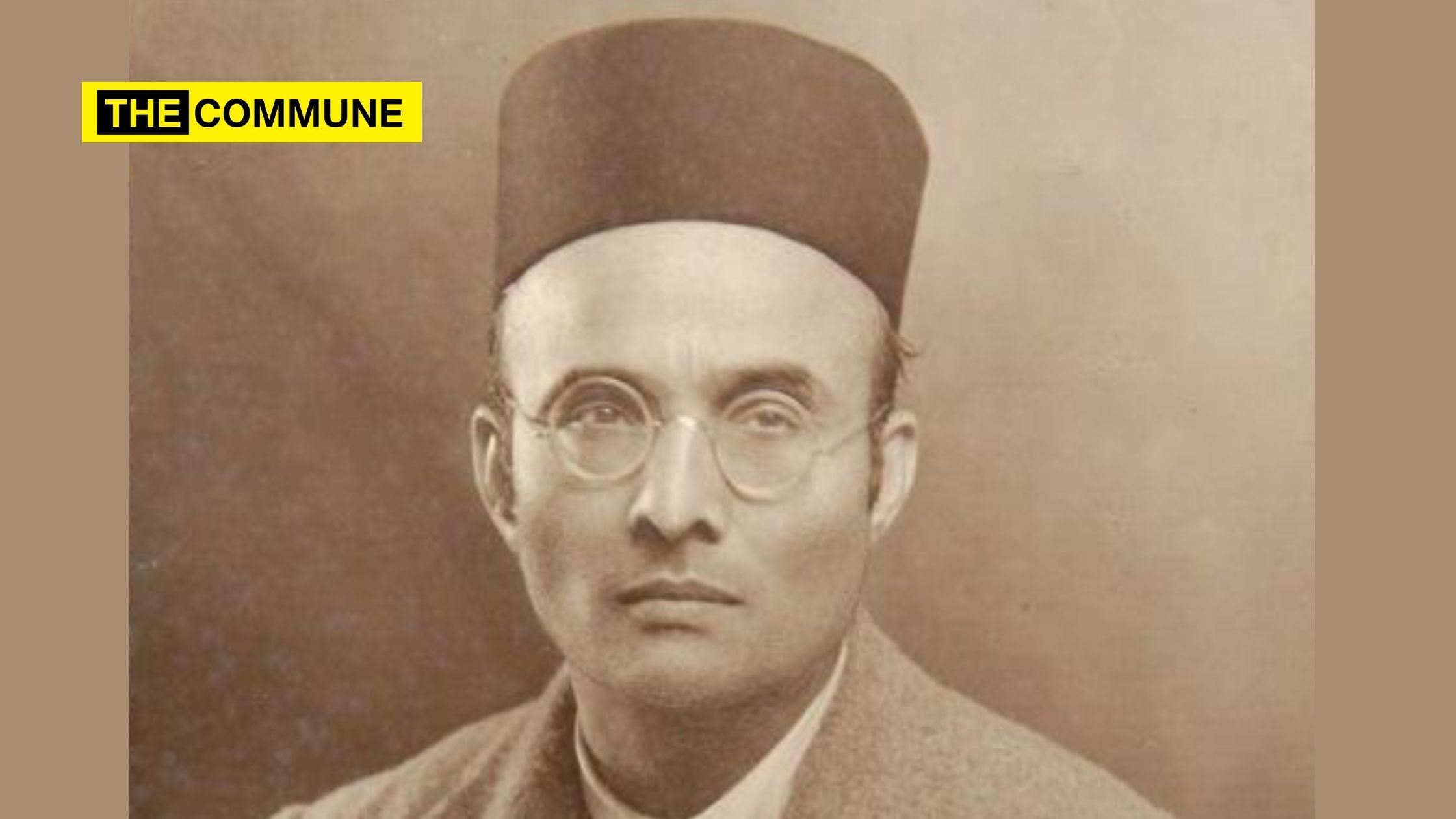
Every time, a person from the Indian subcontinent hears the utterance of the word, ‘Veer’ (meaning brave in Hindi/Sanskrit and in many other Bharatiya languages), one is inspired to do selfless service to one’s Motherland/Fatherland. This is the significance of the word ‘Veer’. There are only few people, who earn the sobriquet, ‘Veer’. They are the most deserving ones. Vinayak Damodar Savarkar became known as ‘Veer’ Vinayak Damodar Savarkar after an incidence of bravery in his childhood. Veer Vinayak Damodar Savarkar was indeed, one of the bravest men in world history and the greatest patriot that the world has ever seen. The proof of this has been given by none other than former Poet-Prime Minister, Atal Bihari Vajpayee. In his own words of poetry in Hindi, Vajpayee said –
which means, Savarkar means Speed (it denotes the speed of thoughts, feelings, words and actions of Veer Savarkar), Savarkar means Sacrifice and Savarkar means Meditation!
One can understand the paramount significance of Veer Savarkar from the above lines.
Savarkar’s Early Life
Savarkar was born on the 28 May 1883 in Bhagur village near Nasik in erstwhile Bombay presidency in British-ruled India, which is in the current state of Maharashtra in India. Mother India was not free at that time. She was in cruel chains under British olonial rule. The British had plundered Indian in many ways, especially – morally, mentally, spiritually, culturally and materially.
‘Veer’ Vinayak Damodar Savarkar was born to Damodar Savarkar and Radhabai Savarkar in a Marathi Chitpavan Brahmin Hindu Family. He lost his mother at the young age of eight or nine to an epidemic, which was raging at the time in his native place. He lost his father, too in the next couple of years. He was born with three siblings – Ganesh, Narayan and Maina. His elder brother, Ganesh Savarkar was also known as Babarao Savarkar. In fact, all the three brother later became famous freedom fighters and were often lodged in different jails during the same as well as different periods of time. His entire family was tremendously patriotic. Savarkar was an extrovert and extremely patriotic from a young age. He organized a group of friends and called it ‘Mitra Mela’. In fact, he took an oath at the young age of fifteen (in 1898) that he would free his mother land from British rule. The two major influences on the Life of Savarkar were his brothers and Lokmanya Bal Gangadhar Tilak. Savarkar’s mother used to tell him stories from the epic Ramayana and Maharaj Chhatrapati Sivaji, the great Hindu Maratha ruler when Savarkar was a child. In other words, Savarkar became aware of his religion and nation from early times.
He appeared for his matric exam in 1901. He joined Fergusson College in Pune in 1902 and became a regular writer for ‘Aryan’. One of his well-known articles was ‘Saptapadi’. ‘Saptapadi’ is about the seven stages of the evolution of a nation as envisaged by Savarkar. He had an intellectual bent of mind and read Indian as well as world history and also Indian and Western literature. He read the works of Bhavabuti, Kalidasa, Shakespeare and Milton. In 1904, the name of ‘Mitra Mela’ founded by Savarkar was changed to ‘Abhinav Bharat’. Abhinav Bharat was a group of Bharatiya revolutionaries to free India. This society of 100 select members was inspired by Young Italy of Mazinni. Mazzini was an Italian leader who was an inspiration to Savarkar. In 1905, British Governor-General, Lord Curzon partitioned Bengal. The partition of Bengal by Lord Curzon was opposed by the people of Bharat. In the same year, Savarkar protested against the partition by making a bonfire of foreign goods in Pune under the influence of Bal Gangadhar Tilak. This practice of burning foreign goods on a bon-fire was later adopted by even Gandhiji, who had initially criticized the practice of burning foreign goods on a bonfire as being ‘violent’ while being in South Africa. Unfortunately, he was rusticated from Fergusson College on account of all these ‘anti-national’ activities. The truth was that Savarkar was one of those, who were suffering, sacrificing and sincerely working for the emancipation of India. He was a stupendous patriot and hard-core nationalist. Soon, Savarkar came to side with the Extremists’ Freedom fighters more and more. He was often on the side of Shri. Lala Lajpat Rai, Bal Gangadhar Tilak and Bipin Chandra Pal. He was not on the side of Liberals like Shri. Gopal Krishna Gokhale. Savarkar was allowed to take his B.A. degree much later with the help of Shyamji Krishna Verma.
The London Days
Savarkar decided to go to London to study Law under the influence of Bal Gangadhar Tilak. He received a scholarship from Shyamji Krishna Verma of India House. He attended Gray’s Inn Law College at London and became a Barrister. Veer Savarkar founded Free India Society at London. The Free India Society was yet another group of revolutionaries fighting for Bharat’s freedom from outside Bharat. Savarkar began reading Bharatiya and World History extensively while in London. In 1909, his book ‘Indian War of Independence 1857’ was published. Till then, the British had dismissed ‘the First Bharatiya Freedom Struggle for Independence’ as a mere ‘mutiny’. Bhikhaji Cama helped to publish the landmark book in the Netherlands, France and Germany after ‘Not -At- All- Great’ Britain banned the book for inspiring the Indian freedom struggle. The book was considered a kind of ‘essential reading material’ by Bharatiya freedom fighters. It inspired late freedom fighters like Bhagat Singh and others. Veer Savarkar was one of the earliest freedom fighters to set the revolutionary trend in the freedom struggle.
On the 1 July 1909, Madan Lal Dhingra shot at the British official, Wyllie Curzon at a public meeting. Madan Lal Dhingra was considered to be a keen follower and friend of Savarkar. Madan Lal Dhingra was hanged by the British. Veer Savarkar was heartbroken by the death of his friend and comrade, Madan Lal Dhingra. He was melancholic and composed some poems as a tribute to Dhingra. Savarkar was arrested on the thirteen of May of 1910. Meanwhile in India, Ganesh Savarkar had organized protests against Morley Minto reforms in 1919. He was taken to Yerwada Central Jail in Pune.
Transportation For Life
On the 18th of July of 1910, he tried to escape from the British by jumping off a ship and swimming to French shores. He was illegally captured by the British on French soil and sentenced to two life imprisonments in the dreaded Andaman and Nicobar Cellular Jail (Kaala Paani). The British imperialists were very cunning and cruel rulers. They were those who didn’t like any Indian freedom fighter to survive to return to struggle for India’s independence. Thus, they handed over two life imprisonment sentences (2 x 25 years) amounting to fifty years to Veer Savarkar at the dreaded Cellular Jail at Andaman and Nicobar Islands. During that time at the dreaded Kaala Paani, Savarkar along with other political prisoners were tortured in multiple horrendous ways of morbid physical and mental kinds over a period of many years. Many political prisoners committed suicide unable to bear the physical and mental torture by the jail authorities, who displayed special debased animalistic pleasure in torturing their hapless and weakened Indian freedom fighters in their horrendous prisons. This explains as to why those freedom fighters, who were subject to extreme sufferings took to writing the so-called mercy petitions.
The Mercy Petitions
The British imperialists were tricksters, mass murderers and devils by nature. Naturally, they used different measures (both ethical and unethical) to maintain supremacy over their Indian subjects and Indian political prisoners. Mercy petitions were one such weapon wielded by the British imperialists. Very often, there were Mercy petitions prepared and kept ready by the British officials presiding over Indian Jails, who would be waiting for their opportunity to prey upon vulnerable Indian freedom fighters by making the latter undergo extreme mental and physical torture at different levels and in different ways in their prisons. Then, they would get the signature of the political prisoners in the latter’s deepest moments of desperation and despondency. Veer Savarkar was thus, just a victim of bloody British imperialists’ treachery, deceit, criminality, cruelty, inhumanity and gross human rights violations of the highest level.
These petitions were sent by Indian political prisoners, who were being shattered into smithereens at all levels and made incapacitated leaving them no option but to put their signatures on the miserable mercy petitions. Some political prisoners chose to serve India by dying for her – Sukhdev, Bhagat Singh, Rajguru and Azad were amongst those who chose this option. Savarkar chose to serve Mother India by deciding to keep himself alive as he possessed staggering abilities- especially intellectual ones.
The Ratnagiri Days
On the 2th of May 1921, the Savarkar was moved to a jail in Ratnagiri, where he continued to be tortured under horrendous conditions pushing Savarkar to the extreme limits of mental and physical pain and later to Yerwada Central Jail. He was released on the 6th of January 1924 under stringent restrictions by the British ruling dispensation in India amidst mounting pressure from the general Indian public and Indian National Congress after 13 years of absolute and horrendous misery. He was ordered not to leave Ratnagiri district and was to refrain from political activities for next 5 years by the evil British masters.
However, V.D. Savarkar did not waste the years after his return to Ratnagiri. He organized many religious functions. He convened many Mahar conferences. He was against the caste system and especially against the practice of untouchability, which he found very evil.
Savarkar’s Views On Hindu Society
Savarkar was not a very religious person but a highly spiritual one. He was more of an atheist. Nevertheless, he was most closely connected with the coining and propagation of the ‘Hindutva’ ideology. Savarkar smoked and drank more so after his return from the Andaman Islands dreaded ‘Kaala Paani’. It is most likely his extreme physical and mental torture as well as denial of home bliss during his incarceration might have led him to choose means to feel free and happy. He was also a non-vegetarian from his youth. He ate fish, prawn and meat dishes too. In this, he differed from Gandhi, who was a pure vegetarian. Savarkar found it ridiculous that anyone who did not consume ‘animal protein’ would be able to stand up against the might of the mighty British imperialists.
Savarkar said that there were seven shackles that were keeping the Hindu society in chains. They include Vedoktabandi. Vedoktabandi means keeping the Sacred Vedas in chains. Savarkar believed that the knowledge regarding the Vedas was universal. According to Savarkar, this knowledge about the Vedas cannot be restricted to any one caste. He strongly believed that whosoever has the aptitude, discipline and desire should be allowed to study the Vedas. He also believed that there should be no Vyavasaaybandi or no one should be forced to join any profession.
In 1922, Gandhi had written – ‘hereditary occupation for maintaining societal order cannot be shaken.’ Savarkar believed that a human should be free to choose their profession based on their talent, merit and nature. Savarkar was also against the evil practice of untouchability. He also believed that Sparshbandi or the practice of untouchability was not right and that it was a sin. Let us understand this ‘deviance’ from the ‘kind and compassionate’ Gandhi who advised Shudras to move away to maintain peace and ‘brotherhood’, when there was a fight between the Shudra and Savarna community. The ancient practice of not letting Hindus travel overseas was not appreciated by Savarkar. Savarkar also considered Samudrabandi or the practice of not travelling overseas as a backward practice. He believed that Europe’s naval traditions were what made them strong We must not forget that the Cholas of ancient Tamil Nadu were great naval powers in Ancient Bharat. He also did not like the practice of Shuddibandi. Shuddibandi means the practice of not letting an individual to reconvert back into the mother religion (Gharwapsi). Savarkar believed that everyone should be allowed to return to their root religion or mother religion. He also opposed Rotibandi. In other words, Savarkar favoured inter-caste dining. He was also against Betibandi and believed that there should be inter-caste marriages within Hindu religion.
Savarkar’s Contribution To Literature
Thus, Savarkar contributed in multiple ways. First and foremost, he was a freedom fighter and patriot incomparable. His travails as a freedom fighter can be forgotten. His bravery in the face of excessive physical and mental torture should never be under-estimated.
Second, he was a grand litterateur. Savarkar was a poet, novelist, short story writer and playwright. He worked to purify the Marathi language. One of his more famous songs is ‘Sagaraprantalamala’, which was written after his close associate, Madan Lal Dhingra (whom many claim that he had influenced greatly) was sent to the gallows in London after Dhingra murdered Wylie. Dhingra’s death along with other circumstances weakened Savarkar’s overall health.
It was during the aftermath of all this that he sang ‘Sagara’. In fact, he being a literary genius sang as he composed the song. The song was immortalized by the emotional music of Hridaynath’s music and sung by the famous Mangeshkar siblings (Usha, Lata, Asha and Hriday). The song is as follows (translated into English from Marathi) –
‘O Ocean, take me back to my motherland; My soul is tormented.
I had always seen you,
Washing the feet of my motherland.
You led me to a different country,
To experience the diversity of nature there.
Knowing that my mother’s heart was full of anguish,
You promised her that you would take me back;
I was reassured.
I believed that my experience of the world,
Would help me to serve her better.
Saying that I would return soon,
I took leave of her.
Oh, Ocean, I am now pining for my motherland
Like a doe caught in a snare,
The promise you made was deceptive!
I cannot suffer the separation anymore,
Darkness envelops me everywhere.
I had accumulated flowers of virtues,
In the hope that my mother will be rendered fragrant with their smell.
What use, this burden of knowledge and virtues
If my mother cannot prosper from it?
I miss the love of the mango tree, the flowers in my garden back home the blossoming creepers and the blooming rose… I feel desolate…
Oh Ocean, I am pining for her… Take me back to my motherland
Oh Ocean, I am pining for her…
In Cellular Jail, Savarkar wrote another poem “Jayostute” (Victory to you) in Marathi.
‘Jayostute’ deserves to be our National Anthem as this was written by our freedom fighter, Veer Vinayak Damodar Savarkar in the most tumultuous of sufferings undergone by a genuine patriot. There are no doubts or suspicions regarding the circumstances in which This Patriotic song has been composed. This is quite unlike another song, which many claim was written to please British masters.
In ‘Jayostute’, Savarkar sang paeans to the Goddess of Freedom.
हे अधम रक्त रंजिते। सुजन-पुजिते! श्रीस्वतंत्रते
तुजसाठिं मरण तें जनन
तुजविणजननतेमरण
तुजसकलचराचरशरण
स्वतंत्रते भगवतीIत्वामहं यशोयुतांवंदे।।
The following is the translation of ‘Jayostute’ into English –
Victory to you, O Auspicious One, the Munificent and Holy!
O Goddess of Freedom, I seek your blessings for success
You are the embodiment of our national spirit, our morality and our accomplishments
O glorious Goddess of Freedom, you are the Queen of righteousness
In the dark skies of enslavement
O Goddess of Freedom, you are the shining star of hope.
Whether on flowers as soft as cheeks, or on cheeks as soft as flowers!
O Goddess of Freedom, You are that blush of confidence!
You are the radiance of the Sun, the majesty of the Ocean
O Goddess of Freedom, but for you the Sun of Freedom is eclipsed.
O Goddess of Freedom, you are the face of eternal happiness and liberation,
That is why the scriptures hail you as the supreme soul.
All that is ideal, magnificent and sweet,
O Goddess of Freedom, is associated with you
You are the destroyer of evil (stained with their blood), O Goddess of Freedom
Life is to die for you,
Death is to live without you.
All creation surrenders unto you!
Victory to you, O Auspicious One, the Munificent and Holy!
O Goddess of Freedom, I seek your blessings for success
Savarkar composed his first poem when he was eleven. He wrote ‘Swadeshichaphatka’ at that tender age of 11 when he was still in school. He wrote poems throughout his entire adult life. He wrote hundreds of poems on the walls of his Cell in A&N Islands. It is estimated that he wrote up to 6000 poems on the walls. His famous plays were ‘Usshap’, ‘Sanyastakhadga’ and ‘Uttarkriya’.
His contribution to Marathi literature is immense. He composed pawadas (ballads). One of his famous poems is Raarakaaspahun. His other famous poems include ‘Sagara’ and ‘Jayostute’. He also wrote poems opposing the cruel practice of ‘untouchability’.
Third, he was also a very good Historian, who had read countless Books of History and who had keenly observed the Independence Movement in India. He wrote – Joseph Mazzini, the biography of the Italian revolutionary, 1857 Che Swatantra Samar (First Independence Struggle 1857), Shikhancha Itihas – The History of the Sikhs, Mazi Janmathep ( narrating his ordeals at Kaala Paani), Kale Pani and many others. His other well-known books were Hindu-Pad-Padshaahi on Maratha History and ‘Six Glorious Epochs.’
Fourth, He was also a proponent of Hindutva Philosophy. His book of 1922, ‘The Essence of Hindutva’ revolutionized the nation. ‘Hindutva’ as defined by Veer Savarkar is –‘Everyone, who considers this land, from the river Sindhu till the sea as his or her fatherland/motherland and holy land is a Hindu.’ His book, ‘Hindutva: Who is a Hindu?’ is yet another remarkable book.
Eight works of Savarkar were banned by the British government. They included ‘Mazzini’, the biography of the Italian Patriot who fought for Italy’s unification and Independence. Mazzini was a great inspiration to Savarkar. Savarkar was influenced by both Indian freedom fighters and by freedom fighters outside India, too. He respected heroes from other nations but was devoted to Bharat. He greatly admired Chhatrapati Sivaji. His drama Usshaap was banned. His brother ran a magazine called ‘Shraddhanand’. The magazine used to carry his articles regularly. The magazine was banned by the British.
He called for a single unifying language to unite India. He wished that should one common link language in India.
An Inspiration To Many
Savarkar inspired countless freedom fighters like Madan Lal Dhingra, Chandrasekhar Azad, Bhagat Singh, Sukhdev and S.C. Bose. British Officer, J.P.Saunders was assassinated by Bhagat Singh, Shivaram Rajguru and Sukhdev and all three freedom fighters were hanged.
Everyone appreciated the valour and greatness of Veer Vinayak Damodar Savarkar including the likes of Rash Behari Bose – the founder of the Indian National Army, Subhas Chandra Bose – the successor of R.C.Bose and the Legal Luminary and champion of the Socially Depressed classes, Shri. B.R.Ambedkar.
Ninth, Savarkar helped to design the first Indian National Flag, which Madam Cama unfurled at the World Socialist Conference at Stuttgart, Germany.
There are people right inside India, who spew venom about him. They don’t understand the personality who was convicted indirectly for the murder of A.T.M. Jackson, Collector of Nasik. Jackson was supposedly sympathetic towards Indian aspirations. They fail to realise that Savarkar was a very intelligent man. He knew that the British who ruled India were cruel, cunning and pretentious. He knew that the British officials only pretended to be sympathetic to Indian aspirations and even if they were really sympathetic, it was insufficient to get rid of our British imperialist masters from Indian soil. He knew that we Indians would need to pick up the cudgels against each and every British official in British ruled India.
Books On Savarkar
Many valuable books have been written including two valuable volumes on Savarkar by author and historian, Vikram Sampath. BJP leader S.G. Suryah has translated My Transportation For Life in Tamil. Another author Ashutosh Deshmukh wrote ‘Braveheart Savarkar’.
There was a slogan coined by Savarkar – ‘One Country, One God, One Caste, One Mind, brothers… all of us without difference.’ The important point to note is that what Savarkar wanted was that all Bharatiya people should realise that we are brothers and sisters without difference of land, religion, or caste. Nevertheless, it is important to respect different identities.
Savarkar passed away on the 26 February 1966 at the age of 82 after a long-drawn fast.
Savarkar had to endure much sufferings, cruelty, injustice, loss of domestic bliss, development of health issues and coping mechanisms due to his long years under tortuous conditions in the dreaded Cellular Jail (Kaala Paani) at the Andaman Islands. So, if anyone has any problems with calling Savarkar a patriot and calls him a coward – one is quite tempted to bless such an individual with some years in incarceration like Savarkar and see as to how they cope with life!
Even Prime Minister, Indira Gandhi recognized and honored the legacy of the great patriot Veer Savarkar by issuing a commemorative stamp on Veer Savarkar in 1970. She also donated a sum of Rs.11,000 from her personal account to Savarkar Trust. She also ordered the Films Division of India to produce a documentary film on the life of the ‘Great Revolutionary’ on the life of Veer Savarkar that she personally cleared in 1983.
Thus, the contributions of Savarkar in his one life-time cannot be replicated easily. There are only few great achievers in this mortal sphere like Veer Vinayak Damodar Savarkar.
Click here to subscribe to The Commune on Telegram and get the best stories of the day delivered to you personally.
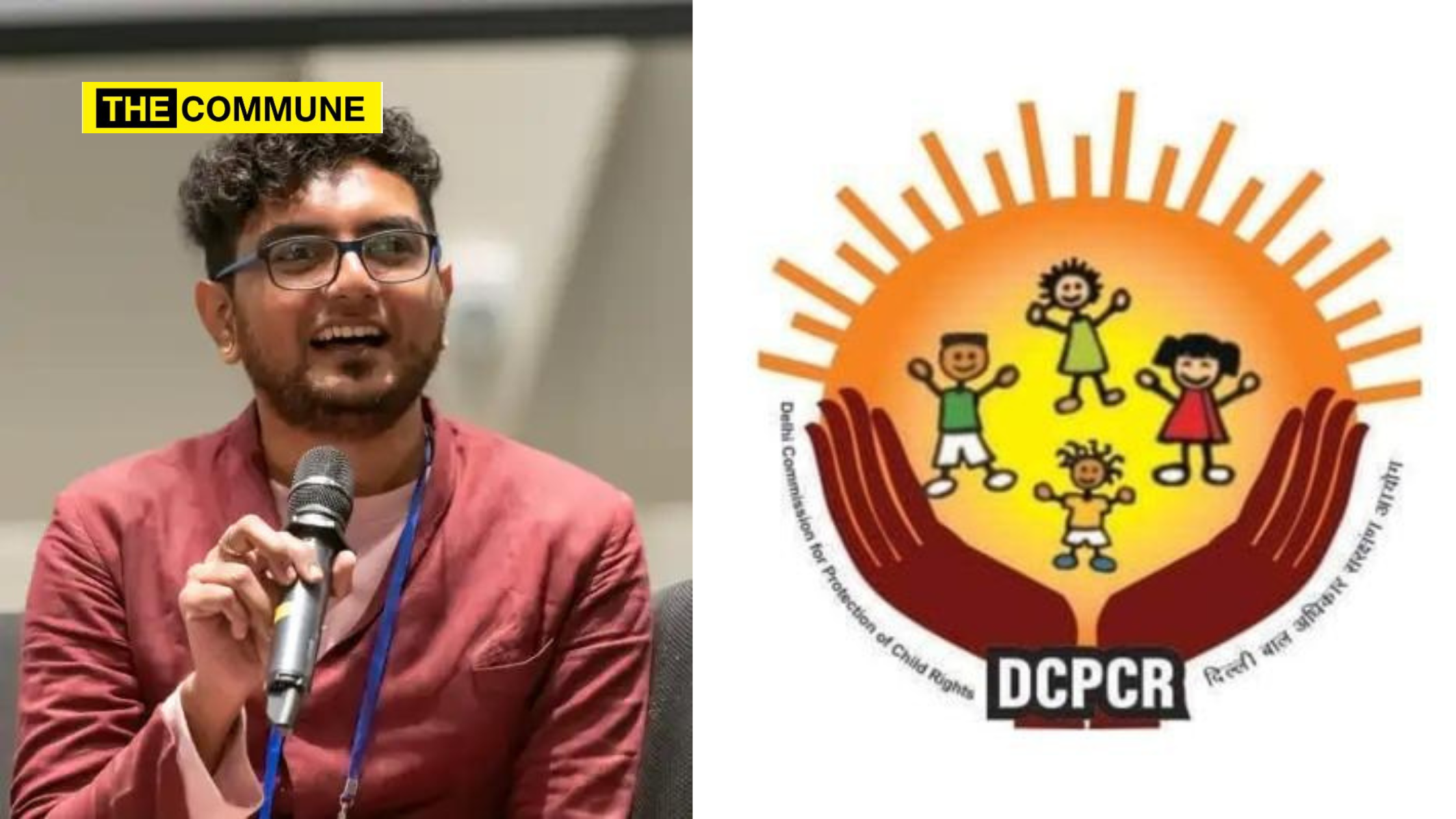
Gopi Shankar Madurai, an intersex activist, has received the Children’s Champion Award from the Delhi Commission for the Protection of Child Rights (DCPCR).
DCPCR honored Gopi Shankar Madurai for his contributions to advocating for the rights of infants born with multiple sex and gender characteristics.
DCPCR instituted the “Children’s Champion’s Award” last year to recognize individuals and institutions who have championed the cause of children in the areas of education, justice, health, nutrition, sports, and artistic expression.
According to the jury, Gopi Shankar Madurai has been recognized as an individual making a difference in the lives of children in the Child Protection category.
The award ceremony is scheduled to be held on 25 March 2023 in Delhi.
Delhi Commission for Protection of Child Rights (DCPCR) is a statutory authority constituted with the goal of promoting the cause of children. Recognizing the individuals or institutions who have contributed significantly to the health, education, protection, and agency of the children is an important and strong way to promote the cause of the children. Hence, the Delhi Commission For Protection of Child Rights (DCPCR) announces pan India Children’s Champion awards.
Gopi Shankar Madurai, intersex activist and founder of Srishti Madurai, an LGBTQIA+ non-funded student collective that aims at educating academicians, members of the medical fraternity as well as schools and college students about the community’s issues. Gopi Shankar Madurai is also the South Regional Representative for the National Council for Transgender Persons (NCTP), appointed under the Transgender Persons (Protection of Rights) Act, 2019, and the first intersex Statutory authority with the Government of India.
Click here to subscribe to The Commune on Telegram and get the best stories of the day delivered to you personally.
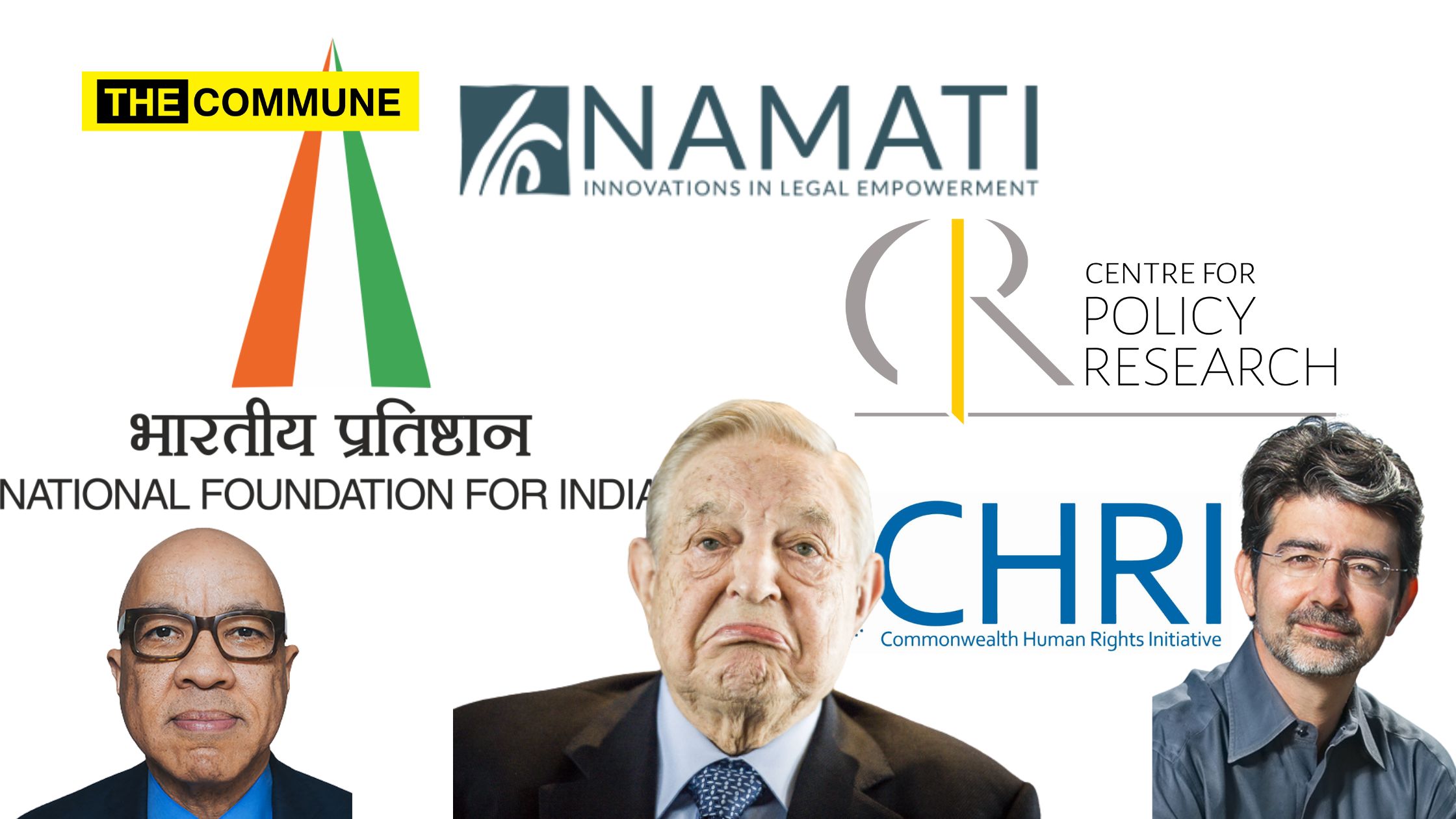
The Lede showed in Part 1 how George Soros, Pierre Omidyar’s foundations as well as The Ford Foundation functioned.
Following the Indian government’s restrictions on foreign money flowing into Indian NGOs from 2016-17 onwards, these foreign foundations were in a fix.
The Indian Ministry of Home Affairs placed George Soros’ Open Society Foundations and Open Society Institute on a ‘prior permission’ list. This meant that each time either of these foundations wished to make a donation to an Indian NGO or firm, they would have to seek the permission of the MHA.
The Ford Foundation too came under the lens of the investigating agencies around 2015, when it was found that the American NGO had given USD 290,000 to Teesta Setalvad’s NGO Sabrang between 2004 and 2006. However, a diplomatic intervention appears to have ensued, allowing the Foundation to continue its operations in India.
As for Omidyar Network, they came under scrutiny in May 2022 when they were one among 10 NGOs accused of bribing FCRA officials to renew their licences.
As a result of this crackdown, these foreign entities began to find convenient Indian and international conduits to funnel money into the country to their pet projects among NGOs as well as media houses.
We look at three case studies in this piece.
Case Study 1: Commonwealth Human Rights Initiative (CHRI)
One of the most intriguing NGOs, the CHRI has been flush with funding from Open Society Foundation (OSF) as well as The Ford Foundation.
The CHRI website states that the NGO “focuses on issues relating to access to justice, with a focus on police and prison reforms, and access to information. We work to address pressures on the freedom of expression and on media rights, as well as build the capacity of civil society to access and engage with UN human rights mechanisms. We support the eradication of contemporary forms of slavery and human trafficking through research, capacity building, and grassroots mobilisation.”
A perusal of the FCRA data shows that in the 12 years between 2006 and 2018, over Rs 50 crore has been donated to the NGO. Of this, about one quarter of the funding has come from Open Society Foundation and its sister organization Open Society Institute from Switzerland, Budapest and New York.
The second largest donor is Friedrich Naumann Stiftung, which is a German foundation for liberal politics, related to the Free Democratic Party. The Foundation follows the ideals of the Protestant theologian, Friedrich Naumann.
After 2016 though, the OSF was no longer able to fund the NGO, since it was put on the Home Ministry’s watchlist. As a result, an interesting shift took place.
A new donor emerged in 2018 – CHRI-UK – which donated Rs 2.1 crore to CHRI that same year.
What is CHRI-UK?
CHRI-UK is a registered charity in the United Kingdom. It received grants from the UK Foreign Office and the European Commission in 1998 to the tune of 50,000 Pounds.
In 2006-07, CHRI-UK received 20,000 Pounds from the Ford Foundation. For the year 2013-14, CHRI-UK reported a cash at hand of just 7337 Pounds. Even in 2016, & 2017, CHRI-UK reported having only small sums under ‘Reserves’.
CHRI-UK had little income until 2017. But its fortunes changed drastically from 2017-18 with large donations from Foundation to Promote Open Society (1,33,732 Pounds) and Foundation Open Society Institute (18,971 Pounds). There was no other income that year.
The UK Charity Commission website also shows the same about the UK branch of the Indian NGO CHRI.
The CHRI-UK’s 2019-20 funding data can be found on its own website and the data, once collated, shows a specific trend.
What does all this data show? It is evident that CHRI-UK acted as a conduit to funnel money from George Soros’ Open Society Foundation into CHRI India.
This was done despite restrictions placed on foreign funding into the country. In other words, once Soros’ OSF found that the Indian government had blocked its funding to CHRI, the foundation diverted its funding through other firms in order to ensure that CHRI India receives the same.
Who Runs CHRI?
RTI exponent Venkatesh Nayak has been the Director of CHRI since 2021.
Former journalist turned human rights activist Sanjoy Hazarika is the International Director of CHRI. According to his bio, he “holds the Dr. Saifuddin Kitchlew Chair at Jamia Millia Islamia, New Delhi, where he also directs the Centre for North East Studies and Policy Research. He has been a member of various academic organizations and official committees, including the Justice Jeevan Reddy Committee to Review AFSPA, the Society of Indian Institute of Advanced Studies, Shimla, and the North East India Studies Programme at Jawaharlal Nehru University.” Hazarika also heads another NGO called the Centre for Policy Research – we shall look into this NGO later on in this piece.
Maja Daruwala is currently Senior Advisor at CHRI having been the Director of CHRI for 20 years until 2016. She is the daughter of decorated veteran, the late Sam Maneckshaw.
Hazarika is on the Executive Committee of another NGO called the Indian Police Foundation or IPF. Daruwala is on IPF’s General Council. IPF is helmed by Prakash Singh, a retired IPS officer.
The stated goal of the IPF is to “to work for police reform and the improvement of policing through research, capacity building and policy advocacy.”
To this effect, Prakash Singh filed a writ petition before the Supreme Court of India in 1996 along with advocate Prashant Bhushan, demanding police reforms. The verdict arrived in Singh’s favour with the Supreme Court imposing a limit of 3 months of residual service for aspiring DGPs, a two-year tenure for DGPs and a caveat for the UPSC to clear the names of DGPs sent by states. This would result in a shaking up of the police force, with officers across the country clashing to gain the top post and becoming increasingly subservient to their political bosses. (More details on this aspect of the puzzle later on The Lede)
CHRI has consistently stood by Prakash Singh’s causes and of course, with two members of the CHRI leadership on the Board of IPF, it is but natural to do so.
Case Study 2: National Foundation for India (NFI)
The second large NGO we are going to look at is the National Foundation for India (NFI) which is also headquartered in Delhi.
The NGO’s stated aim is to serve as a “foundation for a diverse range of social actors in our collective journey to enable social justice. To this end, we partner with, train and mentor many individuals in climate action, women’s empowerment, independent journalism, gender rights, peace, health & nutrition, among other goals.”
A perusal of the FCRA donations declared by the NGO on its own website is given below. Between 2015 and 2022, NFI has received Rs 58.1 crore in foreign donations. Of this, Rs 94 lakh was donated by Soros’ Foundation to Promote Open Society. The Omidyar Network has pumped in Rs 3.3 crore. And the Ford Foundation has donated Rs 12 crore.
After 2016, when Soros’ foundations were put on the prior permission list, there were no direct donations. However, other Indian donors increased their funding to NFI.
One glaring example is that of Swadhikar. Swadhikar’s donations began in November 2016 with funds to the tune of Rs 9.5 lakh. Between then and 2018, Swadhikar donated about Rs 50 lakh to NFI.
Swadhikar is an NGO that supports Dalit rights and is sponsored directly by Soros’ OSF (as per FCRA filings) and indirectly through Fund for Global Human Rights which is supported by Soros’ OSF as well as Luminate, another Soros entity.
Donations to NFI from another South Africa-based NGO called Global Fund for Community Foundations began in May 2018 with a donation of over Rs 43,000. By 2021, NFI received a total of Rs 73 lakhs from this organisation.
The GFCF’s website shows who the sponsors of the organisation are – the usual suspect Soros’ OSF finds a place here as well.
This again goes to show how cleverly FCRA rules are circumvented and how Soros, the Ford Foundation and Omidyar continue to push money to India to their preferred NGOs.
As for the NFI, they offer fellowships to train journalists and young professionals, they run The Reporters’ Collective and provide grants to publish stories that are in line with the ideology of their funders.
Case Study 3: Centre for Policy Research (CPR)
This is another large NGO that rakes in funding from the foreign entities in question.
Its direct foreign funding in 2019-20 was Rs 24.5 crore. Apart from this, it had unspent FCRA funds to the tune of Rs 43.7 crore.
CPR had received Rs 11.63 crore from the Ford Foundation during 2013-2019 to study ‘urban research network.’
By the financial year ended March 2021, CPR had a balance amount of Rs 2.3 crore given in grants by the Ford Foundation. It also had Rs 1.6 crore balance from grants given by the Omidyar Network. And from Washington DC-based Namati, CPR had a balance of Rs 8.2 lakh.
In 2022, as per FCRA data available on the site, Namati had provided funding of Rs 2 crore.
The same year, the Ford Foundation had provided funding to the tune of Rs 52 lakhs.
The World Resources Institute (WRI) had provided funding to the tune of Rs 89 lakhs in 2022.
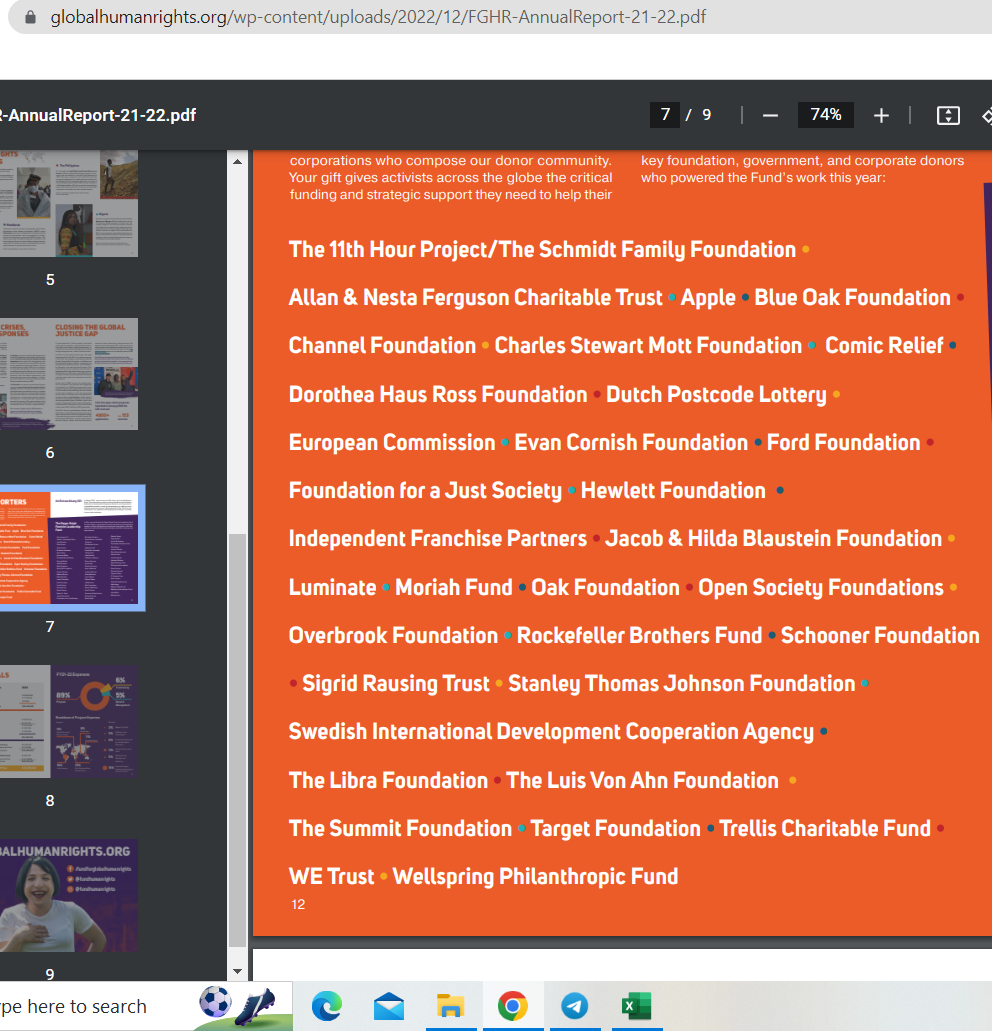
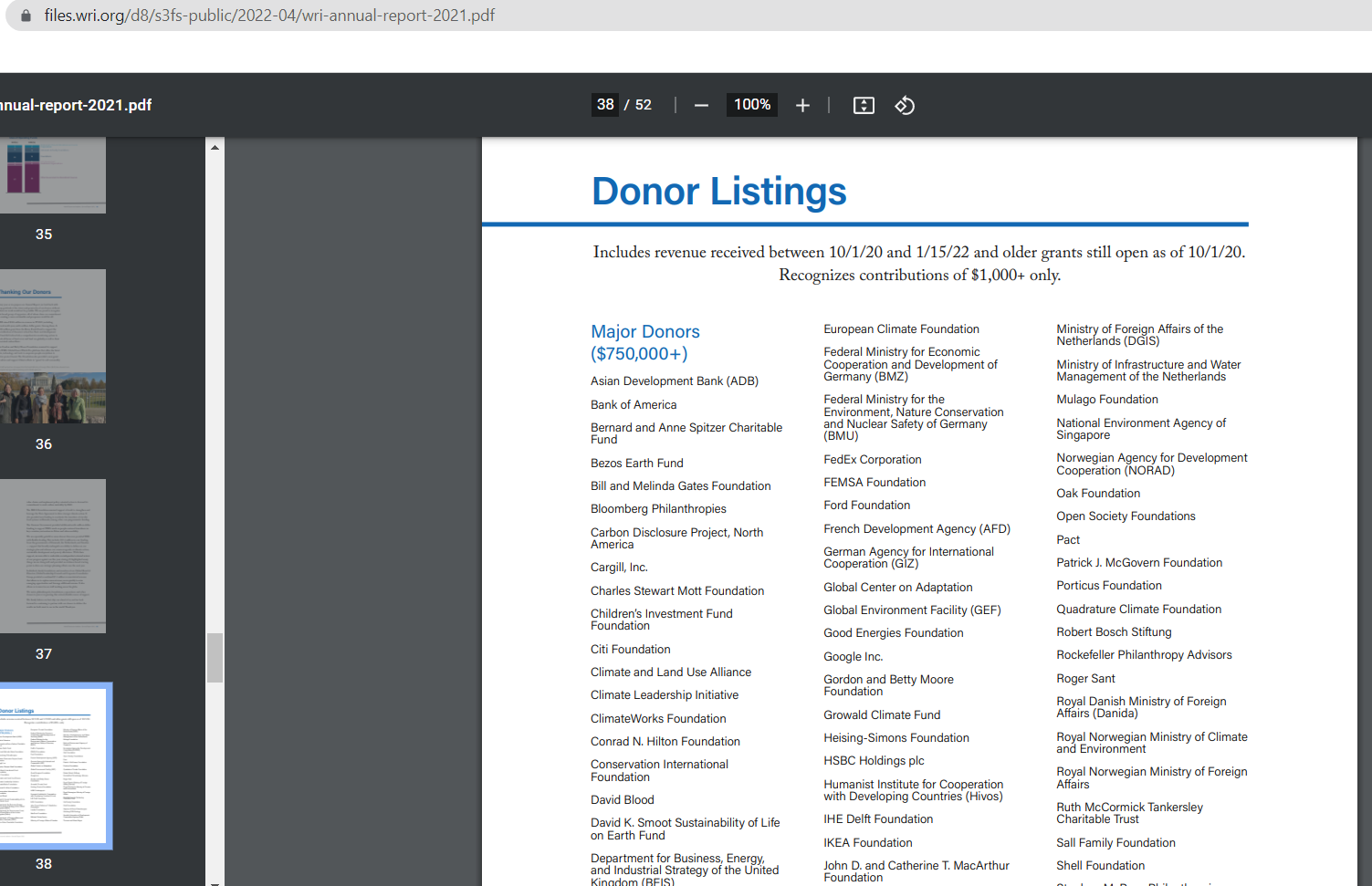
World Resources Institute has listed as a major donor, Soros’ Open Society. While the exact funding is not provided, Soros’ OSF appears to have provided more than USD 750,000 in funding to WRI between 2020 and 2022.
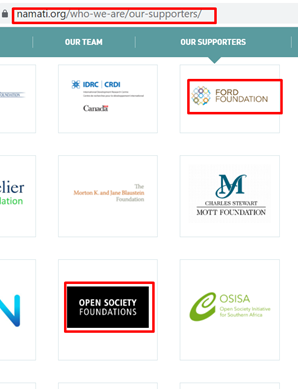
Let us take a look at Namati as well. Namati is directly funded by George Soros’ OSF and Luminate, the Ford Foundation as well as by the US State Department.
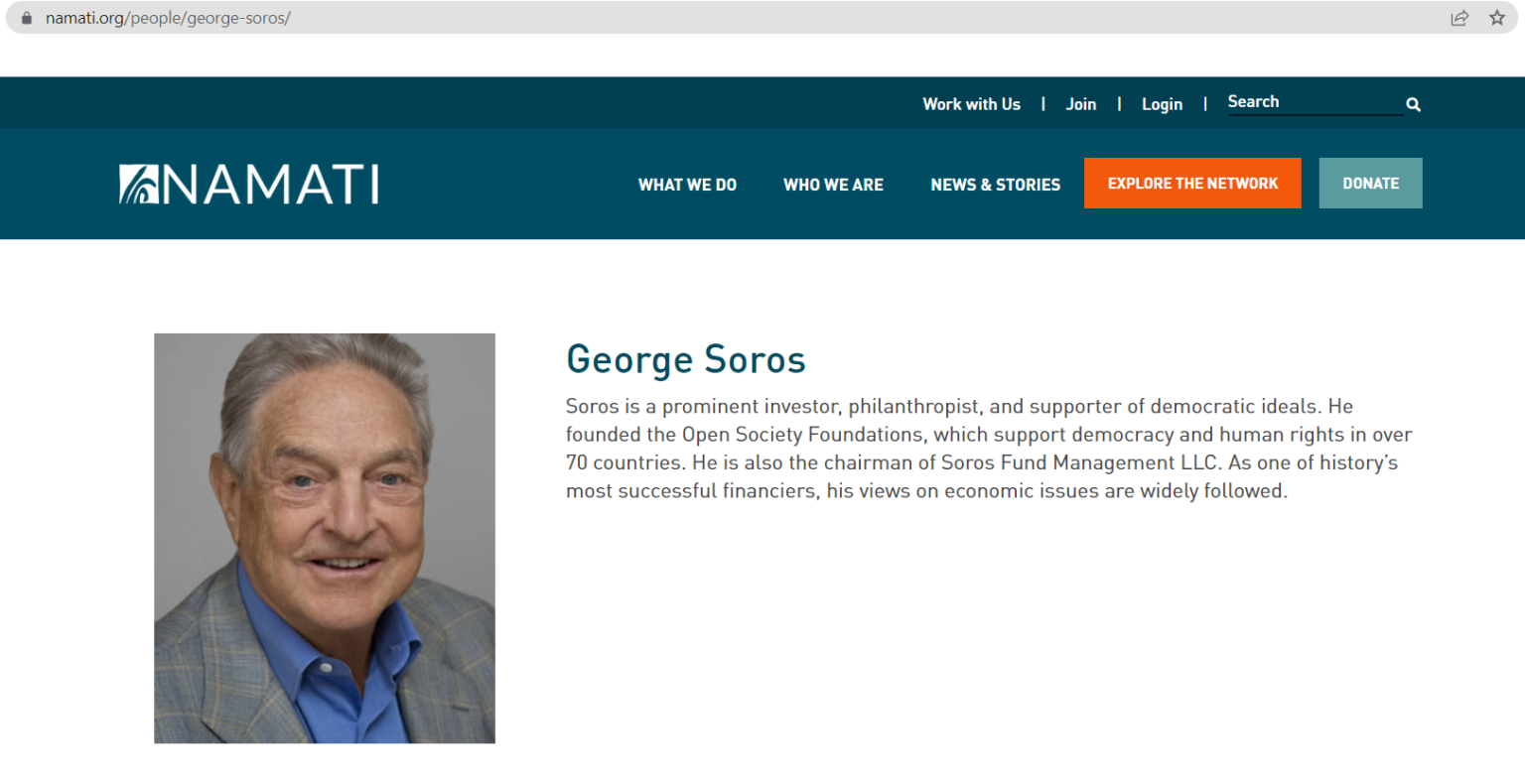
In fact, George Soros is on the Advisory Board of Namati, as per its website.
The CPR is headed by Chairperson Meenakshi Gopinath and President and Chief Executive Yamini Aiyar. Earlier CPR was headed by journalist Pratap Bhanu Mehta.
A Maze Of NGOs & Media Houses
It is very apparent that the pathways to seeding ideology have been perfected over the decades, grooming individuals, and creating spaces for them to perform. The funding pathways do not also seem to pose a challenge, with the foreign entities in question evolving and landing on their feet even as new checks and balances are put into place.
It is quite obvious that this did not happen overnight. This is a result of decades of institution- and people-building in covert and overt ways, with policy-makers, media persons and many others being complicit in the process. It would be interesting to study the past impacts of such circles of influence, and how these circles survived and expanded, operating without oversight, and with complete impunity.
A maze of entities from across the world are interlinked with these big foundations and money flows from one to another in confusing disarray. The foreign entities in question appear to have evolved an almost perfect mechanism to continue to push funding into India in an effort to propagate the political ideologies of their respective founders.
This is the ‘soft power’ that is being weaponised in India today. The timing is clearly significant. It is a year ahead of a crucial Lok Sabha election, and the narratives of these foreign powers are likely to get more aggressive.
(With additional reporting by Sandhya Sridhar, Abhijit Iyer-Mitra, Twitter OSINT user @thehawkeyex and The Lede’s research team)
(This article was originally published in The Lede and has been republished here with permission.)
Click here to subscribe to The Commune on Telegram and get the best stories of the day delivered to you personally.