Home Blog Page 85

Cutouts In Trichy, Lookalikes In Kolathur, Hologram In Kumbakonam, But Where Is Joseph Vijay?
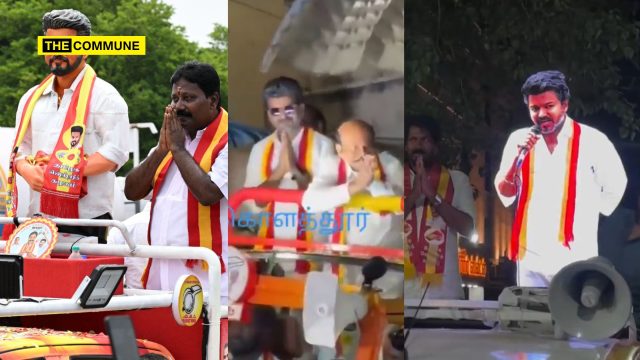
Cutouts In Trichy, Lookalikes In Kolathur, Hologram In Kumbakonam, But Where Is Joseph Vijay?

As Tamil Nadu heads into the 2026 Assembly elections, candidates of Tamilaga Vettri Kazhagam (TVK) are confronting an unusual and increasingly uncomfortable reality: they are campaigning without the physical presence of their party’s founder, C. Joseph Vijay.

Across constituencies, what should have been a star-driven campaign has instead turned into a patchwork of improvisations:  cardboard cutouts, hired lookalikes, and now even AI-generated holograms – all attempting to fill the vacuum left by Vijay’s absence.

A Campaign of Substitutes

The reliance on substitutes has only deepened. In what is being described as a first in Indian electoral campaigning, TVK’s Kumbakonam candidate R. Vinoth deployed a life-size 3D AI hologram of Vijay at a rally on 12 April 2026.

The hologram developed using AI-generated visuals and audio, projected Vijay delivering a direct message to voters, urging them to support the party’s symbol and remain steadfast.

While technologically novel, the move has raised a more fundamental question: why is a party forced to simulate the presence of its leader in the middle of an election campaign?

From Star Power to Cardboard Campaigning

On 6 April 2026, TVK’s Tiruverumbur candidate Navalpattu S. Viji, also known as Vijayakumar, was seen taking out a roadshow in Tiruchi district – not with Vijay himself, but with a life-size cardboard cutout of the actor-politician.

For a party contesting its first-ever Assembly election, such optics underline a deeper problem. TVK’s entire political proposition rests on Vijay’s personal appeal. When that central figure is missing, substitutes begin to look less like strategy and more like necessity.

Kolathur: High-Stakes Battle, Low Presence

The contrast is even starker in Kolathur, where TVK candidate V.S. Babu is up against M. K. Stalin – one of the most politically significant contests in the state.

In a constituency where every vote demands intense campaigning, TVK deployed a Vijay lookalike to accompany its candidate during canvassing.

The move drew ridicule rather than support, with critics pointing out that while established parties may use symbolic figures, they do so alongside strong organisational networks and active leadership.

TVK, by contrast, lacks both.

Repeated Absence, Repeated Cancellations

The issue is not merely one of limited appearances. Vijay has reportedly campaigned in fewer than ten constituencies across the state. More significantly, several of his scheduled campaign rallies, for which permissions had already been obtained, were cancelled.

Official explanations have cited scheduling constraints and security concerns. However, these justifications have drawn skepticism, particularly from party workers and candidates who are engaged in daily, on-the-ground campaigning.

For them, the expectation was clear: the leader whose entry into politics inspired their candidacy would stand beside them during the most critical phase of the election. That expectation has not been met.

Cadre Left to Fight Alone

On the ground, TVK candidates continue to canvass in peak summer conditions, relying largely on local networks and personal outreach. The absence of Vijay has effectively shifted the burden of campaigning entirely onto candidates who were, in many cases, banking on his presence to mobilise voters.

Unlike legacy parties such as AIADMK or DMK, which can fall back on decades of cadre strength and layered leadership, TVK remains heavily centralised around a single figure. Without that figure physically present, the campaign appears fragmented and inconsistent.

A Party Built on One Man – Missing in Action

TVK was launched on the strength of Vijay’s personal brand and mass appeal. But elections test more than popularity; they test organisational depth, leadership commitment, and the ability to translate charisma into votes.

Substituting a political leader with cardboard cutouts, lookalikes, and holograms signals more than innovation – it signals a disconnect.

At a time when candidates are seeking visibility, momentum, and direct voter engagement, the continued absence of the party’s central figure raises uncomfortable questions about leadership priorities.

The Optics of Absence

In electoral politics, presence matters. It signals commitment, builds trust, and energises cadre. Absence, particularly when repeated and unexplained, risks doing the opposite.

For TVK, the 2026 election was meant to be a debut powered by Vijay’s star appeal. Instead, it is increasingly being defined by his absence and the lengths to which the party must go to compensate for it.

Subscribe to our channels on WhatsAppTelegram, Instagram and YouTube to get the best stories of the day delivered to you personally.
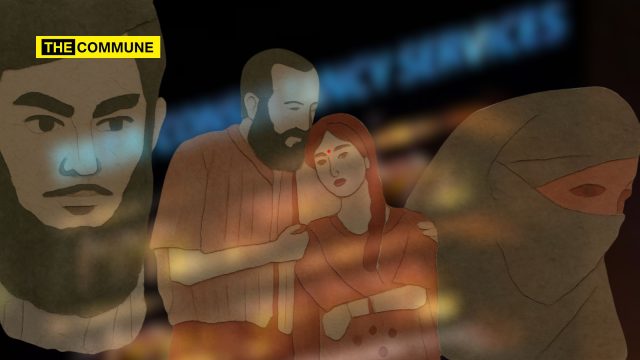
TCS Nashik Grooming Gang Case: WhatsApp Groups Used To Target Women, Police Share SIT Report With NIA, ATS, IB; Hunt On For Nida Khan

Hindu Gods Mocked, Namaz Forced, Beef Force-Fed How A Muslim Grooming Gang At A Famous IT Firm Targeted Hindu Female Colleagues

The investigation into the alleged harassment and religious coercion case at a Tata Consultancy Services (TCS) office in Nashik has escalated significantly, with the city police sharing a comprehensive report with central agencies including the Anti-Terrorism Squad (ATS), National Investigation Agency (NIA), and Intelligence Bureau (IB), as reported in News18.

The case, which began as a sexual harassment complaint, has expanded into a multi-agency probe amid allegations of pressure on employees to convert religion, consume beef, and participate in namaz. Investigators are now examining whether the incidents form part of a coordinated and organised network.

Nine FIRs Detail Pattern of Abuse and Coercion

The Special Investigation Team (SIT), led by ACP (Crime) Sandeep Mitke, is currently examining nine FIRs that describe repeated instances of harassment over several years.

According to the complaints, the alleged acts include inappropriate physical contact, stalking, sexually explicit remarks, derogatory comments about religion, and attempts to force women into religious practices. Several victims have also alleged that they were pressured to consume beef, perform namaz, and, in some cases, enter into physical relationships under false promises of marriage.

Sources indicate that the pattern of abuse was not random. Investigators are probing claims that groups within the organisation were used not merely for casual interaction but to identify and target women. Victims have alleged that internal discussions may have played a role in selecting individuals, and that a separate group was created around the first complainant, who was later allegedly sexually exploited.

Investigators believe that digital evidence, including WhatsApp communications, could point to a deliberate pattern linking harassment, sexual exploitation, and attempted religious conversion.

Central Agencies Step In, Wider Network Under Scanner

The involvement of central agencies marks a significant escalation in the probe. The ATS, NIA, and IB have sought detailed inputs from the SIT, indicating that the case may have broader implications.

Agencies are examining multiple angles, including possible external funding, links to anti-national elements, and connections to banned organisations. Digital activity, financial transactions, international links, and social networks associated with the accused are all under scrutiny.

Teams from central agencies are expected to join the investigation on the ground and coordinate closely with local police.

Arrests Made, Key Accused Absconding

So far, seven individuals have been arrested in connection with the case, while one accused, identified as Nida Khan, remains absconding and is being actively traced. Investigators have referred to her as a key figure in the case.

Of the eight accused, six have been sent to judicial custody, one remains in police custody for interrogation, and Nida Khan is still absconding. The HR officer’s role drew particular focus, despite receiving repeated complaints from victims, she allegedly dismissed them saying “these types of things keep happening in an MNC,” and took no action.

In a significant development, the company’s Operations Manager, Ashwini Chenani, was arrested from Pune and has been remanded to police custody till April 13. Investigators have alleged that lapses in handling complaints allowed the situation to continue over an extended period.

A News18 reporter confronted the families of the accused on camera. Raza Memon’s mother, whose son is named in eight FIRs, flatly denied the allegations, insisting her son was innocent and being framed, saying she had full faith that justice would eventually clear his name. A second family member, speaking about another accused, described how the arrest unfolded: the young man had been on leave when he was summoned first to the office and then directly to the police station, with no prior visit to their home by police. The father maintained that his son was a well-behaved, devout young man who “walks with his head down going and coming back” and had never had any trouble with anyone in his years of employment — adding, pointedly, that he “offers namaz and minds his own business.”

Victim Turned Key Witness, New Dimension Emerges

During the course of the investigation, a person initially suspected to be linked to the accused has now been identified as a victim.

According to investigators, the individual stated during questioning that he had been coerced into changing his religion several years ago. His testimony is being treated as a key development, offering insights into the methods allegedly used, including psychological pressure and gradual behavioural influence.

Government Calls Case ‘Serious and Shameful’

The seriousness of the allegations has prompted a strong response from the Maharashtra government.

State minister Girish Mahajan, who visited Nashik, described the case as “extremely serious and shameful.” He stated that the allegations include harassment of women, pressure for religious conversion, coercion into participating in religious practices, and mental torture.

He also referred to claims that women were lured with job opportunities and subsequently subjected to such treatment. He said that if the allegations are proven, strict action would be taken against those involved.

Mahajan added that the Chief Minister has taken the matter seriously and has directed authorities to ensure a fair and thorough investigation. He also appealed to women to come forward without fear, assuring that their identities would be protected and that the government would extend full support.

Company Responds

Tata Consultancy Services (TCS) has issued a statement stating that it follows a strict zero-tolerance policy towards harassment or coercion in the workplace and prioritises employee safety.

Subscribe to our channels on WhatsAppTelegram, Instagram and YouTube to get the best stories of the day delivered to you personally.
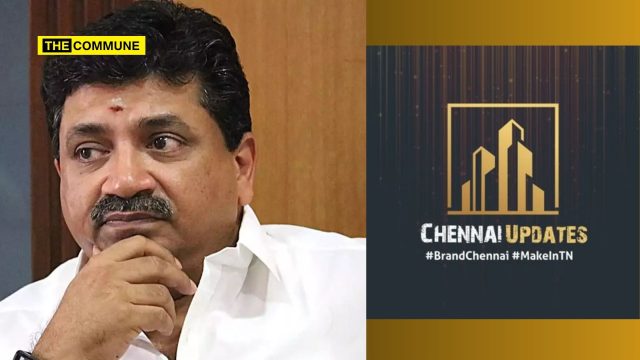
DMK Minister PTR Palanivel Thiagarajan Publicly Doxxes Anonymous X Handle At Election Rally

DMK Minister PTR Palanivel Thiagarajan Publicly Doxxes Anonymous X Handle at Election Rally

In what comes across as a below-the-belt act by a DMK minister, PTR Palanivel Thiagarajan, using a campaign rally podium, he publicly doxxed an anonymous X handle. This came about despite the handle simping for the ruling DMK government over the years.

What PTR Said at the Rally

At a campaign rally in Madurai, PTR delivered a combative speech targeting what he called “evil forces” spreading lies in his constituency. In the course of the speech, he named Sandhya Ravishank, Vinod Arulappan, Chennai Updates, Parthiban Kumar, AC Shanmugam and the ‘Cinema Sanghi’ director Sundar C – accusing all of them of coordinating to build a false political narrative for their own professional benefit.

By naming “Chennai Updates” alongside identified individuals in a public setting, PTR effectively unmasked the operator’s real identity to the rally crowd and, by extension, to anyone watching the speech online – the defining act of doxxing.

He framed the entire group as working to “portray the State Governor as some great man” and dismissed them as operating for their “next business venture.”

He even made a post naming the handle on his X account.

Chennai Updates (@UpdatesChennai) is an anonymous account on the social media platform X, known for tracking civic issues in Chennai and also Madurai, and for regularly flagging governance lapses including those attributable to the DMK government. Despite its critical tone on specific issues, the handle had a history of broadly supporting the DMK and was not considered an adversarial or opposition-aligned account. It seems that the handle had not, by any public record, personally attacked PTR.

This is not the first time PTR has responded to unfavourable media coverage with public pushback rather than accountability. His response to Vinodh Arulappan’s ground report was a lecture on constitutional federalism that critics argued deflected rather than addressed the civic failures documented. The doxxing at the rally follows the same pattern targeting the messenger rather than engaging with the message.

PTR holds the IT portfolio in the Tamil Nadu government, making the act of doxxing a digital critic particularly pointed.

Subscribe to our channels on WhatsAppTelegram, Instagram and YouTube to get the best stories of the day delivered to you personally.
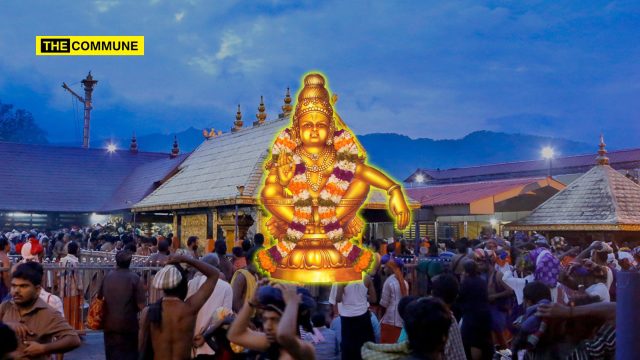
Ayyappa Is Not Just A ‘Forest Or Village God’: History, Inscriptions And Tamil Texts Tell A Different Story

When writing history, it is essential that the author undertakes deep research into the subject, or at the very least possesses a sound familiarity with the historical and cultural landscape. When someone relies heavily on secondary sources, especially questionable ones, the result is often a half-baked work in which the underlying agenda becomes all too obvious. The article in The Print is one such example.

Written in the backdrop of the ongoing court case, the article attempts to portray Lord Ayyappa as merely a “local forest deity” who was later appropriated by the usual target of such narratives – “the Brahmins.” What is unfortunate is that the larger background, religious context, and historical evolution of the worship are completely ignored in order to sustain this superficial argument. The author also resorts to the familiar wordplay often seen in Dravidianist discourse: if the names are different, then the deities must be different. This is the standard line used to construct a theory of exceptionalism claiming, for instance, that Murugan is different from Karthikeya, Durga is different from Kotravai, and so on.

The very opening paragraphs of the article are riddled with factual errors. One striking example is the claim: “In Tamil Nadu, he is known as Ayyanar, and is more of a village protector-god.” Really? The deity has been known since ancient times as Shasta, and is worshipped under various names such as Ayyanar and Ayyappan. At its core, this is the worship of Shasta in different forms.

The name Shasta appears in Tamil sources from an early period, including Sangam literature. In fact, several Tamil poets bore names such as Saattan, which is the Tamil form associated with Shasta. To reduce Shasta merely to a “village protector-god” is therefore historically inaccurate. Shasta has been worshipped not only in village shrines, but also in major and urban temples. It is true that, over time, this form of worship became especially prominent in rural settings, but that does not define either its origin or its full historical character. The name itself is traditionally explained as “one who knows the many Shastras,” as noted by Adiyarkkunallar in his commentary on the Silappadikaram.

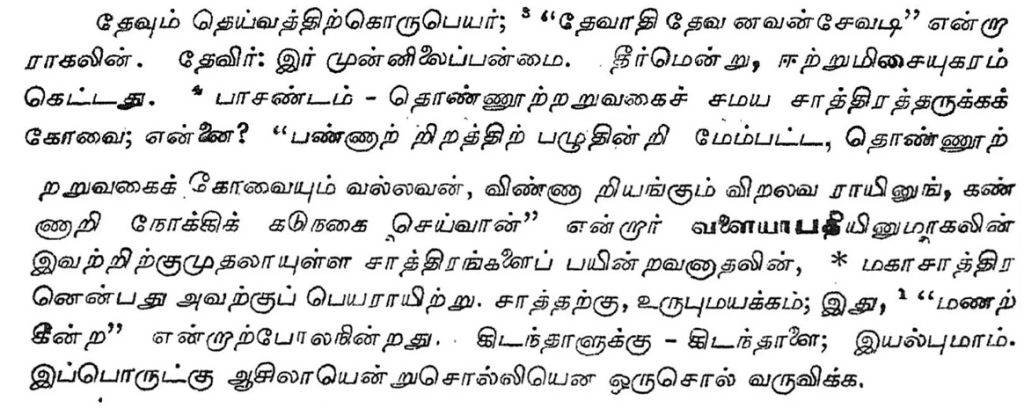
Definition of Shasta in Silappadhikaram commentary

The famous Kanchipuram Kamakshi Amman Temple also has a shrine for Shasta, and tradition holds that Karikala Chola worshipped there before embarking on his northern expedition. A well-known verse refers to this association.

கச்சி வளைக்கைச்சி காமகோட்டங்காவல்
மெச்சியினிதிருக்கும் மெய்ச்சாத்தன் கைச்செண்டு
கம்ப களிற்றான் கரிகாற்பெருவளத்தான்
செம்பொன் கிரிதிரித்த செண்டு.

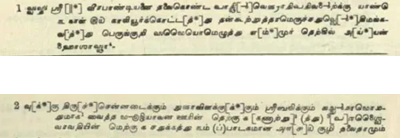
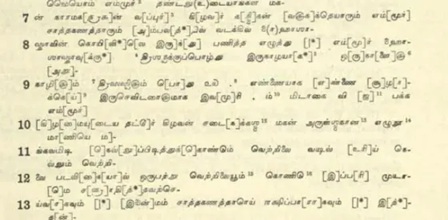
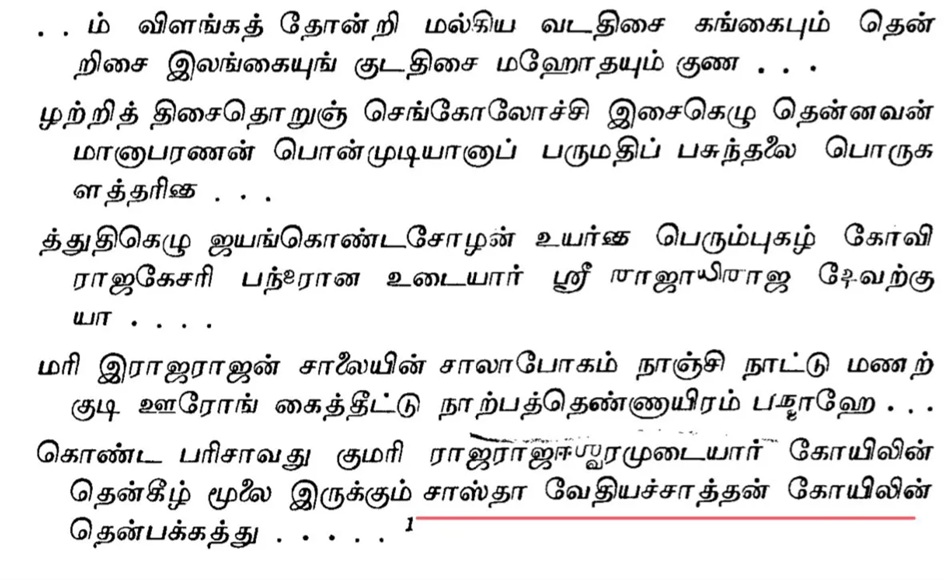
Further, many Pallava temples had shrines dedicated to Shasta. Endowments made to Shasta temples were known as “Aiyan Bhogam,” and the administrators of such temples were called “Sattan Ganathar.” These details are attested in numerous inscriptions of the Pallavas, Cholas, and Pandyas. One such example is an inscription of Parthivendra Varman at the Uthiramerur Maha Shasta Temple. Significantly, the inscription uses both Ayyan and Shasta to refer to the same deity, clearly showing that these names were understood as referring to one and the same divine tradition.

“Ayyan Mahashasta” says Parthivendravarman Inscription at Uttiramerur

Similarly, there is another inscription of Rajaraja I at Ukkal, dated to 1002 CE, which records grants made to the Mahashasta temple. It also notes that the transaction was registered in the presence of the Sattan Ganathar, the administrators of the temple.

All this clearly establishes that Ayyanar/Shasta worship was not confined to village settings. Let us now turn to some of the other claims made in the article. It states: “Kalittokai, a compendium of early Tamil poems, mentions that Ayyan was revered by peasant chieftains called the Ay.”

This is again misleading. The Ay chieftains ruled parts of south Kerala from the Sangam age onward and cannot simply be reduced to “peasant chieftains.” They traced their lineage to the Yadavas said to have migrated from the north. They were also patrons of Vedic learning, Veda patasalas, and temples, as inscriptions such as the Parthivasekarapuram Copper Plates make clear. Therefore, even in the case of the Ay rulers, Ayyanar was not some marginal or folk deity detached from the Vedic framework; he was very much understood within that broader religious tradition.

Another line in the article claims that “the epic Silappadikaram mentions a hunter god known as Chattan and Ayyanar.” This is precisely the problem with writing from secondary sources without even undertaking basic primary verification.

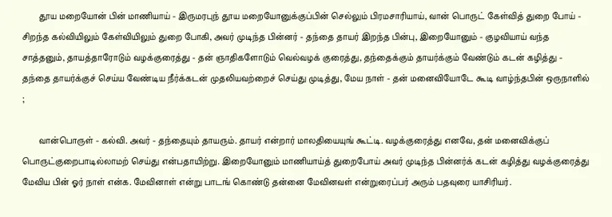
Silappadikaram refers to Pashanda Sattan, who is described as one who knew the ninety-six shastras, hence the name, as noted earlier. Silappadhikaram mentions that Shasta was born as a Brahmin and did all the rituals for his parents.

The text also states that there was a kottam, a temple for him, at Poompuhar, the great Chola port city. Where, then, does this “hunter god” interpretation come from? It is a reading imposed on the text rather than one grounded in it.

The article makes yet another factual blunder : “Ayyanar, on the other hand, is rarely mentioned in temple inscriptions in Tamil Nadu, as he had become a god of ‘lower’ castes, such as potters.” This is simply incorrect. The Kanyakumari inscription of Rajaraja I clearly refers to Shasta as a Vedic deity, without any ambiguity, and presents him as a deity worshipped within the mainstream religious fold. The inscriptional record does not support the simplistic caste-based reduction that the article attempts to impose.

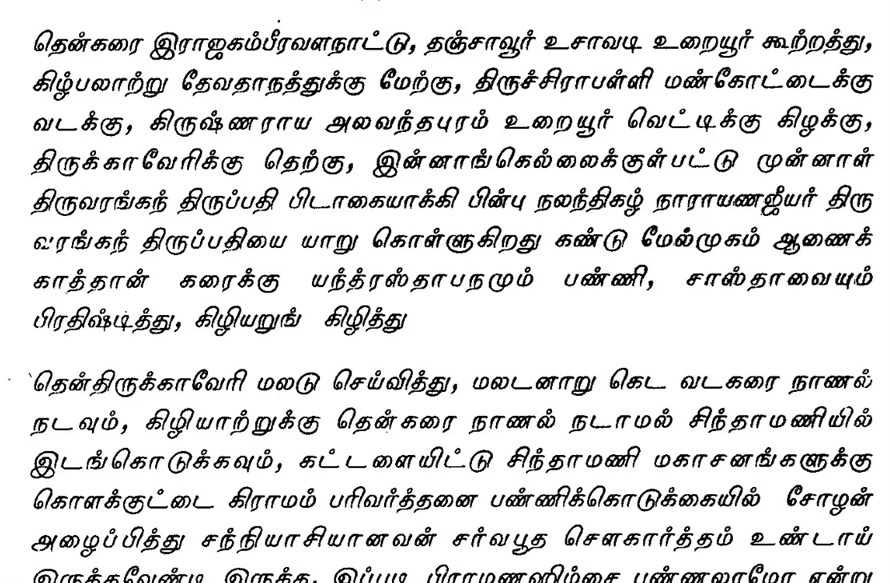
A blatant falsehood appears in the article’s claim that there is “a 13th century inscription from Srirangam attesting that a ‘Shudra-Devata’, probably Ayyanar, was installed by a Brahmin priest ‘to control erosion of the temple grounds and to prevent the interference of shudra elements by the river’.” The inscription is available in detail, and nowhere does it use the term “Shudra-Devata.”

What it actually records is that, because the river repeatedly breached its banks, the Jeeyar performed the pratishtha of Shasta along with a yantra. That is all. This is precisely the level of “scholarship” on which the article is built: a meaning is invented and then passed off as epigraphic fact.

At one point, however, the author almost stumbles into reality by admitting: “Despite the divergence, Ayyanar and Ayyappa continued to influence each other. They share iconographic links.” In truth, Shasta, Ayyanar, and Ayyappan belong to the same deity tradition, with the same essential iconographic features. One would hardly find their vigrahas, right from the Pallava period onward, without the yajnopavita. As with many deities in Sanatana Dharma, the same god appears in different forms in different places according to local sthala puranas and devotional traditions.

Take Murugan as an example. At Palani, he is worshipped as Dandayudhapani; at Tiruchendur, as the divine warrior; at Tirupparankundram, in the context of his marriage to Deivayanai; and in many other temples, together with Valli and Deivayanai. In some places he is in a seated posture; in others, he stands. None of this means that the deity is different. The form varies; the deity does not.

The same applies to Ayyanar/Ayyappan. He is worshipped in different forms in different temples. In many places, Ayyanar appears with his consorts Poorna and Pushkala. At Sabarimala, however, Ayyappan is worshipped as a brahmachari. Tradition associates this form with the later history of the region, including the movement of the Pandya line into Pandalam during the Chola–Pandya conflicts, and the belief that Ayyappan manifested there in that form. Accordingly, the temple came to worship him as a brahmachari, in keeping with that local sacred tradition. Yet, in the same Kerala, at places such as Aryankavu, the deity is worshipped together with Poorna and Pushkala. For anyone familiar with Sanatana Dharma, such variation is neither unusual nor contradictory; it is entirely natural within a living and layered sacred tradition.

There is therefore no justification for branding Ayyappa as merely a “tribal deity” simply because one form of Shasta is worshipped in a forest shrine. Ayyappa has, from the earliest period, been worshipped by people across social sections, and it is precisely this wide and unifying appeal that has made the temple a recurring target of controversy. The fact that the temple stands as a living symbol of Hindu unity is something that vested interests have found impossible to tolerate.

In sum, the article suffers not merely from a difference of interpretation, but from a serious weakness in method. It lifts selective claims from dubious secondary readings, ignores primary literary and inscriptional evidence, and then builds a sweeping argument on that fragile foundation. The result is a narrative that tries to detach Ayyanar/Ayyappan/Shasta from the broader civilisational and Vedic framework in which the deity has long existed. Tamil literary sources, temple traditions, and inscriptions from the Pallava, Chola, and Pandya periods all point in the opposite direction: Shasta was a well-established deity worshipped in major temples as well as village shrines, known by multiple names, and understood within a mainstream sacred tradition.

What we are really seeing here is an attempt to impose a modern ideological template upon a far older and more complex religious world. In that template, every local variation must be turned into a rupture, every difference in name into a different god, and every historical layer into a story of appropriation. But Sanatana Dharma has never functioned in such rigid compartments. The same deity can be worshipped in different forms, postures, and local traditions without losing essential continuity. To ignore this is not scholarship; it is distortion. A serious study of Ayyanar or Ayyappan must begin with the humility to read the sources in full, understand the tradition on its own terms, and resist the temptation to force history into a pre-decided ideological frame.

TS Krishnan is a Tamil scholar, historian and author.

Subscribe to our channels on WhatsAppTelegram, Instagram and YouTube to get the best stories of the day delivered to you personally.
The Kerala Story Got Real: Kumbh Mela Fame Monalisa Found Underage, POCSO Case Filed, Wedding Was Backed By CPI(M) Leaders

Monalisa Bhosle, a young tribal girl from Madhya Pradesh’s Khargone district, rose to fame during the 2025 Maha Kumbh Mela in Prayagraj, where she went viral on social media while selling fancy ornaments.

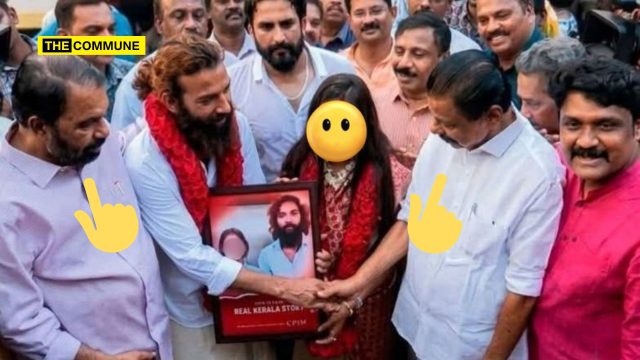
On 11 March 2026, Monalisa and her boyfriend Farman Khan approached the Thampanoor police station in Thiruvananthapuram, claiming that Monalisa’s father was trying to forcibly take her back to Madhya Pradesh against her will. The couple also claimed both were adults. The two subsequently got married at a temple in Arumanoor, on the outskirts of Thiruvananthapuram (also reported as Poovar temple).

Three prominent CPI(M) leaders attended the wedding and publicly celebrated it as a symbol of social harmony and communal amity:

  • V. Sivankutty – Kerala Cabinet Minister (Education)
  • M.V. Govindan – CPI(M) State Secretary
  • A.A. Rahim – CPI(M) Rajya Sabha MP

CPI(M) leaders framed the inter-faith marriage as the “Real Kerala Story” as a counter to the Bollywood film The Kerala Story.

The state police even defended the wedding and that the girl was a major by stating that she had an Aadhar card that proved so.

Monalisa’s father had filed a complaint alleging kidnapping, and a case under BNS Section 137(2) (kidnapping) was already registered based on his complaint. His claims that his daughter was a minor were dismissed at the time, as the couple produced an Aadhaar card showing her date of birth as 1 January 2008 – which would make her 18 at the time of marriage.

Farman Khan, at a press conference, specifically cited K-SMART to assert that the marriage was legally registered: “She is an adult and the marriage was legally registered through the Kerala government’s K-SMART app”. The marriage certificate was generated within 30 minutes of document submission.

Kerala LSGD officials defended the system, stating that “under-age marriage cannot be registered under this system” as all age and residence proofs are verified before issuance.

Social activist Adv. Pritham Dubey from Uttar Pradesh brought the matter before the National Commission for Scheduled Tribes (NCST). The NCST conducted an investigation and obtained hospital birth records from Government Medical Hospital, Maheshwar, which showed Monalisa’s actual date of birth as 30 December 2009. This made her 16 years, 2 months, and 12 days old at the time of her marriage – well below the legal marriage age of 18.

The Aadhaar card used to register the marriage was alleged to be a forged document issued in the name of Maheshwar Municipality with a fabricated date of birth.

Following the NCST findings, Madhya Pradesh Police registered a POCSO case against Farman Khan at Maheshwar Police Station, Khargone district. The NCST recommended adding multiple serious sections to the case, including:

  • Sections 87, 83, 96, 64, 81, 56 of BNS covering rape, procuration of a child, kidnapping, fraudulent marriage ceremonies, and cohabitation by deceit
  • Sections 17 & 18 of POCSO Act abetment and attempt to commit sexual offences against children
  • Provisions under the SC/ST (Prevention of Atrocities) Act, 1989
  • The MP Freedom of Religion Act, 2021
  • The Prohibition of Child Marriage Act, 2006

The NCST also directed the DGPs of both Kerala and Madhya Pradesh to appear before it.

BJP Kerala state secretary S. Suresh demanded that Sivankutty, Govindan, and Rahim be charged under the SC/ST Act and Criminal Conspiracy. The three leaders facilitated the marriage of a minor for political optics ahead of the Kerala Assembly Elections 2026.

CPI(M) leaders denied organising the wedding, with Rahim stating they had arrived at the venue only after seeing media reports portraying it as a case of family obstruction to an inter-faith couple. Govindan maintained that “as per records produced by the girl’s father himself, the girl was not a minor”. Kerala Police also continued to defend the Aadhaar card as genuine.

Subscribe to our channels on WhatsAppTelegram, Instagram and YouTube to get the best stories of the day delivered to you personally.
Udhayanidhi Exalts DMK Min Sivasankar Who Demeaned Lord Rama

Udhayanidhi Exalts DMK Min Sivasankar Who Demeaned Lord Rama

DMK scion Udhayanidhi Stalin campaigned in Kunnam constituency in support of DMK candidate and minister Sivasankar, urging voters to ensure a decisive victory for the party in the upcoming Assembly elections.

He described Sivasankar as an active and hardworking representative who had contributed to both governance and party work. He highlighted the candidate’s tenure as Transport Minister, stating that efforts had been made to replace old buses with new and modern ones across Tamil Nadu, including the introduction of air-conditioned services and expansion of connectivity to rural areas.

Listing constituency-specific projects, Udhayanidhi Stalin said that several infrastructure works had been carried out over the past five years.

He went on to say, “Our leader (Stalin) has entrusted you with a truly exceptional, indeed, a winning candidate. When our Thalaivar calls upon him our brother Sivasankar, how does he address him? He addresses him, quite simply, as “The Lion of Ariyalur.”

What Sivasankar Said

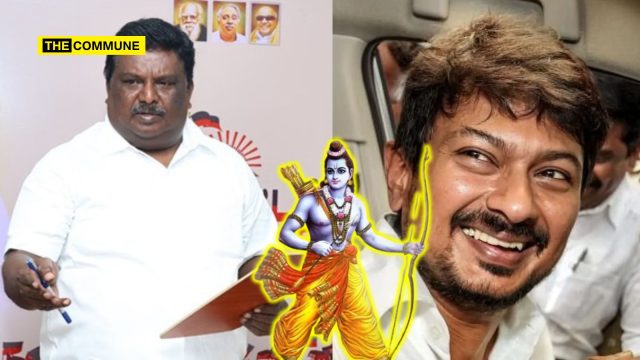
It is noteworthy that the same Sivasankar who DMK scion Udhayanidhi Stalin is exalting today had one day questioned the existence of Lord Rama.

In August 2024, DMK Transport Minister S. S. Sivasankar, while addressing an event in Ariyalur to mark the birth anniversary of Chola emperor Rajendra Chola, spoke about the importance of commemorating historical figures with documented evidence.

He said, “We must celebrate the birthday anniversary of our great ruler Rajendra Chola, who made our land proud. We should celebrate his birthday; otherwise, people may be compelled to celebrate something that has no connection or evidence to them.”

Referring to historical records, he added, “To show that Rajendra Chola lives on, there are ponds constructed by him, temples built by him, and his name is mentioned in scripts, sculptures, and other artefacts. We have history and evidence for it, but there is no evidence or historical record of Lord Ram’s existence. They call him (Lord Rama) an avatar. An avatar can’t be born. It is being done to manipulate us, hide our history, and present another history as superior.”

Subscribe to our channels on WhatsAppTelegram, Instagram and YouTube to get the best stories of the day delivered to you personally.
Class 8 Civics Lessons For MIT Sloan PhD, Lehmann Bros Fame, 4th-Gen Dynast ‘Pannaiyaar’ PTR

ptr madurai MIT sloan buffalo dmk

PTR Palanivel Thiagarajan, the incumbent MLA of Madurai Central constituency has attracted the media limelight for all the wrong reasons, plainly because of his arrogance.

Madurai Ground Reality Flagged

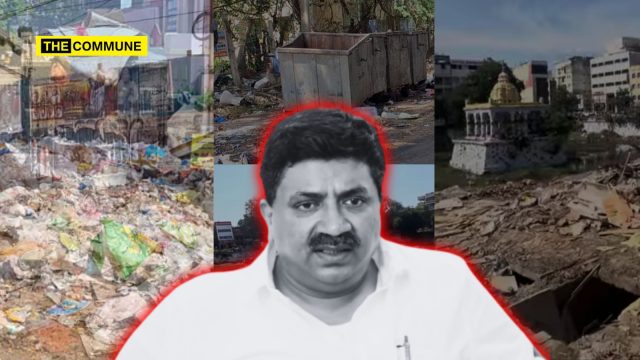
A few days ago, PTR claimed he wanted to do a lot for his constituency but couldn’t do it and that was because of political reasons. Following this, his opponent and several news reports pointed out to him the sad state of affairs in his constituency – plethora of civic issues given that Madurai has been ranked the dirtiest city of the country.

PTR Responds With ‘Federalism’ Argument

When this fact was pointed out, PTR chose to target and discredit journalists reporting unfavourable ground sentiment. He came up with an eight-point lecture heavy on constitutional theory, light on accountability, that a PhD from MIT Sloan, a Lehmann Brothers alumnus, a fourth-generation political dynast, and a man who served as Tamil Nadu’s Finance Minister probably did not need to deliver to a working journalist.

The lecture, however, inadvertently revealed something more interesting than PTR intended.

What Are The Responsibilities?

PTR’s response reduced the concerns of Madurai’s citizens into a jurisdictional flowchart. Roads? That’s the Corporation. The Corporation? That’s the Local Body. The Local Body? Not my department. It is a response that would make a bureaucrat proud and a voter furious.

  • Ward Councillors bear primary responsibility for garbage collection, street cleaning, and local roads.
  • The Mayor holds city-wide sanitation and waste system oversight.
  • The Commissioner (an IAS officer appointed under State government controls) handles execution, staff, and contracts
  • MLAs carry responsibility for funding, escalation, and policy push.
  • Ministers and Departments control budget allocation and oversight of local bodies.

PTR’s position as a minister explicitly grants him “control over local bodies.” He is not a bystander to Madurai Corporation’s failures. He is, constitutionally and administratively, part of the oversight chain. The federalism argument he deploys against journalists is the same one he conveniently discards when claiming credit for the 6th State Finance Commission’s role in doubling Corporation revenues.

Federalism vs Ground Reality

PTR’s federalism argument rests on the 74th Constitutional Amendment (1992), which assigned 18 civic functions to Urban Local Bodies under Article 243W and the 12th Schedule. He is textually correct. But Tamil Nadu’s ground reality exposes the argument as selective. The same amendment’s Article 243X grants municipalities taxation powers; Article 243Y mandates State Finance Commissions to ensure fiscal devolution. Tamil Nadu constitutes its SFCs and then implements their recommendations partially, leaving corporations executing state decisions with state money, their grants predominantly tied to salaries and power bills rather than infrastructure priorities. That is not devolution. That is supervised administration with a constitutional letterhead.

Water supply and sewerage which are core civic functions remain with TWAD, a state parastatal, not the Corporation. The Municipal Commissioner answers to the state, not the Mayor. Urban planning sits outside ULB control entirely. PTR’s own state government holds the money, the commissioner, and the parastatals. Then it points at the Mayor when cities rot.

In perhaps the most unintentionally revealing moment of his response, PTR asked whether it would be an “abuse of power” to direct the Corporation to prioritise P.T. Rajan Road – the road named after his grandfather. The question answered itself. A road bearing a family name in a constituency a family has represented across generations, in a city the family calls home, remains in a state of disrepair and the MLA’s response is to cite conflict-of-interest as the reason he cannot intervene. The dynasty is invoked for prestige; accountability for the dynasty’s own street is outsourced to the Corporation.

Madurai’s Dirtiest Secret

Federalism is a framework for cooperation, not a ladder for escaping blame. The 74th Amendment did not create islands of isolated responsibility – it created a layered system where Ward Councillors, the Mayor, the Commissioner, the MLA, the Minister, and the State Government are all expected to function as interlocking gears. When a road caves in or garbage rots on a pavement, no single gear failed in isolation. The system failed together.

An MLA who genuinely understands federalism does not look at a pile of uncollected garbage on a Madurai street and say “not my job.” He picks up the phone. He escalates to the Commissioner. He flags it to the Minister of Municipal Administration. He uses his legislative platform. He withholds his party’s goodwill from a Corporation that is failing. That is what federalism in practice looks like – not a flowchart printed to hand to a journalist.

If Madurai has been ranked the dirtiest city in India, that verdict did not land on the Ward Councillor’s desk alone. It landed on everyone in the oversight chain and PTR, as both the sitting MLA and a former Finance Minister who controlled devolution to Urban Local Bodies, sits squarely within that chain. A city’s filth is not a jurisdictional question. It is a political one.

Case Study: Jaihindpuram Road Issue

In Jaihindpuram, Madurai, a 2.93 km stretch remained an unpaved mud road for nearly three years disrupting shopkeepers, pedestrians, schoolchildren, and daily commuters. The Corporation’s explanation: underground pipe laying by TWAD, a state parastatal outside local body control.

On 31 May 2025, CM Stalin conducted a roadshow through Madurai ahead of the DMK General Council meeting. The roadshow passed through Jaihindpuram. The road that had resisted repair for three years was laid overnight. The excuse that had served three years did not survive one political itinerary. This is not local body failure. It is the state’s infrastructure fragmentation made visible — and then made invisible, on demand.

PTR asked why he received no credit for steps taken as Finance Minister that helped Madurai Corporation double its annual revenues. It is a fair question, but it cuts both ways. If he claims credit for revenue doubling, he must also answer why a Corporation flush with doubled revenues still cannot maintain basic roads and sanitation in the city his family has politically represented for generations.

MLA Funds and Civic Responsibility

There is one final contradiction PTR’s lecture cannot survive. His own Ward 56 constituency report lists 14 road and road repair works funded through his MLA Constituency Development Scheme. His Madurai Central report further lists BT Roads laid under MLACDS funds from 2016 to 2025.

Source: PTR X handle

Roads are a 12th Schedule function – local body territory by his own argument. Yet he spent his legislator’s fund on them and listed them as achievements. The constitutional separation he invokes to avoid blame was never observed when building a record. Why does an MLA fund roads at all? Because Tamil Nadu’s ULBs are starved of untied funds – a structural condition the state government, which PTR served as Finance Minister, created and perpetuated. The MLACDS fills the gap the state engineered. The MLA takes the credit. When roads fail, the Corporation takes the blame.

Accountability Beyond Structure

A man who studied public finance at MIT Sloan, who managed risk at Lehmann Brothers before its spectacular collapse, and who presented multiple state budgets to the Tamil Nadu Assembly knows precisely how institutional responsibility is structured. He does not need a civics lesson. He needs to stop pretending that he does not already know the answer to every question he is posing.

The same system that allows an MLA to claim credit for roads also allows him to deny responsibility for them. That contradiction is not administrative – it is political.

Subscribe to our channels on WhatsAppTelegram, Instagram and YouTube to get the best stories of the day delivered to you personally.
DMK Minister & Madurai MLA PTR Claim ‘Countless Works’ Done In Constituency, His Own Data Shows A Different Reality

PTR Says ‘Countless Works’ — His Own Data Shows a Different Reality

On 12 April 2026, with the Madurai Central election weeks away and opponent Sundar C drawing growing crowds, DMK’s PTR Palanivel Thiagarajan took to his X handle with a campaign broadside he titled “A Lesson for the ‘Cinema Sangi’: Chapter 2.”

Focused on Ward 21 in the Aruldaspuram area of his constituency, the post listed what he described as proof of decade-long development: 34 roads built, smart classrooms at Thiru.Vi.Ka Corporation School, a breakfast scheme extended to Class 8 students at Vilangudi Panchayat Union Middle School since September 2023, a community hall at Kalathupottal, an upgraded Primary Health Centre with a scanning facility, and “countless other works.” He signed off with a defiant flourish: “I am a man from Madurai – who are you?”

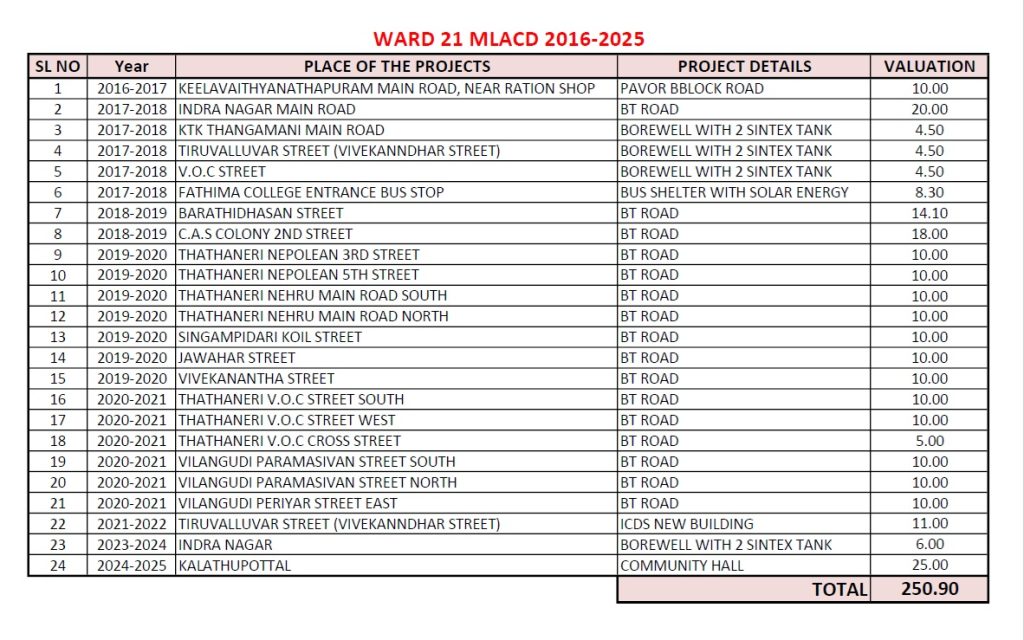
The document PTR attached to the post, the official MLACD (MLA Constituency Development) data for Ward 21, was meant to settle the debate. Instead, it quietly opened one.

What the Document Actually Shows

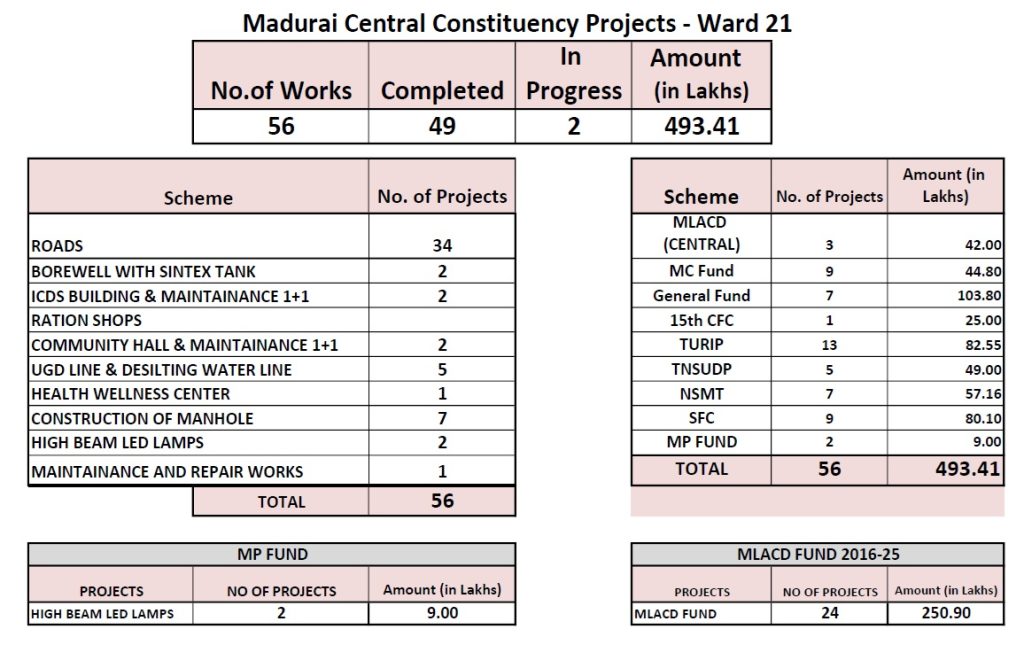
The MLACD fund data for Ward 21, covering 2016 to 2025, lists 24 projects with a total outlay of ₹250.90 lakh. PTR’s post claims “34 roads”, a figure that we are unable to independently verify within the MLACD data alone, as road works may also have been executed under other scheme heads.

What the MLACD record does confirm is that 16 of those 24 projects are BT (bituminous tar) road-laying works – straightforward resurfacing jobs ranging from ₹5 lakh to ₹20 lakh each. The community hall at Kalathupottal (₹25 lakh, 2024-25) and an ICDS building (₹11 lakh, 2021-22) are the only non-road, non-borewell entries across nine years of MLACD work in this ward.

Crucially, there is not a single drainage project, waste management initiative, or public toilet in the entire 24-entry MLACD record for Ward 21.

The distribution of works over time is equally telling. 21 of the 24 MLACD projects fall in the 2016-2021 period – when PTR was an MLA but in the opposition. Only three are recorded after 2021, when he became a ruling-party minister: one borewell (2023-24), the Kalathupottal community hall (2024-25), and the ICDS building at the cusp of the DMK government’s arrival (2021-22). Whether this reflects scheme cycles or a genuine slowdown in ward-level investment during the ruling years is a question the data alone cannot fully answer – but the pattern is stark: more ward-level work was recorded when PTR had less power than when he had the most.

India’s Dirtiest City. His Constituency. His Promise.

PTR once promised, during his 2021 campaign, to make Madurai “like Singapore.” In November 2025, the Central Government’s Swachh Survekshan 2025 report delivered its verdict: Madurai ranked as the dirtiest city in India among all cities with populations over ten lakh, scoring just 4,823 out of 12,500, finishing last among 40 comparable cities.

The sub-scores detail the extent of the collapse. Waste processing: 4%. That means 96 paise of every rupee’s worth of waste generated in the city goes unprocessed. Public toilet cleanliness: 3%. Door-to-door waste collection: 37% of households. This is not a city on its way to Singapore. This is a city that finished below every other major Indian city in every measurable category of cleanliness on the watch of the MLA who represented its central constituency and served as the state’s Finance Minister.

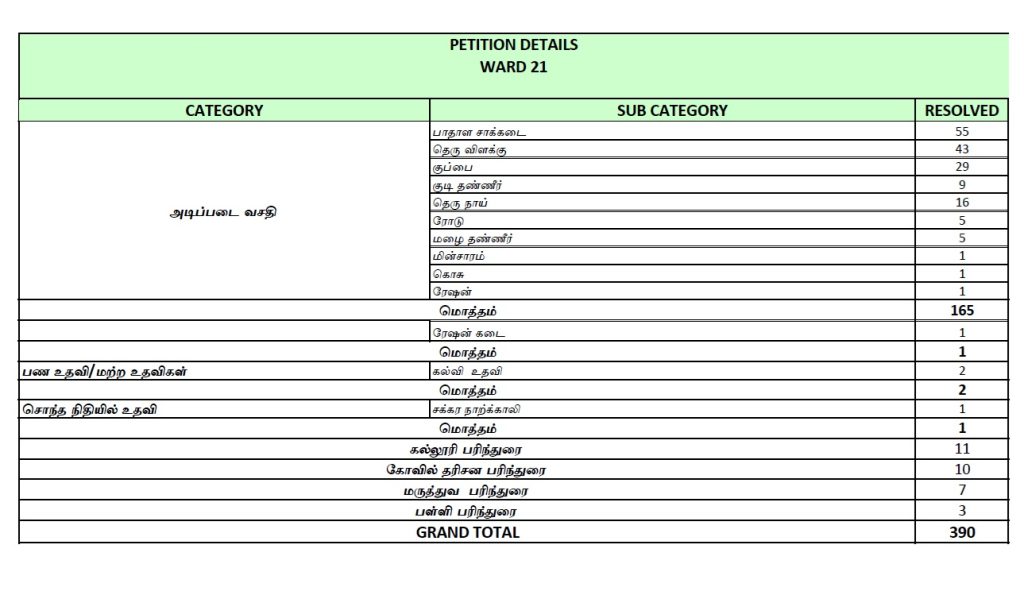
The ward-level complaint data mirrors this city-wide failure precisely. Of the 165 basic-needs petitions resolved in Ward 21 by PTR’s office, 55 were about underground drainage, 43 about streetlights, 29 about garbage, and 9 about drinking water – the four most elementary municipal services together accounting for 82% of all basic-needs petitions filed in the ward in 2026. The problems citizens complained about most were the ones entirely absent from PTR’s MLACD investment record.

Source: PTR X handle

Zero drainage projects. Zero waste management. Zero public toilets.

Source: PTR X handle
26 Health Cards. 3,682 Beneficiaries. For a Constituency of Lakhs.

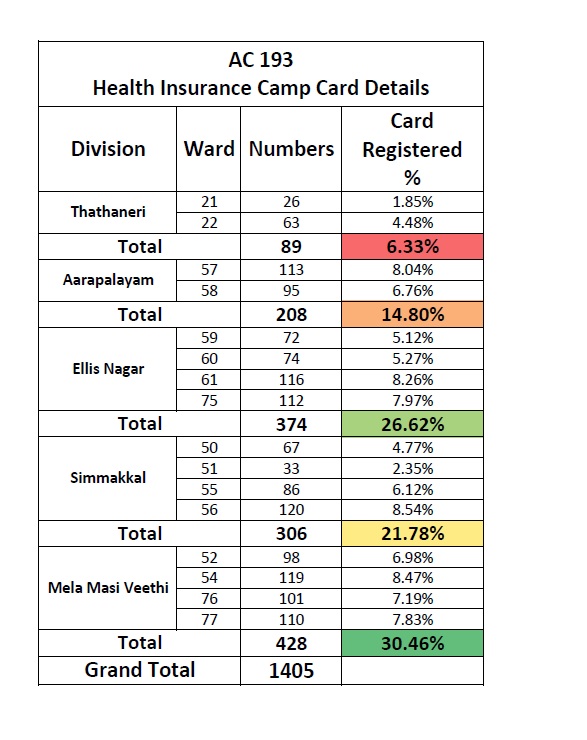
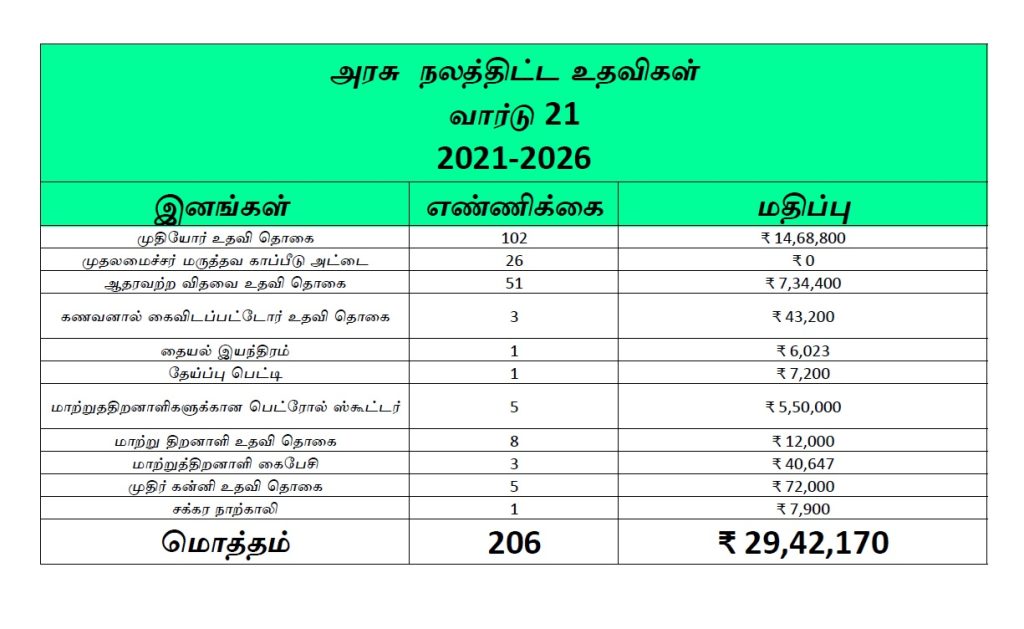
PTR’s document lists welfare beneficiaries for Ward 21 over the period 2021–2026. The Chief Minister’s Health Insurance cards distributed in Ward 21 across five years: 26. For a ward estimated at approximately 12,000 residents, that is a reach of under 0.3%. Even accounting for eligibility criteria, these are means-tested schemes and not universally applicable, the scale remains strikingly modest relative to the scale of need.

Source: PTR X handle

PTR’s document records 206 direct welfare beneficiaries in Ward 21 alone covering old-age pension, widow assistance, disability benefits, and similar schemes over the period 2021 to 2026, with a total disbursement of ₹29.42 lakh.

Source: PTR X handle

Across the entire Madurai Central constituency, the document records 1,405 Chief Minister’s Health Insurance cards registered at camp level with Ward 21 accounting for just 26 of those in a ward that had about 12000 people. Even accounting for eligibility criteria, the scale remains too modest for a constituency represented by a sitting Cabinet minister over two terms.

Sanitiser as Alcohol. ₹48,000 Crore Revenue. ₹20 Crore for De-addiction.

Beyond the ward data lies a more disturbing data point – one that PTR, as the man who read the state’s budget, cannot claim ignorance of. In 2025, it was reported that in Madurai district, people were drinking hand sanitiser because they could not afford TASMAC liquor prices. In PTR’s city. In the constituency he calls home.

TASMAC recorded ₹48,000 crore in revenue in the same period – a record high. The state’s de-addiction budget: ₹20 crore. The ratio 2,400:1 is a policy choice, not an oversight. PTR was the Finance Minister who signed off on these numbers. He knew the TASMAC revenue. He knew the de-addiction allocation. He knew the gap. The question is not whether he was aware. The question is what he did about it.

The Minister Who Said He Could Not Do What He Envisioned

The sharpest challenge to PTR’s campaign document may not come from his opponents, but from his own recorded words. During the election campaign, PTR himself had stated publicly: “I had a deep desire to do so much for Madurai. However, I was unable to accomplish anything that I had envisioned. There may be various reasons for this. Yet, those involved in politics cannot always speak with complete candor.”

PTR has also admitted in the Tamil Nadu Assembly that his IT department had “no funds, no authority.” He was transferred out of the Finance Ministry, widely seen as a political demotion, following a leaked audio tape in which he was heard saying, among other things, that “within the DMK, the son and son-in-law have amassed ₹30,000 crore.” PTR denied the tape was authentic.

What the Ward 21 data ultimately reflects is a decade of incremental works, dominated by road relaying, alongside persistent gaps in basic civic infrastructure: no drainage investment, no public toilets, and a city that, by the Central Government’s own Swachh Survekshan ranking, became India’s dirtiest under his watch. The campaign document was meant as a lesson. The numbers embedded within it may teach a different one.

Subscribe to our channels on WhatsAppTelegram, Instagram and YouTube to get the best stories of the day delivered to you personally.
“If You Did Nothing, Why Stay MLA?”: Annamalai Tears Into PTR Over His Own Admission

Annamalai Takes A Jibe At DMK Min PTR Sycophantic Praise Of Udhayanidhi Stalin

The campaigns for the upcoming Tamil Nadu Assembly elections are taking place at a frenzied pace. Madurai Central constituency which has DMK’s PTR Palanivel Thiagarajan and actor-director Sundar C contesting in the AIADMK’s symbol is grabbing everyone’s attention.

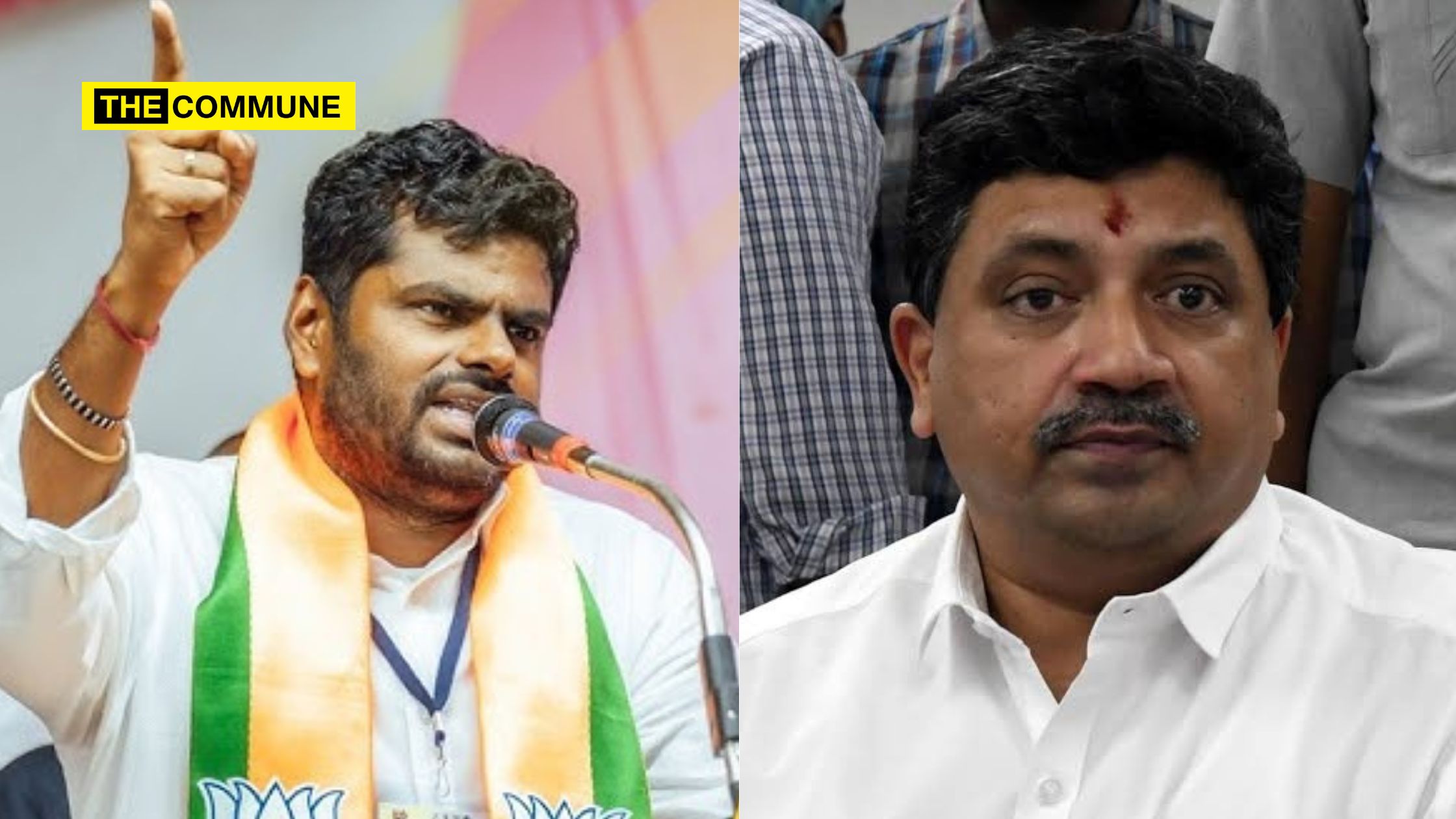
BJP leader Annamalai campaigned for Sundar C and took the DMK candidate to the cleaners.

The most damaging attack at Annamalai’s Madurai Central rally came not from the BJP itself, but from PTR’s own words. Annamalai recalled PTR’s own admission where he confessed he “wanted to do much more but couldn’t”. Annamalai read PTR’s words out verbatim at the rally: “I had a deep desire to do so much for Madurai. However, I was unable to accomplish anything that I had envisioned. There may be various reasons for this. Yet, those involved in politics cannot always speak with complete candor.”

Annamalai’s rhetorical dissection of this statement was sharp. “If that is the case, then why are you serving as an MLA? Are you there merely to lament and complain? Are you there simply to whine?” The statement, he argued, was a sitting MLA publicly confessing to two terms of failure – not an admission wrung out by opponents, but a voluntary acknowledgment delivered at a press conference.

Annamalai then pivoted to the episode that cost PTR the Finance Ministry: the leaked audio tapes of 2023.Annamalai with a note of self-implicating candour of his own acknowledged at the rally that he had been the one to release the tapes. “Sir, he was indeed a competent Finance Minister. However, I did commit one minor error: I leaked an audio recording of his conversation. In that recording, he goes on speaking continuously for thirty minutes. Sir, I released only half of it – just ten minutes’ worth. There are still twenty minutes remaining that I have not released; were I to release that portion, it would trigger a massive political crisis.”

The ten-minute clip Annamalai released in April 2023 sent shockwaves through Tamil Nadu politics. In the audio, PTR was heard allegedly saying that “within the DMK, the son and the son-in-law have amassed a fortune of ₹30,000 crores” – a reference to Deputy CM Udhayanidhi Stalin and CM Stalin’s son-in-law V. Sabareesan. Annamalai had shared the audio on Twitter at the time, stating: “TN State Finance Minister reveals that TN CM’s son Udhayanidhi and son-in-law Sabareesan have accumulated ₹30,000 crores in a year.” PTR denied the tapes were authentic, calling them fabricated. Nevertheless, within weeks, he was transferred out of the Finance Ministry to the IT Ministry – a move widely read as political punishment.

Annamalai linked PTR’s professional trajectory directly to his governance failure in Madurai: “You yourself went to the United States, to Buffalo University, to Goldman Sachs, to Morgan Stanley, and various other places, and after driving those companies into financial ruin, you have now proceeded to bankrupt Madurai as well.” The reference to Goldman Sachs and Morgan Stanley was a pointed jab at PTR’s Wall Street credentials, which he has frequently cited as proof of his competence. Annamalai also circled back to PTR’s absconding associates: “Your Personal Assistant and that young man from your IT wing are all currently absconding; given this reality, on what grounds do you presume to speak of integrity?”

Subscribe to our channels on WhatsAppTelegram, Instagram and YouTube to get the best stories of the day delivered to you personally.
“₹100 Crore Scam, One Arrested, One Missing And He Lectures On Integrity”: Annamalai’s Blistering Attack On PTR Palanivel Thiagarajan’s Inner Circle

“₹100 Crore Scam, One Arrested, One Missing”: Annamalai’s Blistering Attack On PTR Palanivel Thiagarajan's Inner Circle

The campaigns for the upcoming Tamil Nadu Assembly elections are taking place at a frenzied pace. Madurai Central constituency which has DMK’s PTR Palanivel Thiagarajan and actor-director Sundar C contesting in the AIADMK’s symbol is grabbing everyone’s attention.

Annamalai campaigned for Sundar C and exposed PTR over and over again in his 30-minute speech.

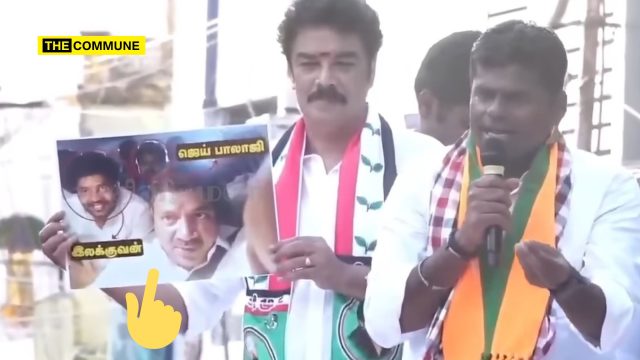
When K. Annamalai held up his second photograph at the Madurai Central rally, he was careful to pre-empt the obvious rebuttal. “Because if I were to share this one, you might accuse me of having morphed it,” he told the crowd. The photograph he was holding up showed two individuals alongside PTR: a man named Ilakkuvan, and Jai Balaji – both of whom, Annamalai alleged, had used their proximity to PTR to loot crores of rupees from government tenders.

Jai Balaji, according to Annamalai, served as PTR’s personal assistant for a “considerable period” before being dismissed. “Jai Balaji was dismissed from his position for looting crores of rupees — specifically, for using PTR’s name to commit fraud in government tenders.” This is not merely a campaign allegation: in February 2026, news reports confirmed that PTR’s former assistant Jai Balaji and his wife Kalavathi were arrested by Madurai Central Crime Branch police on fraud charges. Multiple complainants had alleged that Jai Balaji collected money from contractors by promising government contracts using PTR’s name and from the public by promising land allotments and then defrauded them. Reports indicate the fraud ran to approximately ₹100 crore.

The second individual in the photograph, Ilakkuvan, is the more alarming case. Annamalai alleged that Ilakkuvan “engaged in the very same illicit activities” as Jai Balaji, and has since “fled the country and is no longer in India.” Annamalai said he had personally inquired with police contacts about Ilakkuvan’s whereabouts and had received no satisfactory answer. He turned the question directly to PTR at the rally: “Mr. PTR, please answer: Where did Ilakkuvan go? Where did Jai Balaji go? First, clean up the mess within your own household; only then should you enter the political arena to speak about Brother Sundar C or anyone else.”

The broader thrust of the attack was PTR’s public persona as an incorruptible technocrat – a Harvard and Oxford-educated former Lehmann Brothers banker who presents himself as a cut above regular politicians. PTR has repeatedly described himself as “educated” and above the rough-and-tumble of ordinary party politics. Annamalai used the Ilakkuvan-Jai Balaji association to puncture this image directly. “Yet, despite keeping associates like these two by his side, this man has the audacity to lecture us about integrity and purity,” he said.

The controversy adds to PTR’s already turbulent political record. In 2023, leaked audio tapes of PTR allegedly criticising the inner workings of the DMK government, describing it as unsustainable due to the outsized influence of CM Stalin’s son and son-in-law, cost him the Finance Ministry portfolio. PTR denied the tapes were authentic, calling them fabricated by a “blackmail gang.” He was reassigned to the IT Ministry, a portfolio seen as a political demotion.

Annamalai also raised PTR’s hereditary trusteeship of the Madurai Meenakshi Amman Temple as a further indictment of his tenure. “Is it not your family that holds the hereditary trusteeship? What is he asking for? He asks, as a devout worshipper, that those visiting the temple be provided with restrooms and toilets, and that the access roads be kept clean. Yet, what is the response? ‘Do you know who I am? Do you know who my father was?'” The demand for basic sanitation infrastructure at one of India’s most-visited temples, unmet across two terms, was presented as the most damning measure of PTR’s governance – not corruption, but simple, inexcusable neglect.

Subscribe to our channels on WhatsAppTelegram, Instagram and YouTube to get the best stories of the day delivered to you personally.