Home Blog Page 1792

Explained: Locust Invasion
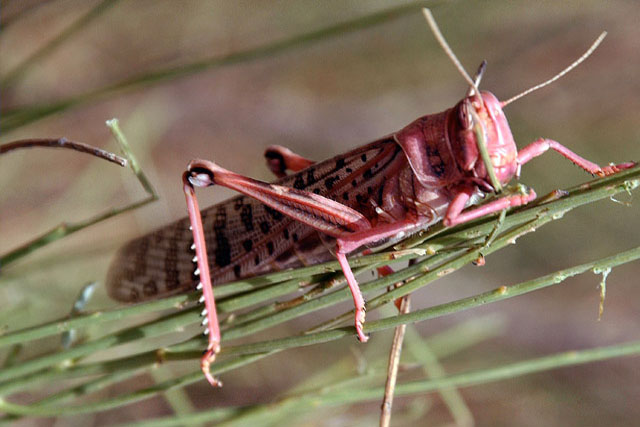
For the past few days, desert locusts have been having a field day quite literally. Swarms of them have plagued the fields eating away crops in Rajasthan, Gujarat, Maharashtra, Madhya Pradesh, Punjab and Uttar Pradesh. What are these insects? What has led to their outbreak? What explains the attack this year? What can we do about it? Here is an explainer addressing some of these questions.

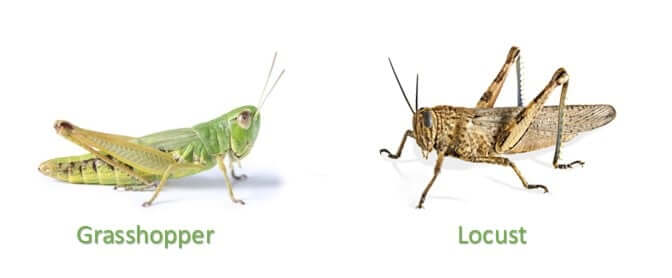
What are locusts? How are they different from grasshoppers?

Locusts are large herbivorous insects and are a species of short-horned grasshoppers. Locusts and grasshoppers look similar in appearance but their behaviours are different. Locusts can exist in two different behavioural states – solitary and gregarious. When the population density is low, locusts exhibit solitary behaviour. However, when the population density becomes high, it undergoes physiological and behavioural changes and form large swarms of adult locusts. These swarms are migratory in nature while grasshoppers do not exhibit such behaviours and are mostly solitary in nature.
What are desert locusts?

Desert locust is a species of locust and a periodically swarming short-horned grasshopper. Unlike grasshoppers, it is one of the most devastating migratory pests in the world. They feed on large quantities of green vegetation like crops, pasture, and fodder. They are mostly concentrated in the Horn of Africa part and are found across the Arabian Peninsula, West Asia and a portion of the Indian subcontinent.
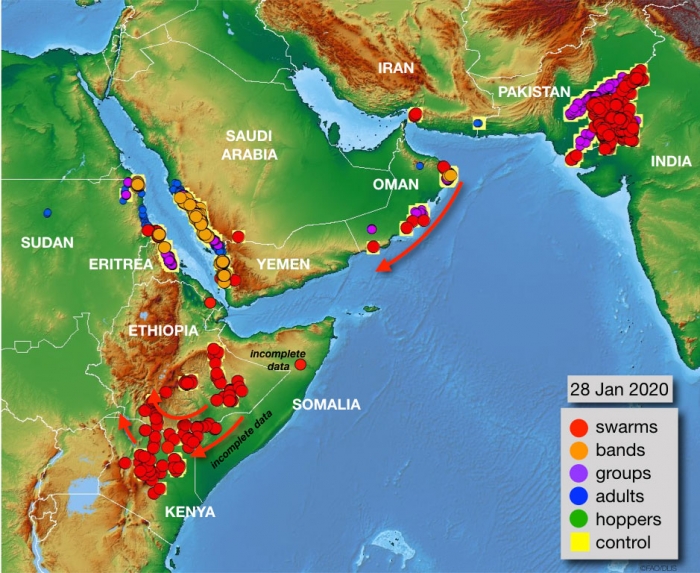
Image Source: ReliefWeb

They have the ability to follow the path of greenery and moisture due to their biological radar. However, their migration path follows the prevailing wind direction.

How did they arrive in India?

The desert locusts that have entered parts of India now originated in the Horn of Africa (Somalia, Eritrea, Ethiopia and Djibouti where excess rains had triggered breeding of the insect. They crossed the Red sea over to Iran and Pakistan to fulfil their lust for moisture and greenery. Some of them had a stopover at Iran, Pakistan and Baluchistan before where there was another round of breeding. They had reached Pakistan by mid-April.
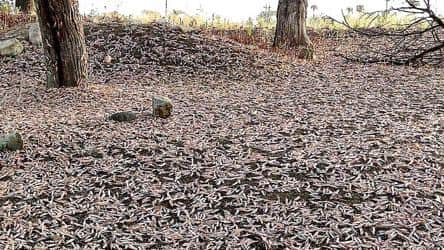
Image Source: Hindustan Times

With the onset of monsoon in India, swarms of desert locusts have entered from Pakistan to Punjab and have made their way into Rajasthan, Haryana, Madhya Pradesh, and few parts of other states like Gujarat and Uttar Pradesh.

Why is it a concern?

The onset of monsoon is followed by the new kharif cropping season when sowing of rice, sugarcane, cotton, sesame and other crops are undertaken. If the swarms are not controlled, it could lead to a huge loss for farmers. Many farmers in Rajasthan, Punjab and Haryana have already lost significant portion of their crops to these pests. Large scale destruction of crops by locusts could lead to food shortage.

Will they reach southern part of India?

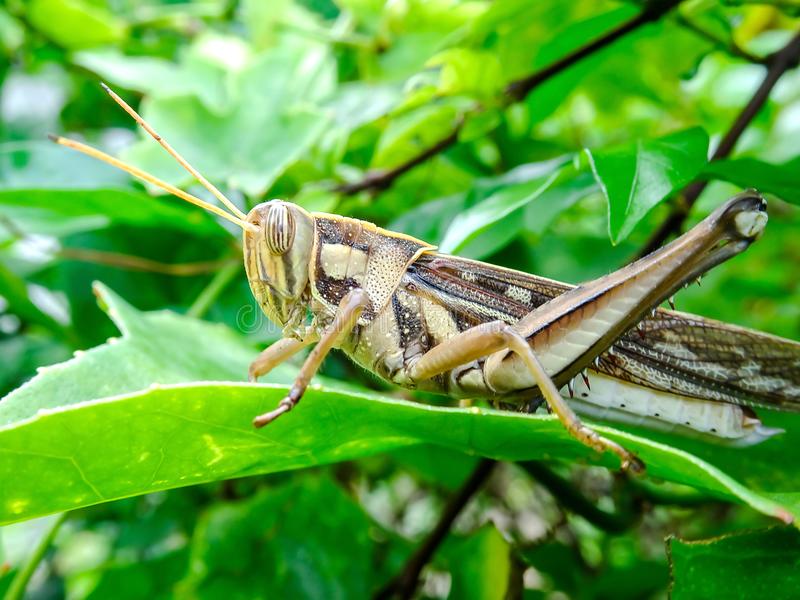
Experts say that they are less likely to reach southern states like Tamil Nadu and Andhra Pradesh as these states receive rain during the north-east monsoon. Recently, reports of locust species being sighted in plantations in Nilgiris district of Tamil Nadu emerged. A member of the Grasshopper Specialist Group of the Species Survival Commission of International Union of Conservation of Nature clarified that these species of spotted coffee grasshopper, Bombay locust and the Crytacanthacris Tartarica, a type of grasshopper, have been mistaken for the swarm of desert locusts.
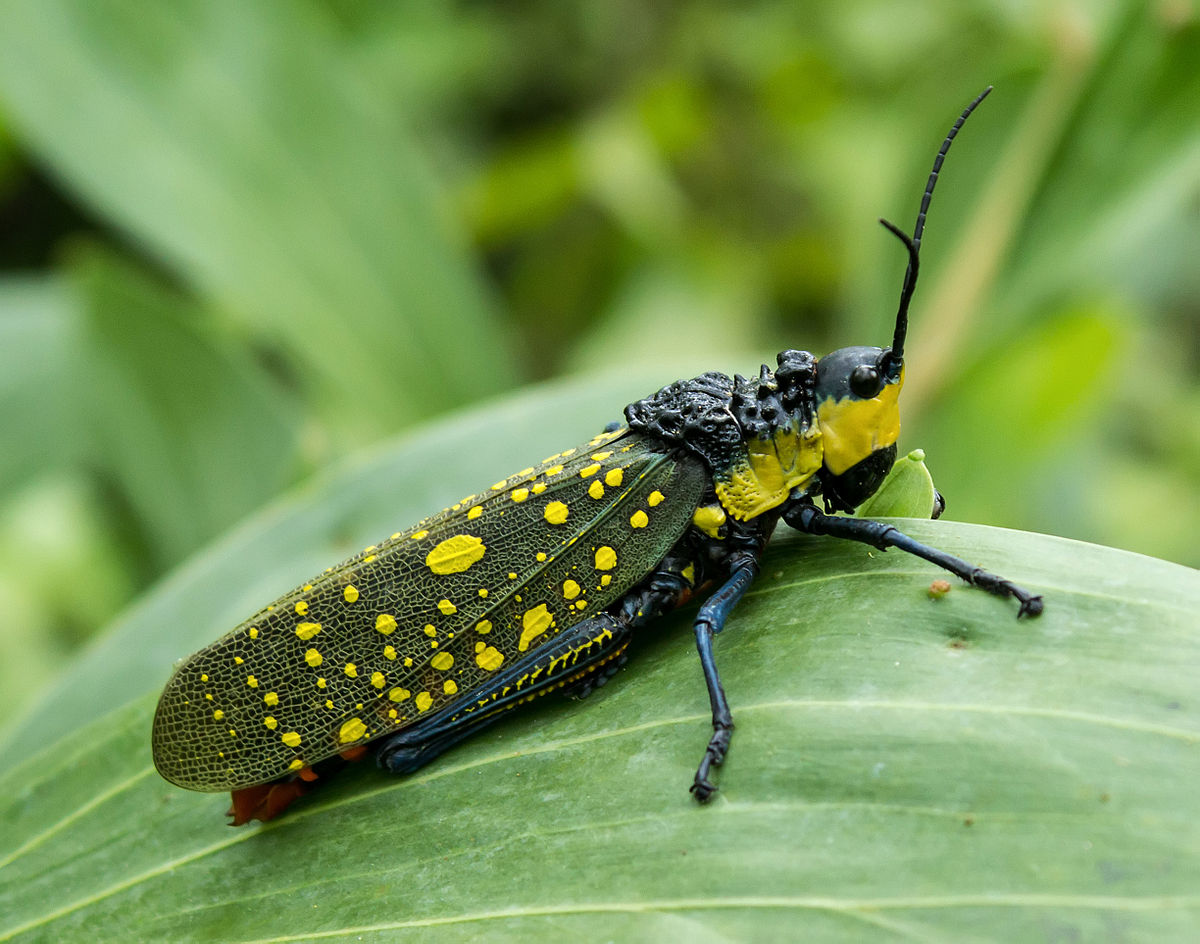
Coffee Locust
Bombay Locust

Is this the first time that desert locusts are invading India?

The last time desert locusts wreaked havoc was in 2010. Prior to that, there were 13 locust attacks between 1964 and 1997. There were 5 outbreaks from 1997 to 2010 which were controlled. No major swarms were reported from 2010 to 2018.
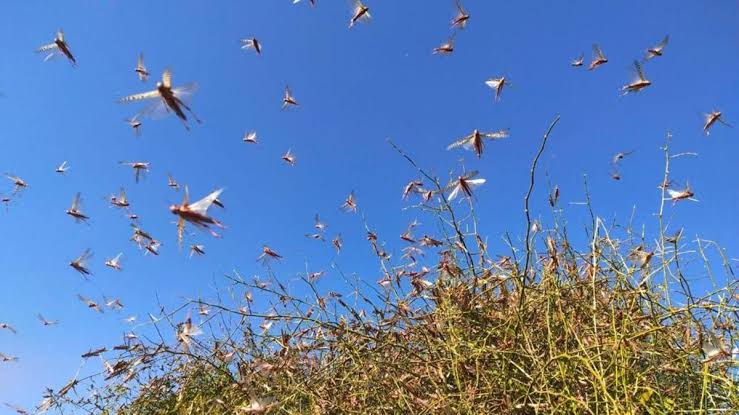
Image source: Hindustan Times

In 2019, Gujarat and Rajasthan saw locust invasions destroying nearly 3.5 lakh hectares of cumin, rapeseed and mustard.

What is the link with climate change?

The locusts upsurge can be attributed to the phenomenon of Indian Ocean Dipole (IOD), the alternate warming and cooling of western and eastern Indian oceans.
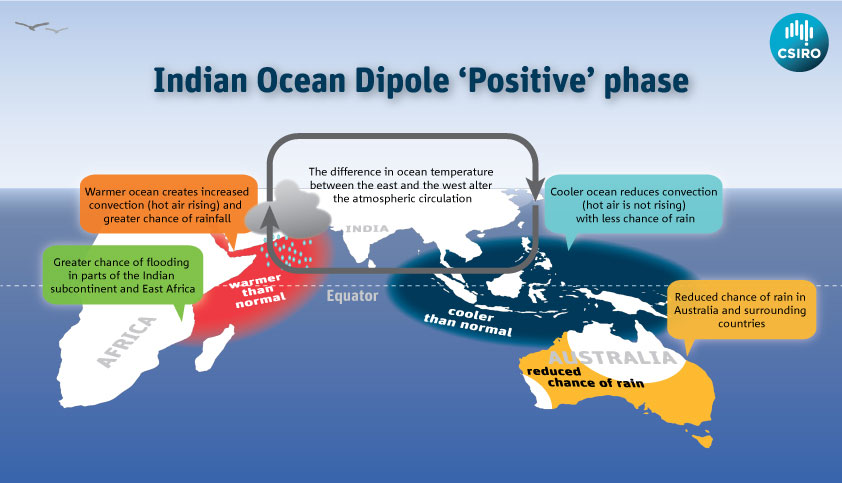
Image Source: phys.org

A positive dipole is when the western part is hotter than the eastern part and negative dipole happens when the eastern part is hotter than the western part. A positive dipole is favourable to India as it brings in good rains. Last year’s positive dipole was very strong leading to an above normal monsoon. It led to the monsoons extending to parts of West Asia, Arabian Peninsula and Horn of Africa. This moisture facilitated the swarming up of desert locusts. The desert locusts have now carried themselves with the monsoon winds now.

Against the backdrop of global warming, stronger positive IODs are set to become more frequent. This could lead to regular locust infestations that could pose serious threat to agriculture and thereby food security.

What can be done?

Desert locusts travel only during day time thereby making them vulnerable at night. The Locus Warning Organization under the Ministry of Agriculture are monitoring and tracking the swarms. Drones are being used to spray insecticides on non-cropped areas. In agricultural areas, a chlorpyrifos is sprayed using drones and tractor mounted sprays. In some areas, the Indian jugaad mind has come out with a solution by playing loud music to ward off swarms.

Mexico’s death toll skyrockets soon after lockdown ease

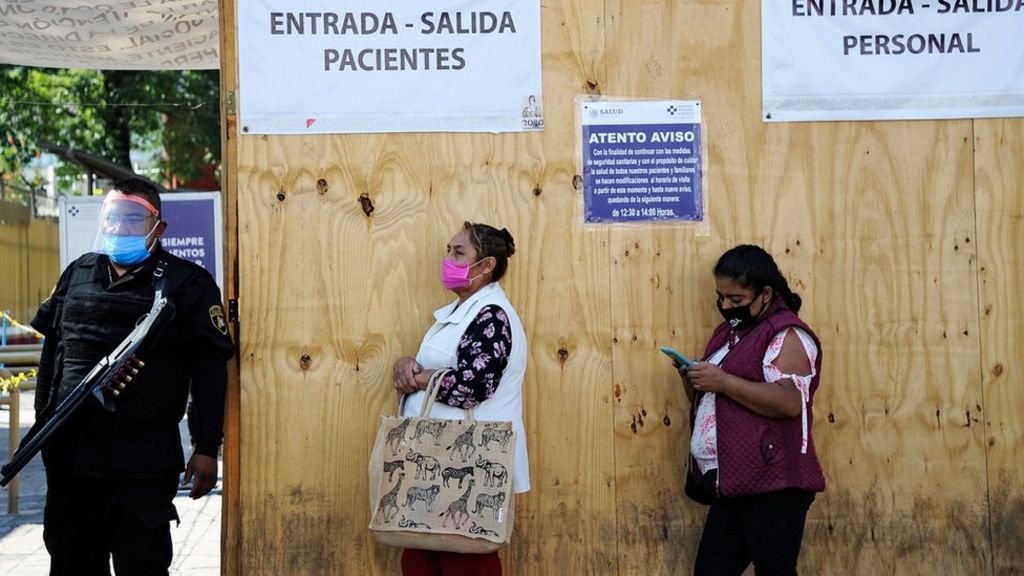
The death toll in Mexico has crossed 10,000 as restrictions were released a few days ago. The number of total confirmed cases as of Monday has become 93,000, and the exact number of recorded deaths due to COVID-19 are 10,167.

Latin America is fast becoming the epicentre of this pandemic. In the wake of this, Mexico stands fourth, only next to Brazil, Chile and Peru.

The worst affected states are Mexico City, the state surrounding it and Baja California in the south. The testing rate is far lesser than the ideal rate, and this is a major cause for concern in that region. Experts have warned that the actual toll could be far higher than that showcased by the government.

While most parts of Mexico have been under lockdown since March 23, some industries continued to function, triggering outbursts amongst the workers. The easing of lockdown started on May 18 in regions that were relatively less affected. By June 1, construction activities as well as automobile manufacturing resumed functioning, along with parks at one-third capacity.

Mexico’s President Andrés Manuel López Obrador in a press release on Monday, said, “We have to move towards the new normal because it’s necessary for our national economy, our people’s wellbeing; we need to, little by little, return production, economic, social and cultural activity to normal.” This statement has been facing backlash due to his decision to phase out the lockdown as cases steadily increased.

Watch: ADMK Spokesperson shares video testimony of Ramkumar, Dalit youth beaten with slippers by DMK’s Karunanidhi

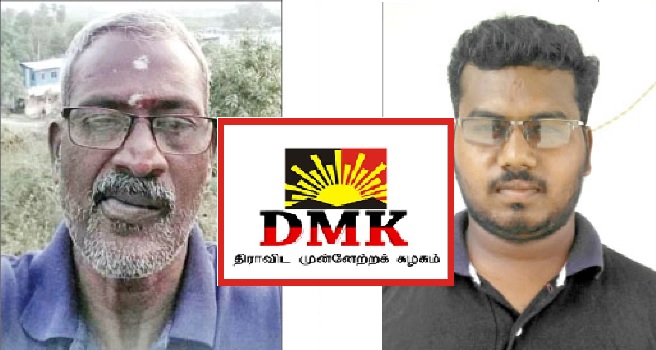
On May 15, Ramkumar a young graduate belonging to the Scheduled Caste community and a youth wing leader of Dravidar Kazhagam (DK)’s Tiruvannamalai unit was verbally and physically abused by the DMK’s panchayat union leader Karunanidhi. Karunanidhi and his brother Parthasarathy had hurled casteist slurs at Ramkumar and his mother and also beat them with slippers.

Karunanidhi is reported to have said ““How dare you raise your voice and speak against me? [We] should have thrown you guys outside the village a long time back. Since that wasn’t done, you got enough courage to speak up against us is it?

Ramkumar is later said to have reported the incident at Thachampattu Police Station where his complaint was initially rejected. After a long hiatus, an FIR was registered. Later, Thachampattu Block Councillor Ramanan of the DMK had threatened Ramkumar to withdraw the case.

AIADMK Spokesperson and Vellore Zone IT head has shared on his timeline a testimony of Ramkumar. Here is the English transcript of Ramkumar’s testimony. The video is attached at the end of the article.

Vanakkam! My name is Mu. Ka. Ramkumar. I am the head of the Dravidar Kazhagam’s student wing unit in Tiruvannamali district. I have done my B.Sc. Biochemistry. I run a lab near Nallorpalayam. On May 15, there happened an incident. Parayampatti panchyat union leader Karunanidhi beat me with slippers. He also hurled casteist slurs at me. It doesn’t seem like a one person attack.. It looks like the entire family was behind it. Prior to this incident, I was attacked when I had gone to relieve myself nearby his fields. I was verbally abused then too. When I had informed this incident to my dad, he too was beaten with slippers. We had filed a case then too. However, we withdrew the case upon his request and also considering that he is a veteran. Now, this is the second time this abuse and attack has happened to me. This is totally condemnable.  I belong to the DK and he to the DK’s companion party DMK. However, it is evident that he has a casteist and oppressive mindset. The most important point to note here is that his entire family is behind in attacking us. His brother’s son had claimed that he had been waiting for an opportunity to attack me and take me down. It shows that were expecting me to get into a small trouble to attack me. It pains to see such men in a rationalist party like DMK.”

https://www.facebook.com/sathyan.rajan.7/videos/3240811279283905/

Govinda Gooooovinda! Lord Venky to first meet local devotees starting June 8

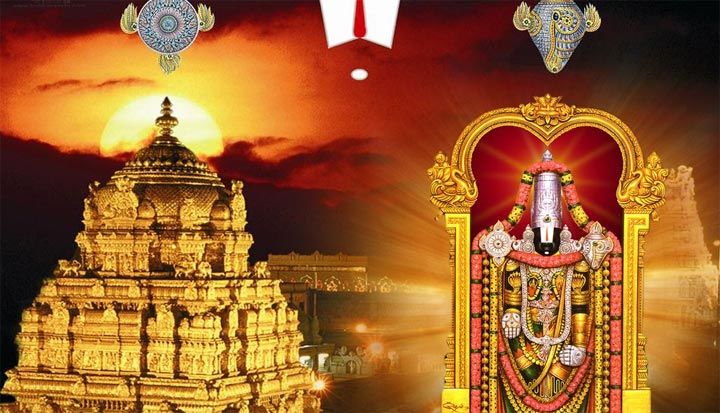
The Andhra Pradesh government has given a go ahead to let local devotees visit the abode of Lord Venkateswara at the Tirumala hills.

In the first phase, the employees of Tirumala Tirupathi Devasthanam (TTD), and local devotees will be allowed to have darshan of Lord Venkateshwara.

The temple was shut on March 20 for the first time in history and has remained closed for 67 days ever since the pandemic spread.

Tirumala has been in the green zone since the start of the pandemic however it was closed down as a precautionary measure.

The TTD is putting in place measures to adhere to COVID19 protocol. The temple which witnesses close to a lakh footfalls a day will be restricting the number of devotees per day to 25,000 to 30,000. Thermal scanners are being placed and circles have been marked in places where pilgrims usually stand in queues. Pilgrims will have to wear mask compulsorily.

Ground situation after oil blowout in Baghjan, Guwahati still the same; OIL calls for experts

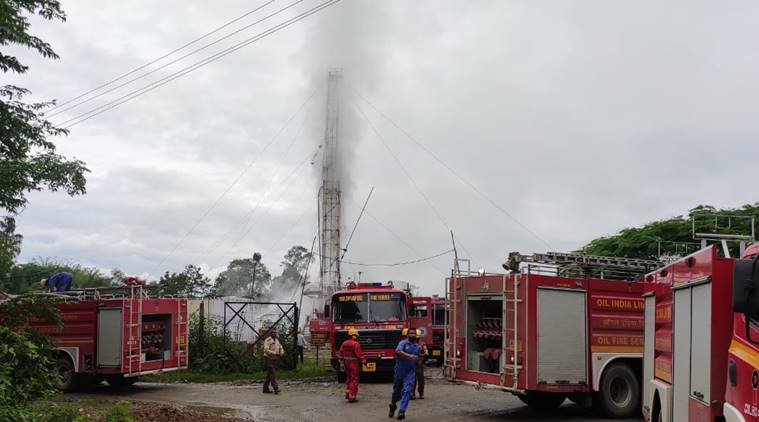
On May 27, OIL (Oil India Ltd.) had a blowout in Well No.5 at Baghjan Oilfield in the Tinsukia district. Operations to produce gas from a new oil-bearing reservoir at the depth of 3729 metres are the cause. Reports say that there are no fires or any forms of major casualties.

A blowout happens when pressure control systems fail and crude gas gushes uncontrollably.

Operations were suspended and people (almost 4000) were evacuated immediately, who are now sheltered at a nearby school. Efforts are being made to provide food and medical care.

The blowout poses threats to wildlife and aquatic animals as it continues to increase. Previous reports say that a radius of 1km is damp and misted with oil-vapour which in itself is a major flammable risk.

Residents have shown dismay and the All Moran Students’ Union and Assam Jatiyatabadi Yuba Chhatra Parishad want a probe into the incident. They have also demanded to blacklist the outsourced company— M/s John Energy, and to stop the pipeline work from Madhuting to Baghjan over Maguri Beel undertaken by ACI Company. OIL has asked M/s John Energy to show cause.

Meanwhile, the efforts of the crisis management team formed by the PSU to plug the leak, including the continuous pumping of water into the well’s valve to cool the gas have progressed nowhere positively.

As of now, global experts such as Boots and Coots, and Alert and Wild Well Control have been asked to help while the well continues to leak oil.

Assam Chief Minister Sarbananda Sonowal spoke to Union Minister for Petroleum and Natural Gas, Dharmendra Pradhan and urged him to take immediate remedial measures.

Assam HM says that the situation will stabilize by Jun’ 10 despite rise in positive COVID-19 cases

The total number of COVID-19 cases rose to 1463 in Assam as more people came back to their native state. This demographic includes interstate migrant workers along with flight passengers from Kuwait, who are quarantined in Guwahati University’s hostels.

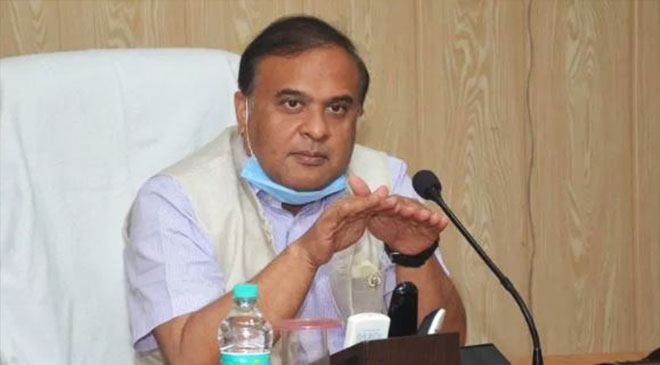
However, Assam Health Minister Himanta Biswa Sarma has said that the situation will stabilize by June 10. He has expressed confidence as the surge is almost entirely due to new entrants who are being quarantined if they test positive.

Recently, Assam took up the lead and exceeded the pace of Kerala’s preventative measures.

By the end of May, the total number of tests had already surpassed 1 lakh in Assam (compared to 70k+ in Kerala).

Today, Himanta Biswa Sarma inaugurated a Boragaon-located laboratory, powered by the Gauhati Medical College and Hospital (GMCH) & Institute of Advanced Study in Science & Technology (IASST) that can test up to 10,000 samples daily, another addition to the efforts put out by Himanta Biswa Sarma and his team.

Kamal gets snubbed by Kerala Health Minister while attempting to discredit Tamil Nadu’s COVID19 efforts

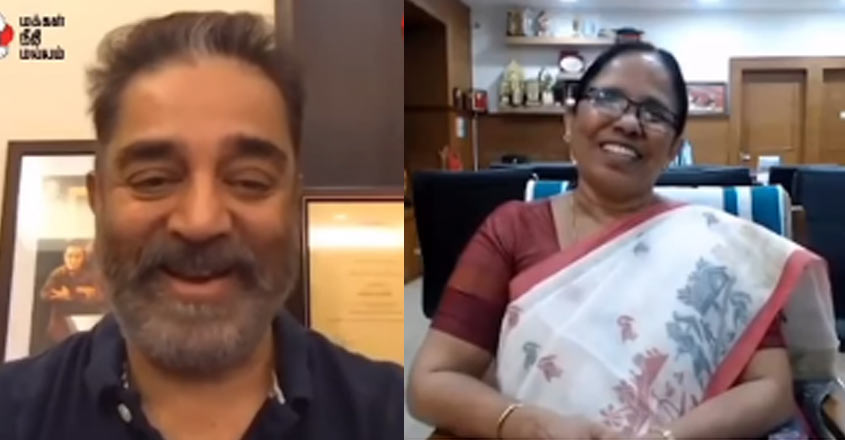
Actor-politician Kamal Hasan on May 31 while having a conversation on “The New Normal” with Kerala Health Minister Shailaja Teacher as part of his Maiam Talks series, got rebuffed when he tried to belittle Tamil Nadu government’s efforts in the fight against COVID 19.

Kamal mentioned that “we’re supposed to be a better a equipped [state] than Kerala, Tamil Nadu, but we are floundering” to which Health Minister Shailaja replied back saying that Tamil Nadu is also doing a good thing [job].

He again tried to trivialize Chief Minister Edappadi K. Palaniswami by saying “a unanimous backing by the government like how your CM supported.. I think we will have to recommend our CM, Hon’ble CM that we should also unabashedly copy the model because it is a winning model.” The Helath Minister replied that “Tamil Nadu has a very good public health system. You can also implement these things.

Throughout the interview, Kamal can be heard taking a dig at Tamil Nadu and its Chief Minister and belittling the efforts of the state in the fight against the pandemic. Concluding the interview he said “Everybody is talking about Kerala. Shailaja Teacher is a hero. A leader like you who is willing to take help is very important.”

Manipur wants mass production of Leirum Phee in UP stopped to protect livelihood of traditional weavers

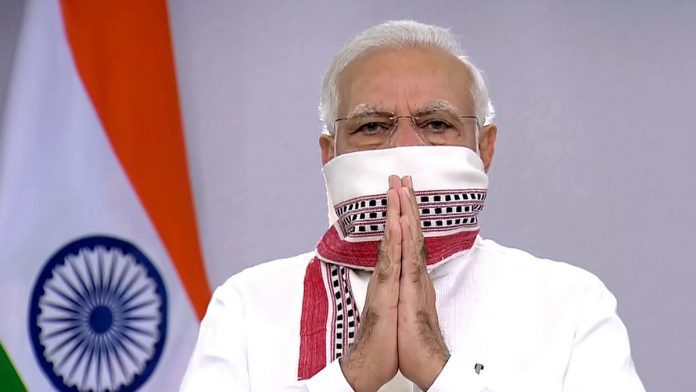
Leirum Phee, the traditional cloth of Manipur popularized by Prime Minister Modi has found a new lease of life as ‘Modi Gamcha’ the demand for which has been on the rise ever since the Prime Minister started wearing it as a facemask in the wake of COVID19. Since then, there has been a mass production of the cloth in UP which has raised concerns in Manipur.

The Economic Times had tweeted a video in which weavers from Barabanki in Uttar Pradesh were seen producing the cloth to be sold in e-commerce platforms.

Many twitter users from the north-east had expressed their displeasure over the same saying that it puts the livelihood of Manipuri Women at risk.

https://twitter.com/chekla/status/1266626755651145730

The Director Handloom and Textiles Department of Manipur K Lamlee Kamei has requested the Development Commissioner for Handlooms, Ministry of Textiles to take steps to safeguard Manipur’s traditional cloth and the livelihood of local weavers.

Mr. Kamei has written to the Ministry of Textiles regarding the same saying that the ‘Leirum Phee’ designed as ‘Lengyan’ or muffler has cultural, historical and emotional value, the Hindustan Times reported.  Civil bodies of Manipur, like the ACOAM-Lup, Kangleipak, AMESCO, and HERICOUN, among others, have criticized the government of Manipur for not taking steps to get GI tag for the traditional ‘muffler.’

However, it was reported that the department has started the process of getting GI tag for Leirum Phee.

CM continues his business to get more business in the state, to reach out to 9 aerospace companies

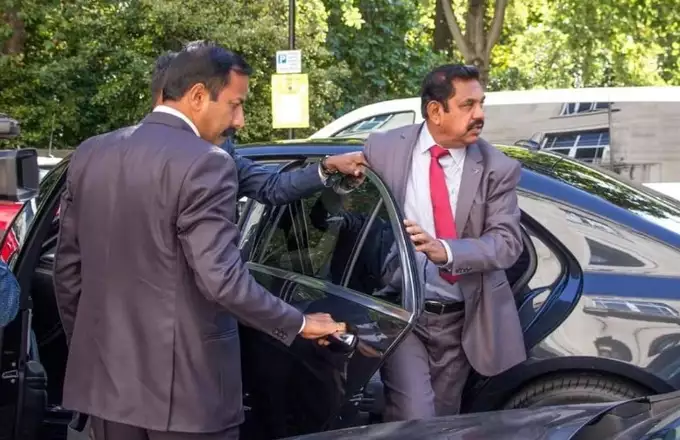
Apart from dealing with the pandemic, Tamil Nadu Chief Minister Edappadi K. Palaniswami has been taking all efforts to turn the crisis into an opportunity and inviting businesses to invest in the state. Last week, the Chief Minister signed MoUs with 17 companies set to bring in investments worth ₹15,128 crores which is likely to generate 47,150 jobs.

In continuation to this, the CM has decided to personally reach out to global heads of 9 aerospace companies. He would be writing to CEO of M/s. United Technologies Gregory J. Hayes, CEO of M/s. General Electric H. Lawrence Culp Jr., CEO of M/s. Boeing Dave Calhoun, CEO of M/s. Lockheed Martin Marilyn Hewson, CEO of M/s. Safran Philippe Petitcolin, CEO of M/s. Rolls Royce Warren East, CEO of M/s. Airbus Guillaume Faury, CEO of M/s. Leonardo Alessandro Profumo and CEO of M/s. Honeywell Darius Adamczyk.

The letter will pitch in Tamil Nadu as an attractive place to invest highlighting the excellent support for business and industries offered by the State to help firms further their growth. Each firm would be getting customized incentives suiting to their needs.

In the wake of COVID19, many companies are mulling of shifting their manufacturing units to India. The CM has constituted a Special Investment Promotion Task Force under the Chief Secretary to rope in investments into Tamil Nadu

J&K terror outfit issues open threat, says Non-locals ‘will be considered and dealt as RSS agents’

Resistance Front, an off-shoot of the terrorist group Lashkar-e-Taiba has issued an open threat that any Indian who is a non-resident of Jammu and Kashmir would be considered and dealt as agents of Rashtriya Swayamasevak Sangh (RSS).

The Resistance Front has been claiming responsibilities for some of the terror attacks in Kashmir and is associated with other terrorist groups like Hizbul Mujahideen, Jaish-e-Mohamed and Lashkar-e-Taiba.

“We openly declare that any Indian who comes with an intention to settle in Kashmir will be treated as an agent of RSS and not as civilian and will be ‘dealt with appropriately’”, it said in a statement.

The statement comes in the wake of the Union government selecting members of the Delimitation Commission. Leaders of the National Conference have also been chosen as members of the commission. But the party has rejected the Delimitation Commission and has said that the party’s 3 members will not participate.